What Aluminium Window Profile Sizes Mean and Why They Matter
Every specification error on a window schedule traces back to one number: the cross-sectional depth of the frame. That measurement, expressed in millimetres, is what the industry means by aluminium window profile sizes. It dictates how much glass a frame can hold, how wide the thermal break can be, and whether the assembly will resist the wind loads your project demands.
Aluminium profiles are categorised by series number — 38, 50, 60, 70, 80, 90 — and these figures serve as shorthand across manufacturers and markets. A 70 series window profile, for instance, signals a frame depth in the vicinity of 70mm. Architects and builders use these series designations on schedules, in tender documents, and during procurement conversations as though they represent fixed, universal dimensions.
They don’t.
What Aluminium Window Profile Sizes Actually Refer To
The series number describes the nominal construction depth of the frame measured from the exterior face to the interior face of the profile. This single dimension governs the structural capacity of the section, the maximum insulating glass unit (IGU) thickness it can accommodate, and the width of thermal break strip that fits within it. It is, in practical terms, the master variable from which most performance characteristics flow.
Why Series Numbers Can Be Misleading
Here is where specifications go sideways. Series naming is a nominal designation, not a precise measurement. One system supplier’s 60 series aluminium window profiles might measure 65mm at the deepest point of the frame, while another’s measures 58mm. Both are marketed under the same label. The variance stems from differences in chamber geometry, gasket placement, and thermal break configuration between proprietary systems.
Series numbers are nominal designations, not exact measurements. A “60 series” from one manufacturer may differ by 5-7mm from another’s. Always verify actual dimensions from technical drawings and system datasheets before locking in a specification.
This article takes a specification-first approach — dimensional data, selection logic, and structural reasoning rather than marketing language. The sections that follow break down exactly how frame depth, wall thickness, and alloy grade interact to determine whether a given window profile will perform under your project’s specific loading and thermal requirements.
Standard Series Dimensions from 38 to 90
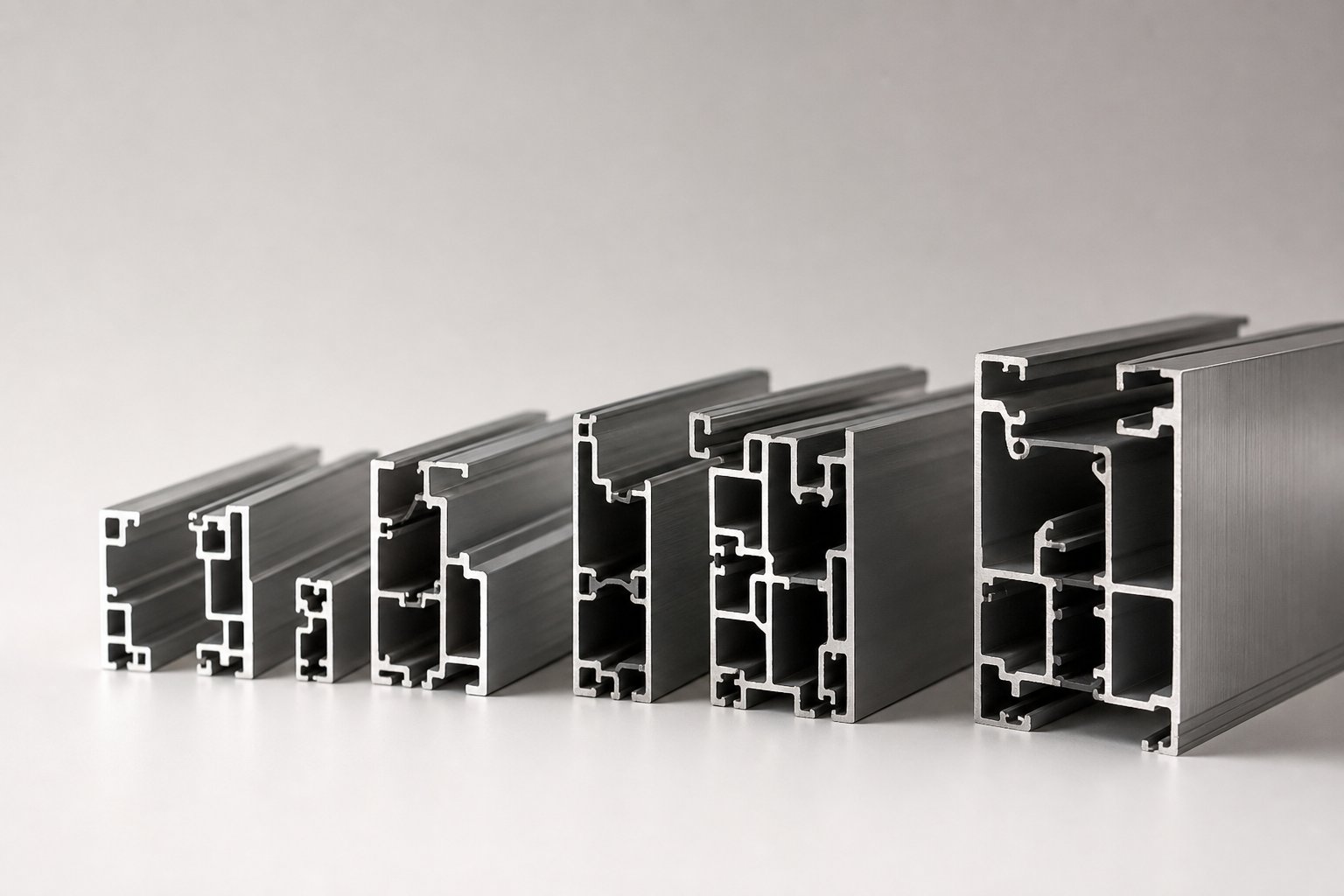
Knowing that series numbers are nominal gets you halfway. The other half is understanding the actual dimensional ranges each series occupies and what those millimetres translate to in terms of sightlines, mullion widths, and glazing capacity. Across the global market, six standard aluminium profiles dominate window specification: 38, 50, 60, 70, 80, and 90 series. Each occupies a distinct performance bracket.
Common Series and Their Typical Dimensions
The table below consolidates typical dimensions across multiple system providers. These are representative ranges rather than universal constants — a critical distinction, because two systems sold as “60 series” can differ by several millimetres in frame depth, sightline, and mullion width depending on chamber geometry and gasket configuration.
Frame depth is the primary dimension (the number that gives the series its name), but sightline width is what occupants actually notice. Sightline refers to the visible width of frame material when looking at the window from inside — it determines how much of the view is frame versus glass. Mullion and transom widths matter for multi-panel configurations where structural members divide the opening.
| Series | Typical Frame Depth (mm) | Typical Sightline Width (mm) | Typical Mullion Width (mm) | Common Applications |
|---|---|---|---|---|
| 38 Series | 35–42 | 45–55 | 50–60 | Internal partitions, secondary glazing, single-glazed screens |
| 50 Series | 48–53 | 50–62 | 60–72 | Standard residential windows, apartments, renovations |
| 60 Series | 58–65 | 55–68 | 70–85 | Residential and light commercial, double-glazed units |
| 70 Series | 68–75 | 60–72 | 80–95 | High-performance residential, thermally broken systems |
| 80 Series | 78–86 | 65–78 | 90–110 | Commercial buildings, high wind-load zones, triple glazing |
| 90 Series | 88–96 | 70–82 | 100–120 | High-rise facades, heavy commercial, cyclone-rated assemblies |
| Note: All values are indicative ranges compiled from multiple system brands. Actual dimensions must be confirmed against specific system datasheets and technical drawings before specification. Sliding window systems often use different series naming conventions (e.g., 798, 888, 900) that reflect track width rather than frame depth. | ||||
A few patterns stand out. The 60 series and its neighbours remain the most widely specified for general residential work across most markets, including Australia. For sealed balconies and enclosed living areas exposed to weather, 70 series or 90 series systems are typically the minimum where structural solidity and thermal performance are non-negotiable.
How Frame Depth Relates to Sightline and Mullion Width
Frame depth and sightline don’t scale in lockstep. A deeper profile doesn’t automatically mean a fatter visible frame. Some extruded aluminium sizes in the 70 series achieve sightlines comparable to a competitor’s 60 series by pushing structural material behind the glass plane rather than beside it. This is a design decision baked into each system’s cross-section geometry.
Mullion width, however, does track more closely with frame depth. Deeper profiles carry more moment of inertia, which means they can span greater distances between fixing points without excessive deflection. But mullions also need to accommodate gaskets on both sides and, in thermally broken systems, a polyamide strip running their full height. The result is that aluminium extrusion sizes in the 80 and 90 series tend to produce mullion widths above 90mm — something that matters visually on large glazed facades where slender divisions are part of the design intent.
Transom heights follow similar logic but add the complication of dead-load transfer. A transom carries the weight of glass above it, so its vertical dimension is typically 5–15mm greater than the equivalent mullion width in the same system. For architects targeting minimal horizontal lines, this asymmetry between mullion and transom is worth flagging early in the design process.
The dimensional picture gets more complex once wall thickness and alloy grade enter the equation. A standard aluminium profile in the 60 series with thicker walls can sometimes outperform a thinner-walled 70 series section structurally — a counterintuitive relationship that catches specifiers off guard when they assume a higher series number always means greater strength.
Wall Thickness Grades and Alloy Choices
Frame depth tells you how much space a profile occupies. Wall thickness tells you how hard that profile can work. Two 70 series sections with identical external dimensions will behave very differently under load if one has 1.4mm walls and the other has 1.8mm — the thicker-walled aluminium extrusion carries a higher moment of inertia, resists deflection more effectively, and tolerates greater glazing weight before the section begins to flex.
Wall Thickness Grades and What They Mean Structurally
The most widely referenced classification system for aluminium profile wall thickness comes from China’s GB/T 5237.1-2017 standard, which governs wrought aluminium alloy extruded profiles for architecture. This standard groups wall thickness dimensions into three categories — Group A (fin walls), Group B (peripheral walls of closed cavities), and Group C (partitions between closed cavities) — and sets permissible deviations for each.
In practice, the industry shorthand most specifiers encounter divides profiles into two performance tiers:
- Grade A profiles — minimum wall thickness of 1.4mm. Suited to primary window and door framing, external applications, and any situation where wind load, span, or glazing weight demands structural robustness.
- Grade B profiles — minimum wall thickness of 1.2mm. Acceptable for internal partitions, secondary glazing, sheltered openings, and applications with shorter spans and lighter glass.
These thresholds originated in Chinese manufacturing standards but have become de facto benchmarks across much of the global supply chain, including profiles imported into Australia. European standards such as EN 12020 and EN 755 don’t use the same A/B terminology, but they impose comparable requirements through dimensional tolerance tables and minimum mechanical property thresholds for architectural aluminium extrusions. In Australia, the performance-based framework of AS 2047 doesn’t prescribe a specific wall thickness — instead, the profile must pass structural adequacy testing for its intended wind load classification. The practical effect is similar: thinner walls demand either a deeper section, a stronger alloy, or both.
Wall thickness directly governs moment of inertia. A 60 series profile with 1.8mm walls can match or exceed the deflection resistance of a 70 series profile with 1.4mm walls, depending on chamber geometry. Never assume a higher series number compensates for thinner aluminium.
The interaction between wall thickness and frame depth is where many aluminium window profile sizes get misjudged. Moment of inertia — the section property that determines how much a profile resists bending — depends on both how deep the section is and how much material sits at the extremes of that depth. Thickening the outer walls of a profile by just 0.2mm can increase the moment of inertia by 10–15%, which translates directly into longer allowable spans and better deflection performance under wind pressure.
Alloy Selection and Its Relationship to Profile Thickness
Wall thickness and alloy grade are not independent decisions. A thinner wall reduces material weight and cost, but it also reduces the cross-sectional area carrying stress. One way to recover that lost capacity is to specify a stronger alloy — trading material volume for material strength.
Four alloy-temper combinations dominate architectural aluminium window profiles:
- 6063-T5 — The workhorse of the window industry. Offers good extrudability, clean surface finish for anodising or powder coating, and adequate strength (approximately 150–185 MPa tensile) for most residential and light commercial applications. Best paired with Grade A wall thicknesses where spans are moderate.
- 6063-T6 — Same alloy, higher strength (approximately 190–240 MPa tensile) achieved through full solution heat treatment and artificial ageing. Specified when 6063-T5 falls marginally short on structural calculations without jumping to a heavier aluminum profile type.
- 6060-T66 — Common in European-origin systems. Similar to 6063 but with tighter compositional tolerances that improve extrusion consistency. The T66 temper delivers strength between T5 and T6, making it a practical middle ground for thermally broken aluminium extrusion profiles.
- 6061-T6 — The structural option. With tensile strength around 290–310 MPa, 6061-T6 provides roughly 50% more capacity than 6063-T6. It’s specified for high-load scenarios — large-span mullions, high-rise facades, cyclone-rated assemblies — where reducing wall thickness or frame depth is architecturally desirable but the loads are unforgiving. The trade-off is reduced extrudability and a coarser surface finish, which can affect anodising quality.
For most residential projects across Australia, 6063-T5 with Grade A walls handles the job. Specifying a larger series with thicker walls isn’t always the right move — the correct combination depends on the actual span between fixing points, the wind load zone determined under AS 1170.2, and the weight of the glazing unit. A well-engineered 60 series profile in 6063-T6 with 1.6mm walls can outperform a poorly optimised 70 series in 6063-T5 with 1.4mm walls on both deflection and load capacity.
Where things shift is in exposed coastal locations, upper storeys of multi-level buildings, or projects in cyclone-prone regions of northern Queensland and the NT. These conditions push wind pressures high enough that specifiers need to consider 6061-T6 alloys or move to deeper sections with heavier walls — and sometimes both. The alloy-thickness-depth equation has no single correct answer; it’s solved project by project, opening by opening, against the specific aluminum extrusion dimensions and span tables provided by the system supplier.
Profile Size Requirements by Window Type
Alloy grade and wall thickness set the structural ceiling, but the window’s operation type determines where on that ceiling the profile actually needs to sit. A casement window and a sliding window of the same overall size place entirely different mechanical demands on the aluminium window profile — different stress paths, different hardware interfaces, and different minimum frame depths. This is the variable most often underspecified on window schedules: the opening mechanism drives the profile selection more than many architects realise.
Casement and Awning Profile Requirements
Casement windows hinge at the side and swing outward (or inward, depending on the system). The profile must resist the torsional load of a sash hanging from two or three hinges, with the full weight of the glazing unit acting as a cantilever moment about the hinge axis. For standard residential casements up to about 600mm wide, a 50 or 60 series aluminium window profile handles this comfortably. Push past 750mm sash width or specify heavier IGUs, and the hinge-side stile needs the additional moment of inertia that a 70 series section provides.
Awning windows rotate on a top hinge, which reverses the cantilever problem. The sash hangs from the head of the frame, and the bottom rail bears the full dead load of the glass while the window is open. This means awning profiles need reinforced head and sill sections — particularly the sill, which must accommodate friction stays or chain winders without deflecting under the combined weight of the sash and wind suction on the open panel. Most Australian system suppliers specify a minimum 60 series for awning windows, moving to 70 series once the sash height exceeds roughly 900mm or the glazing weight crosses 25kg per sash.
Sliding and Tilt-and-Turn Dimensional Demands
Sliding windows introduce a fundamentally different constraint: the track system. Unlike hinged windows where the profile’s job is to resist bending, a sliding window’s profile must house one, two, or three parallel tracks within its frame depth while maintaining enough material around those tracks for structural integrity and weathersealing.
Real-world data from sliding window systems illustrates this clearly. An 80 series sliding frame accommodates a basic double-track configuration with 1.4mm walls and a sash thickness around 30mm. Step up to an 86mm frame depth with 1.6mm walls, and the system gains room for 15mm insulation strips in both frame and sash. A 95mm thermally insulated sliding window pushes sash thickness to 41mm and supports 14.8mm thermal break strips, while triple-track configurations with integrated insect screens demand frame depths of 115mm to 130mm — well into the territory that casement windows would never require at comparable opening sizes.
The bottom rail of a sliding sash also needs to be heavier than a casement bottom rail. It carries the full weight of the panel on rollers concentrated at two points, rather than distributing load across hinges along one full edge. This concentrated loading drives minimum wall thickness requirements higher in sliding aluminium window extrusion profiles than in equivalent-sized casement sections.
Tilt-and-turn windows present yet another constraint: the eurogroove. This standardised channel — typically 16mm wide and positioned at a specific offset from the rebate face — accepts the multi-point locking hardware that allows the sash to either tilt inward at the top or swing open like a side-hung casement. The eurogroove must be precisely located within the profile’s cross-section, and accommodating it alongside adequate thermal break width and gasket channels pushes minimum frame depth to 60mm at the absolute floor. Most tilt-and-turn systems sit in the 70 series bracket, with 80 series reserved for larger sashes where the hardware must control heavier panels through both operational modes.
Fixed-Light Windows and Minimal Sightline Profiles
Fixed-light windows — panels of glass that don’t open — strip away every mechanical complication. No hinges, no tracks, no locking hardware. The profile’s only job is to hold the glazing unit in place, transfer wind load to the structure, and provide a weatherseal. This makes fixed lights the one window type where architects can legitimately push for the slimmest possible aluminium window profiles without compromising function.
A 38 or 50 series section handles many fixed-light applications, particularly internal shopfront glazing or sheltered exterior panels with moderate spans. Some manufacturers offer dedicated structural glazing profiles as narrow as 35mm for fixed panels, achieving sightlines under 20mm — essentially a frameless appearance from inside. The limiting factor shifts from hardware accommodation to pure deflection: how far will the profile bow under peak wind pressure given its span between fixings? For large fixed panels on exposed facades, 60 or 70 series sections return to the specification simply to provide enough moment of inertia across a wide unsupported span.
| Operation Type | Typical Minimum Series | Critical Dimensional Constraint | Reason |
|---|---|---|---|
| Casement | 50–60 Series | Hinge-side stile depth | Must resist torsional load from cantilevered sash weight on side hinges |
| Awning | 60–70 Series | Head and sill reinforcement | Bottom rail carries full dead load of glass while open; friction stays need solid anchorage |
| Sliding | 80–130 Series | Track width and number of tracks | Must house parallel tracks, rollers, interlocks, and weatherseals within frame depth |
| Tilt-and-Turn | 70–80 Series | Eurogroove position and thermal break width | 16mm eurogroove for multi-point hardware plus adequate space for polyamide thermal break |
| Fixed Light | 38–60 Series | Moment of inertia for span | No hardware constraints; profile depth driven solely by deflection limits under wind load |
| Minimum series values assume standard residential spans and moderate wind zones. Larger openings, heavier glazing, or higher wind load classifications will push requirements upward. Always confirm against system provider span tables for your specific project conditions. | |||
The pattern is straightforward once you see it laid out: the more mechanically complex the opening type, the deeper the profile needs to be. Sliding windows consume the most frame depth because they pack moving parts, weatherseals, and tracks into a single cross-section. Fixed lights consume the least because they have no moving parts at all. Casement and awning fall in the middle, with tilt-and-turn slightly above them due to the eurogroove and dual-mode hardware requirements.
What catches specifiers out is applying a single series across an entire window schedule without accounting for these differences. A project might legitimately use 50 series for its fixed-light panels, 60 series for casements, and 80 series for sliders — all within the same facade elevation. Treating them uniformly either over-specifies the simple openings (wasting budget and adding visual bulk) or under-specifies the complex ones (risking hardware failure and poor weathering). The profile size conversation doesn’t end at structural adequacy — it extends into glazing capacity and thermal performance, where frame depth determines how much insulation the window can actually deliver.
How Profile Size Affects Glazing Capacity and Thermal Performance
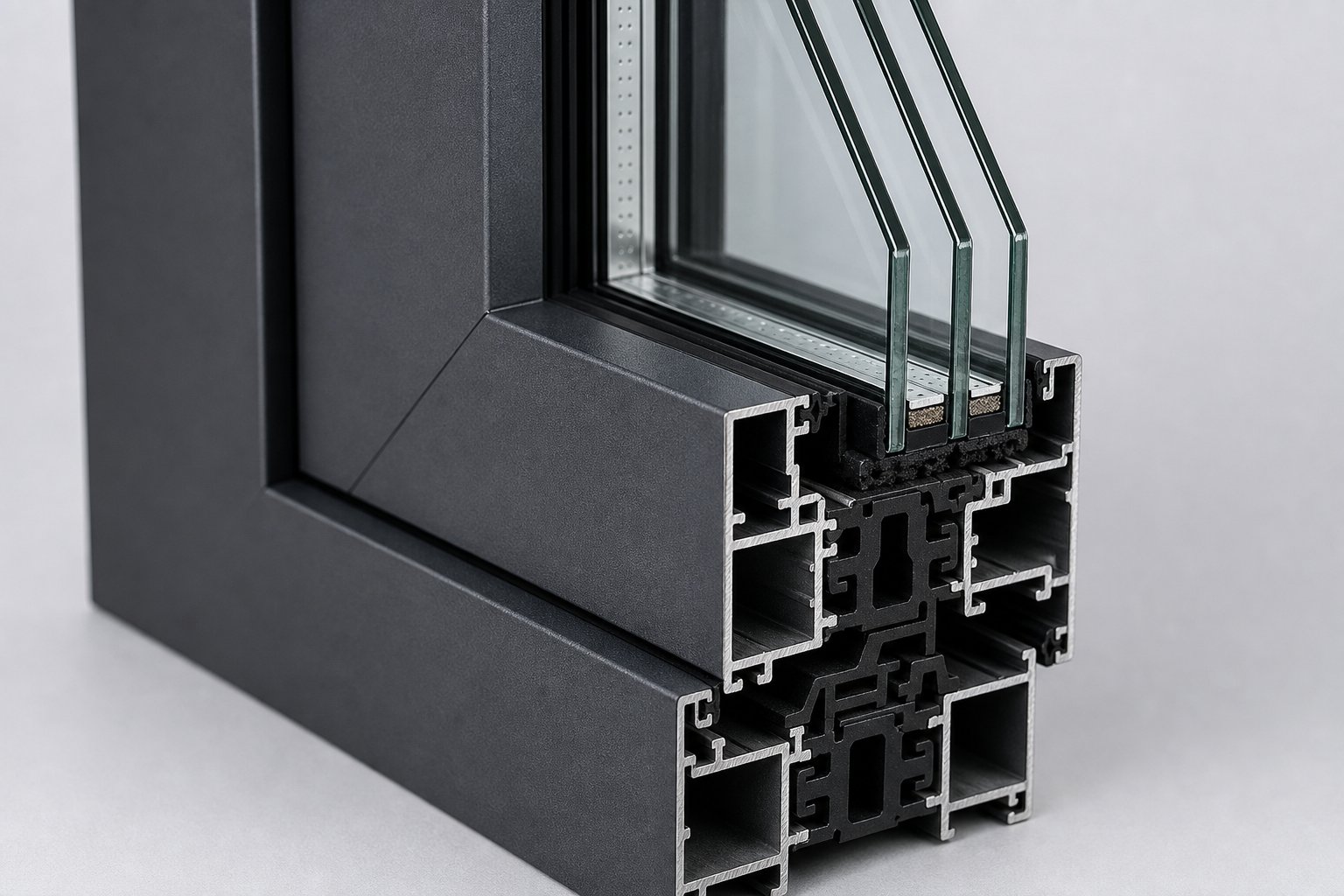
Frame depth doesn’t just determine what hardware fits inside the profile — it governs the maximum thickness of glass the window can physically accept and how much thermal insulation can be engineered into the frame itself. These two variables, glazing capacity and thermal break width, are the reason energy-efficient aluminium window profile sizes trend larger than their single-glazed predecessors. The physics is simple: insulation takes space, and space means depth.
Glazing Unit Thickness and Profile Depth Relationship
An insulating glass unit is not a single pane. It’s two or three sheets of glass separated by gas-filled cavities, bonded at the perimeter by a spacer bar and sealant. A standard double-glazed IGU with two 5mm panes and a 12mm argon-filled cavity measures 22mm total. Add Low-E coatings and a wider 16mm cavity for better thermal and acoustic performance, and the unit grows to 26–28mm.
A 60 series aluminium window profile — with its 58–65mm frame depth — typically accommodates IGUs up to about 28mm. That covers most standard double-glazed residential configurations comfortably. But the moment you step into triple glazing, the maths changes. A triple-glazed unit with three 4mm panes and two 12mm cavities measures 36mm. Factor in warm-edge spacers and Low-E coatings on multiple surfaces, and real-world triple IGUs often land between 36mm and 44mm thick.
Housing that kind of glass requires 70mm or deeper aluminium windows profiles. The glazing rebate — the channel within the profile that holds the IGU — needs enough depth to seat the unit, apply structural gaskets on both faces, and leave clearance for thermal movement. A 60 series section simply doesn’t have the internal geometry to manage a 36mm+ unit without compromising seal compression or reducing the edge cover that protects the IGU spacer from UV degradation.
For projects chasing NatHERS ratings of 7 stars or above, triple glazing is increasingly part of the conversation in southern Australian climate zones. That specification decision locks in a minimum 70 series aluminum window frame profile before any structural or wind load calculation even begins.
Thermal Break Width and Its Impact on Frame Dimensions
The thermal break — that polyamide strip separating the interior and exterior aluminium sections — is where frame depth and energy performance collide most directly. A wider strip means a longer path for heat to travel through the frame, which reduces the frame’s U-value (Uf). But every millimetre of additional thermal break width must come from somewhere inside the profile’s cross-section.
The relationship is essentially linear: specify a wider thermal break, and the minimum frame depth increases accordingly. A 14.8mm polyamide strip fits within a 60 series section, while a 34mm strip demands an 80 or 90 series frame to leave adequate material for structural walls, gasket channels, and glazing rebates on either side.
Here’s how common thermal break widths map to minimum profile depths and approximate thermal performance:
- 14.8mm thermal break — Fits within 55–60 series profiles. Reduces frame Uf from approximately 5.0–7.0 W/m²·K (non-thermally broken) down to roughly 3.5–4.0 W/m²·K. A meaningful improvement, but marginal for stringent energy compliance in cooler climate zones.
- 20mm thermal break — Requires minimum 65–70 series depth. Pushes Uf toward 2.5–3.2 W/m²·K. This is the threshold where thermally broken aluminium starts competing with timber-frame thermal performance in milder climates.
- 24mm thermal break — Requires 70–80 series profiles. Achieves Uf values of approximately 1.8–2.5 W/m²·K. Suitable for most NCC Section J compliance paths and comfortable for WERS-rated performance in climate zones 4 through 7.
- 34.8mm thermal break — Demands 85–96 series frame depth. Combined with foam-filled cavities, delivers Uf values of 0.8–1.2 W/m²·K — performance comparable to high-end timber frames. Specified for Passive House projects and buildings targeting near-zero energy standards.
Each step up in thermal break width delivers diminishing returns on Uf improvement but demands a proportional increase in frame depth. Moving from 14.8mm to 24mm roughly halves the frame’s thermal conductance. Moving from 24mm to 34.8mm halves it again, but at the cost of a substantially deeper and visually heavier aluminium window profile.
This is the trade-off architects navigate constantly: slimmer sightlines versus better energy performance. A 60 series frame with a 14.8mm thermal break looks elegant but may not satisfy the energy assessor. A 90 series frame with a 34.8mm break satisfies every thermal calculation but introduces sightline widths that undermine the design intent of maximum transparency.
The answer, for most Australian residential and commercial projects, lands in the 70–80 series range with 20–24mm thermal breaks. That bracket delivers genuine thermal performance improvement while keeping frame proportions visually acceptable. Projects in tropical zones — where cooling loads dominate and solar heat gain through the glass outweighs frame conduction losses — can often justify staying at 60 series with a narrower break, since the return on deeper insulation within the frame is smaller relative to the glazing system’s Solar Heat Gain Coefficient (SHGC).
The critical takeaway: profile depth is never just a structural decision. It’s simultaneously a thermal and glazing decision. Specifying a series number without checking whether it can house your required IGU thickness and thermal break width is how projects end up redesigning window schedules at construction documentation stage — after the facade proportions are already locked in.
Regional Standards That Govern Profile Sizing
Structural logic and thermal calculations might point you toward a particular profile series, but the final authority on whether that selection is acceptable sits with the applicable standard for your jurisdiction. Different regions regulate standard aluminium extrusions through different frameworks — some control dimensional tolerances at the extrusion stage, others test the finished window assembly under simulated load, and a few do both. Specifying a profile without knowing which standard governs your project is like sizing a beam without confirming the load code.
European and North American Standards for Aluminium Profiles
In Europe, two standards define the baseline for architectural aluminium extrusion profiles. EN 12020 covers precision profiles in 6060 and 6063 alloys, setting dimensional tolerances, straightness limits, and surface quality for standard aluminum extrusion profiles used in window and curtain wall systems. EN 755 takes a broader scope, specifying mechanical properties and tolerance classes for extruded bars, tubes, and profiles across all wrought aluminium alloys. Together, they ensure that a profile leaving the press meets both geometric accuracy and minimum strength thresholds before it ever reaches a fabrication workshop.
European window performance is then governed by EN 14351-1, which tests the completed window for air permeability, watertightness, and wind resistance. This layered approach — material standard plus product performance standard — means profile sizing in Europe is verified at two levels: the extrusion must meet EN 12020/755 tolerances, and the finished window must pass EN 14351-1 classification testing at the required performance class.
North America takes a different path. ASTM B221 specifies dimensional tolerances and mechanical properties for aluminium alloy extruded profiles, but window performance testing falls under ASTM E330 (structural), E547 (water penetration), and E283 (air leakage). Compliance with regional energy codes — such as those referencing NFRC-rated thermal transmittance values — further constrains which profile depths and thermal break widths are viable. The result is that standard aluminum extrusion profiles acceptable under ASTM B221 may still fail to satisfy the performance requirements imposed by local building codes.
China’s GB/T 5237 series — referenced earlier in the wall thickness discussion — governs both dimensional tolerances and surface treatment quality for architectural aluminium. It’s the standard behind much of the global extrusion supply chain, and profiles imported into Australia or Europe are frequently manufactured to GB 5237 tolerances before being adapted to meet destination-market performance requirements.
Australian Standards AS 2047 and Wind Load Compliance
Australia’s framework is performance-based rather than prescriptive. AS 2047 doesn’t tell you which series to use or mandate a minimum wall thickness. Instead, it requires that the completed window assembly demonstrates adequate structural performance, water penetration resistance, and air infiltration control when tested to the wind pressures applicable to its installation location and height.
Those wind pressures come from AS/NZS 1170.2, which defines wind speed regions across Australia — from Region A (non-cyclonic, most of southern Australia) through Region D (severe tropical cyclone, parts of northern WA, NT, and Queensland). The building’s terrain category, height, and shielding determine the design wind pressure in Pascals that the window must withstand. That pressure figure is what ultimately drives profile size selection: a window rated to 2.0 kPa might sit comfortably in a 60 series frame, while the same opening size rated to 4.5 kPa for an upper storey in a cyclone region demands 80 or 90 series sections to meet deflection limits.
This indirect relationship between AS 2047 and aluminium window profile sizes is what confuses specifiers. The standard never says “use 70 series.” It says the window must pass testing at the required pressure rating — and the system provider’s tested configurations tell you which profile series achieves that rating for your specific opening dimensions. No tested configuration, no compliance path.
AS 2047 is performance-based: it doesn’t prescribe a profile series. The wind load zone (from AS 1170.2) and your opening dimensions together determine the minimum profile depth needed to achieve compliance through the system provider’s tested span tables.
For specifiers working across international projects — or sourcing châssis aluminium systems from European or Asian suppliers for Australian installation — the key risk is assuming that compliance with one jurisdiction’s standard satisfies another. A profile system tested to EN 14351-1 Class C5 may deliver equivalent wind resistance to an AS 2047 rating of N5, but it still requires separate verification or evidence of compliance under the Australian framework. The National Construction Code references AS 2047 directly, and building certifiers will expect documentation to that standard regardless of the system’s country of origin.
A practical checklist keeps the process orderly:
- Identify jurisdiction — Confirm which country and state-level codes apply. In Australia, the NCC applies nationally with state-specific amendments.
- Determine the applicable performance standard — For Australian projects, this is AS 2047 for windows and AS 1288 for glazing selection and installation.
- Confirm wind load zone and design pressure — Use AS/NZS 1170.2 to establish the service wind pressure (in Pascals) for each elevation and storey height.
- Verify minimum profile series from the system provider’s tested configurations — Cross-reference your opening sizes and design pressure against the supplier’s span tables and test reports to confirm which series achieves compliance.
Skip any step and you risk specifying a profile that looks right on paper but has no tested evidence of adequacy for your project’s actual conditions. The next challenge — and where most re-specification happens — is translating this compliance logic into a practical selection framework that accounts for all constraints simultaneously: opening size, wind zone, glazing thickness, and thermal performance target, all resolved into a single profile series decision.
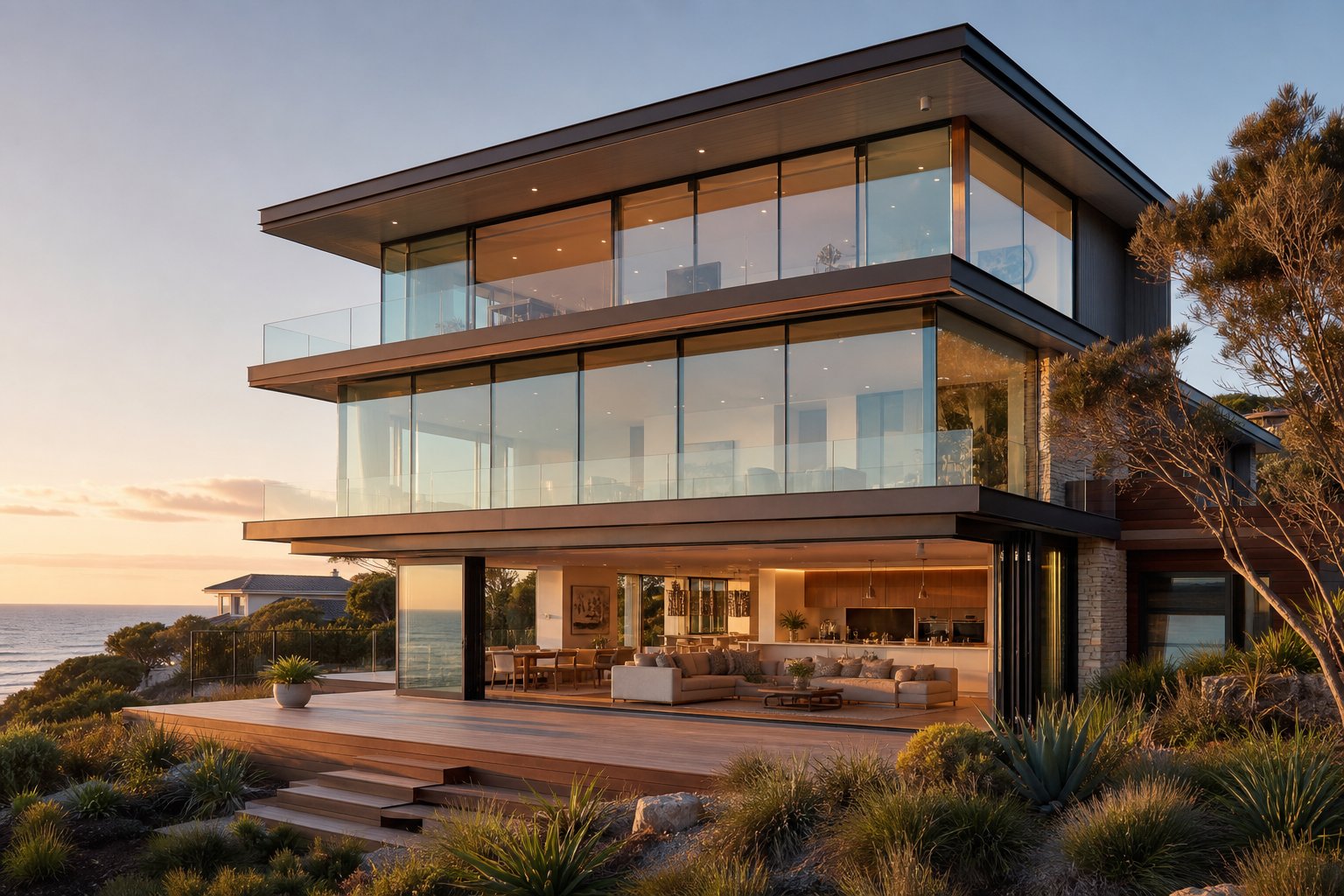
Selecting the Right Profile Size for Your Project
Standards tell you what the window must achieve. Span tables tell you what the profile can achieve. The gap between those two — where opening dimensions, wind pressures, glazing weight, and thermal targets all collide — is where profile selection actually happens. Most re-specification events trace back to resolving these constraints sequentially rather than simultaneously. By the time the thermal requirement surfaces, the structural selection is locked in and the frame depth is too shallow to accommodate the needed break width.
A systematic decision logic prevents that. Whether you’re specifying window profiles for a new apartment tower or a single-storey coastal renovation, the variables are the same — only their values change.
Decision Logic for New-Build Projects
For new construction where subframe dimensions haven’t been fixed yet, the aluminium profile for windows selection follows a constraint-stacking sequence. Each step narrows the viable series range until only one bracket (or sometimes one specific system) satisfies everything:
- Establish maximum opening dimensions — Record the widest and tallest openings on the window schedule. These set the upper bound of the span that the profile must resist without exceeding deflection limits (typically L/200 or L/250 depending on the system and application).
- Identify wind load zone and design pressure — Using AS/NZS 1170.2, determine the ultimate and serviceability wind pressures for each elevation and storey height. Upper floors and exposed facades carry higher pressures and will drive larger profile requirements than sheltered ground-floor openings.
- Determine glazing specification — Confirm the IGU makeup: double or triple glazing, cavity width, glass thickness, and overall unit depth in millimetres. A 28mm double-glazed unit fits comfortably in a 60 series rebate; a 40mm triple-glazed unit won’t.
- Check thermal break width needed for energy compliance — Cross-reference the project’s NatHERS target or NCC Section J pathway against the frame U-value required. A 6-star rating in climate zone 6 demands a different thermal break width than a 7-star target in climate zone 1.
- Select the minimum series that satisfies all constraints simultaneously — The profile must accommodate the glazing unit, house the thermal break, and pass structural adequacy testing at the design wind pressure for the specified span. If any single constraint pushes the requirement above the current series, the entire selection moves up.
- Confirm with the system provider’s tested span tables — No aluminium profile for windows selection is complete until verified against the specific system’s test evidence. Span tables show the maximum opening size achievable at each wind pressure rating for a given series and configuration. If your opening exceeds the tested span, you either reduce the opening, increase the series, or add mullions.
The sequence matters. Jumping straight to step 5 — picking a series number based on instinct or past-project habit — skips the inputs that determine whether that choice actually works. A 70 series section might feel like a safe default for residential work, but it could be undersized for a 2.4m-wide sliding door on an exposed upper storey, or oversized for a 900mm-wide casement on a sheltered ground floor.
Engaging a project-capable supplier early in design development collapses several of these steps into a single coordinated conversation. Rather than working through generic catalogue data, teams that bring their drawings and schedules to a supplier like MEICHEN at concept or schematic stage get system recommendations calibrated to actual opening sizes, wind zones, and thermal targets — before facade proportions are locked in and before tender documents commit the project to a series that may not stack up.
Renovation Constraints and Subframe Limitations
New builds offer flexibility. Renovations don’t. The existing subframe — typically timber or steel — imposes a hard ceiling on profile depth. If the structural opening accommodates a 70mm reveal and the new aluminium window profile needs 75mm including installation tolerances, either the subframe gets modified (cost, time, potential structural implications) or the profile selection adapts downward.
This is where the decision logic inverts. Instead of stacking constraints upward to find the minimum viable series, renovation projects start from the maximum available depth and work backward to determine what performance level is achievable within that envelope. The questions become: given a maximum frame depth of 62mm, which systems offer a tested configuration at my wind pressure rating? What thermal break width fits? Can the rebate still accept my specified IGU, or does the glazing specification need to step down from a 24mm unit to a 20mm unit?
Common scenarios that force compromise in renovation projects:
- Brick veneer reveals — Typical reveal depth of 90–110mm sounds generous, but once you subtract plaster returns, packer thickness, and installation clearance, the usable profile depth may drop to 60–70mm.
- Timber-frame weatherboard homes — Stud depth of 90mm (older construction) or 70mm (some post-war fibro) limits options, particularly where the window sits flush with the external cladding line.
- Heritage-listed openings — Council conditions may restrict visible frame width and depth to match original proportions, pushing specifiers toward slimline systems that sacrifice thermal break width for dimensional compatibility.
In every renovation scenario, the answer is the same: measure the existing opening accurately, establish the maximum installable profile depth, and then find the highest-performing system that fits within it. There’s no point specifying an 80 series thermally broken window profiles system if the subframe physically cannot accept it.
For builders and architects managing these constraints across multiple openings — some new, some existing — working with a supplier who can assess each opening individually and recommend system-specific solutions saves significant back-and-forth. MEICHEN’s project support services cover exactly this scope: from reviewing drawings and schedules through to material calculation and system recommendations tailored to each opening’s dimensional and performance requirements.
Custom Profile Sizing and Fabrication Considerations
Standard systems cover the vast majority of projects — but not all of them. Unusual opening geometries, heritage replication requirements, or architectural facades demanding non-standard sightlines eventually push specifiers beyond the catalogue. At that point, the question shifts from “which series fits?” to “is custom extrusion viable for this project’s scale and timeline?”
When Custom Profile Sizes Are Worth the Investment
Custom window profiles aluminium require a purpose-built die — a block of H13 tool steel machined to produce your specific cross-section. That die represents the major upfront cost barrier. For simple solid or semi-hollow aluminium profiles for windows, tooling typically runs AUD $750 to $3,500. Complex hollow or multi-cavity dies — the kind needed for thermally broken window sections with multiple chambers — push toward AUD $4,500 to $7,500 or more depending on the circumscribing circle diameter and tolerance requirements.
Die cost is a one-time expense. Once the tool exists, future production runs use it at no additional tooling charge. This is where project scale becomes the deciding factor. A 200-unit apartment development amortises a $5,000 die across hundreds of metres of extruded profile — adding negligible cost per window. A single residential renovation producing 30 linear metres of extrusion absorbs that same $5,000 across a tiny volume, making the per-metre premium difficult to justify.
Lead time compounds the issue. Custom dies require 7 to 15 working days for fabrication, followed by trial extrusion runs and dimensional verification. Total lead time from design approval to deliverable profile typically lands between 15 and 30 days — roughly double the turnaround for standard sections held in stock. For projects running tight construction programmes, that additional lead absorbs float that may not exist.
Before committing to custom extrusion, the smarter first step is checking whether an existing system can be adapted. Many proprietary aluminium window systems include optional reinforcement sections, extended glazing beads, or alternative mullion configurations that address non-standard requirements without new tooling. A 3030 dimensions adapter or a wider transom cap within an existing 70 series system might solve the problem at a fraction of the cost and time.
Working with a Fabrication Partner on Non-Standard Dimensions
The viability of custom aluminium profiles for windows depends on a handful of measurable factors. Before requesting a quote, assess your project against these criteria:
- Project volume — Is there enough linear metreage to justify die amortisation? Below approximately 200–300 metres of extrusion, the per-metre cost premium over standard profiles is typically 30–50% higher.
- Die amortisation horizon — Will the die serve a single project or multiple future projects? A developer building across several stages can spread tooling cost over years of production.
- Lead time tolerance — Can the construction programme absorb 4–6 weeks of additional procurement time for tooling, trial runs, and production?
- Adaptability of existing systems — Has a system provider confirmed that no standard or semi-custom configuration meets the requirement? This step alone eliminates a significant portion of custom extrusion requests.
For multi-storey developments, commercial fitouts, or projects with repeating non-standard openings, custom profiles often deliver better long-term value through optimised material use and reduced post-extrusion fabrication. The key is engaging a fabrication partner who can evaluate both paths — adapt versus custom — with full visibility of your drawings, quantities, and programme constraints.
MEICHEN’s project services support exactly this decision point for builders, developers, and procurement teams. Their scope covers system recommendations, material calculation, and manufacturing coordination — helping teams determine whether a standard configuration satisfies the requirement or whether custom tooling genuinely delivers better project outcomes. That assessment, made early with accurate quantities in hand, prevents the two most common custom-profile mistakes: paying for tooling you didn’t need, or discovering too late that standard sections won’t fit.
Frequently Asked Questions About Aluminium Window Profile Sizes
1. What does the series number mean on aluminium window profiles?
The series number (38, 50, 60, 70, 80, 90) is a nominal designation representing the approximate cross-sectional frame depth in millimetres. However, these numbers are not exact measurements. A 60 series profile from one manufacturer might measure 58mm while another measures 65mm, depending on chamber geometry, gasket placement, and thermal break configuration. Always verify actual dimensions from the system provider’s technical drawings rather than relying on the series label alone.
2. How do I choose the right aluminium window profile size for my project?
Profile selection follows a constraint-stacking approach. Start by establishing your maximum opening dimensions, then identify your wind load zone under AS/NZS 1170.2. Next, confirm your glazing specification (double or triple glazed, total IGU thickness), and determine the thermal break width needed for energy compliance. The minimum viable series is whichever satisfies all these constraints simultaneously. For Australian projects, working with a project-capable supplier like MEICHEN early in design development helps validate selections against tested span tables before specifications are locked in.
3. What is the difference between Grade A and Grade B aluminium profiles?
Grade A profiles have a minimum wall thickness of 1.4mm and are suited to primary window framing, external applications, and situations with higher wind loads or heavier glazing. Grade B profiles have a minimum wall thickness of 1.2mm and are acceptable for internal partitions, secondary glazing, and sheltered openings with shorter spans. These classifications originate from China’s GB 5237 standard but serve as de facto benchmarks across the global supply chain. In Australia, AS 2047 doesn’t prescribe a specific wall thickness but requires the finished window to pass structural testing for its wind load classification.
4. Can a 60 series aluminium profile accommodate triple glazing?
Generally, no. A 60 series profile (58-65mm frame depth) typically accommodates insulating glass units up to approximately 28mm, which covers standard double-glazed configurations. Triple-glazed units measure 36-44mm thick and require 70 series or deeper profiles to provide adequate rebate depth, proper seal compression, and sufficient edge cover to protect the IGU spacer. If your project targets high NatHERS ratings requiring triple glazing, plan for a minimum 70 series frame from the outset.
5. When is custom aluminium profile extrusion justified over standard systems?
Custom extrusion becomes viable when project volume is high enough to amortise die tooling costs (typically AUD $750 to $7,500 depending on complexity) across sufficient linear metreage — generally 200-300 metres minimum. Multi-storey developments with repeating non-standard openings often justify custom tooling, while single residential projects rarely do. Before committing, confirm with your fabrication partner whether an existing system can be adapted using optional reinforcement sections or extended glazing beads. MEICHEN’s project services can assess both paths and recommend the most cost-effective solution based on your drawings and quantities.
More Window & Door Guides