Why Burglars Target Windows and What You Can Do About It
Imagine standing outside your own home and looking at it the way a stranger would. What do your windows tell someone who’s sizing up an easy target? A burglar doesn’t need a toolkit or a master plan. They need a weak window and thirty seconds of privacy.
The numbers back this up. InterNACHI data shows that 23% of burglars enter through a first-floor window, and 81% of all break-ins happen on the ground floor. That sliding window on the side of your house, half-hidden by overgrown shrubs? That’s not a design feature. It’s an invitation.
Why Windows Are a Burglar’s Preferred Entry Point
Burglars think in terms of speed and silence. Doors often have deadbolts, reinforced frames, and sometimes even bulletproof doors in higher-risk properties. Windows, on the other hand, tend to get overlooked. A standard latch on a single-pane window can be defeated with a flathead screwdriver in seconds. Sliding windows are especially vulnerable because they can often be lifted right off their tracks. And windows tucked along the side of a house or behind fencing give intruders the cover they need to work unnoticed.
This is why upgrading your windows for security is one of the highest-impact decisions you can make as a homeowner. It’s not about turning your home into a fortress. It’s about removing the easy opportunities that burglars rely on.
The Anatomy of a Vulnerable Window
Every window has multiple points of failure. A burglar evaluates all of them at a glance. Here are the key vulnerability factors that determine whether your security windows will hold up or fold under pressure:
- Glass type – single-pane glass shatters instantly, while laminated or bullet proof glass resists impact and holds together
- Frame material – rotting wood or thin aluminium frames can be pried apart, whereas steel or heavy-duty aluminium frames resist forced entry
- Lock quality – basic crescent latches offer almost no resistance compared to multi-point locking systems
- Visibility – windows hidden by landscaping, fences, or structures give burglars cover to work without being seen
- Accessibility – ground-floor windows, basement windows, and any window reachable from a flat roof or balcony are primary targets
Whether you’re considering something as simple as better locks or as advanced as bullet proof windows for house protection, the goal is the same: eliminate the weak links before someone else finds them. This guide walks through every layer of window security, from glass types and frame materials to smart sensors and professional installation, so you can make informed decisions based on your actual risk level rather than guesswork.
Matching Your Threat Level to the Right Window Protection
Not every home faces the same risks, so not every home needs the same upgrades. A suburban house in a quiet cul-de-sac has a very different threat profile than a ground-floor apartment in a high-crime urban area or a rural property that sits empty for weeks at a time. Spending money on the wrong tier of protection wastes your budget and can leave real gaps unaddressed.
The framework below breaks window security into three distinct threat levels. Think of it as a self-assessment tool. Identify where you fall, and you’ll know exactly which upgrades deserve your attention and which ones you can skip.
Level 1 — Basic Deterrence for Low-Risk Areas
If you live in a low-crime neighborhood and your main concern is opportunistic break-ins, Level 1 upgrades are your starting point. These are simple, affordable changes that make your windows noticeably harder to exploit than the house next door.
You’re looking at upgraded window locks, reinforced latches, and visible security stickers or signage. Even a basic pin lock added to a sliding window can stop the lift-off-the-track technique that burglars use most often. The goal here isn’t to build an impenetrable barrier. It’s to signal that your home isn’t the easy target a burglar is scanning for. Deterrence works because most residential break-ins are crimes of opportunity, not planned operations.
Level 2 — Forced-Entry Resistance for Moderate-Risk Areas
When your risk level steps up, so should your protection. Level 2 is designed for homes in moderate-risk areas, properties that have experienced nearby break-ins, or homeowners who want meaningful resistance against someone actively trying to force their way in.
This tier introduces laminated security glass, which holds together under impact instead of shattering into an open entry point. It also includes multi-point locking systems that engage the sash and frame at several locations simultaneously. As Renewal by Andersen explains, multi-point locks distribute force across the entire frame, preventing an intruder from concentrating pressure on a single vulnerable spot. Pair that with security screens for windows, typically woven stainless steel or aluminium mesh rated to resist cutting and impact, and you’ve created a layered defense that buys significant time and deters all but the most determined attackers.
Level 3 — High-Security and Ballistic-Rated Protection
Level 3 exists for a different reality altogether. This tier applies to high-risk residential properties, homes of public figures, properties in areas with civil unrest, or anyone facing threats that go beyond standard burglary.
Here, you’re looking at high security windows built with ballistic-rated glazing, steel-reinforced frames, and integrated alarm systems. Ballistic glass windows use multiple layers of glass and laminate sandwiched together to absorb and stop projectile force. ASIS International notes that bullet-resistant glass is rated by Underwriters Laboratory (UL) levels, with Level 3 designed to withstand at least three shots from a .44 Magnum at 1,350 FPS. These systems also incorporate blast proof windows and bullet resistant doors to ensure the entire envelope of the home is hardened, not just individual openings. Integrated alarm sensors on every window feed directly into a monitored security system, adding an electronic response layer on top of the physical barrier.
The table below puts all three levels side by side so you can quickly match your situation to the right tier of protection:
| Threat Level | Threat Type | Recommended Upgrades | Typical Use Case | Relative Cost Tier |
|---|---|---|---|---|
| Level 1 — Basic Deterrence | Opportunistic break-ins, casual intrusion attempts | Upgraded window locks, reinforced latches, security stickers, pin locks for sliding windows | Low-crime suburban homes, apartments with limited ground-floor exposure | Low ($) |
| Level 2 — Forced-Entry Resistance | Targeted break-ins, forced entry with tools | Laminated security glass, multi-point locking systems, security screens for windows | Moderate-risk neighborhoods, homes with prior nearby incidents, ground-floor urban units | Moderate ($$) |
| Level 3 — High-Security / Ballistic | Armed threats, ballistic attacks, civil unrest | Bulletproof glass windows, steel-reinforced frames, integrated alarm systems, ballistic-rated glazing | High-risk properties, public figures, conflict-prone areas, high-value estates | High ($$$) |
Most homeowners will find themselves squarely in Level 1 or Level 2. That’s a good thing, because it means effective protection is well within reach without extreme costs. The key is being honest about your actual risk rather than defaulting to the cheapest option or over-investing in protection you don’t need.
Of course, choosing the right threat level is only half the equation. The type of glass in your windows plays an equally critical role in how well they perform under pressure, and the differences between tempered, laminated, polycarbonate, and ballistic glazing are far more significant than most homeowners realize.
Security Glass Types and What Their Ratings Actually Mean
Picking a threat level gives you direction. But when you start shopping for burglar resistant windows, you’ll quickly run into a wall of glass terminology that sounds technical and rarely gets explained in plain language. Tempered, laminated, polycarbonate, ballistic — each one behaves completely differently when someone swings a crowbar at it. Understanding those differences is the gap between buying real protection and paying for a false sense of security.
Tempered vs Laminated vs Polycarbonate Glass
Tempered glass starts life as standard annealed glass, then gets heated to around 1,150 degrees Fahrenheit and rapidly cooled. This process makes it roughly four to five times stronger than regular glass. Sounds impressive, right? Here’s the catch: when tempered glass does break, it crumbles into small, blunt granules. That’s safer for people nearby, but it means the entire pane collapses at once. A burglar hits it hard enough, and the opening is completely clear. No barrier remains. Tempered glass is a safety product, not a security product.
Laminated security glass takes a fundamentally different approach. Two or more layers of strengthened glass are bonded together with a tough thermoplastic interlayer, usually polyvinyl butyral (PVB) or ethylene-vinyl acetate (EVA). When struck, the glass may crack and spider-web, but the interlayer holds the broken pieces in place. The pane stays in the frame. The opening stays sealed. An attacker has to keep hitting the same spot repeatedly to eventually punch through, and that takes time, noise, and visibility — three things burglars avoid. Depending on its composition, laminated glass can be up to 100 times stiffer and five times stronger than other commercial glass types.
Polycarbonate glazing isn’t glass at all. It’s a transparent thermoplastic that looks like glass but flexes under impact instead of cracking. It’s virtually unbreakable under normal forced-entry conditions, significantly lighter than glass, and can often be retrofitted over existing panes without full window replacement. The trade-off? Polycarbonate is more prone to surface scratching and can yellow over time without UV-resistant coatings. For homeowners searching for bulletproof glass for sale, you’ll often find that higher-end polycarbonate and glass-clad polycarbonate products dominate the market because they combine the scratch resistance of real glass on the exterior with the flex strength of polycarbonate on the interior.
Ballistic-rated glass, sometimes called glass-clad polycarbonate (GCP), sits at the top of the hierarchy. It layers laminated glass with polycarbonate backing to create a composite that can absorb and stop projectile force. This is the category used in government buildings, banks, and high-risk residential properties where the threat extends beyond break-ins to armed attacks.
Understanding Security Glass Ratings and Standards
Here’s where most homeowners get lost — and where most articles stop short. A glass product is only as trustworthy as the standard it’s been tested against. Three key standards matter most when evaluating windows for security:
- ASTM F1233 — This is a comprehensive forced-entry resistance test for security glazing. It subjects the glass to a 41-step sequence that includes sledgehammer blows, sharp tool impacts, propane torch exposure, and chemical deterioration. There’s no overall time limit. Testing continues until the glazing fails. If a product passes ASTM F1233, it has proven it can withstand a sustained, multi-method physical attack.
- EN 356 — The European standard for security glazing classification. It rates glass from P1A through P8B, with lower ratings covering resistance to thrown objects (like a brick) and higher ratings covering resistance to repeated axe strikes. If you’re comparing products from international manufacturers, EN 356 is the rating system you’ll encounter most often.
- UL 752 — The benchmark for bullet-resistant glazing. UL 752 rates products across multiple levels based on the caliber, velocity, and number of rounds the glass must stop. Level 1 covers 9mm handguns, while Level 8 handles 7.62mm rifle rounds. Any product marketed as ballistic-rated should carry a specific UL 752 level — if it doesn’t, treat the claim with skepticism.
A complete security suite for your windows means matching the right glass standard to your actual threat level. A Level 1 homeowner from the framework above doesn’t need UL 752-rated ballistic glazing. But a Level 2 homeowner absolutely should verify that any laminated glass they’re buying has been tested to ASTM F1233 or EN 356, not just marketed with vague “security glass” language.
The table below breaks down how each glass type performs and which standard applies:
| Glass Type | Impact Behavior | Relevant Standard | Best For |
|---|---|---|---|
| Tempered Glass | Shatters into small, blunt granules — entire pane collapses on failure | AS/NZS 2208 (safety), not rated for security | Safety compliance, interior partitions, areas where human impact is the primary concern |
| Laminated Security Glass | Cracks but holds together — interlayer keeps broken glass in the frame | ASTM F1233 (forced entry), EN 356 (P1A–P8B) | Residential security upgrades, storefronts, Level 2 threat environments |
| Polycarbonate Glazing | Flexes under impact without cracking — virtually unbreakable | UL 972 (burglary resistance) | High-risk retail, schools, retrofit over existing glass, forced-entry deterrence |
| Ballistic-Rated (Glass-Clad Polycarbonate) | Absorbs and stops projectiles — combines glass hardness with polycarbonate flex | UL 752 (ballistic levels 1–8) | Government facilities, banks, high-risk residences, Level 3 threat environments |
A glass rating alone does not make a window secure. The strongest glazing in the world will fail if it’s mounted in a weak frame with a basic latch. Glass, frame, and hardware must be evaluated as a single system — upgrading one while ignoring the others simply moves the point of failure rather than eliminating it.
It’s also worth noting that no security glazing product — regardless of rating — will hold indefinitely. As TSS points out, repeated impacts will eventually break through any barrier. The value isn’t in creating something impenetrable. It’s in buying time: time for alarms to trigger, time for neighbors to notice, time for authorities to respond. Even a 30-second delay can be the difference between a completed break-in and an abandoned attempt.
Glass type and ratings give you the foundation. But glass is only one layer in the system. Security screens, window films, bars, and smart sensors each add a different kind of protection — and each comes with trade-offs that are worth understanding before you commit.
Security Screens vs Film vs Bars vs Smart Sensors
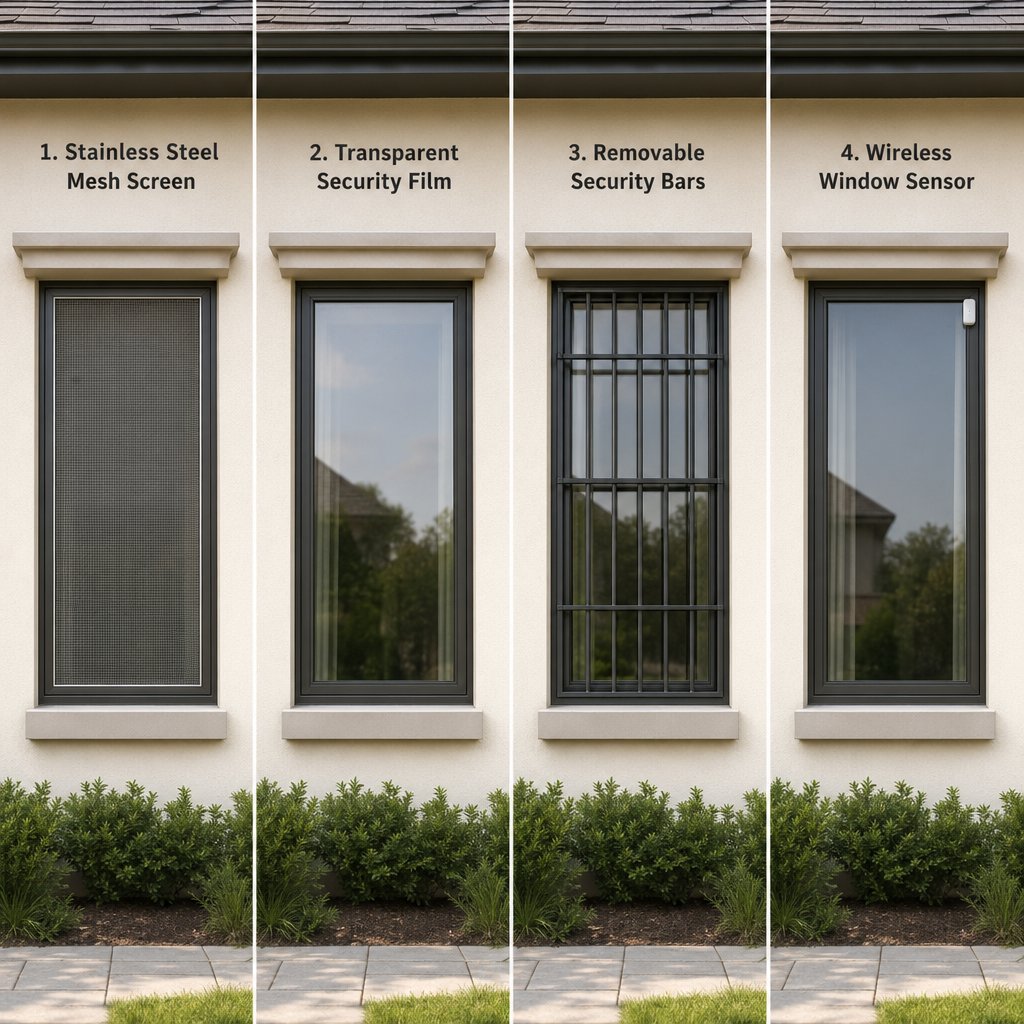
Replacing your glass is one path to stronger windows for security, but it’s not the only one. Four complementary approaches — security screens, window film, bars and grilles, and smart sensors — can each add meaningful protection without a full window replacement. The challenge is that they solve different problems, carry different trade-offs, and suit different budgets. Choosing the wrong one wastes money. Choosing the right combination multiplies your protection.
Security Screens and Mesh — Strength Without Sacrificing Airflow
If you’ve ever dismissed security window screens as clunky metal grids that make your home look like a prison, modern products will change your mind. Today’s screens use tightly woven stainless steel mesh or marine-grade aluminium mesh that resists cutting, prying, and blunt-force impact while remaining nearly transparent from a few feet away. You get ventilation, natural light, and insect protection without giving up a clear sightline.
The best windows security screen products are tested to withstand knife attacks, screwdriver prying, and sustained body-weight force. High-grade stainless steel screens resist corrosion even in coastal environments, and their physical barrier means an intruder has to defeat the screen before they can even reach the glass. That extra layer alone is often enough to make a burglar move on. For homeowners who want bulletproof windows-level confidence without the cost of ballistic glazing, a quality security screen paired with laminated glass is one of the most effective mid-range combinations available.
Security Film, Bars, and Smart Sensors Compared
Security film is a polyester-based retrofit product applied directly to existing glass. It won’t stop a determined attacker from eventually breaking through, but it holds shattered glass in the frame long enough to slow entry and trigger an alarm. At roughly $5–$15 per square foot compared to $30–$60 for screen installation, film is the budget-friendly option — though it provides a noticeably lower level of physical resistance.
Window bars and grilles deliver raw stopping power. Fixed steel bars are nearly impossible to defeat without power tools. But here’s the tension most articles ignore: permanent bars can trap you inside during a fire. Emergency egress codes require that any bars, grilles, or security coverings on bedroom and habitable-space windows must be removable from the inside without tools, keys, or special knowledge. If your bars don’t have a quick-release mechanism, they may violate local building codes and create a life-threatening hazard. Always verify compliance before installation.
Smart sensors round out the picture by adding an electronic detection layer. Glass break detectors monitor audio frequencies and trigger an alarm the moment they recognize the sound of shattering glass — a single sensor can cover an entire room with a range of 20 to 25 feet. Vibration sensors mount directly to the glass and detect physical tampering before a full break occurs. Smart window locks send real-time alerts to your phone if a window is opened unexpectedly. None of these stop a physical intrusion on their own, but they dramatically shrink the window of time an intruder has to work undetected.
The table below puts all four approaches side by side so you can match each one to your situation and the threat level framework from Section 2:
| Approach | Pros | Cons | DIY Friendly | Best Threat Level Match |
|---|---|---|---|---|
| Security Screens (stainless steel / aluminium mesh) | Strong physical barrier, allows airflow and visibility, corrosion-resistant, deters cutting and prying | Higher upfront cost, professional installation recommended for heavy-duty models | Basic models: Yes. Heavy-duty: No | Level 2 — Forced-Entry Resistance |
| Security Film (polyester retrofit) | Low cost, holds shattered glass in frame, UV protection, easy to apply | Does not prevent glass from breaking, lower physical resistance, may scratch over time | Yes | Level 1 — Basic Deterrence |
| Window Bars and Grilles (fixed or removable) | Extremely high physical resistance, visible deterrent, difficult to defeat without power tools | Can conflict with fire egress codes, aesthetic impact, must include quick-release for bedrooms | Removable: Yes. Fixed/structural: No | Level 2–3 — Forced-Entry to High-Security |
| Smart Sensors (glass-break, vibration, smart locks) | Instant alerts, covers multiple windows per sensor, integrates with home security systems, no visual impact | No physical barrier, relies on response time, potential for false alarms | Yes | Level 1–2 — Complements any physical upgrade |
The strongest setups combine approaches rather than relying on a single one. A security screen handles the physical barrier, film reinforces the glass behind it, and a smart sensor ensures you’re alerted the moment anything goes wrong. That layered thinking matters even more when you consider that different window styles — casement, sliding, double-hung — come with their own built-in strengths and weaknesses that affect which upgrades work best.
Which Window Styles Offer the Strongest Burglar Proof Security
Every window style has a personality when it comes to security — and some are far more cooperative than others. The way a window opens, closes, and locks is baked into its design, which means certain styles resist forced entry almost effortlessly while others practically roll out the red carpet. Before you spend a dollar on upgrades, it’s worth understanding what your existing windows bring to the table.
Casement and Awning Windows — The Most Secure by Design
If you could only pick one window style for burglar proof windows, casement would be the answer. Casement windows are hinged on the side and swing outward using a crank handle. When closed, the sash compresses tightly against the frame, and hook-shaped locks embedded within the frame engage at multiple points along the edge. An intruder trying to pry one open from the outside is working against the entire frame structure, not just a single latch point.
As Window World notes, casement windows feature multi-point locking systems that secure the window at several locations along the frame instead of just one, making them extremely difficult to force open. The crank mechanism itself adds another layer of difficulty — there’s no handle or grip on the exterior for an intruder to manipulate.
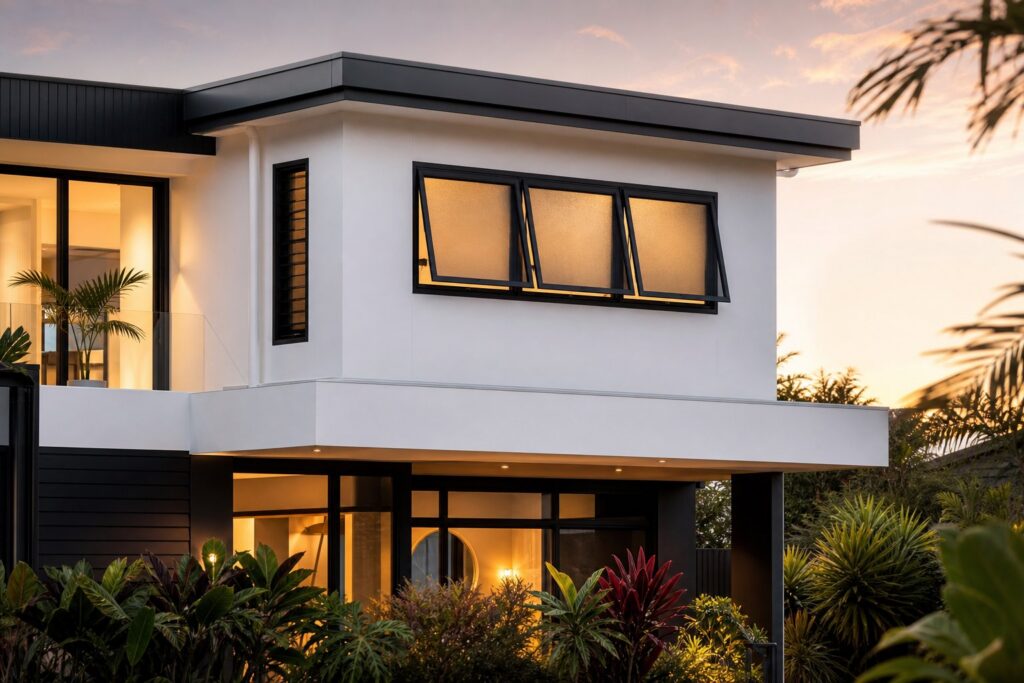
Awning windows share this advantage. They’re essentially casement windows rotated 90 degrees, hinged at the top and opening outward from the bottom. The same compression seal and embedded hook locks apply. Both styles also allow ventilation while remaining highly resistant to entry, since the outward-opening sash can’t be pushed inward even when partially open.
Sliding and Double-Hung Windows — Common but Vulnerable
Sliding windows are among the most popular styles in residential construction, but their security profile is a weak point. They ride along a track and typically rely on a simple latch or cam lock to stay shut. Better Homes & Gardens explains that an intruder can sometimes lift a sliding sash right out of its track or pry the brittle latch open with minimal effort. Hardening strategies include installing a screw-type track lock, placing a dowel or Charley bar in the lower track to block movement, and adding a keyed lock that bolts the sash to the frame at multiple positions.
Double-hung windows present a similar challenge. The standard crescent sash latch that comes with most double-hung units is designed more for draft control than intrusion resistance. A thin blade slipped between the sashes can flip the latch open in seconds. To strengthen them, install a keyed sash lock to replace the factory latch, drill pin holes through both sashes so a bolt lock secures them together, or add a hinged wedge lock that limits how far the window can open. For any operable window — regardless of style — a keyed lock provides the strongest aftermarket upgrade because it forces an intruder to break enough glass to physically reach and turn the lock.
Fixed windows deserve a mention here too. Since they don’t open at all, there’s no operable hardware to exploit. No latch, no track, no crank — just glass sealed into a frame. That makes them inherently secure against forced-entry techniques that target locking mechanisms. The trade-off is real, though: fixed windows sacrifice ventilation entirely and can’t serve as emergency egress points, which means they shouldn’t be your only option in bedrooms or living spaces where fire codes require an operable exit. Pairing a fixed picture window with a window security screen on adjacent operable windows gives you the best of both worlds.
Here’s how common window styles rank from most to least inherently secure, based on their locking mechanisms and structural design:
- Fixed (picture) windows — no operable hardware to exploit; glass is the only attack surface
- Casement windows — hook-shaped multi-point locks embedded in the frame; outward-opening sash resists external prying
- Awning windows — same compression-lock advantage as casement; hinged at top with outward swing
- Double-hung windows — single-point crescent latch is easily defeated; can be significantly hardened with aftermarket keyed locks and pin bolts
- Sliding windows — simple track-and-latch design is the most vulnerable; requires auxiliary locks, track screws, or bars to reach acceptable security
Knowing where your windows fall on this list tells you where to focus first. But even the most secure window style has limits if the glass, frame, and hardware aren’t working together as a unified system — and that full-system thinking is where most homeowners leave the biggest gaps.
Building a Full-System Window Security Strategy
Here’s where most homeowners go wrong: they upgrade one component and assume the job is done. New laminated glass in an old, flimsy frame. A multi-point lock on a window with single-pane glazing. A smart sensor on a window that could be pried open with a butter knife. Each upgrade in isolation sounds reasonable. Together, they reveal a pattern — isolated fixes that shift the point of failure rather than eliminating it.
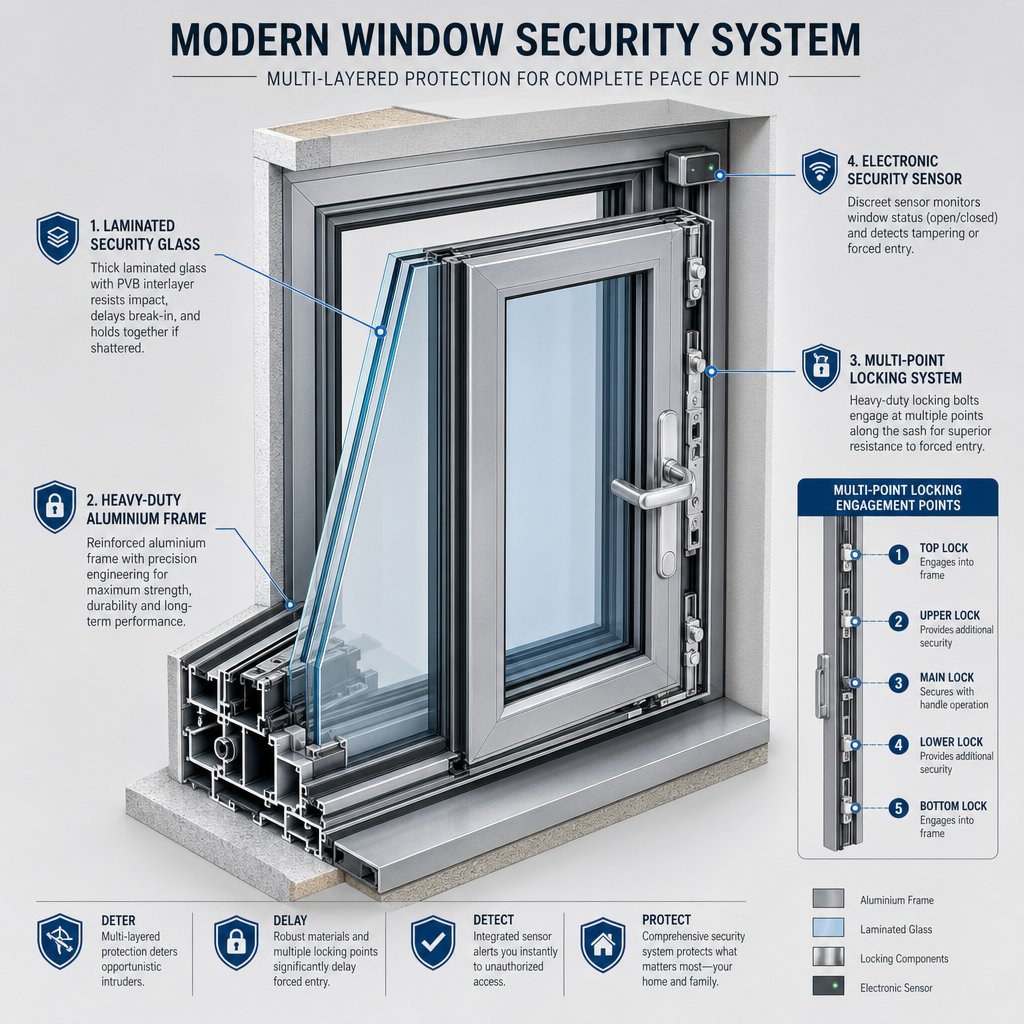
Comprehensive security for residential security windows demands a systems-level mindset. Glass, frame, hardware, screens, and sensors aren’t separate purchases. They’re interdependent layers that either reinforce each other or expose each other’s weaknesses.
How Glass, Frames, and Hardware Work as a Unified System
Think of it this way: your window is only as strong as its weakest component. Install ballistic-rated glazing in a lightweight aluminium frame with a basic crescent latch, and a burglar will simply attack the frame or the lock instead of the glass. The glass becomes expensive decoration rather than functional protection.
Frame material plays a decisive role in this equation. Comparative analysis of frame materials shows clear differences in structural capability:
- Steel frames — highest strength-to-weight ratio, supports the largest panels, inherent burglar resistance, 50+ year lifespan with maintenance
- Heavy-duty aluminium frames — excellent strength, corrosion resistance, narrow sightlines that maximize glass area, 40–60 years of service with minimal upkeep
- uPVC frames — good thermal insulation, cost-effective, but requires internal steel reinforcement to support multi-point locking systems and security-rated glass
- Timber frames — natural insulation and aesthetic warmth, but vulnerable to rot, moisture damage, and prying if not properly maintained
Quality aluminium window systems use heavy-duty extruded profiles engineered specifically to hold security-rated glass and support multi-point locking mechanisms without flex or distortion under force. For Australian homeowners and builders exploring this path, MEICHEN’s aluminium windows collection offers Australian-standard-compliant systems designed with both energy efficiency and structural integrity in mind — a relevant option when you need frames capable of anchoring security glazing and distributing lock engagement points across the full sash perimeter.
That said, the right frame material depends entirely on your threat level and project context. A Level 1 homeowner in a low-risk suburb may find that reinforced uPVC with upgraded locks is perfectly adequate. A Level 2 or Level 3 property benefits from the superior rigidity of aluminium or steel. The point isn’t that one material is universally best — it’s that your frame choice must match the glass and hardware you’re pairing it with.
For those wondering how much are bulletproof windows or bullet proof house windows, the answer depends heavily on the frame system supporting them. Ballistic glazing is meaningless without a frame engineered to hold it under repeated impact. Even a bullet proof door loses its value if the surrounding window frames can be defeated with a pry bar.
Layering Physical and Electronic Security for Maximum Protection
Physical upgrades handle the barrier. Electronic upgrades handle the response. Neither replaces the other, but together they create a system where every second of delay from the physical layer is matched by an immediate alert from the electronic layer.
A practical layered setup looks like this: security-rated glass holds together under impact, buying 30+ seconds. A strong aluminium or steel frame prevents prying, adding more time. A multi-point lock resists concentrated force. And behind all of that, a glass-break sensor triggers the moment impact occurs, sending real-time alerts to your phone and your monitoring service before the intruder has even breached the first layer.
Visible HD cameras add deterrence on top of detection — studies suggest they reduce attempted break-ins by up to 40%. Two-way audio lets you challenge a trespasser remotely. Motion-activated lighting eliminates the concealment that burglars depend on. Each electronic layer costs relatively little compared to physical upgrades, yet dramatically multiplies their effectiveness.
The takeaway is simple: no single product delivers comprehensive security on its own. A full-system approach — where glass, frame, hardware, and electronics are selected as a coordinated package — turns your windows from a collection of individual parts into an integrated defense that a burglar can’t shortcut around.
Of course, knowing what to upgrade is one thing. Knowing which upgrades you can handle yourself versus which ones demand a professional installer is an entirely different question — and getting it wrong can void warranties, reduce performance, or even create safety hazards.
DIY vs Professional Installation for Window Security
You’ve identified your threat level, chosen the right glass, and mapped out a full-system strategy. The next question is practical: which of these upgrades can you tackle on a Saturday afternoon, and which ones will go sideways without a trained installer? Getting this distinction wrong doesn’t just waste time — it can void warranties, weaken the very protection you’re paying for, or create code violations that put your family at risk.
Window Security Upgrades You Can DIY
Several meaningful improvements to your window security fall well within reach of anyone comfortable with basic hand tools. You don’t need specialized training or expensive equipment — just a drill, a tape measure, a screwdriver set, and some patience.
- Auxiliary window locks — pin locks for sliding windows, keyed sash locks for double-hung units, and hinged wedge locks all install with a drill and a few screws. Most come with paper templates for precise hole placement.
- Security film — polyester-based retrofit films apply directly to existing glass using a squeegee, spray solution, and a utility knife. The process is similar to applying a large screen protector. Films in the 4–8 mil range are manageable for a careful DIYer.
- Window sensors — wireless glass-break detectors and vibration sensors mount with adhesive pads or small screws and pair with your home security hub in minutes. Smart window locks follow the same plug-and-play logic.
- Removable window bars — lightweight removable grilles with interior quick-release brackets install with a drill and wall anchors. Just make sure the release mechanism works smoothly from inside without tools, keys, or special knowledge to stay compliant with fire egress codes.
- Basic security screens — standard-duty window security screens designed for residential use often ship with mounting hardware and instructions for homeowners. If the screen mounts to the exterior trim with screws rather than requiring structural fastening, it’s a reasonable DIY project.
These upgrades align with Level 1 and lower Level 2 protection from the threat framework. They’re affordable, reversible, and effective at eliminating the easy opportunities that most burglars rely on. For homeowners exploring safety windows as a starting point, these projects deliver real results without professional labor costs.
When to Hire a Professional Installer
Some upgrades cross a line where DIY effort becomes a liability. The moment you’re altering the structural integrity of a window opening, handling heavy security-rated glass, or working with systems that must meet building code compliance, a professional isn’t optional — they’re essential.
- Replacing existing glass with laminated security glazing or polycarbonate panels — improper fitting can leave gaps that compromise the seal and reduce impact resistance
- Installing steel or heavy-duty aluminium frames — these require precise measurement, structural anchoring, and shimming to ensure the frame doesn’t flex under force
- Fitting multi-point locking systems — alignment across multiple engagement points is critical, and even small errors can prevent the lock from fully engaging
- Any modification that affects structural framing, load-bearing headers, or rough openings around the window
- Bullet proof glass installation — ballistic-rated glazing is heavy, requires specialized handling, and must be mounted in frames engineered to support its weight and absorb impact energy
- Full bulletproof house windows systems — these involve coordinated installation of glass, frames, hardware, and often integrated alarm wiring that demands multi-trade expertise
Improper installation of security film or screens can void manufacturer warranties and significantly reduce actual security performance. A film that hasn’t been properly squeegeed and cured may peel under impact instead of holding glass in place. A screen that’s loosely fastened can be pulled free by hand — defeating its entire purpose.
For Australian homeowners specifically, it’s worth verifying that any professional installer holds the appropriate state or territory licenses for window and glazing work. Products marketed for forced-entry resistance should meet AS 5039 (security screen doors and window grilles) or AS 5041 (security screen doors and security window screens) where applicable. Asking for proof of compliance before signing a contract protects you from substandard products that look the part but haven’t been independently tested.
The dividing line is straightforward: if the upgrade bolts onto your existing window with basic hardware, you can likely handle it yourself. If it replaces structural components, involves heavy materials, or must meet specific standards for certification, bring in a professional. Cutting corners on installation is one of the most common — and most costly — mistakes homeowners make, and it’s far from the only one worth watching out for.
Common Window Security Mistakes That Leave You Exposed
Spending money on window upgrades feels productive. But the wrong upgrade — or the right upgrade done poorly — can leave you just as vulnerable as before, only now with a false sense of confidence on top of it. These are the mistakes homeowners make most often, ranked from the most common to the least obvious.
Upgrading Glass but Ignoring Weak Frames and Locks
This is the number one error, and it’s everywhere. A homeowner invests in laminated security glass or even shops for bullet proof windows, then mounts that glass in the same aging timber frame with the same single-point crescent latch it came with. The result? A burglar skips the glass entirely and attacks the frame or lock instead. As John Rovi of Oldcastle BuildingEnvelope notes, the security of occupants relies on the integrity of the entire system, not just the glass — a failure in the framing can compromise security regardless of glass performance.
Overlooking Fire Egress, Warranties, and False Confidence
The remaining mistakes are less obvious but equally damaging. Here they are in order:
- Installing security bars without quick-release mechanisms — Fixed bars on bedroom windows can violate fire safety codes and trap occupants during emergencies. Many cities enforce strict penalties, including fines and mandatory removal. Always choose bars with interior quick-release latches and verify compliance with local building codes before installation.
- Choosing security film that hasn’t been tested to forced-entry standards — Not all films are equal. A cheap window tint marketed as “security film” won’t behave like a product tested to ASTM F1233. Before buying, confirm the film carries a recognized forced-entry or impact rating. If the manufacturer can’t provide test documentation, walk away.
- Installing aftermarket locks that void the window manufacturer’s warranty — Some keyed locks and auxiliary hardware require drilling into the sash or frame in ways the original manufacturer didn’t design for. Check your warranty terms before modifying any component. A voided warranty can cost you far more than the lock saved.
- Developing false confidence from a single upgrade — This is the subtlest trap. You install a bulletproof glass door on the front entry or add film to every window and assume the house is secure. But a bullet proof house isn’t built from one product. It’s built from layers. A single upgrade without complementary protection — strong frames, quality locks, electronic sensors — just moves the weak point somewhere else. Think of it like windows defender smartscreen on your computer: it catches certain threats, but it’s not a substitute for a full security strategy.
The fix for every mistake on this list is the same principle: evaluate your windows as a complete system, not a collection of individual parts. Glass, frame, hardware, and electronic monitoring either work together or they work against each other. There’s no middle ground.
Avoiding these pitfalls saves money in the long run, but it also raises a practical question — how much should you actually expect to spend, and where does each dollar deliver the most protection per dollar invested?
Budgeting and Prioritizing Your Window Security Upgrades
Security upgrades span a wide cost range, and without a clear picture of what each tier actually involves, it’s easy to either overspend on protection you don’t need or underspend on upgrades that won’t move the needle. The good news? Effective security window improvements exist at every budget level. The key is knowing where your dollars deliver the most protection relative to your actual threat level.
Cost Tiers for Common Window Security Upgrades
Rather than quoting specific prices that vary wildly by region, supplier, and project scope, the table below positions each upgrade category in relative cost tiers so you can plan realistically. If you’ve been researching bulletproof glass cost or pricing for ballistic glass doors, you already know the high end gets expensive fast — but most homeowners don’t need to start there.
| Upgrade Type | Relative Cost Tier | Threat Level Match | DIY or Professional |
|---|---|---|---|
| Window locks and hardware (pin locks, keyed sash locks, track screws) | Lowest ($) | Level 1 — Basic Deterrence | DIY |
| Security film (4–12 mil polyester retrofit) | Low–Moderate ($–$$) | Level 1–2 | DIY (basic) / Professional (high-performance) |
| Security screens (stainless steel or aluminium mesh) | Moderate ($$) | Level 2 — Forced-Entry Resistance | Professional recommended |
| Laminated security glass replacement | Moderate–High ($$–$$$) | Level 2 | Professional |
| Full security window systems with frames (aluminium or steel) | High ($$$) | Level 2–3 | Professional |
| Ballistic-rated glazing / armored glass / bulletproof doors for home | Highest ($$$$) | Level 3 — High-Security | Professional (specialist) |
Notice the pattern: the lowest-cost upgrades are also the ones you can handle yourself, while the highest tiers demand professional installation and specialized materials. Bullet proof windows for homes and armored glass sit at the extreme end because they involve composite layered glazing, reinforced frames, and precision fitting that no standard contractor handles without specific training.
Prioritizing Upgrades on a Limited Budget
If you can’t do everything at once — and most people can’t — prioritize in this order:
- Locks and hardware first. This is the highest-impact, lowest-cost upgrade available. A $15 pin lock on a sliding window eliminates the single most common forced-entry technique. Start with ground-floor windows and any window hidden from street view.
- Add security screens or film next. Screens provide a physical barrier; film holds glass together under impact. Either one adds a meaningful second layer on top of your upgraded locks. Choose based on budget and whether you want airflow (screens) or invisibility (film).
- Consider full window replacement when budget allows. This is where you step into complete systems — security-rated glass paired with engineered frames and multi-point locks working as a unified package. For homeowners, renovators, and builders exploring aluminium window system options at this tier, MEICHEN’s aluminium windows collection provides a practical starting point to compare multiple configurations designed for different project needs and budgets, all built to Australian standards with energy efficiency and structural integrity in mind.
This staged approach means you’re never unprotected while saving for the next tier. Each step builds on the last, and you’re always improving your weakest link first rather than over-investing in one area while leaving others exposed. Think of it like virus threat protection on your computer — you wouldn’t skip basic firewall settings just because you plan to buy premium software later. The fundamentals matter now, and the advanced layers compound their value over time.
Budget constraints don’t have to mean compromised safety. A $50 investment in quality locks and a $200 security screen on your most vulnerable window will outperform a $2,000 glass upgrade on a window that already had decent protection. Spend where the gap is widest, and your security improves faster than your budget might suggest.
Frequently Asked Questions About Windows for Security
1. What type of window is hardest for burglars to break into?
Casement windows are widely considered the most secure operable window style. Their hook-shaped locks embed directly into the frame at multiple points, and the outward-opening sash compresses tightly against the frame when closed. This design means an intruder is working against the entire frame structure rather than a single latch. Fixed (non-opening) windows are technically the most secure since they have no operable hardware at all, but they sacrifice ventilation and emergency egress. For the strongest practical setup, pair casement windows with laminated security glass and a heavy-duty aluminium or steel frame.
2. Is security film on windows worth it?
Security film is a cost-effective first step, but it has clear limitations. Polyester-based retrofit films hold shattered glass in the frame and slow an intruder’s entry, buying time for alarms to trigger and neighbors to notice. However, film alone will not prevent glass from breaking, and cheaper products marketed as security film may not meet forced-entry testing standards like ASTM F1233. Film works best as one layer in a broader strategy — paired with upgraded locks, security screens, or smart sensors — rather than as a standalone solution. Always confirm the product carries a recognized impact or forced-entry rating before purchasing.
3. How much does it cost to make windows more secure?
Costs range widely depending on the upgrade tier. Basic hardware like pin locks and keyed sash locks fall in the lowest bracket and are DIY-friendly. Security film sits in the low-to-moderate range, while stainless steel security screens move into moderate territory. Laminated glass replacement and full security window systems with engineered frames reach the moderate-to-high tier. Ballistic-rated glazing and armored glass represent the highest investment and require specialist installation. A staged approach — starting with locks, then adding screens or film, then considering full window replacement — lets you improve protection incrementally without overextending your budget.
4. Can I install window security upgrades myself?
Several upgrades are well-suited for DIY, including auxiliary window locks, security film application, wireless glass-break sensors, removable window bars with quick-release brackets, and basic residential security screens. These typically require only a drill, screwdriver, and tape measure. However, replacing glass with laminated or ballistic-rated glazing, installing steel or heavy-duty aluminium frames, fitting multi-point locking systems, and any work affecting structural framing should always be handled by a licensed professional. Improper installation can void manufacturer warranties and reduce the actual security performance of the product.
5. What is the biggest mistake homeowners make with window security?
The most common error is upgrading the glass while ignoring the frame and locking hardware. A burglar will always target the weakest component, so installing laminated or even ballistic-rated glass in a deteriorating timber frame with a basic crescent latch simply shifts the point of failure. Other frequent mistakes include fitting security bars without fire-code-compliant quick-release mechanisms, choosing untested security film, and developing false confidence from a single upgrade. Effective window security requires a systems-level approach where glass, frame, hardware, and electronic monitoring are evaluated and upgraded together.
More Window & Door Guides