What Exactly Are Aluminum Awning Windows
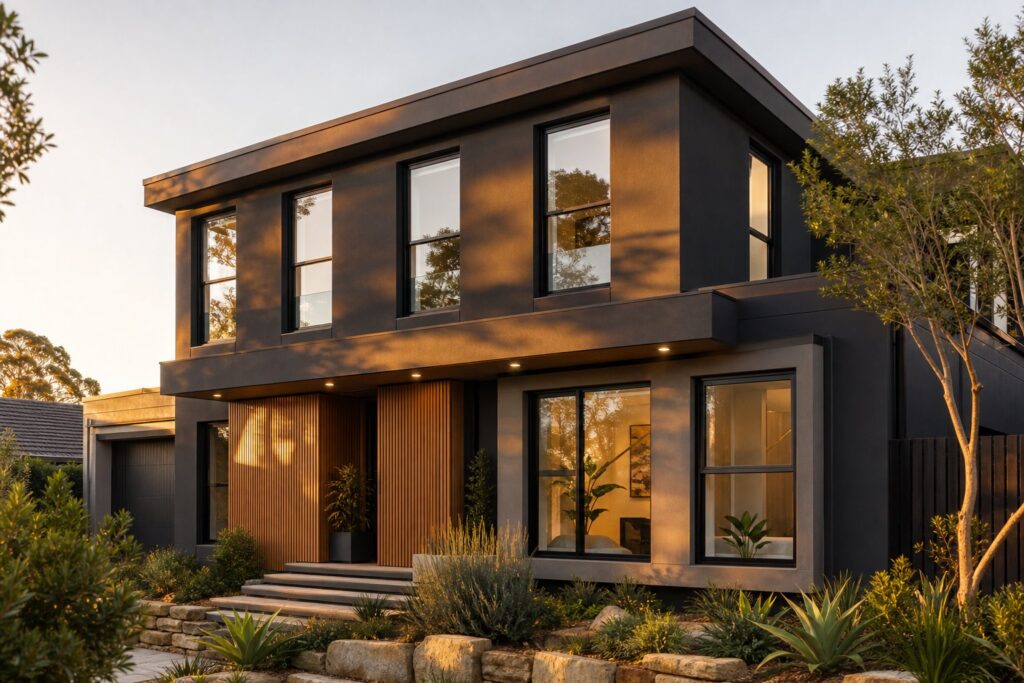
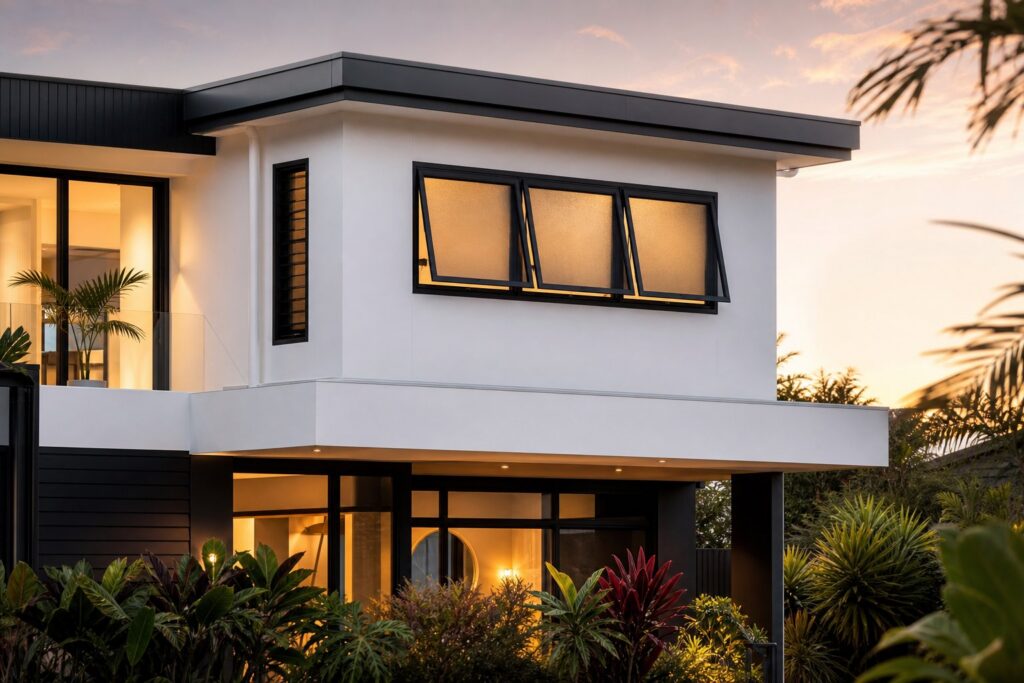
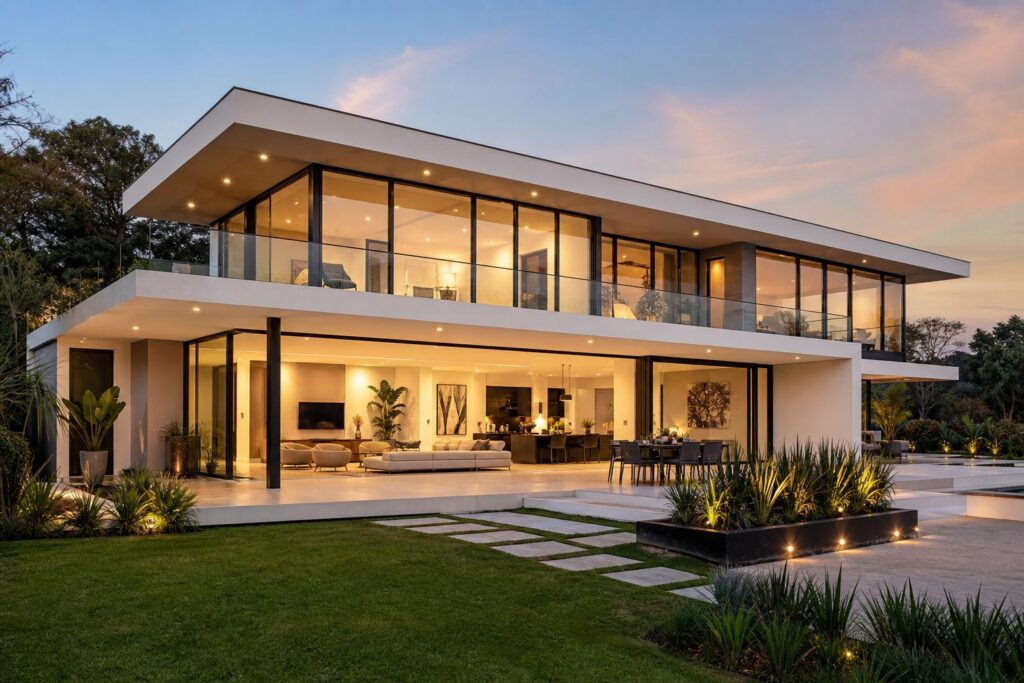
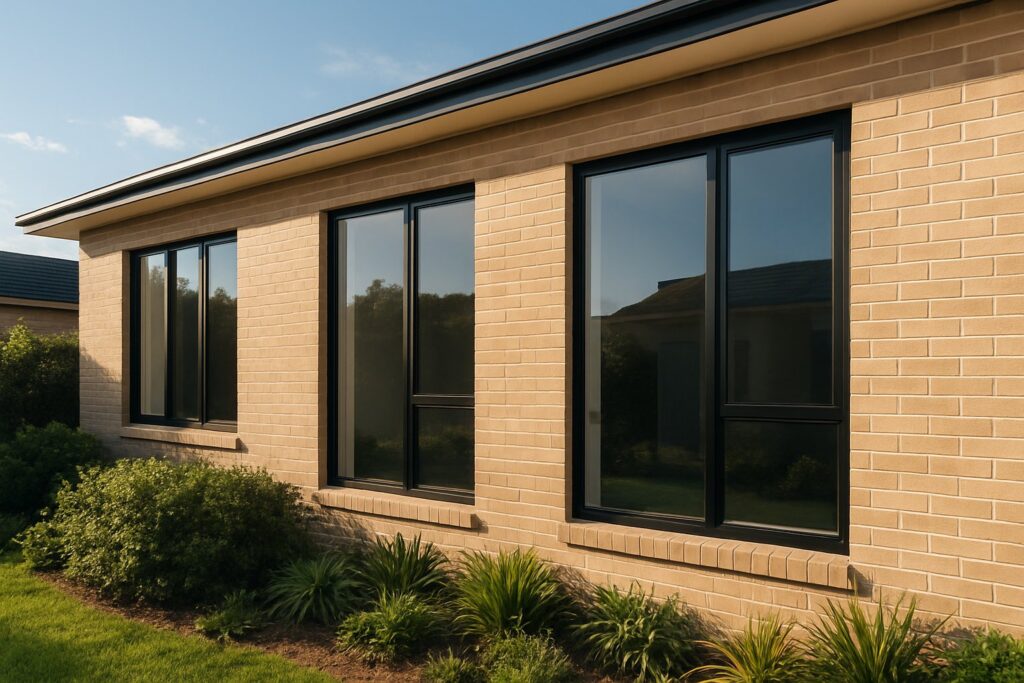
Aluminum awning windows are top-hinged windows with an aluminum frame that swing outward from the bottom, creating a canopy-like opening that sheds rain while letting fresh air flow in. They are typically wider than they are tall, and the aluminum frame gives them a distinctly slim profile that maximizes the glass area compared to bulkier vinyl or wood alternatives.
Sounds simple enough, but the details of how that hinge works — and how it stacks up against other window styles — matter more than most product pages let on.
How the Awning Hinge Mechanism Works
Imagine a window sash attached at the top by two pivot hinges. When you turn a crank handle at the base of the frame (or push the sash outward on simpler models), the bottom edge swings away from the wall while the top stays fixed. The result is an angled opening that acts like a small roof over the gap — rain rolls down the outer face of the glass and drips off the lower edge instead of entering your home.
This is why an awning window can stay open during a light shower, something most other operable window types can’t do without letting water in. The sash presses firmly against the frame when closed, forming a tight seal that also reduces air leakage.
Awning vs. Casement vs. Hopper at a Glance
The differences between awning windows and their closest relatives come down to hinge position and how air moves through the opening. Here’s a quick side-by-side:
| Window Style | Hinge Position | Opens | Airflow Direction | Rain Protection | Typical Placement |
|---|---|---|---|---|---|
| Awning | Top | Outward from bottom | Upward and sideways | Excellent — sash deflects rain | Bathrooms, kitchens, basements, high on walls |
| Casement | Side (left or right) | Outward from side | Sideways, catches cross breezes | Moderate | Living rooms, bedrooms, tall narrow openings |
| Hopper | Bottom | Inward from top | Downward into room | Poor — open sash invites rain | Basements, utility rooms |
| Sliding | None (track-based) | Horizontally on track | Horizontal, limited to open half | None | Wide openings, patios |
| Double-Hung | None (track-based) | Vertically on track | Top and bottom gaps | None | Traditional homes, bedrooms |
You’ll notice that awning and casement windows both crank open and seal tightly when closed, making them among the most energy-efficient operable styles. The key difference is orientation: casements suit tall, narrow openings while awning windows fit short, wide ones.
Why Aluminum Frames Stand Out
Frame material changes everything about how a window performs and ages. Aluminum delivers an exceptional strength-to-weight ratio, which means manufacturers can build narrower frame profiles without sacrificing structural integrity. The payoff for you is more glass, more light, and cleaner sightlines.
Aluminum also resists corrosion naturally — a major advantage for window awnings aluminum frames face in coastal or humid environments where wood rots and steel rusts. It is infinitely recyclable, too, giving it a sustainability edge that wood awning windows and vinyl simply can’t match. And unlike window awnings metal options from decades past, today’s aluminum frames come with powder-coat finishes in virtually any color, so the old “industrial look” concern no longer applies.
These properties make aluminum awnings for windows a compelling choice, but they don’t tell the whole story. The real question is how aluminum stacks up against other frame materials on cost, thermal performance, and day-to-day livability.
Pros and Cons of Aluminum Awning Windows
Every window material has a sales pitch. Aluminum’s pitch is strong — but it’s not the full picture. If you’re going to spend money on a window awning system that needs to last decades, you deserve to see both sides before committing. Here’s an honest breakdown.
Key Advantages of Aluminum Awning Windows
Aluminum earns its reputation in commercial and residential projects for good reason. The benefits are tangible and well-documented:
- Exceptional durability: Aluminum won’t warp, crack, swell, or rot — period. Where wood frames degrade and vinyl can soften under sustained heat, aluminum holds its shape for 40 to 50 years with proper care.
- Slim frame profiles, more glass: Aluminum’s strength-to-weight ratio allows manufacturers to build narrower frames that support larger glass panes. You get more natural light and wider views from the same rough opening — something you’ll notice immediately compared to chunkier vinyl frames.
- Modern aesthetic versatility: Powder-coat finishes are available in virtually any color and resist fading, chalking, and peeling. Whether you want matte black for a contemporary look or a heritage bronze to match an older home, aluminum delivers.
- Corrosion resistance for tough climates: Coastal and humid environments punish most materials. Aluminum, especially with anodized or powder-coated finishes, handles salt air and moisture far better than wood and untreated steel — making a metal awning window a practical choice near the coast.
- Infinite recyclability: Aluminum can be recycled endlessly without losing quality. For green building projects or homeowners who care about lifecycle impact, this is a genuine differentiator that vinyl and composite frames can’t match.
Honest Drawbacks to Consider
No material is perfect, and aluminum has real weaknesses that matter depending on your climate and budget:
- Higher thermal conductivity: Aluminum conducts heat roughly 1,000 times faster than vinyl. Without a thermal break — a non-conductive barrier engineered into the frame — aluminum windows lose energy quickly. Modern thermally broken designs close much of this gap, but vinyl still edges ahead on raw insulation performance.
- Condensation risk in extreme cold: In climates with harsh winters, poorly engineered aluminum frames can develop interior condensation. This is largely solved by quality thermal breaks, but it’s worth verifying the U-factor before buying — aim for 0.30 or lower.
- Higher upfront cost than vinyl: Expect to pay more than you would for comparable vinyl units. Thermally broken aluminum windows carry a premium partly because the engineering is more complex and the market offers fewer budget-tier options.
- Heavier frames, less DIY-friendly: Aluminum is denser than vinyl, which makes larger awning windows sizes harder to handle during installation. Professional fitting is generally recommended, adding to the total project cost.
Who Benefits Most from Choosing Aluminum
Aluminum awning windows aren’t for everyone — and that’s fine. They make the most sense for specific buyer profiles:
If you live in a temperate-to-coastal climate where corrosion resistance matters more than extreme cold insulation, aluminum is a natural fit. Architects and designers who want minimal sightlines and maximum glass gravitate toward it for the same reason brands like Milgard aluminum windows and Marvin Elevate windows have built product lines around slim-profile metal frames — the aesthetic payoff is hard to replicate in vinyl.
Commercial specifiers and builders also lean heavily on aluminum for its structural strength, code compliance, and longevity in high-traffic or multi-story applications. And if you’re renovating a mid-century or contemporary home that already has aluminum-framed windows, matching the existing material keeps the look cohesive without the headaches of mixing frame types.
The advantages are clear for the right project. But how does aluminum actually compare head-to-head with vinyl, wood, and fiberglass when you line up the specs side by side? That’s where the decision gets more nuanced.
Aluminum vs. Other Frame Materials for Awning Windows
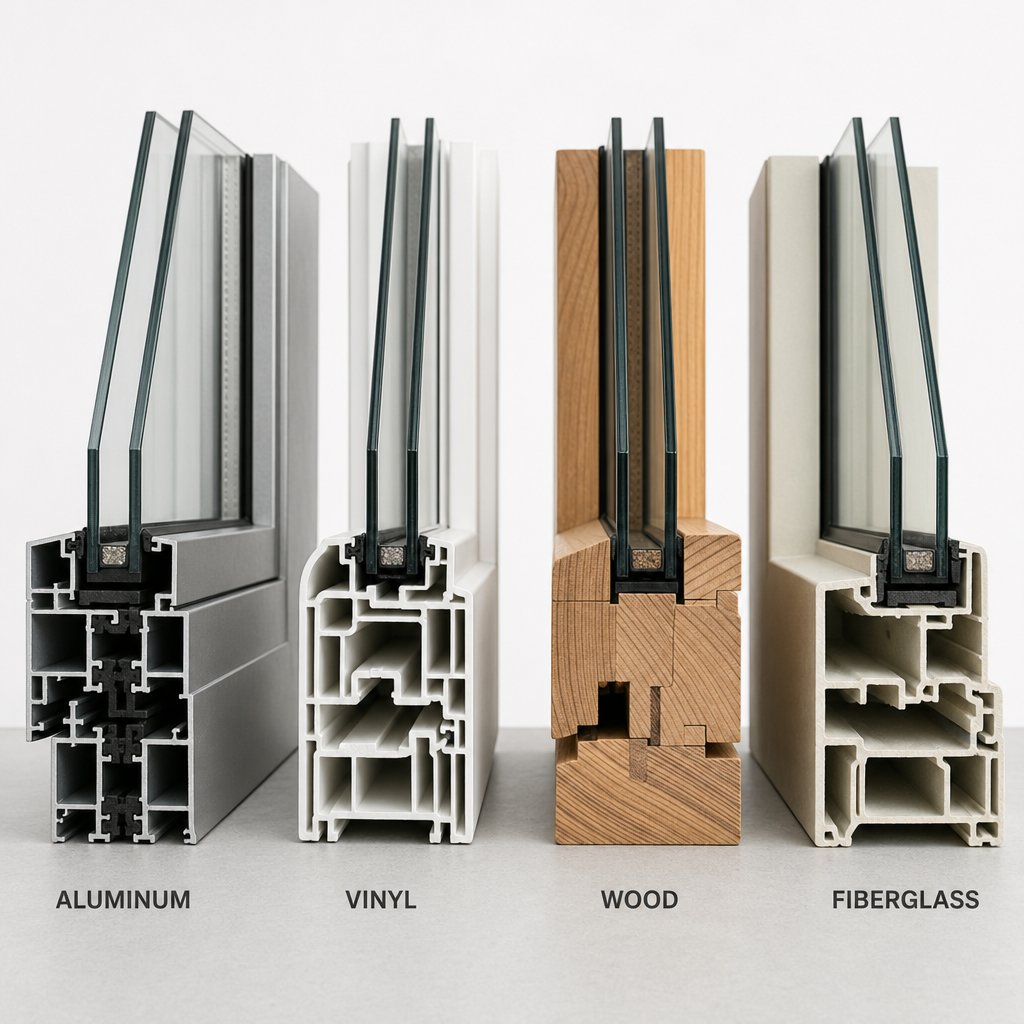
Choosing a frame material is really choosing a set of trade-offs — thermal performance against profile thickness, upfront cost against lifetime maintenance, recyclability against raw insulation value. Most manufacturers only show you their own material in isolation. Here’s what the comparison actually looks like when you put every option on the same table.
Aluminum vs. Vinyl Awning Windows
This is the matchup most homeowners wrestle with first, and for good reason — vinyl and aluminum sit at opposite ends of the material spectrum.
An awning vinyl window is typically 15 to 30 percent cheaper than a comparable aluminum unit. Vinyl frames use multi-chamber PVC profiles that trap air inside the extrusion, giving them naturally low thermal conductivity without any additional engineering. That’s a real advantage in cold climates where every fraction of a U-factor point matters on your heating bill.
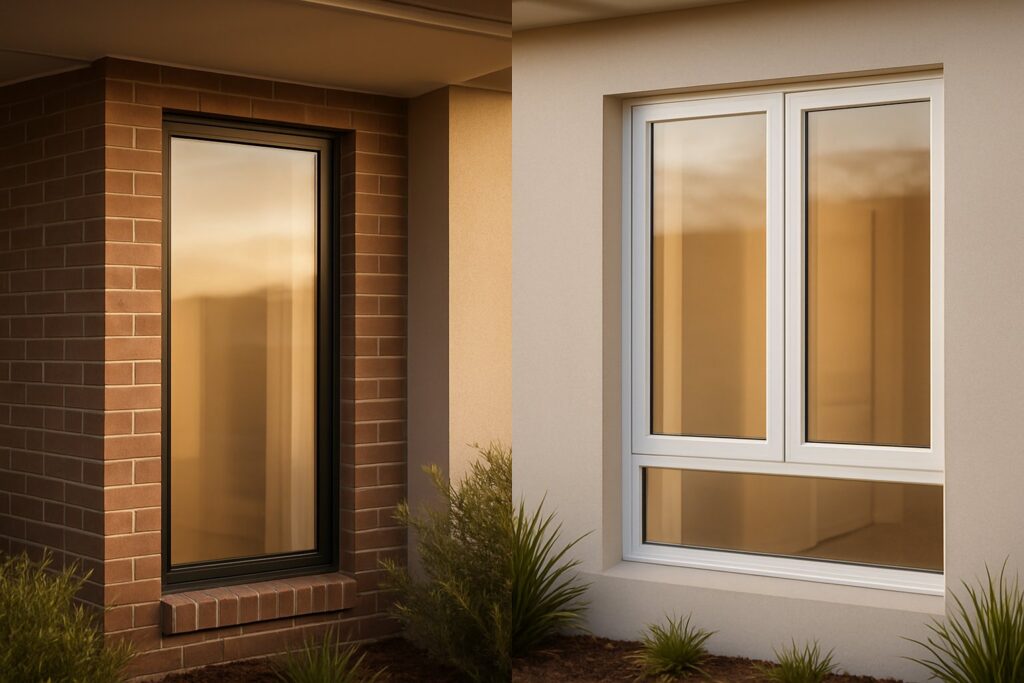
Aluminum fights back on structure and aesthetics. Because the metal is so strong relative to its weight, manufacturers can build frames roughly 30 to 40 percent thinner than vinyl equivalents — which means more glass area and cleaner sightlines in every window with awning operation. Color options are broader too: powder-coated aluminum awning frames hold their finish for decades, while vinyl is mostly limited to neutral tones or laminate wraps that can peel over time.
On longevity, both materials can reach 20 to 30 years, but aluminum’s structural rigidity means it resists sagging and seal failure in larger openings where vinyl frames sometimes flex. Recyclability isn’t even close — aluminum is infinitely recyclable, while PVC recycling infrastructure remains limited.
Aluminum vs. Wood and Fiberglass Options
Wood brings something no other frame material can replicate: natural insulation and a warm, traditional look. A solid wood awning frame insulates better than aluminum out of the box, no thermal break needed. The catch? Wood demands regular painting, sealing, and inspection for rot — maintenance cycles that add real cost and effort over a 30-year window life. In humid or coastal environments where metal window awnings thrive, wood struggles.
Fiberglass occupies an interesting middle ground. It mimics aluminum’s strength and slim profiles while offering thermal performance closer to vinyl. The downside is price — fiberglass awning windows typically sit at the premium end of the market, and fewer manufacturers offer them in a full range of sizes and configurations.
Then there’s the hybrid approach: aluminum-clad wood. You get wood’s insulation on the interior and aluminum’s weather resistance on the exterior. It’s a compelling solution for homeowners who want the best of both worlds, though the cost and complexity go up accordingly. For projects where automatic awnings or motorized operators are planned, the lighter aluminum cladding also reduces strain on mechanical hardware over time.
Side-by-Side Material Comparison
Rather than bouncing between spec sheets, here’s every major frame material compared across the factors that actually drive your decision:
| Factor | Aluminum | Vinyl (PVC) | Wood | Fiberglass | Composite |
|---|---|---|---|---|---|
| Thermal Performance | Moderate (good with thermal break) | High (multi-chamber insulation) | High (natural insulator) | High | Moderate to high |
| Durability | Very high — no warping or rot | Good — may flex in large spans | Moderate — vulnerable to rot and insects | Very high | High |
| Maintenance | Minimal — clean and lubricate | Minimal — clean only | High — paint, seal, inspect regularly | Minimal | Low to moderate |
| Frame Thickness | Slim | Thicker profiles needed | Moderate to thick | Slim to moderate | Moderate |
| Recyclability | Infinite — no quality loss | Limited infrastructure | Biodegradable but not recyclable as a frame | Difficult to recycle | Limited |
| Relative Cost Tier | Mid-range to premium | Budget to mid-range | Premium | Premium | Mid-range to premium |
One critical detail this table can’t capture on its own: the ratings behind the numbers. When evaluating any frame material, look for AAMA certification to verify structural, air leakage, and water resistance performance, and check NFRC labels for independently tested U-factor and Solar Heat Gain Coefficient values. These third-party benchmarks are the only reliable way to compare products across brands and materials — manufacturer claims alone aren’t enough.
For Australian projects specifically, suppliers like MEICHEN engineer their aluminium window systems with thermal performance and AS 2047 compliance built in, offering a practical reference point for what modern aluminum frame engineering looks like in a standards-compliant package. That said, regardless of which supplier you evaluate, always cross-check certifications against your project’s specific climate zone and code requirements.
Material choice sets the foundation, but it doesn’t tell you where in your home an aluminum awning actually earns its keep — and where a different style might serve you better.
Best Rooms and Applications for Awning Windows
A window can check every box on a spec sheet and still underperform if it’s installed in the wrong room. The awning mechanism’s real value shows up when you match its ventilation pattern, weather resistance, and mounting flexibility to the specific demands of each space.
Bathrooms and Laundries
If you put an awning window in only one room, make it the bathroom. Steam from showers and dryers needs an exit path, and the top-hinged design lets moisture escape upward and outward — even during rain — without water splashing back inside. That canopy effect is exactly what wet rooms need.
Aluminum’s corrosion resistance adds another layer of logic here. Bathrooms and laundries cycle between humid and dry conditions daily, an environment that accelerates rot in wood frames and can warp cheaper vinyl over time. An aluminum awning frame shrugs off that moisture without degrading. And because these windows can be mounted high on a wall, you get ventilation and privacy simultaneously — no frosted film or curtain required.
Kitchens and Basements
Imagine standing at your kitchen counter with a casement window swinging into your workspace every time you need airflow. Awning windows solve that problem. Installed above countertops or sinks, they crank open without interfering with the work zone below, venting cooking steam and odors on demand.
Basements benefit from a similar placement logic but for different reasons. Most basement window openings sit near ceiling height, where a horizontally oriented awning window fits naturally. The slim aluminum frame maximizes the glass area in what’s typically the darkest room in the house, pulling in more natural light than thicker window metal awnings or vinyl alternatives would allow. Ventilation matters here too — stale air and excess humidity build up fast in below-grade spaces, and even a small operable window makes a noticeable difference.
Living Areas and Commercial Spaces
In living rooms, large awning windows paired above fixed picture glass create a design statement that doubles as functional ventilation. You keep the expansive view while gaining airflow control through the operable section — a combination that also works as an aluminum sun shade strategy, since the open sash deflects direct sunlight from the upper portion of the glazing.
Commercial and institutional projects lean on awning windows even more heavily. Schools, hospitals, offices, and mid-rise residential buildings need windows that deliver strength, security, and code-compliant performance at scale. Aluminum’s structural rigidity handles higher wind loads and larger spans without the frame flex that lighter materials risk. Specifiers also value the locking mechanism — when closed, the sash compresses tightly against the frame, making forced entry harder than with sliding or single-hung types.
If you’re searching for awning windows near me for a specific project, matching the right size to the right room makes all the difference. Here’s a quick reference:
- Bathrooms and laundries: 24 to 36 inches wide, mounted high for privacy and steam venting
- Kitchens: 30 to 48 inches wide, positioned above countertops or sinks
- Basements: 24 to 48 inches wide, fitted near ceiling height for maximum light
- Living rooms: 36 to 48+ inches wide, stacked above fixed picture windows for combined views and airflow
- Commercial spaces: Custom widths to meet wind load, egress, and security requirements per local code
Getting the room right is half the equation. The other half — and the part most buyers overlook — is understanding how the energy performance of that awning window actually works once it’s installed in your climate zone.
Energy Efficiency and Climate Performance Explained
You can pick the perfect room, nail the right size, and still end up with a window that bleeds energy — if you don’t understand the performance numbers printed on the label. Aluminum awning windows have a complicated history with energy efficiency, and the story has changed dramatically in the last two decades. Here’s what actually matters when you’re comparing products.
Understanding U-Factor and SHGC for Awning Windows
Two numbers on every window label tell you more than any marketing brochure ever will: U-factor and Solar Heat Gain Coefficient (SHGC).
U-factor measures how fast heat passes through the entire window assembly — frame, glass, spacers, everything. Values typically range from 0.15 to 1.1 Btu/h·ft²·°F, and lower is better. A window with a U-factor of 0.25 loses far less heat than one rated at 0.50. When you see a U-factor of 0.20 or below, you’re almost certainly looking at triple-pane glazing.
SHGC measures the fraction of solar energy that gets through the glass and into your home. It runs on a scale from 0 to 1, with typical values between 0.15 and 0.80. A lower SHGC blocks more solar heat — great for cooling-dominated climates. A higher SHGC lets more warmth in — useful in heating-dominated regions where you want free solar gain during winter.
Here’s the part most buyers miss: ENERGY STAR criteria aren’t one-size-fits-all. The program divides the U.S. into four climate zones — Southern, South-Central, North-Central, and Northern — each with different U-factor and SHGC thresholds. A window that qualifies as ENERGY STAR in Miami may not meet the standard in Minneapolis. The Version 7.0 requirements set stricter U-factor limits in colder northern zones while allowing higher SHGC values there to capture beneficial solar heat. In southern zones, the priority flips toward lower SHGC to reduce cooling loads. Always check which zone your project falls in before assuming a product meets the mark.
How Thermal Breaks Changed Aluminum Windows
If you’ve ever heard someone dismiss aluminum as “too cold” or “sweats in winter,” they’re probably thinking of old fashioned metal awnings and window frames from the 1970s and 80s. They weren’t wrong — back then.
Older aluminum frames were solid metal extrusions with no insulating barrier. Aluminum conducts heat roughly 1,000 times faster than vinyl, so those early frames acted like thermal highways, pulling warmth straight out of your home in winter and radiating heat inward during summer. Condensation on interior surfaces was a constant problem in cold climates, and the material earned a reputation it’s still shaking off.
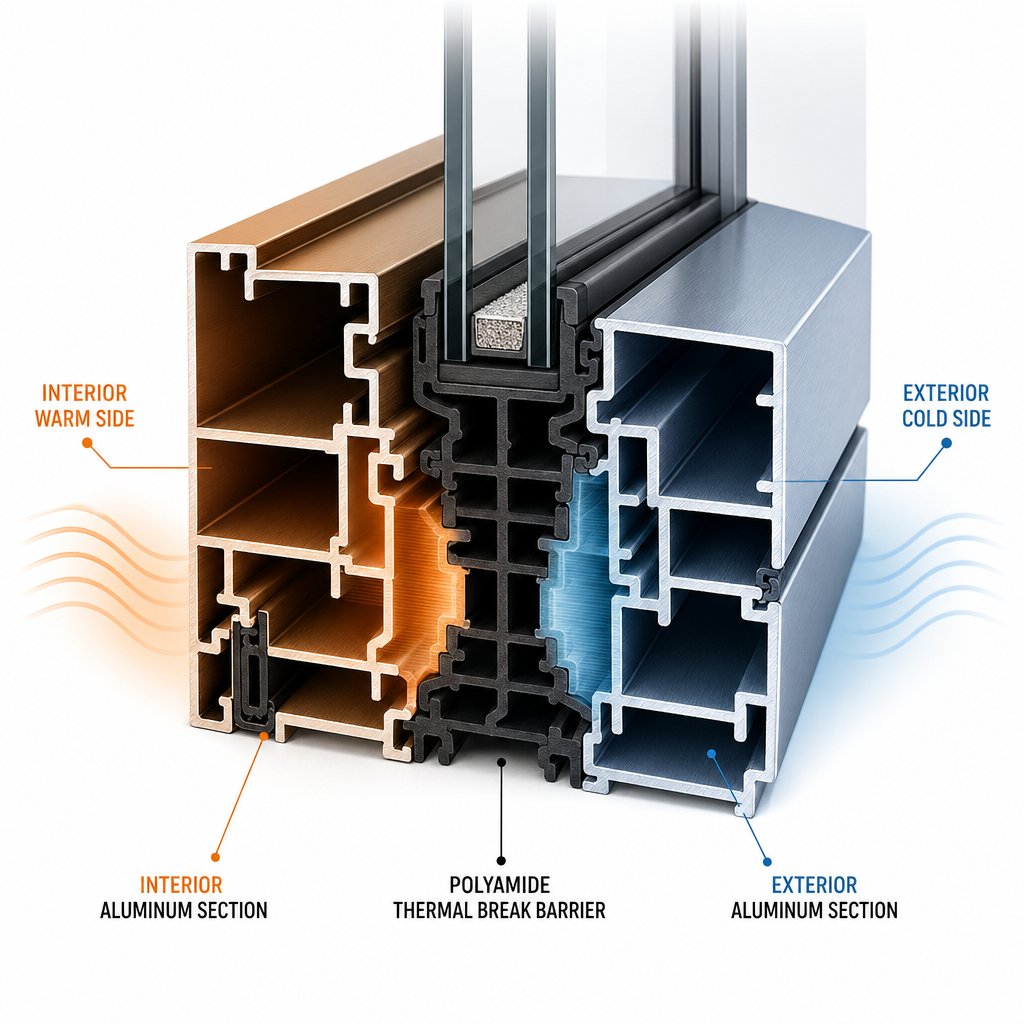
Modern thermal break technology changed the equation entirely. A thermal break is a strip of non-conductive material — typically reinforced polyamide — engineered into the frame between the interior and exterior aluminum sections. This barrier interrupts the conduction path, dramatically reducing heat transfer through the frame itself. The U.S. Department of Energy specifically notes that metal frames should incorporate a thermal break to reduce heat flow, and today’s quality aluminum awning windows do exactly that.
The result? A thermally broken aluminum awning for windows can achieve U-factor ratings competitive with vinyl and fiberglass — while keeping the slim profiles and structural strength that make aluminum attractive in the first place. Condensation resistance improves significantly too, because the interior face of the frame stays closer to room temperature instead of matching the cold outside surface.
Climate and Regional Suitability
So where do aluminum awning windows perform best — and where should you pay extra attention to specifications?
Coastal environments are aluminum’s home turf. Salt air corrodes steel and degrades wooden window awnings within years, but aluminum’s natural oxide layer and powder-coat finishes resist that corrosion cycle. Humid subtropical climates offer a similar advantage — the material won’t swell, rot, or harbor mold the way organic frames can.
In mixed climates with moderate winters and warm summers, thermally broken aluminum handles both heating and cooling seasons well, especially when paired with double-glazed Low-E glass and argon gas fills. This combination keeps the overall window assembly efficient without the cost jump to triple glazing.
Cold climates with extreme temperature swings demand more scrutiny. Aluminum can absolutely work here, but the quality of the thermal break becomes critical. Look for frames with wide polyamide breaks rather than thin plastic strips, and verify the whole-unit U-factor on the NFRC label — not just the center-of-glass number, which always looks better. If you’re in IECC Climate Zones 5 through 8, targeting a U-factor of 0.30 or lower for the complete unit is a reasonable benchmark.
The NFRC label is the only standardized, independently verified way to compare energy performance across different window products and frame materials.
Energy ratings tell you how a window performs in theory. What determines how it performs in practice is how — and how well — it gets installed, along with whether it meets the building codes your project requires.
Installation Considerations and Building Code Requirements
A high-performance aluminum awning window with perfect energy ratings can still fail if the installation is wrong or the unit doesn’t meet local code. This is the part of the buying process that separates a smooth project from an expensive callback — and it’s the part most window guides skip entirely.
New Construction vs. Retrofit Installation
The installation method depends on one question: are your walls open or finished?
New construction installations use a nailing fin — a flange integrated into the window frame’s perimeter — that fastens directly to the wall studs before exterior cladding goes on. Waterproof flashing tape seals over the fin, and siding or stucco covers everything afterward. This creates the most reliable weather barrier because the window integrates into the wall’s drainage plane from the start.
Retrofit installations work differently. The old sashes come out, but the existing frame stays put. The new unit slides into the opening and anchors through the side jambs, leaving the exterior wall untouched. For homeowners keeping their current cladding, this is usually the right path — and it’s far less disruptive. Retrofit installs typically run $600 to $1,000 per window, while new construction installs on existing homes can exceed $2,000 per opening because of the exterior demolition and repair involved.
Aluminum’s rigidity suits both methods well. The frames hold their shape during installation without the flex that lighter vinyl units sometimes exhibit in larger openings. That said, replacement awning windows in aluminum are noticeably heavier than vinyl equivalents, so professional installation is generally the smarter call — especially for units wider than 36 inches. And regardless of method, proper flashing, shimming, and weatherproofing around the rough opening matter just as much as the window itself. A gap in the weather-resistive barrier behind your metal awnings for windows will cause water damage long before the frame ever shows wear.
Standard Awning Window Sizes and Custom Options
Most manufacturers offer stock awning windows in widths from roughly 24 to 48 inches and heights from 16 to 36 inches, though the exact range varies by brand and frame material. These standard sizes cover the majority of residential needs: bathroom vents, kitchen pass-throughs, and basement openings.
Custom sizing enters the picture when you’re dealing with non-standard rough openings, heritage renovations where original proportions need to match, or commercial projects with specific architectural demands. When measuring for a replacement, take readings at three points — top, middle, and bottom for width, and left, center, and right for height — then use the smallest dimension. Aluminum frames have tighter manufacturing tolerances than vinyl, so accurate measurements prevent costly reorders. If you’ve been searching for a metal window awning to fit an unusual opening, custom fabrication is almost always available, but expect lead times of four to eight weeks depending on the supplier.
Building Codes and Compliance Essentials
Building codes aren’t optional, and they vary more than most homeowners expect.
In North America, bedroom windows used as emergency exits must meet egress requirements — typically a minimum net clear opening of 5.7 square feet, with no dimension less than 20 inches wide or 24 inches high. Awnings for windows in the awning style can meet these thresholds, but the outward-swinging sash means you need to verify that the clear opening accounts for the sash angle, not just the frame dimensions. Many standard awning sizes fall short of egress, so don’t assume any unit qualifies as a bedroom escape route without checking.
Coastal and hurricane-prone zones add another layer. Wind load ratings — expressed as design pressure (DP) — determine whether a window can handle the forces your region demands. Impact resistance standards like Miami-Dade NOA or ASTM E1886/E1996 apply in high-velocity hurricane zones. AAMA certification serves as a quality benchmark across all regions, verifying structural performance, air leakage, and water resistance through standardized testing.
For Australian projects, the compliance framework is different but equally strict. All external windows — whether you see them listed as “awning” or the commonly searched “onning” style — must meet AS 2047, which mandates testing for deflection under wind load, air infiltration, water penetration resistance, and ultimate structural strength. The standard also incorporates AS 1288 for glass compliance. Manufacturers must provide test evidence that the product passes these performance thresholds for your specific site conditions, including wind exposure classification and building height. Skipping this verification isn’t just risky — in most Australian states, the installation won’t pass inspection.
Always request the manufacturer’s AS 2047 test report or AAMA certification before signing a purchase order — not after the windows arrive on site.
Installation and compliance protect your investment for decades. But there’s one more factor that shapes the real cost of that investment — and it’s the question most buyers ask first: what will this actually cost me?
Pricing Factors and What Aluminum Awning Windows Cost
You’ve seen the specs, the room recommendations, and the code requirements. The question that’s been hovering over all of it: how much will this actually run me? Pricing for aluminum awning windows varies widely, and the range is driven by more variables than most buyers expect.
What Drives Aluminum Awning Window Pricing
There’s no single price tag for an aluminum window awning — the final number depends on a stack of decisions you make during the specification process:
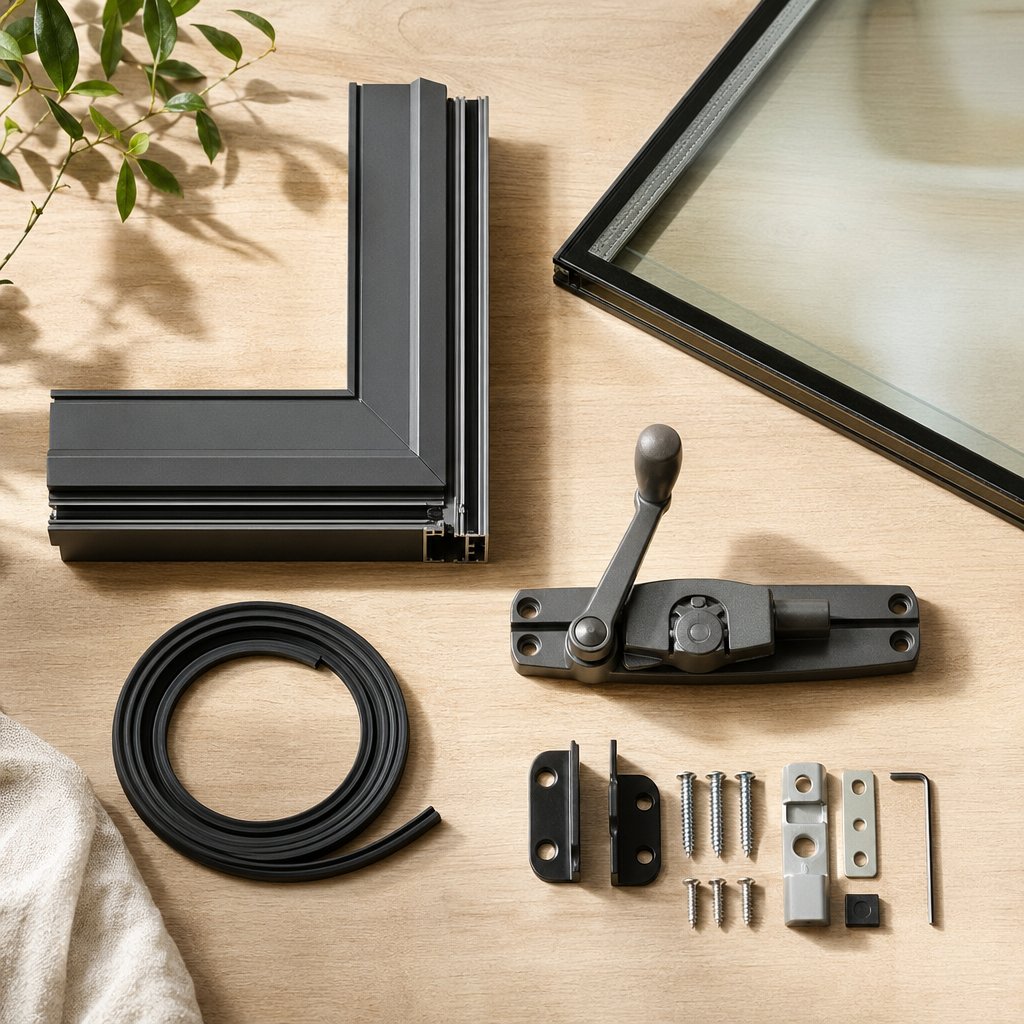
- Frame size and configuration: A 24-by-24-inch bathroom unit costs significantly less than a 48-inch-wide kitchen awning window. Mulled combinations (multiple units joined together) add complexity and cost.
- Glass type: Single glazing is cheapest but rarely appropriate. Double-pane with Low-E coatings is the current standard; triple glazing pushes the price higher but delivers superior insulation.
- Thermal break presence and quality: A thermally broken frame costs more than a non-broken one — but skipping it to save money undermines the entire point of choosing quality home awning windows.
- Hardware and operator style: Chain winders, crank handles, and motorized operators each sit at different price points.
- Standard vs. custom sizing: Stock sizes ship faster and cost less. Custom dimensions for heritage renovations or unusual openings carry a premium.
- Finish and powder-coat color: Standard colors (white, black, grey) are typically included. Custom RAL colors or textured finishes add to the per-unit cost.
- Quantity: Project-scale orders for new builds or full-house replacements often unlock volume pricing that single-unit purchases don’t.
For a general benchmark, Modernize reports that awning window replacements average $477 to $1,107 per window installed in 2026, with materials accounting for roughly $359 to $766 and labor adding $70 to $150. Aluminum frames specifically fall in the $250 to $450 range for materials alone on a standard-sized unit — before glazing upgrades, thermal breaks, or custom finishes.
Aluminum vs. Vinyl and Wood on Cost
Rather than chasing exact dollar figures that shift by region and supplier, think in cost tiers. Aluminum sits in the middle of the pack — above vinyl, roughly level with composite, and below premium wood and fiberglass. The trade-off? Aluminum’s minimal maintenance demands mean you’re not repainting every five to seven years or replacing warped frames at year fifteen. Over a 30-year window life, that lifetime cost picture often favors aluminum even when the upfront number is higher.
| Frame Material | Upfront Cost Tier | Maintenance Cost Over Time | Typical Lifetime Cost |
|---|---|---|---|
| Vinyl | Budget to mid-range | Very low | Low to moderate |
| Aluminum (thermally broken) | Mid-range | Very low | Moderate |
| Composite | Mid-range to premium | Low | Moderate to high |
| Wood | Premium | High (paint, seal, repair) | High |
| Fiberglass | Premium | Very low | High |
Notice that the cheapest upfront option isn’t always the cheapest long-term option. That’s the nuance most awing window pricing guides miss entirely.
Getting Accurate Quotes
When you’re ready to move from research to real numbers, how you request quotes matters as much as who you request them from. A few ground rules will save you from surprises:
First, get at least three itemized quotes. A lump-sum number tells you nothing — you need to see materials, labor, hardware, screens, glazing specs, and disposal fees broken out separately. Window World’s quoting guide reinforces this: if a contractor can’t provide a detailed breakdown, that’s a signal to move on.
Second, verify what’s included. Does the quote cover weatherproofing and flashing? Are screens standard or an add-on? Is the thermal break specified, or is the quote based on a non-broken frame that looks cheaper on paper but performs worse in practice? The cheapest quote often omits these details — and those omissions show up as comfort problems and energy losses after installation.
Third, confirm whether installation is bundled or billed separately. Some suppliers quote window awnings for house projects as supply-only, leaving you to source and pay an installer independently. Others bundle everything. Neither approach is wrong, but comparing a supply-only quote against an all-inclusive one is like comparing apples to engine blocks.
Compare specifications first, prices second. Two quotes at the same dollar amount can represent wildly different products.
Cost tells you what you’ll spend today. What determines whether that spend was actually worth it — five, ten, twenty years from now — comes down to how the material ages and what it asks of you along the way.
Sustainability and Long-Term Maintenance of Aluminum Frames
Spending less over time only matters if the product actually lasts — and if the environmental footprint behind it holds up to scrutiny. Aluminum has a compelling story on both fronts, but it’s worth separating the verified facts from the marketing spin.
Aluminum’s Recyclability and Environmental Edge
Here’s a number that puts things in perspective: recycling aluminum uses roughly five percent of the energy required to produce primary aluminum from raw bauxite ore. And unlike vinyl or composite materials, aluminum can be recycled infinitely without any loss in structural quality. The frame from a 40-year-old awning window replacement can be melted down and reformed into a brand-new profile with identical strength and performance characteristics.
That circular lifecycle makes aluminum a strong fit for green building projects targeting LEED, BREEAM, or similar certifications. Both systems reward materials with high recycled content, low lifecycle emissions, and documented Environmental Product Declarations (EPDs). If sustainability factors into your project scoring — or simply into your personal values — aluminum frames carry real, verifiable weight.
One caveat: not all aluminum windows contain the same percentage of recycled material. Ask your manufacturer for specific recycled content data and supporting EPD documentation before assuming every product delivers the same environmental benefit.
Maintenance and Longevity Expectations
When people calculate awning windows cost, they almost always focus on the purchase price and forget about what happens in year five, ten, or twenty. This is where aluminum quietly wins.
Powder-coated aluminum frames resist UV degradation, fading, chalking, and peeling for decades. Compare that to wood frames, which need repainting or resealing every three to seven years — a recurring expense that adds up fast. The modern awning mechanism itself is mechanically simple: fewer moving parts than a double-hung or sliding window means fewer components that wear out over time. Whether you’re maintaining residential units or rv awning windows on a mobile setup, the routine stays the same.
A practical seasonal checklist keeps everything running smoothly with minimal effort:
- Spring: Clean frames and glass with mild soap and water. Inspect weatherstripping for cracks or gaps that developed over winter.
- Summer: Check drainage holes at the base of the frame for debris blockages. Test that the sash opens and closes without resistance.
- Autumn: Lubricate hinges, cranks, and pivot points with a silicone-based lubricant. Clean tracks with a soft brush to remove dirt buildup before winter.
- Winter: Inspect seals after heavy storms. Run your hand along the closed sash edges to detect drafts — if you feel air movement, the weatherstripping likely needs replacement.
That’s it. No sanding, no priming, no sealer coats. The total annual time investment is measured in minutes, not weekends — and the frame keeps performing at the same level it did the day it was installed.
Knowing that the material lasts and the maintenance is minimal brings you to the final step: turning all of this research into a confident purchasing decision that matches your specific project.

How to Choose the Right Aluminum Awning Windows
You’ve got the knowledge — frame materials, energy ratings, room pairings, installation methods, pricing variables, and maintenance expectations. The challenge now is pulling it all together into a decision that fits your specific project instead of a generic one. Here’s how to do that without second-guessing yourself.
Matching Window Specifications to Your Project
Think of this as your pre-purchase checklist. Before you browse awning windows for sale or request a single quote, confirm these specification checkpoints:
- Thermal break presence: If the aluminum frame doesn’t include a polyamide thermal break, walk away — regardless of how attractive the price looks. This single feature determines whether your awning style windows perform like a modern product or a relic from the 1980s.
- Energy ratings for your climate zone: Verify the whole-unit U-factor and SHGC on the NFRC label (for North American projects) or equivalent test data for your region. A bathroom awning window in a coastal Queensland home has very different performance needs than one in a Chicago basement.
- Building code compliance: Australian projects require AS 2047 certification for structural and weather performance. North American projects should look for AAMA certification. If your window sits in a bedroom, confirm it meets egress requirements before ordering.
- Glazing matched to orientation: South-facing windows (in the Northern Hemisphere) or north-facing windows (in Australia) receive the most direct sun. Choose a lower SHGC for those exposures to manage heat gain, and consider higher SHGC on the opposite side to capture free warmth in cooler months.
- Hardware and operator type: Chain winders, crank handles, and motorized options each suit different mounting heights and accessibility needs. A sun shade aluminum awning window mounted high in a stairwell, for example, benefits from a motorized operator you can control from below.
Where to Find Quality Aluminum Awning Windows
Specifications only matter if the supplier behind them is credible. Rather than searching randomly for aluminum window awnings and hoping for the best, follow a structured sourcing process:
- Start with standards-compliant suppliers: For Australian homeowners, renovators, builders, and developers, MEICHEN’s aluminium windows collection is a practical starting point — their range includes multiple awning and aluminium window configurations engineered to meet Australian standards, making it a useful hub for comparing options across different project types.
- Define your project requirements in writing: List the number of windows, sizes, glazing preferences, finish colors, and any code-specific needs (wind load ratings, egress, impact resistance). A clear brief gets you accurate quotes instead of ballpark guesses.
- Shortlist suppliers who publish compliance certifications: If a manufacturer can’t show you AS 2047 test reports, AAMA documentation, or NFRC labels on request, they shouldn’t be on your list. Reputable suppliers like those offering louvered window awnings and awning configurations make this documentation readily available.
- Request detailed, itemized quotes: Every quote should break out frame material, glazing, hardware, screens, finish, and installation as separate line items. Lump-sum pricing hides trade-offs you need to see.
- Compare on value, not price alone: The lowest quote often reflects thinner profiles, missing thermal breaks, or inferior hardware. Line up the specifications side by side before comparing the bottom line.
Even with a strong supplier like MEICHEN on your shortlist, always cross-check certifications and specifications against your specific site conditions, climate zone, and local code requirements. No single brand suits every project, and doing your own verification is the final layer of protection between research and a result you’ll live with for decades.
Aluminum awning windows reward buyers who take the time to match the right specs to the right rooms in the right climate. Skip the shortcuts, verify the ratings, and let the material do what it does best — deliver slim sightlines, lasting durability, and low-maintenance performance for the long haul.
Frequently Asked Questions About Aluminum Awning Windows
1. What is the difference between awning windows and casement windows?
Awning windows are hinged at the top and swing outward from the bottom, creating a canopy effect that deflects rain while allowing airflow. Casement windows are hinged on the side and swing outward laterally. The key practical difference is placement: awning windows suit short, wide openings like those above kitchen counters or high on bathroom walls, while casement windows work best in tall, narrow openings. Both seal tightly when closed, making them among the most energy-efficient operable window styles available.
2. Are aluminum awning windows energy efficient?
Modern aluminum awning windows with thermally broken frames are significantly more energy efficient than their older counterparts. The thermal break — a non-conductive polyamide barrier engineered into the frame — interrupts heat transfer and brings aluminum’s insulation performance close to vinyl and fiberglass. When paired with double-glazed Low-E glass and argon gas fills, thermally broken aluminum awning windows can meet ENERGY STAR criteria in most climate zones. Always check the whole-unit U-factor on the NFRC label rather than relying on center-of-glass ratings alone.
3. How much do aluminum awning windows cost?
Aluminum awning window pricing depends on frame size, glazing type, thermal break quality, hardware, finish, and whether you choose standard or custom sizing. Material costs for a standard-sized aluminum unit generally fall in the mid-range tier — above vinyl but below premium wood and fiberglass. While the upfront investment is higher than vinyl, aluminum’s minimal maintenance requirements and longer structural lifespan often result in lower total cost of ownership over a 30-year window life. Request itemized quotes from multiple suppliers and compare specifications, not just headline prices.
4. What rooms are best for awning windows?
Bathrooms and laundries are the top candidates because the awning mechanism lets steam escape even during rain, and aluminum resists humidity-driven corrosion. Kitchens benefit from awning windows installed above countertops, where they provide ventilation without swinging into the workspace. Basements gain natural light through the slim aluminum frames mounted near ceiling height. In living areas, large awning windows stacked above fixed picture glass combine expansive views with controllable airflow. Commercial and institutional spaces also rely heavily on aluminum awning windows for their structural strength and security.
5. How do you maintain aluminum awning windows?
Aluminum awning windows require very little upkeep compared to wood or composite alternatives. A seasonal routine covers most needs: clean frames and glass with mild soap and water in spring, check drainage holes for debris in summer, lubricate hinges and pivot points with silicone-based lubricant in autumn, and inspect weatherstripping seals after heavy winter storms. Powder-coated aluminum finishes resist fading, chalking, and peeling for decades without repainting. The awning mechanism’s mechanical simplicity — fewer moving parts than double-hung or sliding windows — also means less hardware wear over time.
More Window & Door Guides