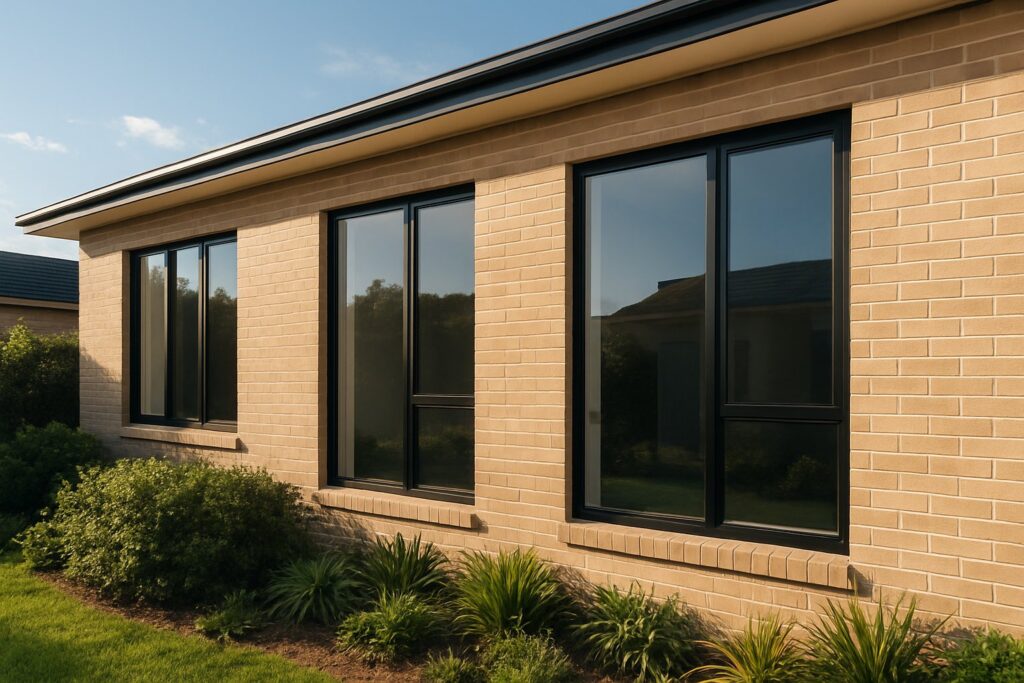
What Rounded Windows Are and Why the Names Vary So Much
Ever searched for a round window online and ended up more confused than when you started? You’re not alone. The terminology around these products is surprisingly inconsistent, and it trips up homeowners, builders, and even contractors every day.
A rounded window is any window featuring a fully or partially curved frame. The category includes full circles, half-round windows, quarter-round windows, oculuses, portholes, eyebrow arches, gothic arches, ellipticals, and lunettes.
That’s a broad family of shapes, and they all share one thing in common: at least part of the frame bends away from the straight lines that dominate most homes. Round windows have deep architectural roots stretching back centuries. Think of the Roman oculus crowning the Pantheon, the intricate rose windows of Gothic cathedrals, or the compact portholes on sailing vessels. These shapes endure because they do something rectangular frames simply can’t — they break visual monotony, draw the eye upward, and scatter natural light in soft, diffused patterns across a room.
What Exactly Is a Rounded Window
At its simplest, a round window is any unit where the frame follows a curve rather than a straight edge. A full circle is the most obvious example, but a half round window — that classic semicircle you’ll see perched above a front door — is far more common in residential construction. Quarter round windows tuck into corners as accent pieces. Eyebrow arches introduce just a subtle curve along the top edge. Gothic arches rise to a dramatic point. Ellipticals stretch wider and flatter than a true semicircle. Each shape creates a different visual effect, and each comes with its own set of practical considerations around cost, operability, and installation complexity.
Why Every Manufacturer Uses a Different Name
Here’s where shopping gets frustrating. Pella labels these products “circle” and “round” windows, while Andersen groups them under “circle and arched.” Other manufacturers use “radius” or simply “arched” to describe overlapping product lines. If you’re researching a window replacement round rock contractors have quoted, or comparing specs across suppliers, this naming inconsistency can slow you down. The table below maps the most common brand terminology to actual geometric shapes so you can decode any product listing.
| Brand Term | Actual Geometric Shape(s) | Typical Configuration |
|---|---|---|
| Circle / Round | Full circle, oval | Fixed accent window |
| Arched / Arch-top | Semicircle top on rectangular base (Springline) | Fixed or combo unit |
| Radius | Any curved-frame shape | Varies by radius specified |
| Half circle / Full chord | Semicircle (half round window) | Transom above doors or windows |
| Quarter circle | Quarter-round arc with one right angle | Fixed corner accent |
| Elliptical | Flattened half-oval | Transom above wide openings |
| Specialty shape | Gothic arch, eyebrow, lunette, oculus | Mostly custom, fixed |
With a shared vocabulary in place, the real question becomes which of these shapes actually fits your project — because the differences go far beyond aesthetics.
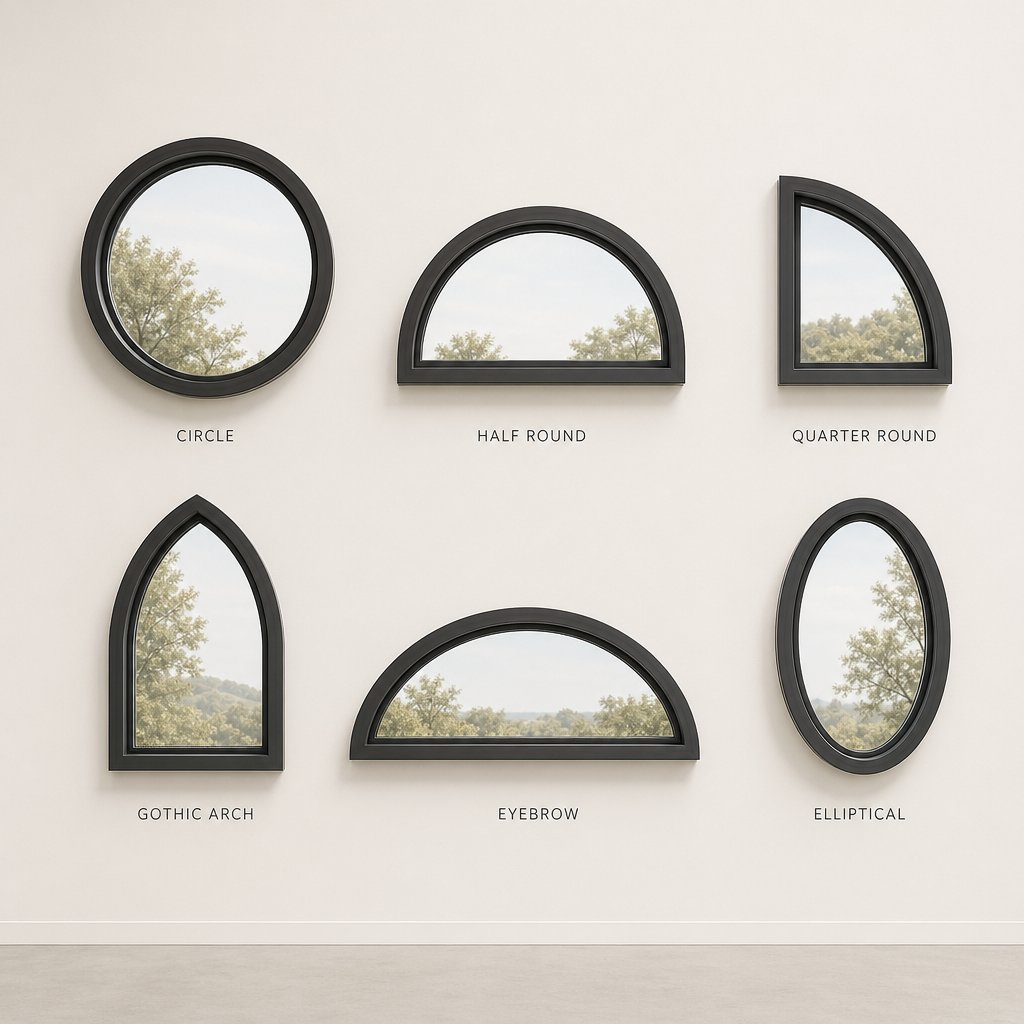
Every Type of Rounded Window Shape Explained
Knowing the vocabulary is one thing. Understanding how each shape actually looks, where it belongs, and what it costs is another. The variety within the curved window family is wider than most people expect, and each shape carries its own personality, price tag, and set of practical trade-offs.
The table below puts every major type side by side so you can compare at a glance.
| Shape Name | Description | Typical Placement | Operable Versions | Cost Tier | Best Style Match |
|---|---|---|---|---|---|
| Full Circle | True round, symmetrical on all axes | Gable ends, stairwells, above entry doors | Rare (pivot) | $$ | Colonial, Modern, Craftsman |
| Oculus | Large open circle, often unglazed historically | Gable peaks, decorative facades | No | $$$ | Classical, Mediterranean |
| Porthole | Small circle, sometimes hinged | Bathrooms, closets, nautical-themed spaces | Yes (hinged) | $$ | Coastal, Nautical, Contemporary |
| Half Round | Semicircle, flat edge at the bottom | Transoms above doors and windows | Rare (casement) | $ | Victorian, Colonial, Traditional |
| Quarter Round | Quarter-pie arc with one right angle | Flanking rectangular windows as corner accents | No | $ | Traditional, Craftsman |
| Arch-Top (Springline) | Rectangular base with semicircular top | Living rooms, dining rooms, facades | Yes (lower section) | $$ | Mediterranean, Tuscan, Traditional |
| Eyebrow | Shallow, subtle curve along the top edge | Above standard windows, dormers | No | $$ | Craftsman, Cottage, Transitional |
| Gothic Arch | Pointed arch rising to a peak | Churches, historic restorations, statement facades | No | $$$ | Gothic Revival, Tudor |
| Elliptical | Wider and flatter than a semicircle | Transoms above wide door or window combos | No | $$ | Federal, Georgian, Traditional |
| Rose / Round Stained Glass | Full circle with decorative glazing | Focal walls, entryways, stairwells | No | $$$ | Gothic, Victorian, Eclectic |
Full Circle and Oculus Windows
A full circle window is exactly what it sounds like — a perfectly round pane framed in a continuous curve. You’ll spot them most often in gable ends, above entry doors, and lighting stairwells where they serve as standalone accent features. Pella notes that circular windows work equally well in traditional interiors and modern, contemporary homes, adding architectural value both inside and out. Common diameters range from 24 inches for a subtle accent up to 48 inches or more for a dramatic statement.
How do they differ from portholes? Size and function. Portholes are smaller — typically under 20 inches — and often feature a hinged mechanism that allows them to open, a design borrowed directly from maritime architecture. An oculus, on the other hand, tends to be larger and is almost always fixed. Historically, oculuses were open-air openings in classical buildings, though residential versions today are fully glazed. If you’ve ever seen the round windows nyt crossword clues reference, they’re usually pointing to this classic shape.
Half Round and Quarter Round Windows
The half round window is the most popular curved shape in residential construction, and for good reason. Its flat bottom edge sits naturally above a rectangular window or door, making it the go-to transom choice. Imagine a semicircle resting on top of your front door frame — that’s the look. Typical widths match standard door and window sizes (30 to 72 inches), and they flood upper wall space with soft, arcing light.
Quarter round windows take that semicircle and split it in half again, creating a pie-wedge shape with one right-angle corner. They’re almost always used in pairs, flanking a rectangular window to form a unified arch composition. Because of their compact size, quarter round windows are exclusively fixed — no operable versions exist on the market. Both shapes are among the most affordable curved options and are widely stocked, which keeps lead times short. Finishing them with round window moulding that matches your existing trim ties the look together seamlessly.
Arched, Eyebrow and Gothic Shapes
This is where the design range really opens up. A standard arch-top window — sometimes called a full springline — combines a rectangular lower section with a curved top. The lower portion can operate as a casement or double-hung while the arched section stays fixed, giving you both ventilation and visual drama in one unit. Arched window replacements average $345 to $950 per unit depending on material and size, making them a mid-range investment.
Eyebrow windows are subtler. The curve is shallow and gentle — just enough to soften a roofline or add a quiet flourish above a standard frame. They’re popular in Craftsman and cottage-style homes where bold curves would feel out of place.
Gothic arches go in the opposite direction. The pointed peak creates a tall, dramatic silhouette rooted in medieval church architecture. These are almost always custom-fabricated and sit at the top of the cost spectrum. Round stained glass windows — the rose windows you’d recognize from cathedrals — fall into the full-circle category but carry distinct glazing considerations. The decorative leadwork and colored glass panels require specialized fabrication and careful structural support, pushing costs and lead times well beyond standard curved units.
- Widely available as stock or semi-custom: half round, quarter round, full circle (standard diameters), arch-top in common widths
- Typically custom-order only: gothic arches, ellipticals in non-standard sizes, oculuses over 48 inches, rose/stained glass, eyebrow shapes
Each of these shapes brings something different to a facade or interior, but the real decision often comes down to a more practical question: how do they actually stack up against the rectangular windows they’ll sit alongside?
Rounded Windows vs Standard Rectangular Windows
It’s a fair question, and one that rarely gets an honest answer. Most window guides either champion curved shapes as must-have upgrades or ignore them entirely. The reality sits somewhere in between — and the best way to see it clearly is to put both options side by side.
| Factor | Rounded Windows | Standard Rectangular Windows |
|---|---|---|
| Upfront Cost | $400–$2,000+ per unit; custom shapes push higher | $300–$2,500 depending on type and operability |
| Energy Efficiency | Good with Low-E glass; curved seals can be slightly less airtight | Excellent; compression seals on casements and double-hungs are proven performers |
| Ventilation Options | Limited — most shapes are fixed; some arch-top combos offer partial opening | Wide range of operable styles (casement, double-hung, slider, awning) |
| Egress Compliance | Rarely meets code minimums for bedrooms or basements | Casement and double-hung styles routinely meet the 5.7 sq. ft. net clear opening requirement |
| Maintenance | Curved seals and round window molding can be harder to source and replace | Standardized parts; widely available replacement hardware and weatherstripping |
| Resale Value Impact | Strong curb appeal boost as accent features | Expected baseline — adds value through quantity and condition, not novelty |
| Design Versatility | High visual impact; best as focal points and accent pieces | Fits any room, any style, any function without special planning |
Where Rounded Windows Win
Curved shapes do things straight lines simply can’t. A half-round transom above a front door creates a sense of grandeur that no rectangular window matches. A full circle in a gable end turns a blank wall into a focal point visible from the street. Arched designs catch and reflect natural light uniquely due to their curved geometry, brightening interiors with soft, diffused patterns rather than the hard-edged shafts rectangular panes produce.
That aesthetic punch translates into real curb appeal. Heritage homes, in particular, benefit from the architectural character these shapes bring — they complement original details and give a facade a distinctive personality that stands out on any street. For homeowners looking to increase perceived home value without a full renovation, even a single well-placed window round accent can shift the entire feel of a room or exterior wall.
Where Rectangular Windows Have the Edge
Practicality favors straight lines. Rectangular windows cost less, ship faster, and come in dozens of operable configurations. Need ventilation in a bedroom? A casement or double-hung handles it easily. Need to meet egress code requirements — that 5.7 square foot minimum net clear opening for sleeping areas — a standard casement window is purpose-built for it. Most curved shapes can’t come close to that threshold.
Then there’s the everyday stuff. Finding round window blinds or shades that actually fit a curved frame is a well-known headache. Rectangular windows accept off-the-shelf curtains, blinds, and roller shades without any custom work. Replacement parts, weatherstripping, and trim are stocked at every hardware store. When something breaks on a rectangular unit, you fix it the same afternoon. When a curved seal fails or round window molding cracks, you’re often looking at a custom order and a longer wait.
Transparency matters here: curved shapes cost more per unit, are harder to cover for privacy, and should never be the sole window in a room that requires emergency egress. That doesn’t make them a bad choice — it makes them a specific one.
Rounded windows work best as intentional design accents alongside standard rectangular windows, not as whole-house replacements. Pair them strategically, and you get the visual impact without sacrificing ventilation, code compliance, or your budget.
The comparison makes one thing clear — material choice matters even more when a frame has to bend. Curved seals sit under greater stress, joints are more complex, and not every material handles a radius equally well.
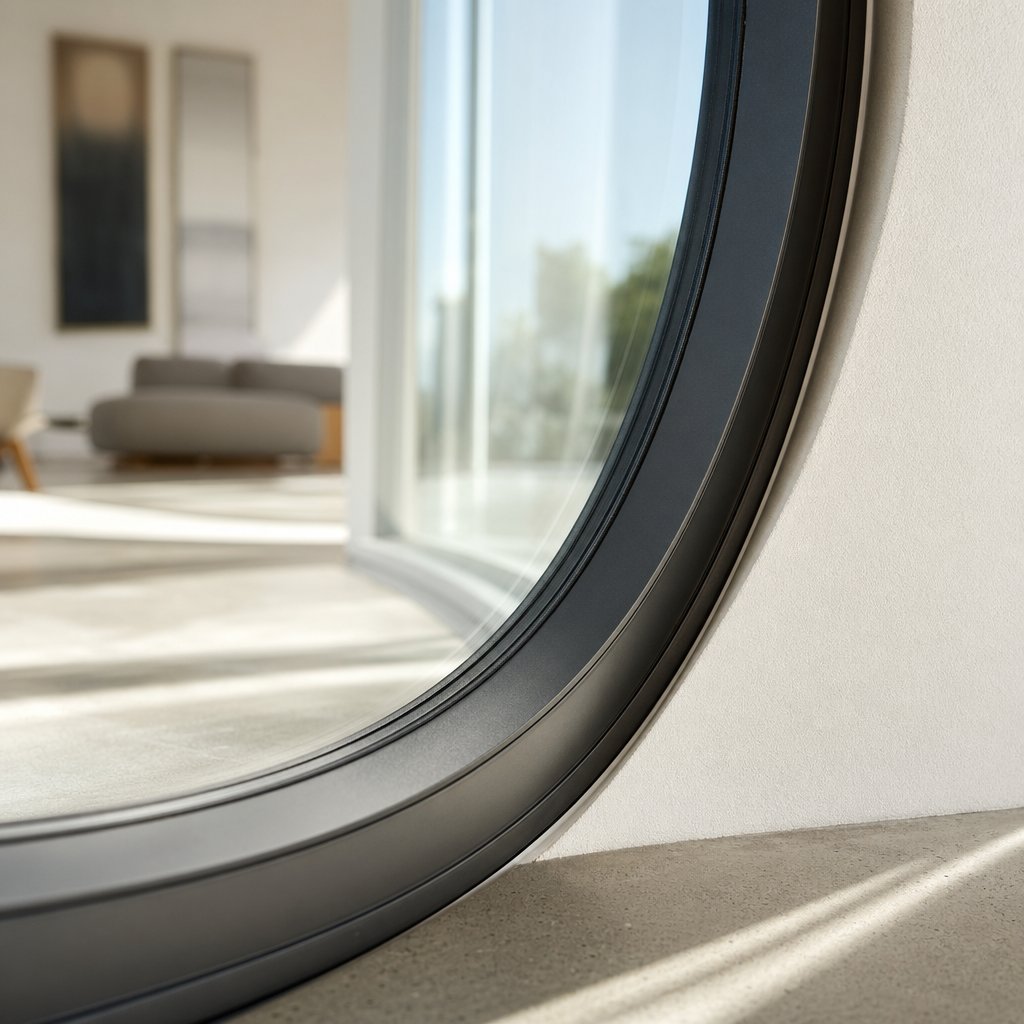
How Frame Materials Perform in Curved Window Designs
Bending a straight piece of material into a smooth, consistent arc is a fundamentally different manufacturing challenge than cutting it to length and joining it at right angles. Every frame material responds to that challenge differently, and the one you choose for a round window frame will affect everything from long-term durability to how much you spend on maintenance years down the road.
How Wood, Vinyl, Fiberglass and Aluminium Handle Curves
Each material brings strengths to rectangular windows that don’t always translate when the frame has to follow a radius. Here’s how they stack up in curved applications.
-
Wood — Traditionally shaped through steam-bending or lamination, wood produces beautiful curved frames with a warm, classic look. The trade-off? Curved wood joints are more exposed to moisture infiltration than straight ones, and the grain can split along the bend if not handled carefully. Ongoing sealing and repainting are non-negotiable, especially on exterior-facing surfaces. In humid or coastal climates, expect more frequent upkeep than you’d need on a standard rectangular wood window.
-
Vinyl — Extruded vinyl profiles can accommodate gentle curves at a lower price point. The material is low-maintenance and resists moisture well. The limitation shows up in tighter radii and extreme heat. Vinyl softens at high temperatures, and a curved frame under direct sun can warp or distort over time — a real concern in warmer regions. It also lacks the structural rigidity to support very large curved openings without internal reinforcement.
-
Fiberglass — Strong, dimensionally stable, and resistant to expansion and contraction, fiberglass handles moderate curves without the warping risk of vinyl. It paints well and holds its shape across temperature swings. The catch is fabrication flexibility. Tight-radius shapes like small portholes or steep gothic arches push fiberglass to its limits, and fewer manufacturers offer it in the full range of curved profiles.
-
Aluminium — This is where curved fabrication really opens up. Aluminium can be precision-bent into tight radii without cracking, losing strength, or compromising its profile geometry. It resists corrosion, supports slim sightlines that maximize glass area, and takes powder-coat finishes in virtually any color. For complex shapes — full circles, gothic arches, ellipticals — aluminium gives fabricators the most design freedom of any frame material.
Why Frame Material Matters More in Rounded Windows
In a rectangular frame, weatherstripping and seals sit in straight channels under even compression. Curves change that equation. Seals along an arc are under variable stress — tighter at some points, looser at others — which means any material weakness gets amplified over time. A seal that performs fine on a straight run might gap or degrade faster when it follows a bend.
That’s why material durability and thermal performance carry extra weight in curved designs. Aluminium frames equipped with polyamide thermal breaks address both concerns at once: the non-conductive barrier between inner and outer profiles reduces heat transfer, while the aluminium itself holds its shape and seal integrity across the full curve. This combination is especially relevant in Australian climates, where frames face intense UV exposure, temperature swings, and — in coastal areas — salt air corrosion.
For homeowners, renovators, builders, and developers exploring aluminium options that meet Australian standards, MEICHEN’s aluminium windows collection offers a practical starting point. Their range covers energy-efficient systems suited to various project types, including those requiring curved or specialty shapes — worth reviewing when you’re comparing material performance across suppliers.
It’s also worth noting that round window trim molding needs to match the frame material’s behavior. Wood trim around an aluminium curve, for example, can expand and contract at a different rate, opening gaps over time. Coordinating frame and trim materials avoids that mismatch.
One more practical angle people overlook: frame material also influences your options for window coverings for round windows. Thinner aluminium profiles leave more glass exposed, which looks stunning but means you’ll need to plan privacy solutions — custom cellular shades, shutters, or frosted glass — earlier in the process rather than as an afterthought.
With the material question sorted, the next decision is where these curved shapes actually belong in your home — because placement changes everything about which shape, size, and configuration makes sense.
Room-by-Room Placement Guide for Rounded Windows
Picking the right shape and material is only half the equation. Where you place a curved window determines whether it becomes a stunning focal point or an awkward addition that fights the room around it. Each space in your home presents different lighting conditions, privacy needs, and structural realities — and the best shape for a gable end is rarely the best shape for a bathroom.
Gable Ends, Stairwells and Entry Doors
If there’s one placement that feels almost universally right, it’s a round or half-round window centered in a gable end. That triangular wall space at the peak of a roofline is tailor-made for curves. A full circle fits comfortably where a rectangular frame would look cramped, and because gable ends face the street, the curb appeal payoff is immediate. As Houzz notes, a peaked roofline inhibits square or rectangular openings, but a circle sits naturally within that triangular shape — flooding the upper floor with light while adding symmetry to the facade. These windows can also ventilate attic spaces when fitted with an operable mechanism, though most homeowners opt for fixed units here.
Above entry doors, a window round top transom — that classic half-round semicircle — creates a grand first impression without requiring a massive structural opening. It lets light pour into foyers and hallways while keeping the door frame proportional. Two-story foyers are especially popular spots for arched or fan-shaped transoms, where the extra height gives the curve room to breathe.
Stairwells are another natural fit. You rarely place furniture against a stairwell wall, so there’s no competition for space. A tall arched window or a full circle at a landing level brings in daylight exactly where homes tend to be darkest, and because stairwells are transitional spaces, privacy is seldom a concern — meaning you can leave the glass uncovered and let the shape speak for itself.
Front doors with round window inserts offer a subtler way to introduce the shape. A small porthole or circular lite set into a solid door panel adds character without the commitment of cutting a new opening in your wall. It’s a low-cost, low-risk entry point — pun intended — for homeowners who want to test the aesthetic before going bigger.
Bathrooms, Kitchens and Living Spaces
Bathrooms and curved windows are a surprisingly good match. A small round or porthole window placed high on a wall delivers natural light while sitting above the sightline of anyone outside. That built-in privacy means you can skip the blinds entirely — a real advantage given how tricky it is to find coverings for non-rectangular shapes. Houzz highlights that a round window in a bathroom can even become the room’s central design feature, especially when paired with a freestanding tub positioned to frame the view.
In kitchens, think accent rather than primary window. A small circle or half-round above the sink, in a breakfast nook wall, or tucked into a backsplash area adds personality without displacing the larger operable windows you need for ventilation and task lighting. The key is proportion — a 24-inch circle in a compact kitchen feels intentional, while a 48-inch one might overwhelm the space.
Living rooms and master bedrooms are where large arched windows really shine as statement pieces. A tall arch-top unit on a feature wall draws the eye upward and makes ceilings feel higher. Just keep one critical detail in mind: most building codes require bedroom windows to meet minimum egress dimensions — typically 5.7 square feet of net clear opening in the US, or equivalent standards under Australia’s NCC. Most curved shapes can’t meet that threshold on their own, so they should supplement a code-compliant operable window rather than replace one.
Whether you’re considering window tint round rock professionals recommend for sun control or simply choosing frosted glass at the factory, planning for light management early saves headaches later — especially in south- or west-facing living spaces where heat gain through large curved panes can be significant.
Renovation vs. New Construction
Here’s a practical reality that changes the math. Adding a curved window to an existing wall is a bigger project than most people anticipate. Framing a new window opening in a load-bearing wall requires header modification, temporary ceiling support, king studs, jack studs, and careful coordination with any electrical wiring in the cavity. A curved opening adds another layer of complexity — the rough framing needs to follow the arc precisely, with less tolerance for error than a rectangular cutout.
New builds, by contrast, can spec rounded windows from the design stage with minimal added cost. The framing crew builds the curved rough opening into the wall from the start, and the header is sized and placed before any finishes go in. If you’re building from scratch, this is the time to be ambitious with shapes and sizes. If you’re renovating, budget for the structural work and always consult a structural engineer before cutting into an existing wall — especially for openings wider than 36 inches.
Use the quick-reference list below to match shapes to rooms based on what works best in practice:
- Gable ends — Full circle, half round, oculus
- Above entry doors — Half-round transom, elliptical, fan window
- Stairwells — Full circle, tall arch-top, gothic arch
- Front door inserts — Small porthole, circular lite
- Bathrooms — Porthole, small full circle (placed high for privacy)
- Kitchens — Small half round, quarter round accents
- Living rooms — Large arch-top, full circle statement piece
- Master bedrooms — Arched accent (paired with a code-compliant operable window)
- Attic conversions and lofts — Full circle, eyebrow curve
Placement answers the “where” question, but it raises another one that catches many homeowners off guard: can any of these shapes actually open? The answer is more nuanced than a simple yes or no — and it has real implications for ventilation, emergency egress, and building permits.
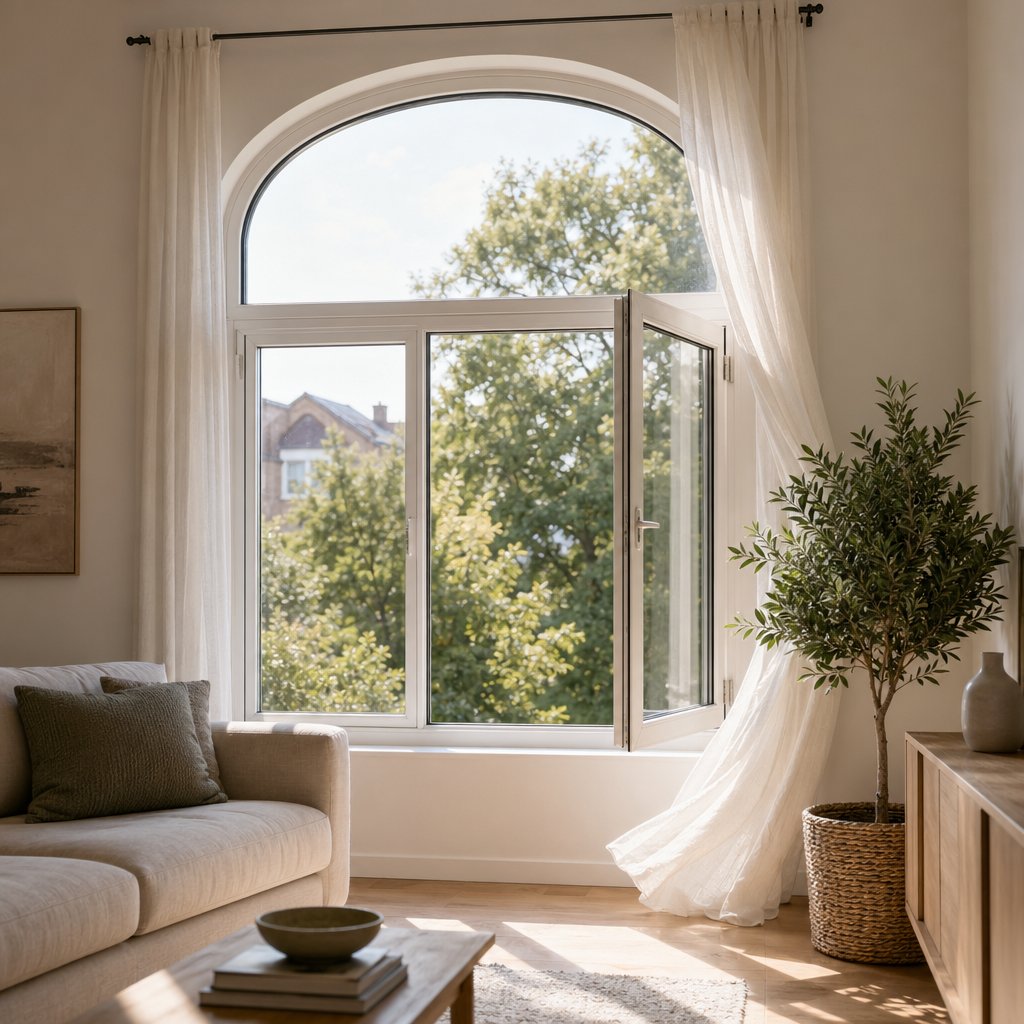
Operable vs Fixed Rounded Windows and What Code Allows
Most people assume every curved window is sealed shut. It’s an understandable assumption — the majority of rounded windows you’ll see on homes are fixed panes. But “most” isn’t “all,” and the distinction between operable and fixed has real consequences for airflow, emergency safety, and whether your project needs a permit.
Which Rounded Shapes Can Actually Open
The operability of a curved window depends almost entirely on its geometry. Some shapes lend themselves to hinges and hardware. Others don’t. Here’s how each one breaks down:
- Full circle — Rarely operable. A small number of manufacturers offer a center-pivot mechanism, but it’s uncommon and typically limited to smaller diameters. A 20×20 round window, for example, is almost always fixed.
- Porthole — Often operable. Borrowed from maritime design, portholes frequently feature a side hinge or top hinge that swings open for ventilation. This is one of the few curved shapes where operability is standard rather than exceptional.
- Half round — Occasionally operable. Some manufacturers produce half-round casement versions that hinge at one side, though availability is limited compared to fixed units.
- Arch-top (springline) — This is the most common operable configuration in the curved family. The unit is built as a combination: the rectangular lower section operates as a casement or double-hung, while the arched top stays fixed. You get ventilation from the bottom and visual drama from the top.
- Quarter round — Fixed only. The geometry doesn’t support any practical hinge placement.
- Eyebrow — Fixed only. The shallow curve serves a purely decorative function.
- Gothic arch — Fixed only. Custom fabrication and the pointed profile rule out operable hardware.
- Elliptical — Fixed only. Used exclusively as transoms and accent pieces.
The pattern is clear: the more complex or compact the curve, the less likely it is to open. If ventilation matters in a particular room, an arch-top combination unit or a porthole are your most realistic options within the curved family.
Ventilation, Egress and Building Code Realities
A fixed window provides zero airflow. That’s fine in a stairwell or gable end where other openings handle ventilation. It becomes a problem in rooms — especially bedrooms and basements — where building codes mandate both ventilation and emergency escape routes.
In the US, most jurisdictions follow the IRC requirement that bedroom windows provide a minimum 5.7 square feet of net clear opening, with a minimum width of 20 inches and a minimum height of 24 inches. The sill can’t sit higher than 44 inches above the floor. Most curved shapes — circles, half rounds, quarter rounds, eyebrows — simply can’t meet those dimensions. Even a generously sized arch-top combo unit may fall short if the operable lower section alone doesn’t hit the threshold.
Australian standards under the NCC carry equivalent intent, requiring safe egress paths from habitable rooms. The specifics vary by state and building class, but the principle holds: rounded windows in bedrooms should be supplementary, never the sole means of escape or ventilation.
Permits add another layer. PermitFlow’s permitting guide notes that you should generally expect to need a permit when changing a window’s size or shape, creating a new opening in an exterior wall, replacing a window in a bedroom that must meet egress requirements, or swapping a fixed window for an operable one. Changing a rectangular opening to a curved one in a load-bearing wall almost certainly triggers a structural review. Permit fees typically run $50 to $250 for basic window replacements, but structural modifications or egress-related changes can push costs higher and extend review timelines from a few days to several weeks.
The practical takeaway? Treat rounded windows as design accents that complement code-compliant operable windows — not as substitutes for them. Plan the permit conversation early, especially if you’re cutting a new curved opening or converting an existing rectangular one, and confirm egress compliance with your local building authority before locking in your order.
With operability and code requirements mapped out, the next question is cost — specifically, whether you’re looking at a stock product or a fully custom fabrication, because that distinction changes both your budget and your timeline significantly.
Custom Sizing vs Stock Rounded Windows and What to Expect
Here’s a misconception that costs people time and money before they even request a quote: the belief that every curved window requires a fully custom order. Some do. Many don’t. The difference between stock availability and custom fabrication can mean hundreds of dollars per unit and weeks — sometimes months — of lead time. Knowing which category your project falls into changes how you budget, plan, and schedule.
Stock Sizes and What Is Readily Available
Major manufacturers keep a surprising number of curved shapes in their standard or semi-custom catalogs. You won’t find every size and configuration on the shelf, but the most popular shapes in common dimensions ship on timelines comparable to rectangular windows.
Half-round and full-circle windows are the most widely stocked curved products. Common diameters include:
- 20×20 round window — a compact accent size popular for bathrooms, closets, and gable details
- 24-inch diameter — the entry-level size for full circles and half rounds used as transoms
- 36-inch diameter — a mid-range option that works well above entry doors and in stairwells
- 48-inch diameter — a statement size for gable ends and feature walls
Arch-top combination units in standard widths — 30, 36, and 48 inches — are also frequently stocked, especially from larger brands. If you’re shopping for an exterior door round window insert, standard porthole sizes (typically 10 to 16 inches) are readily available from door manufacturers and specialty suppliers alike.
Stock and semi-custom products carry shorter lead times (often two to four weeks), lower per-unit costs, and the peace of mind that comes with standardized quality control. If your project can work within these common dimensions, you’ll save significantly compared to a ground-up custom build.
When You Need a Fully Custom Order
Not every curved shape fits neatly into a catalog. Gothic arches, ellipticals, unusually large circles beyond 48 inches, and any window requiring a non-standard radius all fall into full custom fabrication territory. The same applies to oval window round window configurations, which blend two different radii into a single frame — a geometry that stock production lines simply aren’t set up to handle.
Custom orders change the project math in several ways:
- Lead times typically run four to eight weeks longer than stock, and complex shapes or specialty glazing can push that further
- Cost premiums are significant — custom curved windows generally run 30% to 100% more than a same-size rectangular stock unit, depending on shape complexity and material
- Measurement tolerance shrinks dramatically — a rectangular opening can absorb minor framing inconsistencies with shims, but a curved opening has almost no room for error across the entire arc
That last point deserves emphasis. If your rough opening is even a quarter inch off at any point along the curve, the window won’t seat properly, and the seal will be compromised from day one. Creating a cardboard or plywood template of the exact opening before placing a custom order is the single most effective way to avoid a costly misfit. Measure the widest horizontal point, the height along the center of the curve, and check multiple points along the arc — don’t assume symmetry.
One expense that catches people off guard: round window trim and molding for curved frames often can’t be sourced off the shelf either. Standard casing profiles are milled in straight lengths, and bending or shaping them to follow a custom radius typically requires a millwork shop. If you’re planning a window replacement round rock tx contractors can handle, or anywhere else for that matter, factor custom trim fabrication into both your budget and your timeline. As Sense Blinds notes, trim and casing dimensions directly affect the total finished width of a window area — and with curved frames, those calculations become even more critical because the trim must follow the same radius as the frame without gaps or buckling.
The bottom line? Start by checking whether your desired shape and size exist as a stock or semi-custom product. If it does, you’ll save money and time. If it doesn’t, commit to precise templating, realistic lead times, and a budget that accounts for both the window and the custom trim work surrounding it.
Whether you go stock or custom, one challenge remains the same: figuring out how to cover a window that doesn’t have a single straight edge. That’s a frustration with its own set of solutions — and trade-offs.
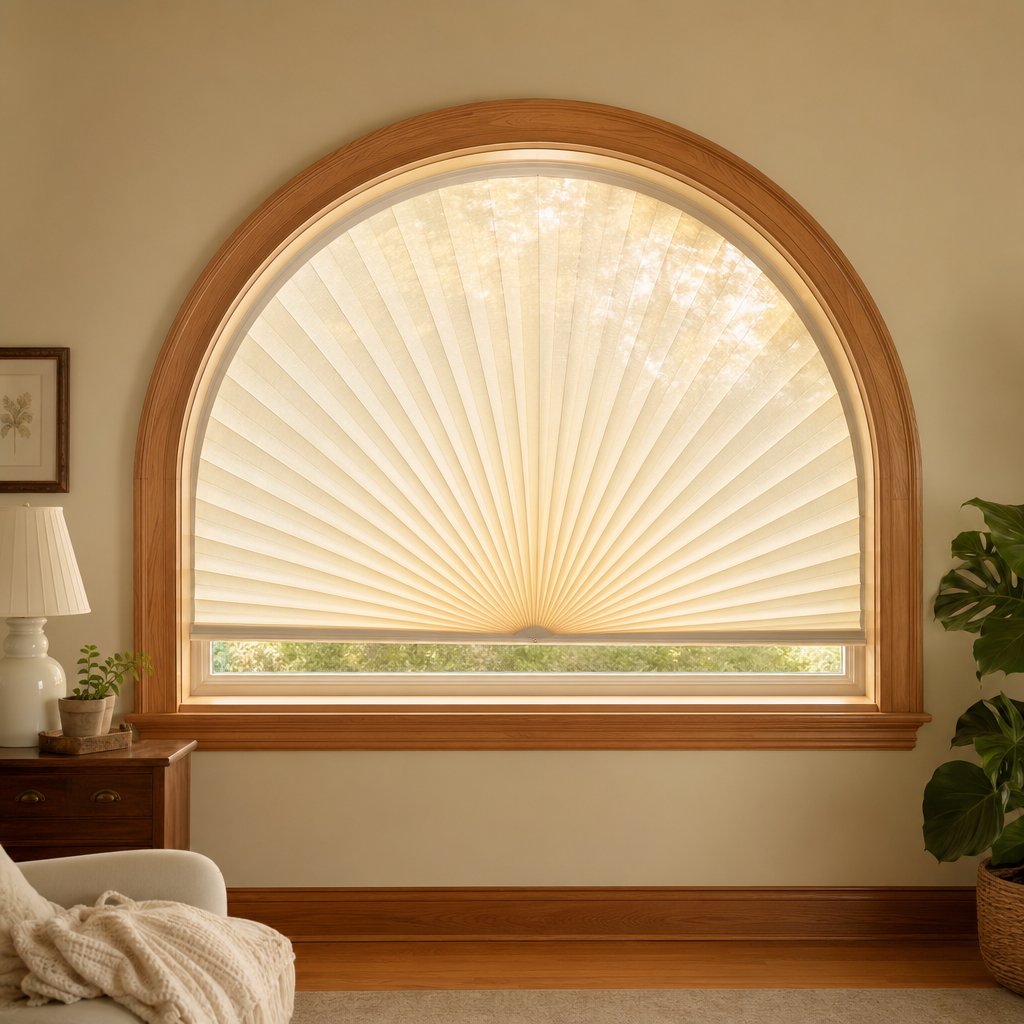
Window Coverings and Treatments for Rounded Windows
You’ve picked the perfect shape, nailed the placement, and sorted out the frame material. Then someone asks, “So how are you going to put blinds on that?” It’s the question that haunts nearly every curved window purchase — and honestly, it’s the one area where rectangular windows have a decisive, undeniable advantage.
Covering a window with no straight top edge takes more thought, more money, and more patience than dressing a standard rectangle. But it’s far from impossible. The options range from purpose-built shades to creative workarounds, and the right choice depends on the shape you’re working with, how much light control you need, and how much you’re willing to spend.
Blinds, Shades and Shutters for Round and Half-Round Windows
A half round window shade is the easiest curved covering to find off the shelf. These fan-shaped cellular shades mount at the base of the semicircle and expand upward in a sunburst pattern, offering light filtering or blackout options depending on the fabric. Cellular shades hold the record for offering the most climate control of any window treatment, and because they mount within the frame, there’s no light gap around the edges.
Fixed-arch sunburst plantation shutters are another popular solution for half rounds and round top windows. The louvers radiate outward from a central point, giving you adjustable light control while following the curve precisely. They look clean, work well in traditional and transitional interiors, and hold up over time — though they require custom sizing for anything beyond the most common diameters.
For arch-top combination units, motorized roller shades on the rectangular lower section are a practical choice. The shade covers the operable portion where you actually need privacy and light control, while the fixed arched top stays exposed. Roman shades installed just below the arch follow the same logic — they drop along the straight section and leave the curve open for natural light.
Full-circle windows are the hardest to cover. The geometry doesn’t cooperate with any standard shade or blind mechanism. Interior shutters custom-cut to the circle’s diameter are one option. Decorative window films — frosted, etched, or stained glass patterns — are often the more practical route, especially for a round stained glass window effect without the cost of actual leaded glass.
Curtains, Drapes and Creative Alternatives
When shades and shutters feel too rigid or too expensive, drapery offers a softer path. Interior designers consistently favor curtains for arched windows because of their mounting flexibility. You can hang panels above the arch on the wall or ceiling — covering the entire curve for full privacy — or mount them just below the arch, leaving the curved top exposed while controlling light through the rectangular section beneath.
Curved curtain rods that follow the arc of an arched window do exist, but they require custom hardware and can make the panels difficult to slide open and closed. Most designers skip them in favor of a straight rod or ceiling-mounted track positioned above the arch, which keeps functionality simple while still framing the window beautifully.
Stationary fabric panels are a third option — purely decorative drapes that flank the window without actually closing. They soften the visual weight of a large curve and add texture to a room without the cost of a fully functional drapery system.
And then there’s the simplest approach of all: leave it uncovered. In stairwells, gable ends, and high-placed bathroom windows where privacy isn’t a concern, an exposed curved window often looks better without any treatment at all. The shape itself is the design element.
Here’s a quick-reference list of covering options, ranked from easiest to install to most involved:
- Decorative window film (frosted, tinted, or patterned) — peel-and-stick application, lowest cost, works on any shape
- Cellular fan shades (half round window shade) — mount within the frame, widely available for semicircles, moderate cost
- Roman shades or roller shades below the arch — standard installation on the rectangular portion only, moderate cost
- Drapery panels on a straight rod above the arch — versatile, wide fabric and style range, moderate to high cost
- Sunburst plantation shutters — custom-fitted to the curve, excellent light control, higher cost
- Custom interior shutters for full circles — precise fit required, highest cost and longest lead time
Some homeowners sidestep the covering challenge entirely by specifying frosted or tinted glass at the manufacturing stage. It’s a one-time decision that eliminates the need for any aftermarket treatment — and for windows in bathrooms, stairwells, or south-facing walls where permanent diffusion makes sense, it’s often the smartest move.
With privacy and light control sorted, the final piece of the puzzle is pulling everything together — matching the right shape to your home’s architectural style and walking through the practical steps before you place an order.
Choosing the Right Rounded Windows for Your Home
Every home tells a story through its facade, and the curved shapes you choose should speak the same architectural language as the rest of the building. A gothic arch on a mid-century ranch looks as out of place as a porthole on a Georgian colonial. Getting the match right is what separates a thoughtful upgrade from an expensive mistake.
Matching Rounded Window Shapes to Architectural Styles
The table below pairs common home styles with the curved shapes that complement them best. You’ll notice aluminium-framed options lead the list — their slim profiles and fabrication versatility make them the most adaptable choice across modern, coastal, and contemporary builds.
| Architectural Style | Recommended Rounded Shapes | Best Frame Material | Notes |
|---|---|---|---|
| Modern / Contemporary / Coastal | Full circle, large round windows, bold arch-top | Aluminium | Slim sightlines maximize glass; powder-coat finishes suit clean aesthetics |
| Victorian / Colonial | Half round windows, gothic arch, rose window | Wood or aluminium | Ornate detailing pairs with decorative grilles and divided lites |
| Mediterranean / Tuscan | Full arch, arched casement, elliptical | Aluminium or wood | Arched windows with decorative ironwork enhance old-world warmth |
| Craftsman / Cottage | Eyebrow curve, subtle arch-top, quarter round accents | Wood or fiberglass | Understated curves respect the style’s simplicity |
| Farmhouse / Transitional | Arch-top with black frame, half round transom | Aluminium or composite | Black aluminium frames deliver the modern farmhouse contrast |
| Gothic Revival / Tudor | Gothic pointed arch, lancet shapes | Aluminium or wood | Almost always custom; expect longer lead times and higher cost |
Style matching goes beyond the window itself. Think about what surrounds it — the trim, the siding, even the landscaping. Homeowners who invest in curb appeal details like choosing the best plants for window boxes all year round often find that a well-placed arched or circular window becomes the anchor that ties the entire facade together.
Practical Steps Before You Buy
Whether you’re building new, renovating, or adding a single accent piece, the buying process follows the same logical sequence. Skipping a step here usually means paying for it later — in delays, returns, or code violations.
- Measure the opening accurately. For curved shapes, create a cardboard or plywood template of the exact arc. Don’t assume symmetry — check multiple points along the curve.
- Confirm egress and code requirements with your local building authority. If the window is going into a bedroom or basement, verify that your plan includes a code-compliant operable window alongside any fixed curved unit.
- Decide on frame material and operability. Aluminium handles the widest range of curved profiles with the least maintenance. If ventilation matters, an arch-top combination unit or porthole gives you operable options within the curved family.
- Request quotes for both stock and custom options. A half-round or full circle in a standard diameter (24, 36, or 48 inches) may be available off the shelf, saving you weeks of lead time and significant cost.
- Factor in lead times for custom orders and trim work. Custom curved windows typically add four to eight weeks, and round window trim molding may need separate fabrication from a millwork shop.
- Plan window coverings early. Decide whether you’ll use cellular shades, shutters, decorative film, or frosted glass — and budget accordingly before the window is installed, not after.
For Australian homeowners, renovators, builders, and developers comparing aluminium systems, MEICHEN’s aluminium windows collection is a useful starting point. Their range covers energy-efficient, Australian-standard-compliant options across multiple project types — from straightforward replacements to specialty shapes — making it a practical resource when you’re evaluating what’s available before requesting formal quotes.
Rounded windows aren’t a one-size-fits-all product, and that’s exactly what makes them worth the extra thought. Match the shape to your architecture, the material to your climate, and the placement to your daily life. Get those three things right, and you end up with something a rectangular window simply can’t deliver — a feature that makes people stop, look up, and notice your home.
Frequently Asked Questions About Rounded Windows
1. What are the different types of rounded windows?
Rounded windows span a wide family of shapes, each suited to different placements and architectural styles. Full circles and oculuses work as bold accent features in gable ends and stairwells. Half-round (semicircle) windows are the most common residential choice, typically installed as transoms above doors or rectangular windows. Quarter-round windows serve as compact corner accents. Beyond these, you’ll find arch-top (springline) windows that combine a curved top with an operable rectangular base, shallow eyebrow curves for subtle detailing, pointed gothic arches for dramatic facades, ellipticals for wide transoms, and portholes borrowed from nautical design. Rose windows with decorative stained glass fall under the full-circle category but involve specialized glazing and structural support.
2. Can rounded windows open for ventilation?
While most rounded windows are fixed panes, several shapes do offer operable configurations. Arch-top combination units are the most widely available option — the rectangular lower section opens as a casement or double-hung while the curved top stays fixed. Portholes frequently feature a side or top hinge for ventilation, making them one of the few curved shapes where operability is standard. Some manufacturers produce half-round casement versions that hinge at one side, though these are less common. Quarter-round, eyebrow, gothic arch, and elliptical shapes are exclusively fixed. If airflow matters in a specific room, plan for an arch-top combo unit or a porthole, or pair a fixed curved window with a separate operable rectangular window nearby.
3. How much do rounded windows cost compared to rectangular windows?
Rounded windows generally cost more per unit than same-size rectangular alternatives due to the added manufacturing complexity of curved frames, seals, and glazing. Stock half-round and full-circle windows in standard diameters (24, 36, or 48 inches) are the most affordable curved options, with arch-top replacements averaging roughly $345 to $950 per unit depending on material and size. Fully custom shapes like gothic arches, large oculuses, or non-standard ellipticals can run 30% to 100% more than a comparable rectangular stock window. Additional costs to budget for include custom round window trim and molding, specialty coverings like cellular fan shades or plantation shutters, and potential structural framing work if you’re adding a curved opening to an existing wall.
4. What is the best frame material for rounded windows?
Aluminium is widely considered the most versatile frame material for curved window fabrication. It can be precision-bent into tight radii without cracking or losing structural integrity, resists corrosion, supports slim sightlines that maximize glass area, and accepts powder-coat finishes in virtually any color. Wood offers a warm, classic aesthetic through steam-bending or lamination but demands ongoing sealing and is vulnerable to moisture at curved joints. Vinyl handles gentle curves affordably but can warp under extreme heat and lacks rigidity for large openings. Fiberglass is dimensionally stable and strong but limited in tight-radius shapes. For Australian climates, aluminium frames with polyamide thermal breaks deliver strong thermal performance while handling UV exposure, temperature swings, and coastal salt air. Collections like MEICHEN’s aluminium windows range (meichenwindows.com.au/aluminium-windows/) offer Australian-standard-compliant systems suited to curved and specialty shapes.
5. How do you cover rounded windows for privacy?
Covering curved windows requires more planning than dressing rectangular ones, but several effective options exist. For half-round windows, fan-shaped cellular shades that expand upward in a sunburst pattern are the most widely available off-the-shelf solution, offering both light filtering and blackout fabrics. Sunburst plantation shutters with radiating louvers provide adjustable light control for semicircles. Arch-top combination units work well with motorized roller shades or Roman shades on the rectangular lower section, leaving the curved top exposed. Full circles are the trickiest — custom interior shutters or decorative window films (frosted, etched, or patterned) are often the only practical routes. Curtain panels hung on a straight rod above the arch can cover the entire window when full privacy is needed. Some homeowners avoid the challenge entirely by specifying frosted or tinted glass at the manufacturing stage.
More Window & Door Guides