Diagnose Your Aluminium Sliding Door Problem First
Before you grab a screwdriver or start searching for how to fix sliding door issues, take a moment to figure out exactly what is going wrong. A sliding door fix that works for worn rollers will do nothing for a warped frame, and misdiagnosing the problem wastes time and money. Aluminium sliding doors fail in predictable patterns, so matching your symptom to its root cause is the fastest path to a lasting repair.
Common Symptoms of a Failing Aluminium Sliding Door
Each symptom points toward a different underlying issue. Run through this list and note which ones match your situation:
- Door sticking or dragging — usually caused by debris buildup in the track, misadjusted rollers, or oxidation creating friction along the rail.
- Grinding or scraping noises — indicates grit lodged in the track, worn nylon rollers with flat spots, or seized roller bearings.
- Visible gaps and drafts around the frame — points to degraded weatherstripping, frame warping, or the panel sitting too low on its rollers.
- Door jumping off the track — often the result of roller height set too low, a flattened track lip, or debris creating a ramp effect.
- Difficulty locking — typically means the panel is misaligned with the frame, preventing the latch from engaging its strike plate.
If your sliding glass door won’t open at all, you are likely dealing with either severely seized rollers or a combination of track obstruction and panel misalignment. A completely broken sliding door that resists all movement usually has more than one issue happening simultaneously.
Why Aluminium Doors Develop Problems Over Time
Aluminium is lightweight and corrosion-resistant, but it is not maintenance-free. Several factors specific to this material cause gradual decline.
Oxidation buildup: Aluminium forms a protective oxide layer naturally, but in humid or coastal Australian climates, that white powdery residue accumulates in the track channel and creates significant friction against the rollers.
Thermal expansion and contraction: Aluminium expands when heated and contracts when cooled. Seasonal temperature swings — and even daily sun exposure on north-facing facades — cause the frame to shift slightly, affecting lock engagement and panel alignment over repeated cycles.
Galvanic corrosion: When aluminium contacts dissimilar metals like steel screws or brass fittings without proper isolation, an electrochemical reaction accelerates corrosion at the contact point. This is especially common in older installations where hardware selection was less considered.
Roller fatigue: Aluminium-framed glass panels can weigh 40 to 80 kg. That constant load wears down nylon wheels and roller bearings over years of daily use, gradually lowering the panel until it drags.
Understanding these causes helps you fix aluminium sliding doors properly rather than just treating symptoms. It also tells you what to watch for during routine maintenance so small issues do not escalate into expensive repairs — which brings us to the tools and safety precautions you will need before starting any hands-on work.
Safety Precautions and Tools You Need
Aluminium sliding doors look deceptively simple, but repairing sliding doors of this type involves real physical hazards. A standard panel with double-glazed glass weighs between 40 and 80 kg — heavy enough to break a foot or crush fingers if it slips during removal. Oxidised or damaged aluminium edges can slice through skin easily, and tempered glass, while safer than float glass when it breaks, still demands respect during handling.
Spending five minutes on preparation prevents the kind of injuries that turn a weekend project into a trip to emergency.
Essential Safety Gear for Aluminium Door Repairs
Before you touch the door panel, gear up properly:
- Heavy-duty work gloves — leather or cut-resistant synthetic gloves protect against sharp aluminium edges and pinch points. Standard gardening gloves are not sufficient.
- Safety glasses — debris, oxidation flakes, and cleaning solution splashes can all reach your eyes during track work.
- Steel-cap boots — a dropped panel or dislodged glass pane can cause serious foot injuries. Closed-toe shoes are the bare minimum; steel caps are strongly recommended.
- A helper — any task that involves lifting or tilting the door panel requires two people. The weight distribution of a tall, narrow glass panel makes solo handling unstable and dangerous.
Long sleeves and trousers also reduce the chance of cuts from corroded frame edges, particularly on older doors where the aluminium surface has become rough and pitted.
Tools and Materials Checklist
Having everything on hand before you start means you will not need to prop a half-removed panel against a wall while you hunt for the right screwdriver. Here is what you need to repair a sliding glass door properly:
| Tool / Material | Purpose |
|---|---|
| Phillips and flathead screwdrivers | Accessing roller adjustment screws and removing hardware |
| Vacuum with crevice attachment | Clearing loose debris from the track channel |
| Soft brass brush | Removing oxidation from aluminium tracks without scratching |
| pH-neutral aluminium cleaning solution | Dissolving grime and corrosion safely — no abrasives |
| Silicone spray lubricant (dry type) | Lubricating tracks and rollers without attracting dust |
| Spirit level | Checking panel alignment and even roller height |
| Replacement rollers (matched to track profile) | Swapping worn or seized wheels |
| Microfibre cloths | Wiping residue without leaving fibres behind |
| Pry bar (flat, thin profile) | Gently lifting panels stuck in the track |
| Replacement weatherstripping | Restoring seals if drafts are present |
One critical rule for aluminium sliding door repairs: never use steel wool, abrasive scouring pads, or harsh alkaline cleaners on aluminium surfaces. These strip away the protective oxide layer that prevents deeper corrosion. A soft brass brush paired with a pH-neutral cleaner handles oxidation effectively without causing further damage.
With your safety gear on and tools laid out, the logical starting point for most repairs is the track itself — the component that accumulates the most debris and causes the majority of sliding problems.
Step 1: Clean and Restore Your Aluminium Door Tracks
A sliding door stuck in track is frustrating, but the fix is often simpler than you think. The vast majority of aluminium sliding door problems originate right at the bottom — in the track channel where grit, sand, pet hair, and oxidation deposits accumulate over months and years. That buildup creates friction that rollers cannot overcome, making the panel feel heavy and unresponsive. Before adjusting rollers or replacing hardware, a thorough track clean is the essential first step to fix sliding door track issues.
How to Deep-Clean an Aluminium Door Track
This process takes roughly 15 to 20 minutes and requires no specialist skills. Work through each step in order for the best result:
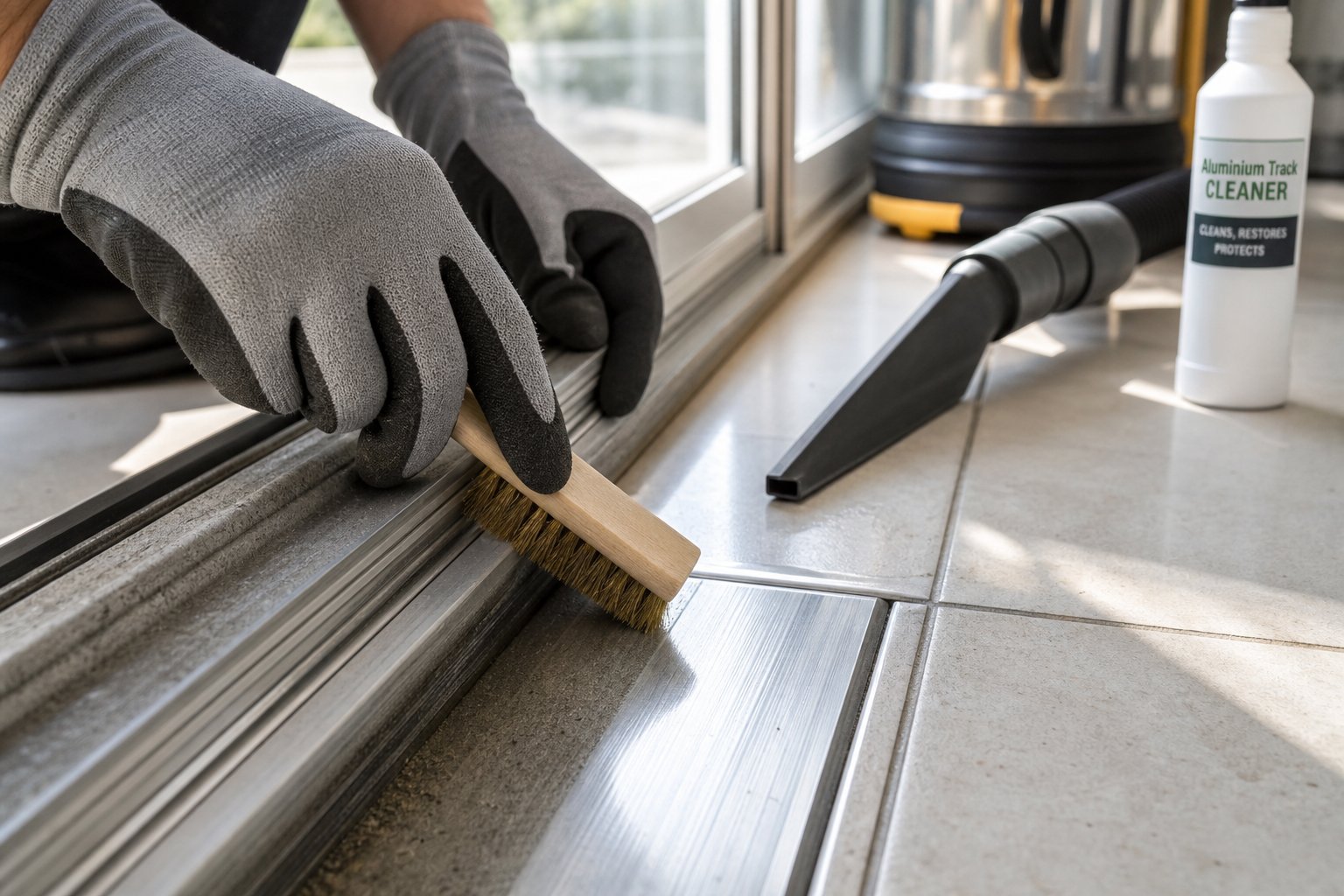
- Vacuum loose debris with a crevice tool. Run the narrow attachment along the full length of the track, paying attention to corners and the area behind the door stop. Sand, leaves, and insect debris collect here constantly, especially on ground-floor aluminium patio door tracks exposed to outdoor elements.
- Apply a pH-neutral aluminium cleaner. Spray or wipe the solution along the track surface. Avoid anything alkaline or acidic — these attack the aluminium and accelerate corrosion rather than removing it.
- Scrub with a soft brass brush. Work in short strokes along the rail to lift oxidation deposits and stuck-on grime. Brass is softer than aluminium, so it cleans effectively without scratching or damaging the track profile.
- Wipe residue with a damp microfibre cloth. Remove all loosened material and cleaning solution. Repeat if you still see discolouration or feel roughness under the cloth.
- Dry the track completely. Moisture left sitting in the channel promotes further oxidation. A dry cloth followed by a few minutes of air exposure does the job.
- Apply silicone-based lubricant along the full track length. A thin, even coat reduces friction and protects the surface. Slide the door back and forth several times to distribute the lubricant across the roller contact area.
After completing these steps, test the door. Many homeowners find that learning how to fix a sliding door track through proper cleaning alone restores smooth operation — no parts replacement needed.
Addressing Oxidation and Corrosion in Tracks
That white, chalky powder you see building up on your aluminium track is aluminium oxide. It forms naturally when the metal reacts with oxygen and moisture, but in humid or coastal Australian climates — think Sydney’s eastern suburbs, Queensland’s coastline, or anywhere within a few kilometres of salt air — the buildup accelerates dramatically. The oxide layer itself is not harmful to the aluminium underneath, but it creates a rough, high-friction surface that grinds against rollers and slows the panel.
A common mistake is reaching for WD-40 to solve the problem. While it provides temporary slipperiness, WD-40 is a water displacer rather than a true lubricant. It evaporates quickly and leaves an oily residue that attracts dust and grime, making the track dirtier within weeks. Dry silicone spray is the correct choice — it lubricates without leaving a sticky film, repels dust, and lasts significantly longer between applications.
If your track shows deep pitting, structural corrosion that has eaten into the rail profile, or visible cracks along its length, cleaning alone will not restore proper function. These are signs that the track has reached the end of its serviceable life and needs repair or replacement — a process that involves more than surface treatment and requires careful attention to matching the original track profile with your roller type.
Step 2: Fix or Replace Sliding Door Rollers and Wheels
A clean track solves many problems, but if your door still drags, sticks, or feels heavy after a thorough clean, the rollers are almost certainly the culprit. These small wheels bear the full weight of your aluminium-framed glass panel — typically 40 to 80 kg — every single time the door opens and closes. Over years of daily use, that load takes its toll. Knowing how to fix sliding door rollers is the most common hands-on repair for aluminium sliding doors, and it ranges from a simple two-minute adjustment to a full roller swap.
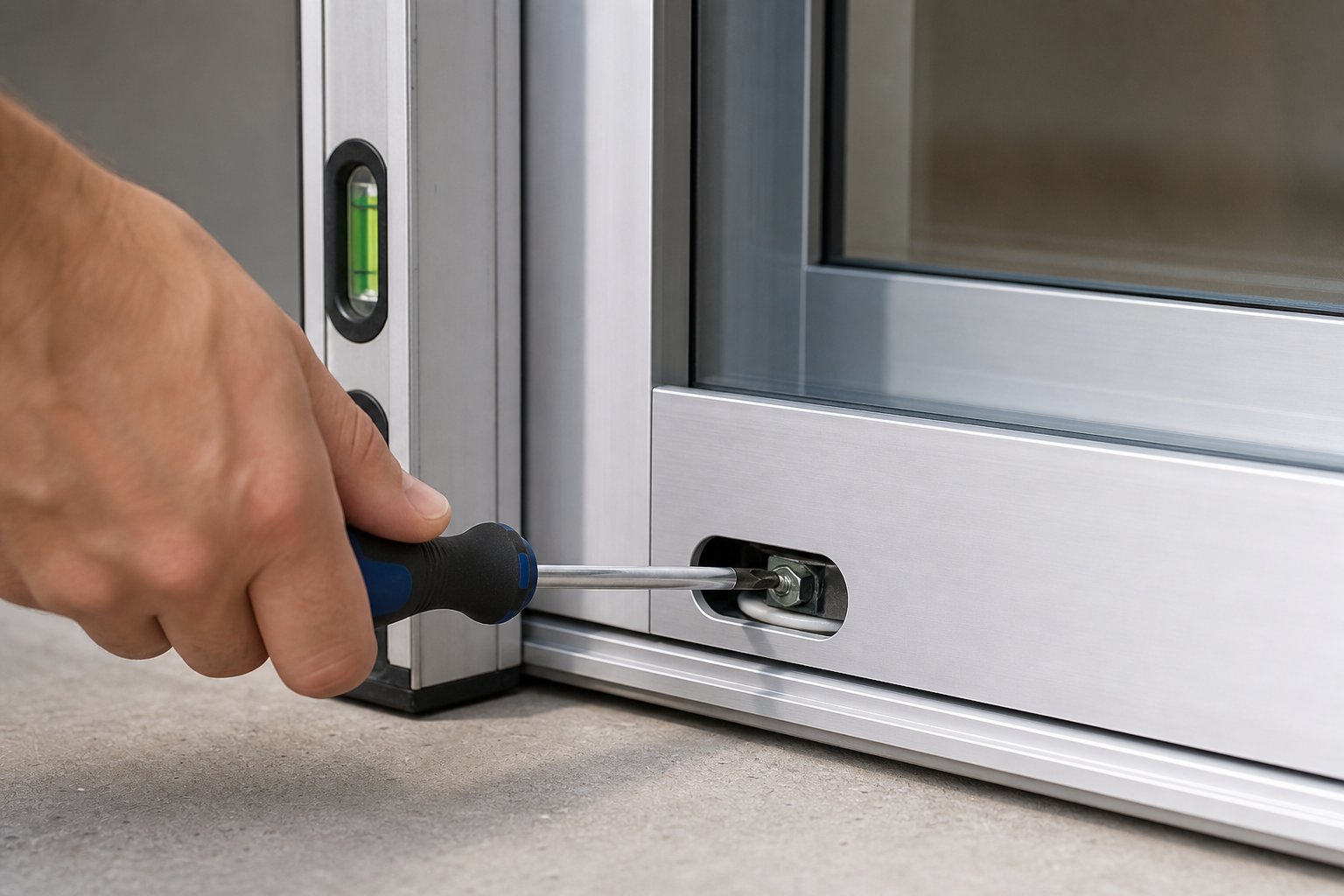
The adjustment screws are located on the bottom edge of the door panel, usually accessible through small holes or behind plastic plugs at each end of the bottom rail. These screws control how far the rollers extend downward, which determines the panel’s height relative to the track. Before you consider replacement, try adjustment first — it costs nothing and takes minutes.
How to Adjust Sliding Door Roller Height
Grab a Phillips head screwdriver and follow this sequence:
- Locate the adjustment screws on the bottom rail. Look for small access holes at both ends of the panel’s lower edge. You may need to remove a plastic cap or cover plate to reach them.
- Turn clockwise to raise the door, or counter-clockwise to lower it. Each quarter-turn makes a noticeable difference, so work gradually. Raising the panel lifts it off the track surface and reduces dragging.
- Adjust both ends evenly using a spirit level. Place the level along the top edge of the panel. Uneven roller height causes the door to bind at one end and creates uneven wear on both the rollers and the track.
- Test the slide after each quarter-turn. Open and close the door fully. You are looking for smooth, consistent movement with no scraping at either end. The panel should clear the track lip by approximately 2 to 3 mm.
If adjustment restores smooth operation, you are done. Run the door back and forth 10 to 20 times to confirm the fix holds under repeated use. If the door still drags, feels gritty, or makes grinding noises despite correct height, the rollers themselves have failed and need replacing.
When and How to Replace Worn Rollers
Rollers do not last forever. Typical lifespan sits between 5 and 10 years depending on usage frequency, panel weight, and environmental exposure. Inspect yours for these signs of failure:
- Flat spots on nylon wheels — the wheel no longer rolls smoothly and creates a bumpy, clicking sensation.
- Cracked or chipped wheel material — visible damage means the roller cannot support the panel evenly.
- Seized bearings — the wheel resists spinning freely when you rotate it by hand, indicating internal corrosion or grit contamination.
- Visible rust or corrosion — particularly common in coastal areas where salt air penetrates the roller housing.
If any of these are present, changing rollers on sliding door panels is the correct fix. Here is how to safely remove the panel for a roller swap:
- Open the door to its midpoint and have your helper grip the panel firmly on both sides.
- Locate the head stop or retaining screw at the top of the frame that prevents the panel from lifting out. Remove it if present.
- Lift the panel straight up into the top track channel. This creates clearance between the bottom of the panel and the lower rail.
- Tilt the base of the panel outward toward you while your helper supports the weight. The panel should swing free of the bottom track.
- Carry the panel to a flat, padded surface — lay it on towels or cardboard to protect the glass and frame.
- Remove the old rollers by unscrewing the mounting fasteners or releasing the clip mechanism, depending on your door system.
- Install the new rollers and confirm each wheel spins freely before reinstalling the panel.
The critical step most people get wrong is how to fix sliding door wheels with the wrong replacement part. Roller type must match your track profile exactly. Concave wheels pair with rounded rail tracks, while flat wheels suit square-profile tracks. A mismatch creates noise, accelerates wear on both the roller and the rail, and can cause the door to derail. Before purchasing replacements, remove one old roller and measure the wheel diameter, width, axle bore, and mounting hole spacing. Take it with you to the hardware supplier or photograph it alongside a ruler for online ordering.
Bearing quality matters too. Plain bushings work for lightweight interior doors, but aluminium-framed glass panels benefit from sealed ball bearings that handle higher loads and resist dust and moisture ingress. For doors in high-traffic areas or coastal environments, sealed bearings significantly extend the interval between replacements.
Hardware selection should always be planned around the actual door system’s track configuration, roller type, and panel weight. When these elements are engineered as an integrated unit rather than assembled from mismatched parts, long-term performance improves dramatically. Systems like MEICHEN’s MA100 Sliding Door illustrate this approach — the track geometry, roller specification, and panel weight are designed together from the outset, which is a useful reference point if you are evaluating whether your current hardware genuinely suits your door system’s requirements.
Once new rollers are installed and the panel is back on the track, repeat the height adjustment process described above. Set both ends evenly, confirm smooth travel across the full opening, and check that the door latches correctly in the closed position. A properly matched and adjusted roller set should restore that effortless one-finger glide — and if it does not, the problem likely sits with the track itself rather than the wheels riding on it.
Step 3: Realign a Door That Has Jumped Off Track
Few things look more alarming than an aluminium sliding door sitting crooked in its frame, one edge dropped below the rail and the whole panel refusing to budge. It feels like a major structural failure — but in most cases, a door that has jumped off track is entirely fixable without professional help, provided the track itself remains undamaged. If you can fix sliding door off track issues with a helper and 20 minutes of careful work, you will save yourself a callout fee and get the door operational again the same day.
Why Aluminium Doors Jump Off Track
Doors do not derail randomly. Something specific causes the panel to lift over or drop below the track lip, and identifying that cause prevents it from happening again.
- Worn or misadjusted rollers — when rollers wear down or the adjustment screws loosen over time, the panel gradually sits lower in the frame. Eventually it drops below the track lip’s retaining edge, and the next time someone slides it with any force, the panel pops free.
- Debris creating a ramp effect — a buildup of grit, leaves, or small stones at one end of the track can act like a wedge, lifting the roller up and over the rail lip as the door passes that point.
- Damaged track lips — the raised edges of the bottom rail keep the rollers contained. If these lips are bent outward or flattened from impact (a kicked doorstop, furniture bumping the frame), the rollers have nothing to hold them in place.
- Lifting the door during use — pulling upward on the handle while sliding, or children hanging on the panel, can momentarily lift the rollers above the track lip and cause derailment.
Understanding how to fix sliding door that fell off track starts with checking which of these causes applies to your situation. A quick visual inspection of the track lips and roller height tells you whether reseating alone will solve the problem or whether underlying damage needs addressing first.
How to Safely Lift and Reseat the Door Panel
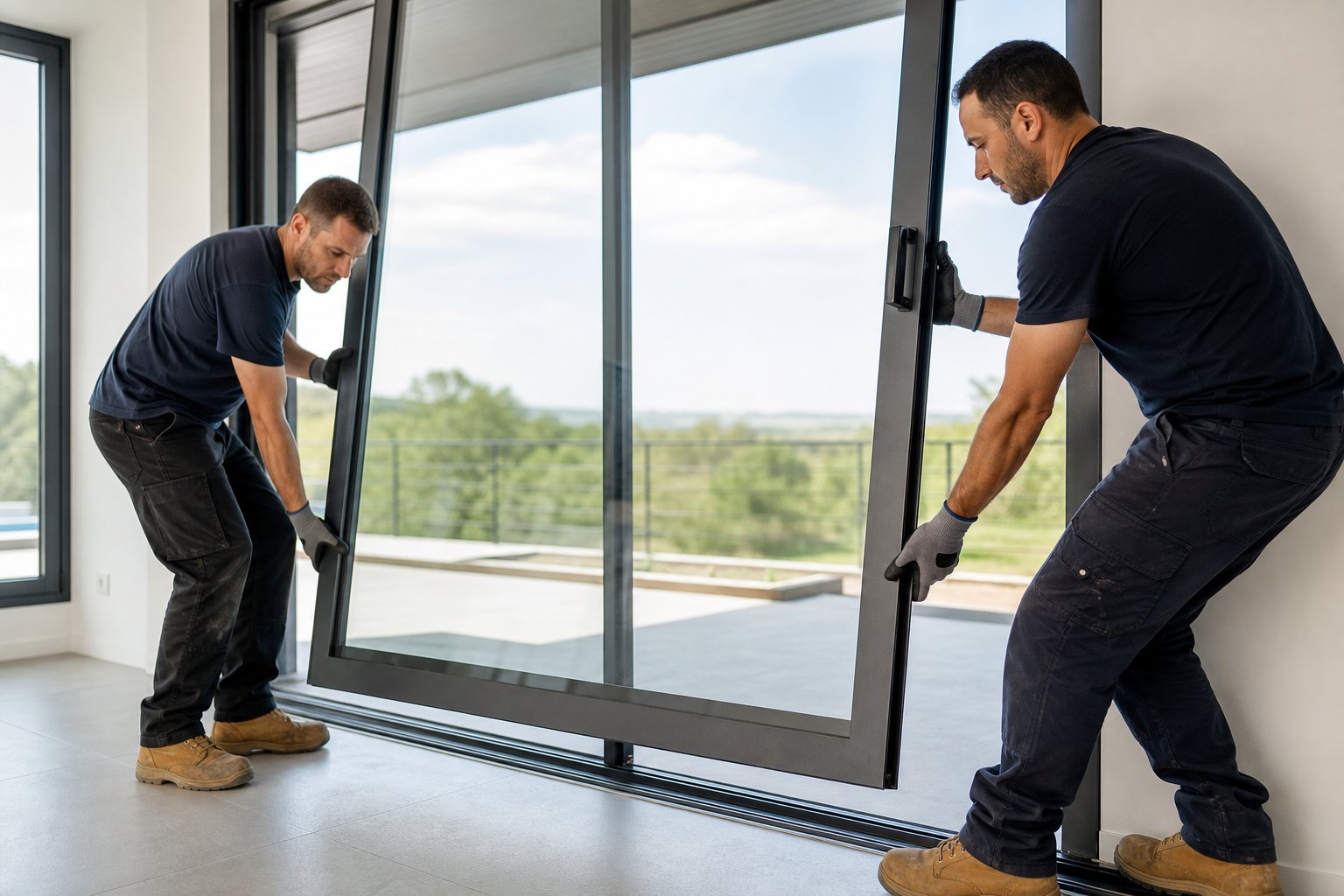
This is a two-person job. Aluminium-framed glass panels weigh 40 to 80 kg, and the tall, narrow shape makes them unstable when tilted. Do not attempt this alone. With your helper ready and the area cleared of furniture and obstacles, follow this sequence:
- Clear all debris from the track. Vacuum the full length of the bottom rail and inspect the track lips for damage. If you reseat the panel onto a dirty or obstructed track, it will derail again almost immediately.
- With a helper, grip the door panel firmly on both sides. Each person should hold the panel near the top and bottom edges for maximum control. Wear heavy-duty gloves — aluminium edges on a derailed panel are often exposed and sharp.
- Lift the panel straight up into the top track channel. The top rail has a deeper channel specifically designed to allow the panel to be raised high enough to clear the bottom rail during installation and removal. Push the panel upward until the bottom edge rises above the lower track lip.
- Swing the bottom edge inward over the bottom track rail. While holding the panel elevated, angle the base inward so the rollers align directly above the track channel.
- Lower the panel gently onto the track. Let the rollers settle into the rail groove. Do this slowly — dropping the panel can damage both the rollers and the track surface.
- Test the slide before releasing fully. While both people still have hands on the panel, push it a short distance in each direction. If it rolls smoothly without catching or lifting, the reseating is successful.
- Adjust roller height so the door clears the track lip by 2 to 3 mm. Use the adjustment screws on the bottom rail to raise the panel slightly. This clearance ensures the rollers stay contained within the track during normal operation without dragging on the rail surface.
If the door derails again within days of reseating, the problem is structural rather than positional. Check the top track guide — if it is bent or pushed outward, it no longer holds the panel’s upper edge in alignment, allowing the bottom to swing free under lateral force. Similarly, if the bottom rail lip is flattened or bent, no amount of roller adjustment will keep the panel contained. In either case, you are looking at how to fix sliding door top track damage or bottom rail repair — work that goes beyond simple reseating and into track restoration territory.
A successfully reseated door that stays on track confirms your rollers and rails are still in serviceable condition. But if the track itself shows signs of wear, dents, or corrosion that contributed to the derailment, surface-level fixes will only buy time before the next failure.
Step 4: Repair or Replace a Damaged Aluminium Track
Cleaning restores most tracks. Roller adjustment fixes most panels. But when the rail itself is dented, corroded through, or warped beyond what a brass brush and lubricant can address, you are looking at repairing sliding door track damage directly — or pulling the old track out entirely and fitting a new one. The deciding factor is straightforward: if the track profile is still structurally intact and the rollers can travel its full length without catching, a localised repair will work. If the rail is cracked, deeply pitted across long sections, or bent enough to deflect a straight edge, aluminium sliding door track replacement is the more reliable path.
Repairing Minor Track Damage
Small dents, burrs, and surface imperfections do not necessarily mean the whole track needs replacing. These targeted fixes handle the most common minor damage:
- Smoothing burrs and raised dents: Run a flat metal file gently along the damaged section of the rail. Work in the direction of door travel, removing just enough material to eliminate the high spot. Test by rolling a spare roller wheel along the filed area — it should pass without catching.
- Reshaping a flared track lip: If the retaining lip has been bent outward (often from the door derailing or impact damage), place a small block of wood against the inside of the lip and use pliers to bend it back into its original upright position. The wood distributes force evenly and prevents the pliers from creating new dents or crimps.
- Filling small pits: Isolated corrosion pits that create rough spots can be filled with aluminium-compatible epoxy. Apply the filler, let it cure fully, then sand smooth with fine-grit wet-and-dry paper (400 grit or higher). This restores a flat rolling surface without replacing the entire rail.
These repairs buy significant time on tracks that are otherwise sound. However, if you find yourself patching multiple spots across the rail’s length, the cumulative damage suggests the track has reached the end of its useful life.
How to Replace an Aluminium Sliding Door Track
Full sliding door track replacement is a bigger job, but it is well within reach for a confident DIYer with a helper. If you want to know how to repair sliding door track problems permanently when localised fixes are no longer enough, this is the process:
- Remove the door panel and any fixed panels. Lift each panel up into the head channel and tilt the base outward, as described in the roller replacement section. Set panels safely aside on a padded surface.
- Unscrew or pry out the existing track from the sill. Most aluminium tracks are secured with screws into the sill plate. Remove these carefully. Older installations may use adhesive as well — a thin pry bar helps release the track without damaging the sill beneath.
- Clean the sill surface thoroughly. Remove old sealant, debris, and any corrosion from the mounting area. The new track needs a flat, clean base to sit level.
- Measure and cut the replacement track to length. Use a fine-tooth hacksaw or mitre saw with a non-ferrous blade. File any cut edges smooth to prevent sharp burrs.
- Apply a bead of silicone sealant along the sill for water-tightness. This prevents moisture from pooling beneath the track and corroding the sill or subfloor — particularly important for ground-floor doors exposed to rain.
- Secure the new track with corrosion-resistant screws. Stainless steel or coated screws prevent galvanic corrosion where the fastener contacts the aluminium. Space screws evenly, typically every 200 to 300 mm, and check the track sits level with a spirit level before fully tightening.
- Reinstall panels and test. Lower each panel back onto the new track, adjust roller height for 2 to 3 mm clearance above the rail lip, and slide the door through its full range of travel.
The single most important detail in this entire process: the replacement track must match the original profile exactly. Track profiles vary between manufacturers — some use a rounded rail, others a flat or V-shaped channel. A mismatched track causes premature roller wear, poor sealing at the base, and potential derailment. Take the old track section to your hardware supplier or contact the door manufacturer directly with the model number to source the correct part. Photographing the cross-section alongside a ruler also helps when ordering online.
With a new track fitted and panels gliding smoothly, the mechanical side of your door is sorted. But smooth rolling means nothing if air whistles through gaps around the frame — and aluminium’s high thermal conductivity makes intact seals even more critical than they would be on a timber or uPVC door.
Step 5: How to Fix Drafty Sliding Glass Doors by Replacing Seals
Aluminium conducts heat roughly 1,000 times more efficiently than timber. That physical property is great for cookware — less so for door frames. It means your aluminium sliding door frame actively transfers outdoor temperatures into your home, whether that is summer heat radiating inward or winter warmth escaping outward. Up to 40% of a home’s heating and cooling energy can be lost through windows and doors, and compromised seals around an aluminium frame accelerate that loss dramatically. If you want to know how to fix a drafty sliding glass door, the answer almost always starts with the weatherstripping.
Identifying Failed Seals and Weatherstripping
Drafts are not always obvious. A slow, steady air leak around your door perimeter can go unnoticed until your energy bills climb or you feel a persistent cold spot near the glass. The simplest detection method uses an incense stick or a candle flame. Close the door, turn off any fans or air conditioning, and slowly move the flame along the full perimeter of the frame — top, sides, and bottom. Where the flame flickers or the smoke stream deflects sideways, air is passing through a failed seal.
Aluminium sliding doors typically use several seal types working together:
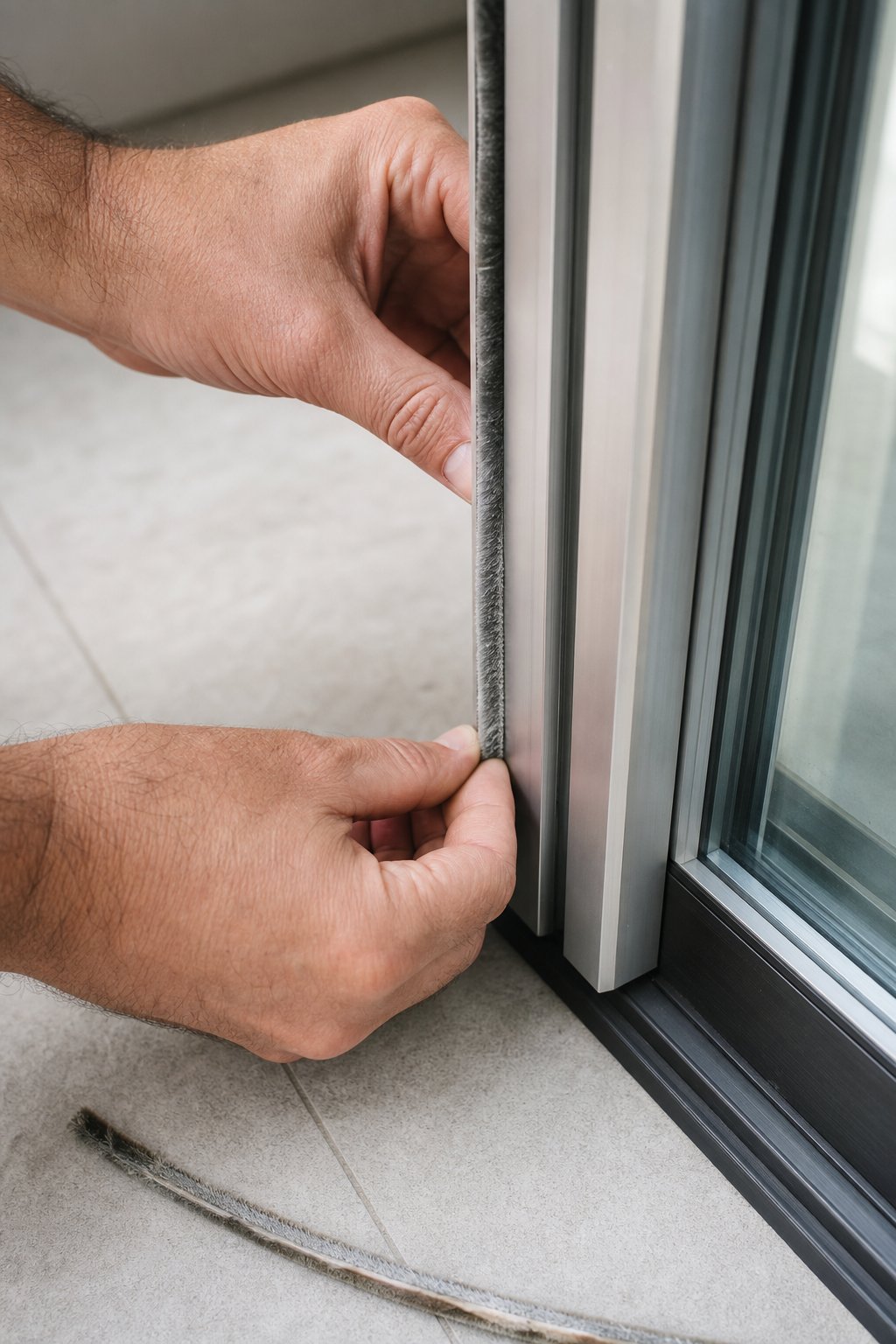
- Pile weatherstrip — the fuzzy, brush-like strip pressed into a channel along the frame edges. It fills the gap between the sliding panel and the fixed frame, compressing as the door closes.
- Fin seals — a pile weatherstrip with a plastic Mylar fin centred in the pile, designed specifically for aluminium sliding doors and windows. The fin adds rigidity and blocks airflow more effectively than pile alone.
- Compression gaskets — rubber or EPDM strips that compress when the door panel presses against the frame in the closed position, creating an airtight barrier along the lock side and head.
- Bottom brush seals — mounted to the underside of the panel or the threshold, these block dust, insects, and air movement at the base where gaps tend to be widest.
Run your fingers along each seal type. Pile that has flattened, hardened, or pulled away from its channel no longer springs back to fill the gap. Rubber gaskets that show cracking, permanent compression set, or sections missing entirely need replacing. These failures are the primary reason for drafts — not the aluminium frame itself.
How to Replace Weatherstripping on Aluminium Doors
Replacing seals is one of the most cost-effective ways to fix drafty sliding glass doors. The materials are inexpensive, the process requires no special tools, and the improvement in comfort and energy efficiency is immediate. Follow this sequence:
- Identify the seal type and measure the channel width. Pull a small section of the existing seal free and note how it attaches — pressed into a groove, adhered with backing tape, or clipped into a retaining slot. Measure the channel width in millimetres so you purchase the correct replacement size.
- Peel or slide out the old seal. Most pile and fin seals slide out from one end of the channel. Compression gaskets may peel away or require gentle prying. Remove the full length — patching short sections creates uneven compression and new leak points.
- Clean the channel with a damp cloth. Remove accumulated dust, old adhesive residue, and any oxidation from inside the groove. The new seal needs a clean surface to sit properly and stay in place.
- Cut new weatherstrip to length. Measure the channel run and cut the replacement slightly long — 5 to 10 mm extra is better than a gap at the end. Trim to final fit once installed.
- Press or slide into the channel starting from one end. Work steadily along the full length, ensuring the seal sits evenly in the groove without bunching or twisting. For adhesive-backed types, peel the backing progressively as you go rather than all at once.
- Test door closure to confirm even compression without excessive resistance. Close the door and check that it latches normally. The seal should compress visibly but not make the door difficult to close. If it binds, the replacement may be slightly oversized — try a thinner profile.
After fitting new seals, repeat the incense stick test around the full perimeter. Properly installed weatherstripping should eliminate detectable air movement at every point.
If drafts persist despite fresh seals, the problem may not be the seals at all. Hold a straight edge or spirit level against the vertical and horizontal frame rails. Any bowing or warping in the aluminium frame creates gaps that no amount of weatherstripping can bridge — the seal simply cannot make contact with a surface that curves away from it. Sliding glass door frame repair for warping is rarely a DIY fix; it typically indicates the frame has been stressed beyond its design limits by foundation movement, incorrect installation, or long-term thermal cycling. At that point, the question shifts from repair to whether the door system as a whole still makes economic sense to maintain.
When to DIY, Call a Professional, or Replace the Door
Knowing how to fix sliding doors is one thing. Knowing when to stop fixing them is another. Every repair has a point of diminishing returns — where the time, cost, and frustration of patching individual components exceeds the value of simply starting fresh. The challenge is recognising that threshold before you have sunk money into parts for a door that needed replacing all along.
DIY vs Professional Repair Decision Matrix
Not every sliding door problem requires a tradesperson, but some genuinely do. This framework helps you decide how do you fix a sliding door issue yourself versus when to hand it off:
| Problem Type | DIY Feasible? | Call a Professional? |
|---|---|---|
| Track cleaning and lubrication | Yes — straightforward with basic tools | Not necessary |
| Roller height adjustment | Yes — screwdriver and spirit level only | Not necessary |
| Roller replacement | Yes — with a helper for panel removal | Recommended if panel exceeds 60 kg or access is difficult |
| Track replacement | Possible for surface-mounted tracks | Recommended for structural sills or recessed tracks |
| Weatherstrip replacement | Yes — no specialist tools required | Not necessary |
| Glass panel replacement | No — safety risk and compliance requirements | Professional only (must meet AS 1288) |
| Frame warping or structural corrosion | No — cannot be reversed with DIY methods | Assessment needed; replacement likely |
| Lock mechanism failure | Depends — simple latch swaps are DIY | Yes, if multipoint lock or mortice mechanism |
The general rule: if you can repair a sliding glass door without removing the panel from the frame, it is almost always safe to DIY. Once the panel needs to come out, or the fix involves structural elements like the sill or frame joints, professional assessment reduces the risk of making things worse.
When Replacement Makes More Sense Than Repair
A single fault — worn rollers, a dirty track, degraded seals — is worth repairing. But when multiple systems fail simultaneously, the economics shift. If your door needs new rollers, a replacement track section, fresh weatherstripping, and a lock overhaul all at once, the combined parts and labour cost can approach 50 to 70 percent of a new door system. And even after all that work, you still have an ageing frame with no warranty.
Consider replacement over continued repair when:
- Frame corrosion extends beyond the surface. Pitting that has eaten into the aluminium profile weakens the structure permanently. No amount of cleaning or filling restores structural integrity once the wall thickness is compromised.
- The door derails repeatedly after fixes. Recurring derailment despite correct roller height and clean tracks indicates the frame geometry has shifted — the top and bottom rails are no longer parallel.
- Visible frame bowing is present. A straight edge held against the frame rails reveals gaps. Warped frames cannot seal properly regardless of weatherstrip condition.
- Single-glazed panels remain in climate zones requiring insulation. Australian energy efficiency requirements under the NCC have tightened considerably. A single-glazed aluminium door in a heating or cooling climate zone costs more in energy loss each year than many homeowners realise.
- Locking hardware has failed with no replacement parts available. Discontinued door systems eventually become impossible to source parts for. When the lock cannot be replaced, the door becomes a security liability.
How to repair sliding door problems effectively depends on treating the door as a complete system rather than a collection of independent parts. Track configuration, roller specification, locking hardware, glazing build-up, water-tightness, air-tightness, and project-specific sizing all need to work together. A roller that suits one track profile will destroy another. A seal designed for one frame depth will not compress correctly in a different one.
This is where purpose-engineered door systems offer a genuine advantage over piecemeal replacement. Systems like MEICHEN’s MA100 Sliding Door are designed so that every component — track geometry, roller carriage, lock engagement, seal compression, and glazing capacity — is matched as an integrated unit. For homeowners who have worked through the repair steps in this guide and concluded that how to fix sliding doors in their situation means starting over, an integrated system eliminates the compatibility guesswork that plagues aftermarket repairs on ageing doors.
Whichever path you choose — targeted repair or full replacement — the diagnostic and repair knowledge from this guide ensures you make that decision from an informed position rather than a frustrated one.
Frequently Asked Questions About Fixing Aluminium Sliding Doors
1. Why is my aluminium sliding door so hard to open?
An aluminium sliding door that resists opening is typically caused by one or more of these issues: debris and oxidation buildup in the track channel creating friction, worn or seized rollers that no longer spin freely, or misadjusted roller height causing the panel to drag against the rail. Start by vacuuming the track and applying a dry silicone spray lubricant. If that does not restore smooth movement, check the roller adjustment screws on the bottom rail — turning them clockwise raises the panel off the track surface. Seized or flat-spotted rollers will need full replacement, which involves lifting the panel out of the frame with a helper.
2. How do I put my aluminium sliding door back on track?
Reseating a derailed aluminium sliding door requires two people due to the panel weight (typically 40 to 80 kg). First, clear all debris from the track and inspect the rail lips for damage. With your helper, grip the panel firmly on both sides, lift it straight up into the deeper top track channel until the bottom clears the lower rail, then swing the base inward over the bottom track and lower gently. After reseating, adjust the roller height so the panel clears the track lip by 2 to 3 mm to prevent future derailment. If the door keeps jumping off despite correct adjustment, the track lips may be bent or the frame geometry has shifted, requiring professional assessment.
3. What lubricant should I use on aluminium sliding door tracks?
Use a dry silicone spray lubricant on aluminium sliding door tracks. Avoid WD-40, which is a water displacer rather than a true lubricant — it evaporates quickly and leaves an oily residue that attracts dust and grime, making the track dirtier within weeks. Dry silicone spray lubricates without leaving a sticky film, repels dust, and lasts significantly longer between applications. Never use petroleum-based oils or greases, as these collect debris and create a paste that accelerates wear on both the track and rollers.
4. How do I know if my sliding door rollers need replacing?
Inspect your rollers for these signs of failure: flat spots on the nylon wheels that create a bumpy or clicking sensation, visible cracks or chips in the wheel material, seized bearings where the wheel resists spinning freely by hand, and rust or corrosion on the roller housing. If adjusting the roller height screws does not restore smooth operation after track cleaning, the rollers have likely reached the end of their serviceable life. Most aluminium sliding door rollers last 5 to 10 years depending on usage frequency, panel weight, and environmental exposure — coastal locations with salt air tend to shorten this lifespan considerably.
5. When should I replace my aluminium sliding door instead of repairing it?
Replacement makes more economic sense than repair when multiple systems fail simultaneously — such as needing new rollers, track sections, weatherstripping, and lock hardware all at once. Other strong indicators include frame corrosion that has eaten into the aluminium profile beyond surface level, repeated derailing despite correct adjustments, visible frame bowing that prevents proper sealing, single-glazed panels in climate zones requiring insulation, or discontinued locking hardware with no available replacement parts. Purpose-engineered systems like MEICHEN’s MA100 Sliding Door offer an integrated solution where track, rollers, locks, and seals are designed together, eliminating the compatibility issues that plague aftermarket repairs on ageing doors.
More Window & Door Guides