

What Makes Aluminium Windows High Performance
High performance aluminium windows are aluminium-framed windows whose performance is backed by independent ratings in three areas: thermal performance (WERS whole-window U-value and SHGC), structural and weather performance (AS 2047 wind, water and air ratings), and durability (finish and corrosion resistance tested to recognised coating standards).
What High Performance Means for Aluminium Windows
Pick up brochures from three different suppliers and all three will probably call their frames "high performance". You may not find a definition in any of them. Most brand pages use the phrase as a label and never explain what sits behind it. That is not necessarily dishonest, but it leaves the buyer doing the guesswork.
A more useful habit is to treat "high performance" as a claim that needs evidence. The evidence should be a rating, a named test method or a certification. If a supplier can't point to one, the phrase says nothing about how the window will cope with a Brisbane summer, a Canberra winter or a southerly buster hitting a double-storey home in Sydney.
The Three Ratings Behind High Quality Aluminium Windows
High quality aluminium windows can be judged in three separate areas, and each one has its own measuring stick:
- Thermal performance: WERS (Window Energy Rating Scheme) ratings for the whole window, frame and glass together, given as a U-value and a Solar Heat Gain Coefficient (SHGC). These are the figures used for NCC energy compliance and NatHERS assessments.
- Structural and weather performance: AS 2047, which rates windows for wind pressure, water penetration resistance and air infiltration. The glass itself is selected under AS 1288.
- Durability: powder coatings to AS 3715 or the AAMA 2603, 2604 and 2605 specifications, and anodised finishes to AS 1231 or AAMA 611.
The finish specifications are graded. The Fenestration and Glazing Industry Alliance describes AAMA 2603, 2604 and 2605 as the "good, better, best" tiers of organic coatings for architectural aluminium. That grading matters on coastal sites, where the coating has to protect the metal for decades.
Why Brand Claims Are Not Ratings
Words like "strong", "energy efficient" and "built for the coast" describe a product. A rating is different. It is a number measured under a defined method, usually by an accredited lab, and you can check it. A window can be well made and still lack the paperwork to prove it, and the paperwork is what your builder, certifier or energy assessor will ask for.
This guide doesn't rank brands. You can apply the same tests to any aluminium window, whether it comes from a local fabricator or a manufacturer listed on a directory such as Archello.
The sections that follow take each rating in turn. They explain how thermal breaks work and how to read a WERS label for your NCC climate zone. They then compare European Uf and Uw figures with Australian ratings and explain AS 2047 for homes and commercial projects. Later sections cover finishes for coastal and high-UV sites, how aluminium compares with uPVC, timber and fibreglass, the trade-offs of slim sightlines, and installation. The guide ends with a checklist you can use on any quote.
It starts with the objection most people raise first. Aluminium conducts heat very well, so how can an aluminium frame be energy efficient at all?
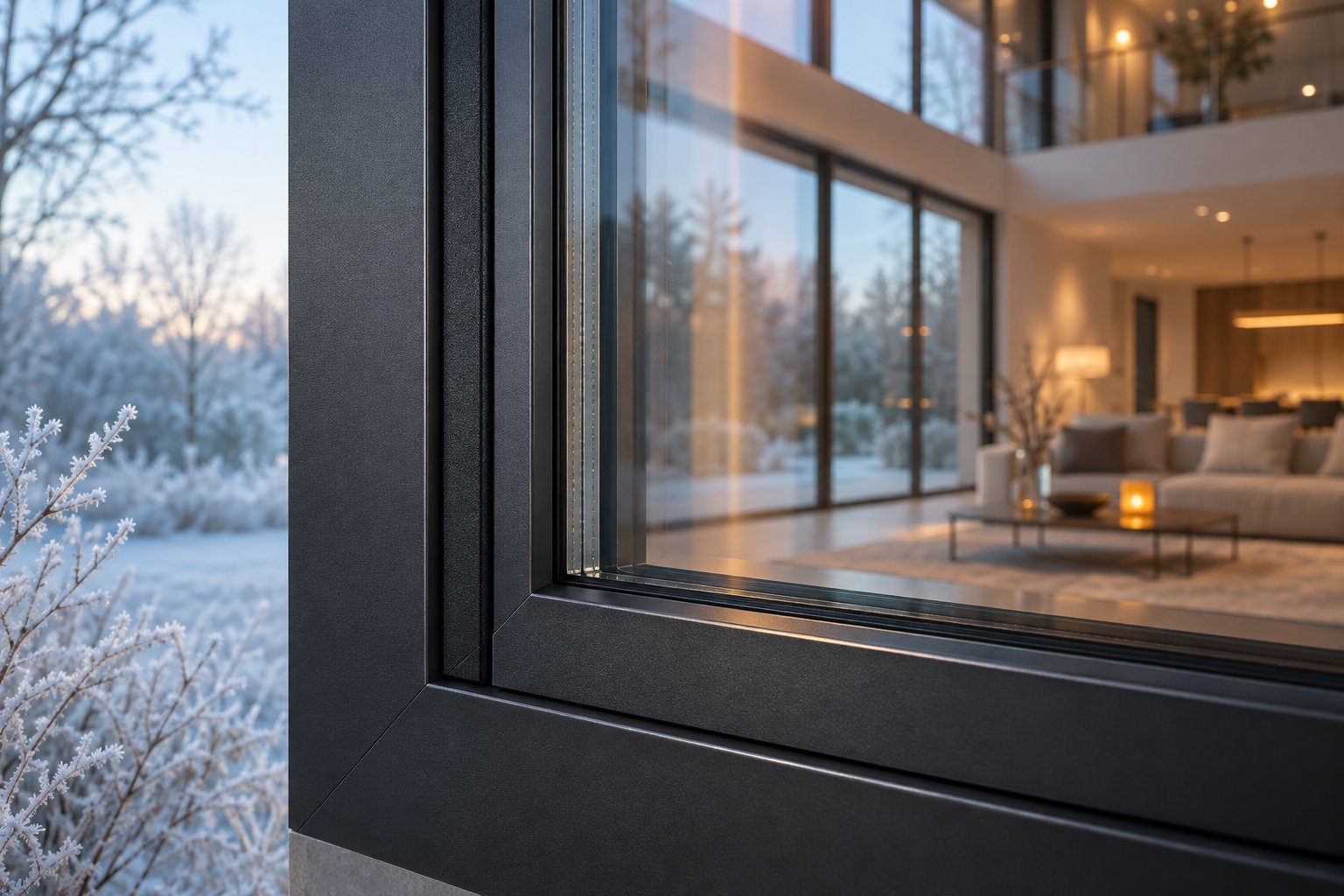
How Thermal Breaks Change Aluminium's Thermal Behaviour
On a July morning in Canberra, touch the frame of an old aluminium sliding window. It feels almost as cold as the air outside. The objection is fair: aluminium moves heat very easily. Modern frames deal with it by putting a barrier in the middle of the frame.
Why Aluminium Frames Lose Heat Without a Thermal Break
Aluminium conducts heat very well. If a frame is one continuous piece of metal, heat from a warm room runs straight through it to the cold outside face. The glass might be a well-specified double-glazed unit, but heat simply goes around it through the frame. This kind of shortcut is called a thermal bridge. A thermal break cuts that path. It is a low-conductivity barrier that separates the interior metal from the exterior metal, so the two halves never touch.
How Thermal Breaks Make Energy Efficient Aluminium Windows Possible
Two manufacturing methods dominate. Thermal barrier manufacturer Azon describes both as proven in windows and curtain wall:
- Polyamide strips: pre-extruded strips, usually glass fibre-reinforced polyamide 6.6, are crimped into knurled grooves in the inner and outer aluminium sections. The crimp holds the frame together, so the extrusions need tight tolerances.
- Pour and debridge: a two-part polyurethane is poured as a liquid into a channel in the extrusion and cured in place. The metal bridge under the channel is then cut away, which leaves no metal-to-metal contact.
The materials differ as thermal insulators. Polyurethane foam has the lowest conductivity, solid polyurethane comes next, and glass-filled polyamide comes after that. The shape of the frame matters as much as the material. A deeper break gives heat a longer path through low-conductivity material. Several small internal chambers slow the air movement that carries heat across large hollow sections. The frame's overall geometry also counts: how much metal sits on each side of the break, and whether the break lines up with the glass. Get these wrong and cold spots remain, even with good thermal insulators in the frame.
How to Tell if Aluminium Window Frames Are Thermally Broken
- Look at a cut frame end on a display sample, or at a cross-section drawing. A thermally broken frame shows a non-metal separator, usually a dark strip or band of resin, between the inner and outer metal.
- Ask for the section drawing of the exact system on your quote. A brochure image of a different range doesn't count.
- Check that the break carries through both the sash and the outer frame. A broken frame paired with a solid metal sash still leaves a path for heat.
Condensation Risk and the CR and CRF Ratings
Condensation forms when the inside surface of the frame drops below the dew point of the room air. Moist air from showers, cooking and clothes drying indoors meets cold metal and turns to water. Without a thermal break, the inner frame can get nearly as cold as the outdoor air. This is why older aluminium frame windows in Hobart, Melbourne and the ACT often drip on winter mornings and grow mould along the seals.
Australian WERS labels concentrate on energy figures. If you are looking at an imported North American system, you may also see one of these two condensation metrics on its data sheet:
| Metric | Standard | Purpose and method | How to read it |
|---|---|---|---|
| Condensation Resistance (CR) | NFRC 500 | Computer simulation of frame, edge and centre-of-glass surface temperatures at 21°C inside and -18°C outside, at 30%, 50% and 70% relative humidity. The results are combined into one rating. | A single number used to compare products. Higher means better resistance. |
| Condensation Resistance Factor (CRF) | AAMA 1503 | Laboratory measurement of interior surface temperatures on a physical sample. | A single number. Higher means better resistance. |
Testing body Intertek notes that the methods are not equivalent and in most cases can't be correlated. Only compare CR with CR, or CRF with CRF. Neither replaces the WERS figures your certifier or energy assessor will ask for.
A warmer frame is the starting point. How much it improves the whole window, and whether that matters more in Hobart or in Darwin, only shows once the frame and glass are rated together.
Reading the WERS Label and Matching It to Your Climate
Two aluminium windows can look the same in a showroom and still behave very differently in a west-facing wall in Perth. The label shows the difference. In Australia that label comes from WERS, the Window Energy Rating Scheme. Very few supplier pages explain what its numbers mean.
How to Read a WERS Label on an Aluminium Window
WERS ratings are calculated under protocols set by the Australian Fenestration Rating Council. Those protocols use simulation methods aligned with the ones used by the US National Fenestration Rating Council (NFRC). Each figure on the label answers a different question:
| Metric | What it measures | How it is determined | Lower or higher? |
|---|---|---|---|
| Total window U-value (Uw) | How easily heat passes through the whole window, in W/m²K | Computer simulation of frame and glass together (method aligned with NFRC 100) | Lower is better |
| Solar heat gain coefficient (SHGCw) | The share of the sun's heat that gets inside, on a scale from 0 to 1 | Simulation (method aligned with NFRC 200) | Lower cuts summer heat gain. Higher helps collect winter sun |
| Visible transmittance (Tvw) | The share of visible daylight that gets through, on a scale from 0 to 1 | Simulation (method aligned with NFRC 200) | Higher means more daylight |
| Air infiltration | How much air leaks through the window assembly, in L/s.m² | Laboratory test to AS 2047 methods | Lower is better |
| Condensation resistance (CR) | How well interior surfaces resist condensation | NFRC 500. This appears only on North American data sheets, not on WERS labels | Higher is better |
Every WERS figure covers the whole window. It rates the frame and the glass together, for a defined product type at a standard rating size. Glass suppliers often publish a centre-of-glass value (Ug) that looks much better because it leaves out the frame and the edge of the glazing unit. A centre-of-glass value is not a window rating. NCC compliance calculations ask for total system values.
When U-Value Matters More Than SHGC
In heating-dominated places such as Canberra, Hobart and the alpine regions, heat lost in winter has the biggest effect on comfort and energy bills. A low Uw keeps the interior surfaces warmer, which also reduces the condensation risk covered in the previous section.
In cooling-heavy climates such as Darwin, Townsville and Alice Springs, sunlight adds more heat than conduction does. There a low SHGCw usually matters more, especially on east and west walls. ENERGY STAR orientation guidance makes the same point for the northern hemisphere, so reverse the compass for Australia. In cooler climates, north-facing glass with a higher SHGC and a low U-value can collect useful winter sun. West-facing glass should have a low SHGC or be shaded.
Visible transmittance can work against a low SHGC. Tints and heavy coatings that cut solar heat can also cut daylight. Real products range from about 0.10 to 0.80, and values below 0.50 noticeably reduce the light that comes through. A dim living room means switching lights on at midday, so check Tvw before you accept the lowest SHGC on offer.
Using NCC Climate Zones to Choose the Best Aluminium Windows
The NCC divides Australia into eight climate zones. They run from zone 1 (hot, humid summers and warm winters, as in Darwin) to zone 8 (alpine). Brisbane is in zone 2, Sydney, Adelaide and Perth are in zone 5, Melbourne is in zone 6, and Canberra and Hobart are in zone 7. In the mixed climates, you balance Uw and SHGCw according to which way each window faces. The best aluminium windows for a Brisbane Queenslander won't be the best for a Hobart weatherboard home.
The maximum U-value and SHGC allowed on a project depend on the climate zone, the glazing area and the compliance path. That path is either the ABCB glazing calculator or a NatHERS assessment. The limits change between NCC editions, so take them from the current NCC or from your energy assessor. Don't rely on a rule of thumb or a sales rep's memory.
Checking Values in the WERS Product Search
- Ask the supplier for the WERS rating code for the exact frame series and glass on your quote.
- Look up the code on the WERS website and check that the manufacturer, product type and glazing all match.
- Compare the Uw, SHGCw and Tvw on the listing with the label and the quote. All three should agree.
- If the quote shows a better figure than the listing, ask where it came from. It is often a centre-of-glass value or a different glass option.
Imported systems complicate things further. Many European spec sheets quote their own Uw, which looks like the WERS figure but is worked out under a different set of rules.
Translating European Uf and Uw Ratings Into WERS Terms
Say a European spec sheet quotes a Uw that is well below the WERS figure for a local system. Both numbers are in W/m²K, so the imported window looks like the clear winner. It might be. But the two figures come from different rules, and the same unit doesn't make them comparable.
Uf and Uw Values Explained for Australian Buyers
European windows in aluminium are rated under EN ISO 10077. Their performance is declared under EN 14351-1, the product standard used for CE marking. European data sheets usually break the thermal figures into separate values:
- Uf: the frame on its own.
- Ug: the centre of the glass.
- Ψg (psi): the extra heat loss at the glass edge, where the spacer sits.
- Uw: the whole window, combining the three.
Uw is the only one of these that comes close to a WERS total window value. Like Ug, a low Uf can look impressive while saying little about the finished window.
Even Uw won't match a WERS figure. EN 14351-1 declarations use a standard window size of 1.23 m x 1.48 m. WERS ratings follow AFRC methods based on NFRC simulation, which use their own reference sizes, temperatures and surface heat-transfer assumptions. Building performance firm Baumann Consulting found that the NFRC and ISO methods can give U-values up to 18% apart for the same double-glazed assembly. The difference didn't run in a consistent direction either. A similar mismatch is likely between European and WERS figures, so no fixed correction factor will turn one into the other.
North American data sheets add a unit problem. They give the U-factor in Btu/h·ft²·°F. To convert, multiply by 5.678, so 0.30 becomes about 1.70 W/m²K. The conversion only changes the units. The result is still an NFRC value, measured under NFRC's size and conditions, and it is not a WERS rating.
What System Depth Numbers Mean in Aluminium Window Systems
Many aluminium window systems have a number in the name, and it usually refers to the profile depth in millimetres. COR 70 Industrial and MB-79N, both sold by European supplier Rhea, follow this pattern. OKNOPLAST's MIRU EVO has no number in its name, so you need the section drawing to find its depth. A deeper profile leaves room for a deeper thermal break and a thicker glazing unit. Depth is still not a rating. Two 70 mm systems can perform quite differently depending on the break and the chamber layout described earlier.
How Imported Aluminium Glazing Systems Get Certified for Australian Projects
To use an imported system for NCC energy compliance, through either the glazing calculator or a NatHERS assessment, you need total system U-value and SHGC figures calculated under AFRC methods. Imported aluminium glazing systems must be simulated by an AFRC-accredited simulator and listed through WERS. They may also need AS 2047 testing where the NCC requires it. The importer or fabricator usually arranges both. Ask whether the work covers the exact frame series and glass on your quote.
| Item | European approach | Australian approach |
|---|---|---|
| Units | W/m²K | W/m²K |
| Values published | Uf, Ug, Ψg and Uw listed separately | Whole-window Uw, SHGCw and Tvw |
| Standards | EN ISO 10077 for the calculation, EN 14351-1 for the declaration | AFRC protocols based on NFRC methods, plus AS 2047 for air, water and wind |
| Reference size | 1.23 m x 1.48 m standard window | AFRC rating sizes for each product type |
| Who certifies | The manufacturer, in a Declaration of Performance for CE marking | AFRC-accredited simulators, with ratings published through WERS |
For an Australian project, ask for the WERS-certified value for the exact system and glass. Don't rely on a European Uw or a converted North American U-factor.
Thermal figures cover only part of an imported system's paperwork. A separate rating shows whether the same window keeps out wind-driven rain on an exposed site.
Structural and Weather Ratings for Residential and Commercial Projects
An easterly storm hits a three-storey home on a Newcastle headland. Rain blows sideways into the glass, and each gust pushes and pulls on the sashes. Whether water ends up on the floorboards depends on the window's structural and weather ratings. Supplier pages rarely publish them. Ply Gem's "Structural Integrity" card and Rhea's wind-load claims both sound reassuring, but you can only check claims like these against a tested rating.
AS 2047 Ratings for Wind, Water and Air
In Australia, windows and external glazed doors are rated under AS 2047. A sample window is tested in a laboratory, and the results are reported as:
- Serviceability wind pressure (SLS): the pressure the window handles in strong everyday winds without bending too far or being damaged. It is given in pascals (Pa).
- Ultimate wind pressure (ULS): the pressure the window must survive without breaking or blowing out of the opening, also in Pa.
- Water penetration resistance: the highest test pressure at which no water gets past the window, in Pa.
- Air infiltration: leakage in L/s.m², the same figure that appears on the WERS label.
For houses, these results are often shown as a wind rating such as N2 or C1, matched to the site's wind classification. A compliant window should come with a label or certificate showing the manufacturer, the product series and its ratings. Each rating holds only for the size and configuration that was tested.
NAFS Performance Classes R, LC, CW and AW on Imported Data Sheets
North American systems are rated under the North American Fenestration Standard (NAFS), AAMA/WDMA/CSA 101/I.S.2/A440. Since the 2008 edition, NAFS has used four performance classes: R, LC, CW and AW. The letters started out as residential, light commercial and architectural labels. The standard later dropped those descriptions, because the class is chosen separately from how the building is used. The test requirements get harder as you move up the classes. For example, AW products face water testing at 20% of design pressure, while the other classes are tested at 15%.
Two terms cause most of the confusion:
- Design pressure (DP): the wind pressure the window was tested to structurally. Windows are load-tested at 150% of their DP.
- Performance grade (PG): confirms that the product passed its DP and every other requirement for its class, including air and water. NAFS made this distinction because some manufacturers were marketing products on DP alone.
A NAFS rating string reads from left to right: class, performance grade, the maximum size tested, and the product type. The general format is "[Class]-PG[number]: Size tested [width x height] - Type [code]". If a data sheet shows a DP with no class or PG, the product hasn't been shown to meet the full standard.
| What is tested | Australian method | North American method | What a pass shows |
|---|---|---|---|
| Air leakage | AS 2047 air infiltration test | ASTM E283 | Air leakage through the closed window stays within the limit for its rating |
| Water penetration | AS 2047 water penetration test | ASTM E331 | No water passes the inside face under spray at the test pressure. NAFS sets a 140 Pa minimum for R-class products |
| Structural load | AS 2047 deflection and strength tests at SLS and ULS | ASTM E330 | The frame and glass resist wind pressure without bending too far or failing |
Impact resistance is tested separately. US products for hurricane regions are tested to ASTM E1886, using the large and small missile criteria in ASTM E1996. A US hurricane rating doesn't automatically satisfy Australian cyclone requirements. In the cyclonic wind regions of northern Queensland, the Northern Territory and northern Western Australia, windows need cyclonic ratings, and some building elements may also need to resist windborne debris. Your certifier or structural engineer decides which of these tests apply.
Which Strong Aluminium Window Is Better for Residential or Commercial Windows
You can't say which strong aluminium window is better until you know the loads on your site. Work out the site's requirements first, then look for a window rated to meet them.
The residential path
- Your builder, certifier or engineer sets the site's wind classification under AS 4055. It runs from N1 to N6 in non-cyclonic areas and from C1 to C4 in cyclonic areas. The classification depends on the wind region, the terrain, shielding from nearby buildings and the site's topography.
- The window's rating must meet or exceed that classification. An exposed beachfront or hilltop double-storey home usually needs a higher rating than a sheltered suburban block.
- Check the water rating as well as the wind rating. A window can pass the wind tests and still leak if its water resistance is too low for the exposure.
- Imported North American products for houses are usually rated R or LC. They still need AS 2047 results for NCC compliance.
The commercial path
- A structural engineer calculates design wind pressures for taller and commercial buildings under AS/NZS 1170.2. Pressures are usually higher near corners and at the top of the building, so one facade may need windows with different ratings.
- Compare commercial aluminium windows and storefront windows on their tested SLS, ULS and water pressures at the proposed size. Those figures should come from test reports issued by a NATA-accredited laboratory.
- For North American systems, specifiers usually compare CW and AW products. Commercial-focused manufacturers such as Kawneer publish separate product series that specifiers compare on these ratings.
- Ask for the full test report rather than a summary sheet. It should state the tested size, configuration, glass and pressures.
Don't take DP, PG or pressure targets from a brochure or from this guide. Get the required values for your project from your certifier, building surveyor or structural engineer. Then check the window's tested ratings against them.
These tests measure a new window on the day it leaves the factory. On a beachfront block in Cairns, the frame also has to resist years of salt air and strong UV, and that depends on a different set of specifications.
Finishes and Corrosion Resistance That Determine Durability
Supplier pages often say aluminium won't warp, swell, rot or attract termites. That is true of the bare metal. On a Gold Coast balcony, though, a window usually fails in two places. The finish chalks, fades or blisters, and salt works its way in around the screws and hinges. A durability claim only holds if the metal, the finish specification and the hardware are all suited to the site.
Anodised vs Powder-Coated Finishes on an Aluminium Window Frame
Anodising changes the surface of the metal itself. It grows a hard oxide layer out of the aluminium. Powder coat and liquid paint are organic coatings that sit on top of the metal. Because the two work differently, they have separate specifications. AAMA 611 covers anodising. AAMA 2603, 2604 and 2605 cover coatings, and a coatings industry guide notes that these three apply to powder and liquid alike.
AAMA 611 has two classes. Class I is the thicker anodic layer, with a minimum of about 18 microns. It is meant for exterior parts that face constant outdoor exposure, and finisher Linetec notes that it resists salt spray and sea coast conditions better than Class II. Class II has a minimum of about 10 microns. It suits interiors, or light exterior use where the frames are cleaned on a regular schedule.
AAMA 2603, 2604 and 2605 Coatings Compared
All three coating tiers go through the same kinds of chemical, mechanical and weathering tests. Each step up makes the tests longer and the pass marks stricter. Outdoor weathering on a hot, humid, high-UV test site shows the gap most clearly. It runs for 1 year for AAMA 2603, 5 years for 2604 and 10 years for 2605.
| Specification | Finish type | Relative exposure performance | Typical use |
|---|---|---|---|
| AAMA 611 Class II | Anodised, thinner layer | Lower. Less wear-resistant than Class I | Interiors, or sheltered exteriors that are cleaned regularly |
| AAMA 611 Class I | Anodised, thicker layer | Higher. Better resistance to salt spray and coastal air | Exteriors under continuous outdoor exposure |
| AAMA 2603 | Organic coating, standard polyester | Lowest of the coating tiers. A "slight change" in colour and gloss is allowed | Mainly interiors. Sometimes used on low-cost residential exteriors |
| AAMA 2604 | Organic coating, super-durable polyester | Good. Sets measured limits on colour change and gloss loss | Exterior windows, doors and shopfronts |
| AAMA 2605 | Organic coating, fluoropolymer (70% PVDF liquid or FEVE powder) | Highest. The strictest weathering tests and the highest gloss retention requirement | High-value homes, curtain walls, and exposed coastal sites |
Australian suppliers often quote AS 3715 for powder coating or AS 1231 for anodising. If they do, ask which class or grade within that standard the finish meets.
Choosing Durable Aluminium Windows for Coastal and High-UV Sites
Salt air carries chloride ions. These get into weak spots in a coating and speed up corrosion of the aluminium underneath, including the thread-like filiform corrosion that can spread under paint. Strong UV, which much of Australia gets all year, breaks down colour and gloss. The longer weathering and salt tests are designed to screen for both of these stresses. That is why AAMA 2605 coatings and Class I anodising are the usual recommendation for beachfront and high-UV sites, from Perth's coast to far north Queensland.
Hardware and fasteners need the same care as the frame. Marine-grade stainless steel, such as grade 316, holds up better than plated steel. When two different metals touch in wet, salty air, galvanic corrosion can start where they meet.
Read the finish warranty carefully as well. Some warranties define a "marine environment" as anywhere within a fixed distance of salt water, such as 300 m or 1.6 km, and exclude or reduce coverage inside that zone. Fairview Architectural advises reading the definitions section before the exclusions, because the definitions decide whether the exclusion applies to you.
Questions to ask before you sign:
- Which AAMA specification, or which AS 3715 or AS 1231 class, does the finish meet? Can the supplier show the coating manufacturer's documentation?
- What does the finish warranty cover and exclude? Is coverage reduced within a set distance of the coast? Ask for the full document rather than a summary card.
- Do custom aluminium windows in non-standard colours use the same coating specification as the standard range? A special colour can come from a different product line.
- What cleaning schedule keeps the warranty valid, and do you need to keep records of it?
- What grade of stainless steel are the hinges, stays, locks and screws?
Low upkeep is one of the main reasons people choose aluminium over timber. Whether aluminium keeps that lead against uPVC, timber and fibreglass depends on more than the finish. Heat loss, stiffness and cost also matter.
How Aluminium Compares With uPVC, Timber and Fibreglass
Plenty of supplier pages say aluminium beats every other frame material. Few of them put it side by side with the alternatives. The table below does that. Each rating describes a general tendency for a typical product. It is not a guarantee for every window made from that material.
Aluminium vs uPVC, Timber and Fibreglass Frames
| Attribute | Thermally broken aluminium | uPVC | Timber | Fibreglass |
|---|---|---|---|---|
| Thermal performance | Moderate to good. Depends on the depth and design of the break | Good | Good | Good |
| Strength and stiffness | High | Lower. Large frames often need internal steel reinforcement | Moderate | High |
| Sightlines | Slimmest | Widest | Moderate to wide | Slim to moderate |
| Durability | High. Won't rot or swell. The finish decides how well it lasts on the coast | Good. Some profiles can distort after long periods of heat and sun | Depends on upkeep. Rot and termite risk | High. Resists warping and swelling |
| Maintenance | Low. Regular cleaning, more often near the coast | Low | High. Needs repainting or re-staining | Low |
| Relative cost | Moderate to high | Low to moderate | Moderate to high | Moderate to high |
Australian prices vary widely by supplier, glazing and region. Fibreglass windows are also less common here than the other three materials, so expect fewer suppliers to choose from.
Where Residential Aluminium Windows Have the Edge
Each of aluminium's advantages comes from a property of the metal. Glazing manufacturer PRL Glass points out that aluminium has a higher strength-to-weight ratio than uPVC and many composite systems. A stiff frame can hold large, heavy glass without a bulky profile. That is why residential aluminium windows can have slim sightlines and wide spans, such as a wall of glass between a north-facing living area and the deck.
The metal is also dimensionally stable. It doesn't absorb water, so it can't swell or rot, and termites have nothing to eat. It also keeps its shape through the long, hot, sunny summers that can distort some plastic frames.
When Aluminium Window Systems Are the Wrong Choice
Another material may suit the project better in these cases:
- Very cold climates on a tight budget. In alpine areas (NCC climate zone 8) or the Tasmanian highlands, a frame needs a deep, high-performing thermal break. If the budget can't cover one, a standard break may fall short of the energy targets.
- Lowest upfront cost. A thermally broken aluminium window usually costs more than a basic one. In standard sizes, uPVC can sometimes meet the same energy target for less. Compare quotes for products with the same ratings.
- A timber interior. Timber windows give that look directly. Aluminium-clad timber is a middle option, with timber on the inside and aluminium facing the weather.
The frame material matters less than the design of the specific product. Green Building Advisor cites a frame optimisation study in which a reference aluminium frame had a frame-only Uf of 2.775 W/m²K. Combining design improvements cut it to 1.210 W/m²K. That improved aluminium frame beat the study's reference uPVC frame (1.503) and reference timber frame (1.640). The best uPVC and timber designs still went lower, to 0.759 and 0.584.
Within one material, the gap between a poor design and a good one can be larger than the gap between materials. Compare the certified WERS ratings for the exact product, not the frame type.
Most of those design improvements need room inside the frame. The very slim profiles that draw people to aluminium leave the least room for them.
Slim Sightlines, Large Spans and the Performance Trade-Off
Picture a three-metre opening that looks out over the water, with frames so thin they almost vanish. Minimal-frame systems sell that look, and European suppliers such as OKNOPLAST and Rhea compete hard for this market. The brochures rarely show what the look costs in performance.
The Thermal Cost of Slim Sightlines and Large Glass Areas
A narrow frame leaves less room for a deep thermal break and for the extra chambers that slow heat flow. Window maker Bildau & Bussmann notes that slim frames also shrink the edge zone where the spacer and seal sit. Manufacturers often make up for this with higher-specification glass, such as triple glazing with warm-edge spacers.
Bigger panes change the numbers in two ways. First, the whole-window rating moves closer to the glass rating, because the glass now makes up most of the window. Glass maker Vitro points out that the frame lowers a window's SHGC compared with the glass on its own. A nearly frameless unit therefore lets in more solar heat, which matters on a west-facing wall in Perth. Second, a large pane catches more wind and weighs more. Slim profiles can still meet the structural requirements, but they often need internal steel or aluminium reinforcement to do it.
Concealed Sash and Flush Designs in Architectural Aluminium Windows
Many architectural aluminium windows hide the sash behind the outer frame or set it flush with the frame face, so you see one clean line. To get that line, the designer has to rearrange the profile. The thermal break may sit in a different position or follow a more complex path than it does in a standard sash. Drainage changes as well. Water that gets past the outer seals still needs a clear route back outside. Ask for the section drawing and check that it shows the break and the drainage path.
Judging Frameless Modern Window Systems for High-End Architecture
Pros
- More glass and daylight. Cutting the visible frame by 20 to 30 mm makes the glazed area noticeably larger, and the gain adds up across multi-pane units.
- Clearer views and a lighter-looking facade.
- Wide spans that connect living areas to decks and gardens.
Cons
- Less room for a deep thermal break and the glass edge seal.
- More solar heat gain, and energy performance that depends more heavily on the glass.
- Higher wind loads and heavier sashes, which may need reinforcement and heavy-duty hardware.
- Higher cost, since the glass, hardware and fabrication tolerances are usually top of the range.
The best frameless modern window systems for high-end architecture have ratings that back up the look at the size you plan to build. Before you commit to any minimal-frame aluminium window system, work through these checks:
- Ask how the WERS values change at your proposed size and configuration, and whether the supplier can provide a project-specific calculation.
- Ask for the AS 2047 wind and water ratings at that size, not just at the size the supplier tested.
- Confirm how the glass is supported in the frame and how water drains out.
- Confirm the weight limits for the hinges, rollers and stays on large sashes.
For commercial projects with custom aluminium window options, ask for project-specific engineering or test reports. Those reports should come from a structural engineer or a NATA-accredited laboratory.
A rating published at a standard size may not hold for an oversized unit. Compare the size tested, shown on the label or test report, with the size on your plans.
A unit rated at the right size still depends on how it is fitted. In the lab, the sample sits in a sealed test rig. On site, it goes into a brick veneer or weatherboard wall, and the quality of that installation affects how the window performs.
Installation and the Gap Between Lab Ratings and Real Results
A window can pass every AS 2047 test and still leak in its first wet winter. The lab only tests the unit itself. On site, how well the window keeps out air and water also depends on the rough opening, the flashings, the sill tray and the seal between the frame and the wall's air barrier. The label covers none of these.
Why Installation Decides Real-World Window Performance
Leaks usually start at the opening, not in the window. A technical guide from US Made Supply says most window leaks trace back to improper flashing and not to defective windows. Two faults come up again and again. The first is reverse-lapped flashing, where a lower layer laps over an upper one and sends water behind the wall wrap. The second is a missing sill tray. Both are hidden once the cladding or brickwork goes up, so they often go unnoticed until the timber frame or insulation is already damaged.
Flashing, Sill Pans and Air Sealing at the Rough Opening
ASTM E2112, the US installation practice, is often cited in imported product instructions. It rests on one principle, shingling: each upper layer laps over the one below it, so water always runs outward. In Australia, AS 2047 includes its own installation requirements, and the NCC adds weatherproofing provisions. In every case, follow the manufacturer's installation instructions for the exact system. Warranties often depend on them.
- Lap the flashings into the wall wrap. Fit the sill flashing first, then the jambs, then the head. The wrap above the opening should lap over the head flashing.
- Drain the sill. Fit a sill tray (also called a sill pan) that slopes to the outside, or use the drainage detail the manufacturer specifies. In brick veneer homes, the flashing also has to carry water across the cavity to the outside face of the brickwork.
- Seal the perimeter continuously. The gap between the frame and the opening needs an unbroken air seal joined to the wall's air barrier. Scattered dabs of foam or sealant are not enough.
- Pack and fix the frame square. Use the right packers and fixings so the frame doesn't twist or bow. A distorted frame can stop the sashes sealing properly.
- Keep weep holes clear. Render, paint, sealant and mortar droppings can block the drainage holes, and the trapped water then finds its way inside.
What Window Fabricators and Installers Should Document
Ask window fabricators and installers to record which version of the installation instructions they followed. They should also photograph the flashings and sill tray before cladding or linings cover them, and keep the product labels.
On large projects, field testing checks the installed windows the same way the lab checked the product. ASTM E1105 sprays installed windows with water while applying an air pressure difference across them. Specifications often call it up through AAMA 502, which defaults to testing three installed windows. There is no industry consensus on how many windows to test, so the contract should say how many windows, which ones and at what pressure.
Before you award the contract, ask aluminium window suppliers for large projects and aluminium window manufacturers whether they supply project-specific installation details, and whether they will attend site testing. Their answer adds one more line to a longer list of documents worth asking for on any quote.
How to Evaluate Any High Performance Aluminium Window
Every rating in this guide has a document behind it. To find out which aluminium window is reliable, ask for those documents before you start comparing prices. A supplier who can produce them quickly has usually done the testing. A supplier who can't is asking you to trust the brochure.
A Buyer Checklist for Any Aluminium Window Supplier
Ask every aluminium window supplier on your shortlist for the same six items:
- The WERS listing. Get the rating code and the certified listing for the exact frame series and glass on your quote. An imported North American product may also carry an NFRC label, but NCC compliance needs the WERS figures.
- The AS 2047 ratings. These are the serviceability and ultimate wind pressures, the water penetration resistance and the air infiltration, along with the size tested. For a North American system, also ask for the NAFS rating string showing the class, PG and DP.
- Test reports by method. Each report should name the AS 2047 test, or ASTM E283, E331 and E330 for a North American product, and the laboratory that ran it.
- The finish specification. This means AAMA 2603, 2604 or 2605 for coatings, the AAMA 611 class for anodising, or the matching AS 3715 or AS 1231 class.
- Installation instructions for the exact system you're buying.
- The full warranty document. Check for coastal exclusions and the maintenance conditions that keep the warranty valid.
Spotting Vague Claims and Comparing Quotes Fairly
You can only compare two quotes if they describe the same window. Line them up on size, configuration (awning, fixed or sliding, and the number of panes), glazing unit and rating basis. A quote that gives a WERS whole-window U-value can't be weighed against one that gives a centre-of-glass Ug or a European Uw. Ask the second supplier for its WERS figure, or ask the first to price the same glass.
Question these phrases whenever they appear without evidence:
- "Energy efficient" with no WERS rating code.
- A low U-value that turns out to be for the glass only, presented as if it rates the whole window.
- "Commercial grade" or "heavy duty" with no AS 2047 rating or NAFS class.
- "Coastal grade" with no named finish specification or class.
- Thermal figures labelled indicative or preliminary. The Australian Glass and Window Association notes that WERS what-if-scenario results are uncertified and can't be used for NCC compliance until they have been audited.
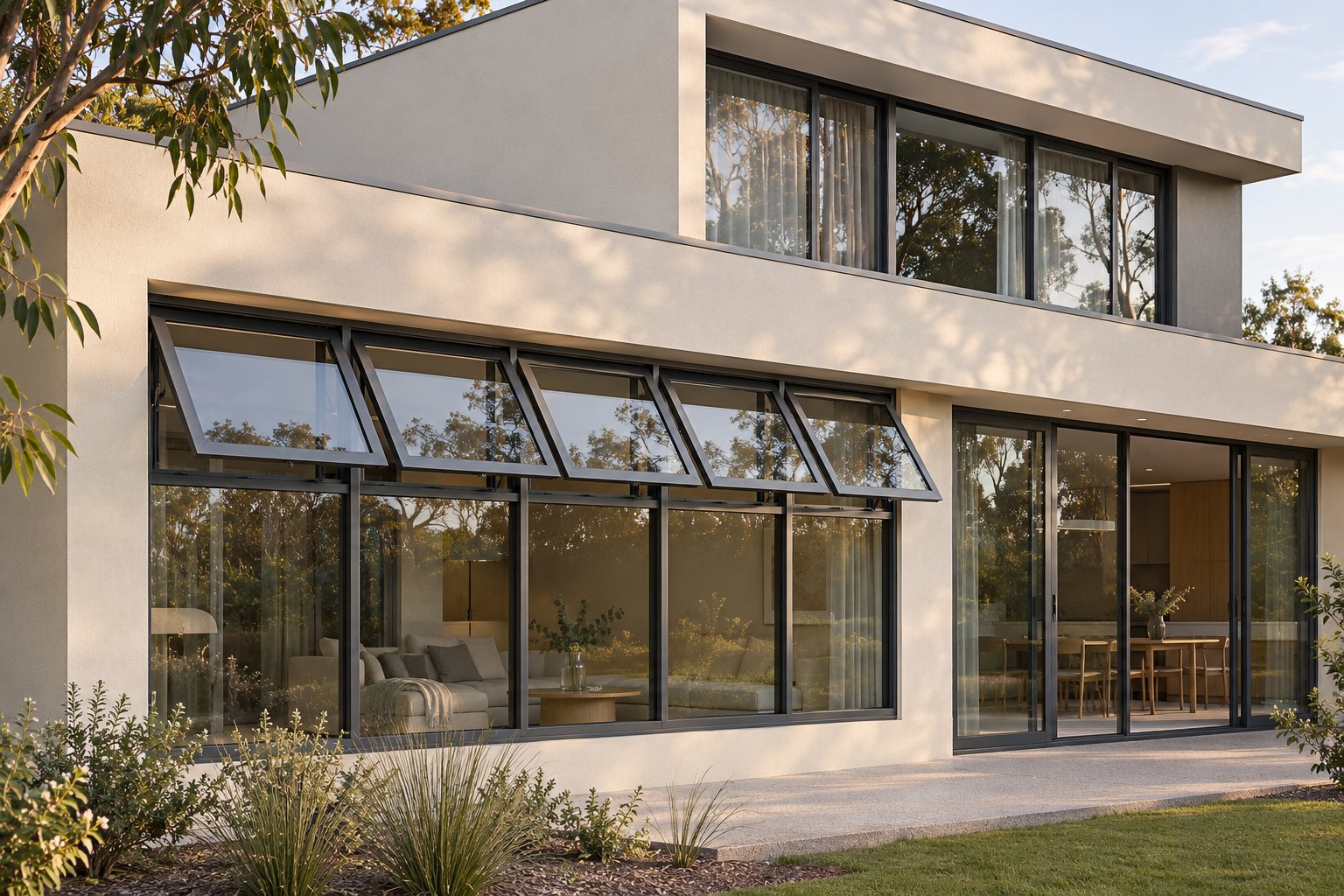
Applying Aluminium Awning Windows Thermal Performance Standards to a Real System
Take MEICHEN's MC100 thermally broken awning window as a worked example. This is not a recommendation, and the same table works for any product. MEICHEN lists a thermally broken aluminium frame, double-glazing options, and finishes and hardware chosen for each project. Because the finishes and hardware are chosen per project, they can be coordinated with a residential or commercial window schedule. That covers both the homeowner path and the specifier path described in Section 5.
| Checklist item | What the supplier lists | What to verify |
|---|---|---|
| Product | MEICHEN MC100 Awning Window | The series, configuration and size on the quote match those in every document you receive |
| Frame | Thermally broken aluminium frame | A section drawing showing that the break runs through both the sash and the outer frame |
| Energy ratings | Listed double-glazing options | A WERS Uw, SHGCw and Tvw for the full frame-and-glass assembly at your size and configuration. A glass-only value does not count |
| Structural and weather ratings | Ask the supplier | AS 2047 wind, water and air ratings at the proposed size, checked against your site's wind classification |
| Finish | Finishes chosen for each project | The AAMA, AS 3715 or AS 1231 specification and class, and whether custom colours use the same specification |
| Hardware | Hardware chosen for each project | The stainless steel grade for coastal sites and the weight limits for the sash size |
| Installation and warranty | Ask the supplier | The installation instructions for this system and the full warranty terms |
For Australian projects, verification means a WERS listing and AS 2047 ratings, as Section 4 explained. NFRC certification and NAFS testing only come into play if a system is going to a US project. The energy performance has to be confirmed for the complete assembly, and no fixed energy savings are promised. Real savings depend on your climate zone, the orientation of each window, shading and the rest of the building, so your energy assessor is the right person to model them.
Once the listing, the test reports and the finish specification agree with your quote and your plans, the window's "high performance" description is supported by evidence.
High Performance Aluminium Windows FAQs
1. Are aluminium windows energy efficient enough for Australian homes?
They can be, but only with a thermal break. A thermal break is a strip of polyamide or polyurethane that separates the inside and outside metal. Without one, the frame carries heat around even well-specified double glazing. Which figure matters most depends on your climate. In cold places such as Canberra or Hobart, a low whole-window U-value does most of the work. In Darwin or Townsville, a low SHGC on east and west walls usually matters more. The proof is the WERS figure for the frame and glass together at your size, not a brochure claim. For example, MEICHEN's MC100 awning window has a thermally broken frame and listed double-glazing options. Its energy performance still has to be confirmed for the complete assembly you are ordering, and no fixed energy savings are promised. Your energy assessor can model likely savings for your orientation, shading and climate zone.
2. What is the difference between a WERS rating and a glass-only U-value?
A glass-only figure, often written as Ug or centre-of-glass, measures the middle of the glazing unit. It leaves out the frame and the edge of the glass, which are usually the weakest parts of the window, so it tends to look better than the real result. A WERS rating covers the whole window, frame and glass together, for a defined product type at a standard rating size. NCC energy compliance through the ABCB glazing calculator or a NatHERS assessment uses whole-window values. If a quote shows a better number than the WERS listing, ask whether it is a glass-only value, a different glass option or an uncertified what-if result.
3. What wind and water rating do my aluminium windows need?
Your site sets the requirement, and the window has to meet it. For houses, your builder, certifier or engineer works out a wind classification under AS 4055. It runs from N1 to N6 in non-cyclonic areas and C1 to C4 in cyclonic areas, depending on wind region, terrain, shielding and topography. The window's AS 2047 ratings must meet or exceed that classification, and its water penetration rating should suit the exposure as well. For taller or commercial buildings, a structural engineer calculates design pressures under AS/NZS 1170.2, and corners and upper levels often need higher ratings. A rating only applies to the size tested, so check the test report against the sizes on your plans.
4. Which aluminium window finish lasts best near the coast?
For beachfront and high-UV sites, the usual recommendation is an AAMA 2605 coating or AAMA 611 Class I anodising. These pass the longest weathering and salt exposure tests in their specifications. If your supplier quotes AS 3715 for powder coat or AS 1231 for anodising, ask which class within the standard the finish meets. The finish is only part of the job. Hinges, stays, locks and screws should be marine-grade stainless steel such as 316, and different metals should not touch in wet, salty air. Read the warranty definitions too. Some warranties reduce or exclude cover within a set distance of salt water, or depend on a recorded cleaning schedule.
5. Can I use a European or US window rating for NCC compliance?
No. European Uw values follow EN ISO 10077 and use their own standard window size. US NFRC values use different sizes and test conditions again. Converting a US U-factor to metric units by multiplying by 5.678 changes only the units, not the rating method, and no fixed correction factor turns either figure into a WERS rating. An imported system needs total system U-value and SHGC figures simulated by an AFRC-accredited simulator and listed through WERS. It may also need AS 2047 testing. Before you sign, ask the importer or fabricator whether that work covers the exact frame series and glass on your quote.