
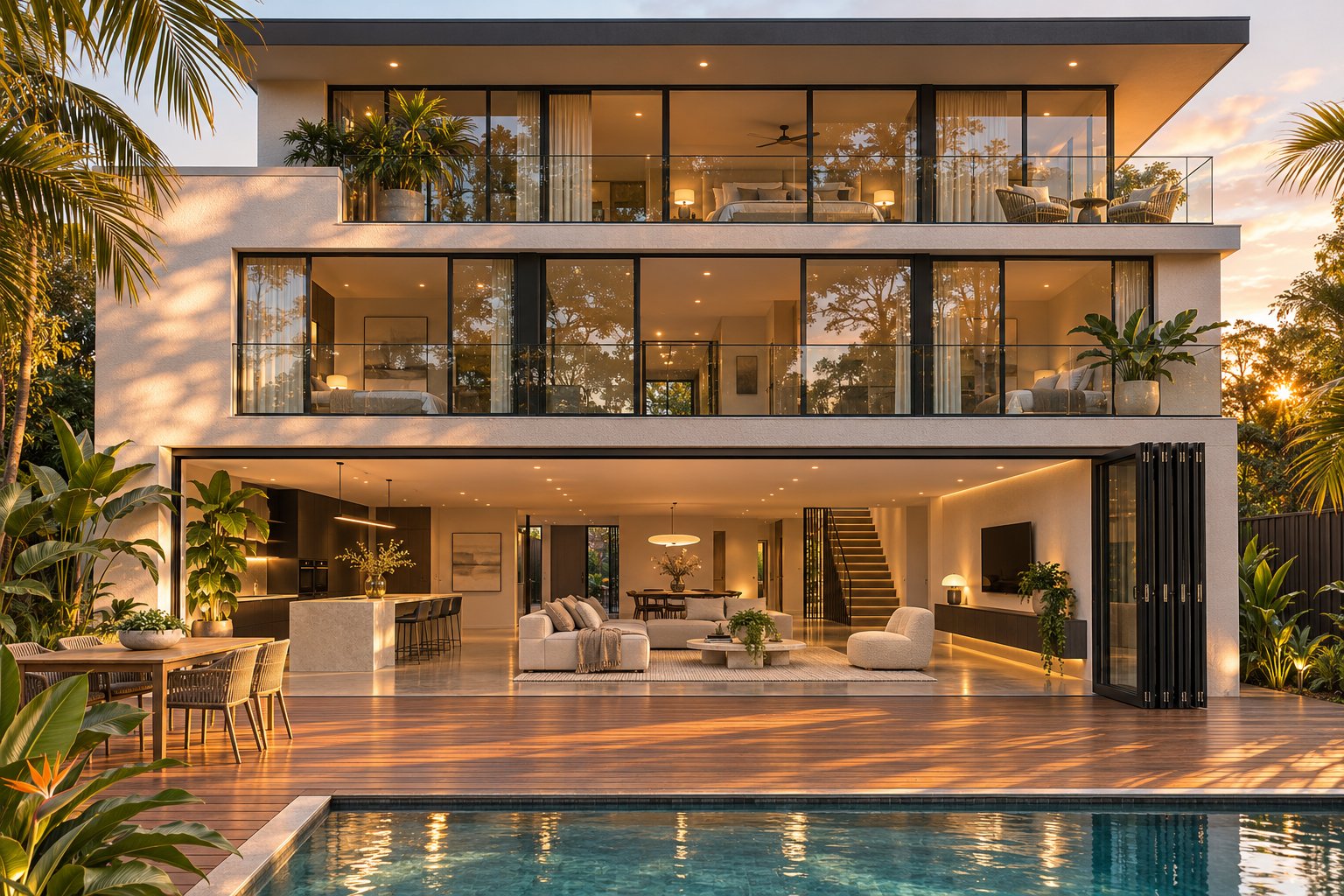
What Black Bifold Doors Are and Why They Work
Black bifold doors are a series of panels connected by hinges that fold concertina-style against one or both sides of an opening, finished in black to create a bold architectural statement. They work indoors — think bedroom wardrobes, laundry cupboards, pantry entries, and room dividers — and they work outdoors, transforming patio openings into seamless indoor-outdoor living spaces. The reason black has surged past white and timber tones as a finish choice is straightforward: it sharpens every line it touches. Against light-coloured walls, pale timber flooring, or rendered brick, a black frame reads as deliberate. It suits modern builds, industrial-style warehouses conversions, and transitional homes with equal confidence.
Search for these doors online and you will land on page after page of product listings and retailer catalogues. What you will not easily find is an independent guide that explains how the finish, the material, the glass, and the hardware all interact. That is the gap this article fills.
Black bifold doors function as both a practical space-saving solution and a design statement — which is exactly why they appear in projects ranging from small wardrobe makeovers to expansive alfresco renovations across Australian homes.
What Makes a Bifold Door a Bifold Door
The defining feature is the folding mechanism. Two or more panels are joined by hinges and ride along a track — typically overhead, sometimes at floor level — so they pivot and fold flat against each other. When fully open, the stacked panels sit tight against the side jamb and roughly 90% of the opening becomes walk-through space. A traffic door built into the set handles everyday access without folding the entire system.
That folding action is what separates bifolds from every other door type. Sliding doors glide behind one another but never leave the frame, so only 50–66% of the opening clears at any time. Pocket doors disappear into the wall cavity entirely — clever, but they demand significant structural modification. Barn doors hang from an exposed rail and slide sideways across the wall face. French doors swing open as a hinged pair, limited to openings of around 2,400 mm. Bifolds occupy a unique middle ground: they can span wide openings like sliders yet clear nearly the full aperture like French doors.
Why Black Stands Out Among Door Finishes
Colour choice in doors is really a question of visual weight. White recedes, timber tones warm, grey softens — but black anchors. It draws the eye not to the door itself but to what lies beyond the opening, whether that is a garden view through glazed exterior panels or an organised walk-in wardrobe behind black closet doors. Designers describe this as framing: the dark border makes adjacent lighter surfaces pop, creating a sense of depth and intention that neutral finishes rarely achieve.
Black also plays remarkably well with hardware. Matte black handles on a black frame deliver a seamless monochrome look. Brushed brass against black aluminium bifold doors introduces warmth that suits transitional interiors. Polished chrome keeps things cool and contemporary. Even satin nickel pairs cleanly. Few other door colours offer that kind of versatility across metal finishes, which partly explains why black dominates specification sheets from compact apartment wardrobes right through to six-panel patio systems.
Yet not all black doors are built the same way or built for the same job. The split between interior and exterior applications changes everything — from the materials involved to the weight of each panel, the glazing requirements, and the budget.
Interior Versus Exterior Black Bifold Doors
Most product pages lump every bifold into one category. In practice, an interior bifold closet door and an exterior patio bifold system share a name and a folding mechanism — and almost nothing else. The materials differ, the engineering differs, the price differs, and the installation complexity sits at opposite ends of the spectrum. Treating them as interchangeable leads to poor purchasing decisions, so it pays to understand where the line falls.
Interior Black Bifold Doors for Wardrobes and Room Dividers
Inside the home, black bifold doors handle relatively gentle duty. They do not face rain, UV bombardment, or wind loads. Their job is to conceal storage, divide living zones, or close off utility spaces — and to do it without eating up valuable floor area the way a hinged door would.
Standard interior panels typically come in widths of around 610 mm (24 inches) or 910 mm (36 inches), with a common height of approximately 2,030 mm (80 inches). Taller options reaching 2,130 mm or 2,440 mm suit newer builds with higher ceilings. Because weather resistance is irrelevant, manufacturers can keep panels lightweight — often just 35 mm thick — using hollow-core timber, MDF, or composite construction. That low weight means a simple top-hung track and a floor-mounted pivot pin are enough to keep things running smoothly.
Black bifold closet doors in particular have become easy to source. Major home-improvement retailers, online marketplaces, and specialist door suppliers across Australia stock them in a range of panel styles, from flat slab profiles to shaker-style mouldings. Availability is rarely an issue for standard sizes.
Here are the most common interior applications and what makes each one tick:
- Bedroom wardrobes — a two-panel or four-panel set covers reach-in and walk-in openings without a door swing crowding the bedroom floor.
- Laundry cupboards — bifolds hide the washing machine and dryer in a hallway nook while folding flat for easy loading access.
- Pantry entries — a single two-panel bifold keeps kitchen storage organised and out of sight, especially useful in open-plan layouts.
- Room dividers — wider multi-panel sets can partition a living area from a study or guest space, then fold away when an open floor plan is preferred.
Because these doors stay indoors, buyers can prioritise aesthetics and budget over performance ratings. A factory-primed MDF panel painted matte black, for instance, delivers a clean look at a fraction of the cost of an aluminium-framed glazed system. That affordability is a big part of their popularity — a pair of black interior bifolds can refresh a dated wardrobe opening for a few hundred dollars.
Exterior Black Bifold Doors for Patios and Outdoor Living
Step outside and the engineering picture changes dramatically. An exterior bifold door faces direct sun, wind-driven rain, temperature swings, and — in coastal parts of Australia — salt-air corrosion. It also carries far more glass, weighs significantly more per panel, and must lock securely against forced entry. The lightweight MDF panel that works perfectly inside a wardrobe would warp, swell, and fail within months if exposed to the elements.
Aluminium is the dominant frame material here, and for good reason. It resists corrosion, accepts durable powder-coated black finishes, and supports large glazed panel spans without excessive bulk. Clad timber — an aluminium exterior shell bonded to a timber interior face — offers an alternative for homeowners who want the warmth of wood inside without sacrificing weather performance outside. Both options require multi-point locking systems, compression weatherseals, and drainage channels engineered to manage water infiltration under pressure, as detailed in weather-resistance guides for exterior bifold systems.
Structural considerations add another layer. Wide exterior openings need engineered steel or laminated timber headers above the door to carry roof and wall loads. The threshold must integrate with waterproofing membranes, floor finishes, and external paving levels — a coordination task that involves multiple trades. Double-glazed or even triple-glazed insulated glass units are standard for thermal and acoustic performance, pushing panel weight well beyond anything an interior track could handle.
One detail that catches many homeowners off guard is stack-back space. When exterior panels fold open, they do not vanish — they stack perpendicular to the wall alongside the opening. A four-panel system folding to one side, for example, creates a stacked block roughly 400–500 mm deep projecting from the jamb. That block can obscure adjacent windows, clash with downpipes, or crowd outdoor furniture if it is not accounted for during the design phase. Choosing a split configuration — panels folding to both sides — halves the stack depth at each end but demands clear space on two sides instead of one. Neither option is automatically better; the right choice depends on the room layout, garden path, and daily traffic patterns.
Exterior black bifold doors transform a solid wall into a retractable one, creating the seamless indoor-outdoor flow that defines contemporary Australian living. But the price of that transformation is a more complex specification process, a higher material cost, and a professional installation that accounts for structural loads, weatherproofing, and regulatory compliance — including relevant provisions of the National Construction Code and, in cyclone-prone regions, specific wind-load ratings.
With interior and exterior roles this different, the material behind the black finish becomes the next critical decision — and the options available for each application vary just as widely.
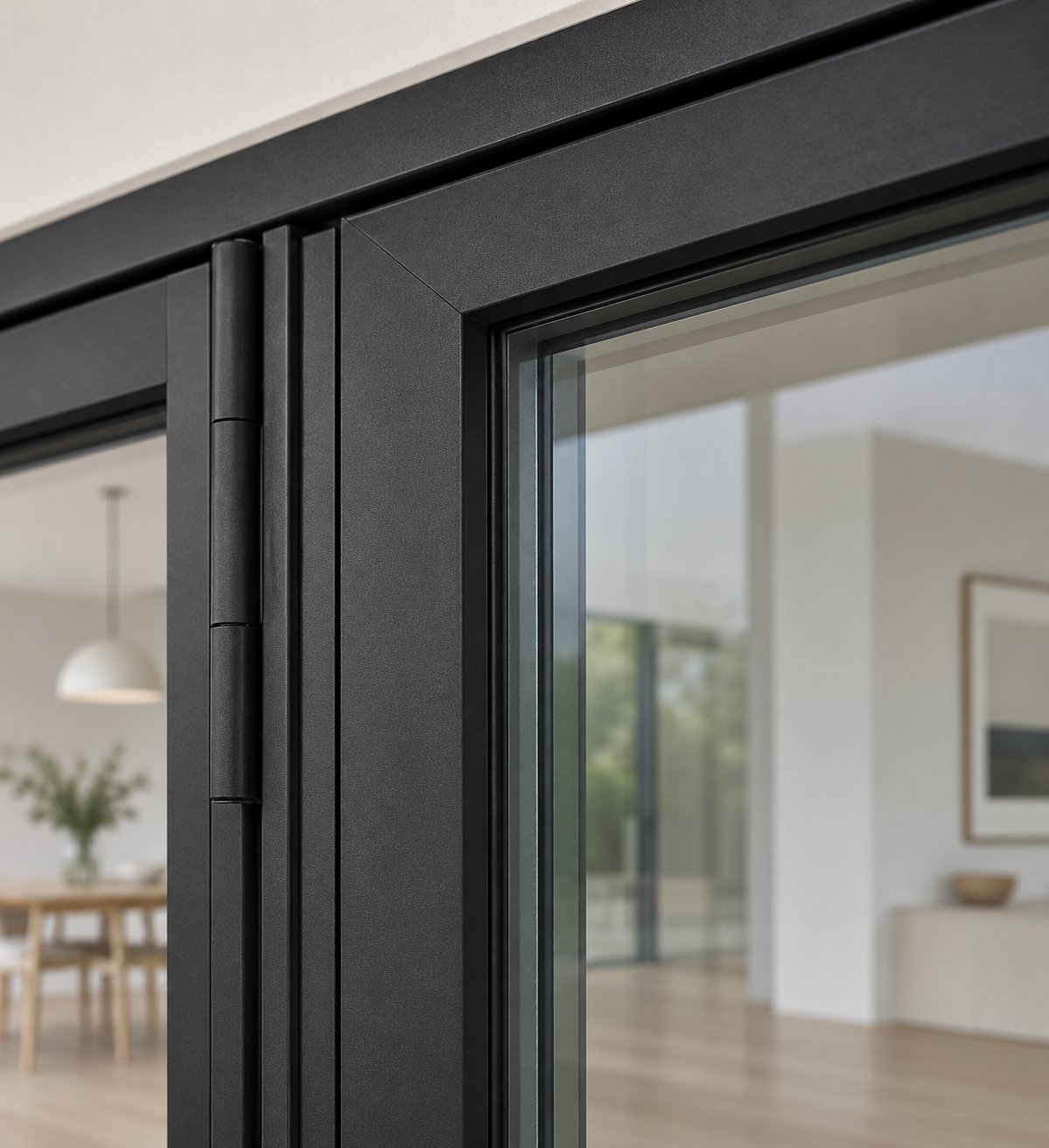
Comparing Materials for Black Bi Folding Doors
A black door is only as good as the material beneath its finish. Two bifold doors can look identical in a photograph — same colour, same panel count, same handle style — yet perform completely differently over five or ten years because one is powder-coated aluminium and the other is painted MDF. The substrate determines weight, durability, weather tolerance, and how well that black finish holds up under daily use. Choosing the wrong material for the application is the single fastest way to end up with a door that peels, warps, or sticks.
The table below breaks down the five most common materials used in black bifold doors, comparing how each one achieves a black finish, how long that finish lasts, and where it belongs in your project.
| Material | Black Finish Method | Durability | Approx. Weight per Panel | Best Application | Maintenance Level |
|---|---|---|---|---|---|
| Aluminium | Powder-coated or anodised black | Excellent — resists chipping, fading, and corrosion; can last 40+ years with minimal upkeep | 25–40 kg (glazed panel) | Exterior (primary); interior (premium option) | Low — wipe with mild soap and water |
| Wood (solid or engineered) | Painted or stained black | Good if maintained — susceptible to swelling, cracking, and paint peel without regular recoating | 15–30 kg (depending on timber species and glazing) | Interior; sheltered exterior only | High — sanding and repainting every 3–5 years |
| Composite / MDF | Factory-primed and painted black | Moderate — consistent factory finish resists flaking, but edges are vulnerable to moisture damage if seals break | 8–15 kg (hollow-core); 18–25 kg (solid-core) | Interior only | Low to moderate — damp cloth; avoid prolonged water contact |
| Vinyl (uPVC) | Laminated film or co-extruded colour | Fair — UV exposure can cause fading, chalking, or discolouration over time | 10–18 kg | Budget interior | Low — wipe clean, but difficult to repair or repaint |
| Clad wood (aluminium exterior, timber interior) | Powder-coated aluminium shell; timber interior painted or stained | Very good — aluminium cladding protects against weather while timber adds interior warmth | 30–45 kg (glazed panel) | Exterior (premium); interior (high-end) | Low (exterior face); moderate (interior timber face needs periodic refinishing) |
Each row tells a slightly different story. Aluminium and clad wood dominate the exterior conversation because they handle moisture, UV, and temperature cycling without degrading. Wood, MDF, and composite shine indoors where affordability and aesthetics matter more than weather resistance. Vinyl sits at the budget end, workable for a basic wardrobe door but limited in both colour depth and longevity — particularly in a dark finish that magnifies every surface flaw as it ages.
Aluminium as the Dominant Exterior Material
There is a reason aluminium frames appear in nearly every exterior bifold specification. The material ticks three boxes simultaneously: it accepts a powder-coated finish that genuinely resists chipping and UV degradation, it supports wide glazed panel spans without becoming impossibly heavy, and it pairs naturally with glass in slim-profile sightlines that maximise views. A well-maintained powder-coated aluminium bifold will hold its black finish for decades, even in harsh coastal environments where salt air attacks lesser materials within a few seasons.
Strength-to-weight ratio is the engineering advantage. A single aluminium bifold panel spanning 900 mm wide and 2,400 mm tall, fitted with double glazing, might weigh around 30–35 kg. A timber panel of equivalent dimensions and glazing spec would be heavier and require beefier track hardware. For multi-panel systems stretching across 4,000 mm or wider openings, that weight difference compounds — and so does the load on hinges, rollers, and the structural header above.
One critical caveat often flies under the radar. Not every aluminium bifold system is thermally broken. A thermally broken frame includes an insulating barrier — typically a polyamide strip — between the interior and exterior aluminium profiles, preventing the metal from conducting heat straight through the wall plane. A non-thermally broken aluminium frame, by contrast, acts as a thermal bridge: it will conduct heat in summer and cold in winter regardless of how good the glazing is. Australian buyers evaluating exterior aluminium black bifold doors should always ask whether the system includes a thermal break, especially in climate zones where energy performance requirements under the NCC and NatHERS ratings are stringent. Double glazing in the panels helps, but the frame and the glass work as a system — upgrading one while ignoring the other limits the overall result.
Corrosion resistance adds another layer of relevance for Australian conditions. Coastal properties from the Gold Coast to the Mornington Peninsula face salt-laden air that accelerates corrosion on unprotected metals. Aluminium naturally forms a protective oxide layer, and a quality powder-coat finish reinforces that barrier. For homes within 500 metres of the shoreline, marine-grade aluminium alloys and enhanced powder-coat specifications may be warranted — a detail worth confirming with the supplier before committing to a purchase.
Wood, MDF, and Composite for Interior Projects
Strip away the need for weather resistance and the material field opens up considerably. Interior black bifold closet doors do not battle rain, wind, or UV — their enemies are fingerprints, scuff marks, and the occasional bump from a vacuum cleaner. That lighter-duty requirement means homeowners can choose based on budget, finish quality, and panel weight rather than structural performance.
MDF and composite panels dominate the affordable end of the market. Factory-primed and painted in controlled conditions, these doors deliver a consistent, smooth black finish across every panel — no grain show-through, no knot bleed, and no variation between batches. Hollow-core versions keep weight down, making them easy to hang on basic overhead track systems. Solid-core composite panels cost more and weigh more, but they feel substantial, dampen sound better, and resist dents. For a wardrobe or pantry door that gets opened and closed daily, solid-core is the better long-term investment.
Solid timber doors appeal to homeowners who want genuine material character. Even painted black, a timber panel has a tactile weight and edge profile that MDF cannot quite replicate. The trade-off is maintenance: timber expands and contracts with humidity changes, and a painted black surface will telegraph any cracking or flaking far more visibly than a lighter colour would. In humid rooms like laundries, timber bifolds may need recoating more frequently.
Buyers sourcing interior doors — whether through retailers like Bunnings, specialist door suppliers, or online — will encounter two formats: prehung and slab.
A prehung bifold door arrives as a complete unit: panels, hinges, track, and frame are already assembled and aligned. You position the frame in the opening, shim it level and plumb, and fix it in place. For anyone tackling a straightforward wardrobe replacement or a new build where the rough opening is standard, prehung sets save time and reduce the risk of misalignment. The factory-applied black finish extends across the panel faces, edges, and frame in a single consistent coat — no touch-ups needed on arrival.
A slab door is the bare panel alone — no frame, no hinges, no pre-drilled holes. It gives renovators complete control over fitting, especially useful when existing openings are non-standard or when heritage-style architraves need to be preserved. The catch with slab doors and black finishes is consistency. Hinge mortises, track-bracket holes, and trimmed edges all expose raw material that must be sealed and painted after fitting. If the on-site paint does not match the factory finish exactly — and it rarely does — those hinge points and cut edges will show. A careful hand with primer, a matching satin or matte black topcoat, and patience during touch-up can minimise the difference, but it is an extra step that prehung buyers avoid entirely.
The right format depends on the project. Replacing a single wardrobe door in an established home with good framing? A slab panel keeps costs down and avoids unnecessary demolition. Fitting out four bedrooms in a new build? Prehung sets deliver speed and uniformity across every opening.
Material and format decisions set the foundation, but the way that black finish is actually applied — powder-coated, anodised, brushed, or painted in matte versus satin versus gloss — shapes how the door looks on day one and how it holds up on day one thousand.
Black Finish Types and How They Perform
Two black bifold doors can sit side by side in a showroom and appear identical. Give them twelve months of daily use — one in a sun-drenched patio opening, the other inside a hallway wardrobe — and those identical-looking finishes will tell very different stories. One might still look factory-fresh. The other could be chalking, showing fingerprints, or wearing thin at every hinge point. The difference is not the colour. It is how that colour was applied.
Understanding finish types matters because the finish is the surface you actually live with. It is what you touch, what you clean, what visitors notice, and what either ages gracefully or deteriorates visibly. For a colour as unforgiving as black — where every scratch, dust particle, and sheen inconsistency stands out — getting the finish right is arguably more important than getting the frame material right.
Powder-Coated Black and Anodised Black
These two finishes dominate the aluminium bifold door market, yet they work in fundamentally different ways.
Powder coating is an electrostatic process. A dry powder — essentially a finely ground mix of pigment and resin — is sprayed onto a grounded aluminium profile. The charged particles cling evenly to the metal surface, and the entire assembly is then cured in an oven at around 180–200°C. Heat melts the powder into a continuous, hard film that bonds chemically to the aluminium. The result is a tough, uniform coating typically 50–150 micrometres thick that resists chipping, scratching, and UV degradation far better than conventional wet paint.
For black bifold doors, powder coating is the industry standard — and with good reason. It is available in matte, satin, and gloss sheens, giving buyers control over the final aesthetic. Matte powder coat delivers a soft, contemporary look. Satin adds a subtle sheen that catches light without glare. Gloss produces a deep, reflective surface that reads as sleek and modern. The colour itself can be matched to RAL or custom colour codes, so "black" can mean anything from a warm charcoal-black to a cool blue-black depending on the specification. If the coating does get nicked over time — say, from a misplaced ladder or a child's scooter — touch-up paint matched to the original powder-coat colour can restore the surface without recoating the entire panel.
Anodising takes a completely different approach. Rather than adding a layer on top of the metal, it transforms the metal's own surface. The aluminium profile is submerged in an electrolyte bath and an electric current drives an electrochemical reaction that grows a dense aluminium oxide layer directly into and on the surface. This oxide layer is exceptionally hard — harder than the powder-coat film, in fact — and becomes an integral part of the metal rather than a separate coating sitting on top of it.
The catch? Anodised black is rarely a true, deep black. The process tends to produce a dark bronze-black or gunmetal tone with a subtle metallic quality that many people find attractive but some find unexpected. If you are picturing the flat, opaque black of a painted door, anodised finishes will not match that expectation. They carry a translucency and depth that reveals the aluminium grain beneath, which can look sophisticated on slim-profile exterior doors but may feel inconsistent next to painted black walls or cabinetry.
Durability is the anodised finish's strongest card. Because the oxide layer is part of the metal itself, it will not peel or flake the way a coating can. It handles UV exposure and salt air with remarkable resilience — a genuine advantage for coastal Australian homes. The downside is repairability: if an anodised surface is scratched through to bare aluminium, there is no simple touch-up option. The entire profile would need to be stripped and re-anodised to restore a uniform appearance, which is impractical on an installed door. Powder-coated surfaces, by contrast, tolerate localised repairs far more gracefully.
For most residential black bifold door projects in Australia, powder coating wins on versatility. It offers true black in any sheen, straightforward touch-up repair, and proven performance across climate zones from tropical Queensland to temperate Victoria. Anodising suits buyers who prefer that distinctive metallic-dark aesthetic and who are comfortable accepting its colour limitations and repair constraints.
Painted Black, Matte Black, and Satin Black
Move away from aluminium and into the world of timber, MDF, and composite doors — the kind you would typically find as a black closet door or a pantry bifold — and the finish conversation shifts to paint. Specifically, it shifts to sheen level, which has a surprisingly large impact on how the door looks, feels, and wears.
Every painted black surface falls somewhere on the sheen spectrum. The three levels worth comparing for bifold doors are matte, satin, and semi-gloss (sometimes labelled gloss). Each has clear strengths and equally clear trade-offs.
Matte Black
- Pros: No sheen or light reflection, which creates a velvety, modern look. Hides surface imperfections such as minor dents, filler patches, and uneven MDF grain. Easier to apply and touch up than higher-sheen paints because lap marks and brush strokes blend more readily. Often the most affordable paint option per litre.
- Cons: Shows fingerprints, palm prints, and dust far more readily than any other sheen. Harder to wipe clean — aggressive scrubbing can burnish the surface and create shiny patches. Less moisture-resistant, making it a poor choice for laundries or bathrooms. High-traffic doors in matte black tend to look dirty quickly and require frequent wipe-downs to maintain their appearance.
Satin Black
- Pros: Low, soft sheen that reflects roughly 25–35% of light — enough to give the surface a gentle lustre without a mirror-like glare. Significantly easier to clean than matte; a damp microfibre cloth removes fingerprints and dust without damaging the finish. More durable and moisture-resistant than flat or matte paints, making it suitable for hallway cupboards, laundry bifolds, and even bathroom dividers. The most versatile sheen for closets doors black finishes that need to balance looks with practicality.
- Cons: Slightly more likely to reveal surface imperfections than matte — bumps, filler lines, and poorly sanded patches become visible under angled light. Harder to touch up seamlessly because the sheen level must match exactly; mismatched touch-up areas can appear as dull or shiny spots. Generally 10–20% more expensive per litre than matte formulations.
Semi-Gloss or Gloss Black
- Pros: High light reflectivity produces a sleek, lacquer-like finish that reads as sharp and contemporary. The most durable and scrubbable option — ideal for kitchen pantry doors, children's rooms, or any high-use application where the surface needs regular cleaning. Excellent moisture resistance.
- Cons: Shows every surface flaw without mercy. Dents, roller marks, brush texture, and even minor undulations in the substrate become glaringly obvious. Requires meticulous surface preparation — sanding, priming, and multiple coats — to achieve a professional result. Difficult to touch up without visible overlap marks. In large, well-lit spaces, a full-gloss black door can appear overly reflective and, as one interior stylist put it, can veer toward a nightclub rather than a home.
The dust question deserves its own moment. Every homeowner considering a black door — whether it is a folding door from a major retailer or a custom timber panel — eventually asks the same thing: will it show dust constantly? The honest answer is yes, more than a lighter finish would. But the degree varies by sheen. Matte black is the worst offender because its textured, light-absorbing surface makes even a thin dust film visible. Satin black handles dust better; the slight sheen allows a quick wipe to restore the surface without streaking. Gloss sits somewhere in between — dust is visible, but the smooth surface makes cleaning faster and more effective.
For Australian homes — particularly in regional areas, near construction zones, or in dry climates where airborne dust is a daily reality — satin is the pragmatic middle ground. It looks sophisticated without the maintenance burden of matte and without the unforgiving perfection demands of gloss. If you are fitting black bifold doors across multiple wardrobes or room openings, specifying satin across the lot delivers a cohesive look that stays cleaner, longer.
Of course, the finish only tells part of the story. On glazed panels — whether clear, frosted, or tinted — the glass type and its thermal properties introduce an entirely separate set of decisions that shape both the door's performance and its visual character.
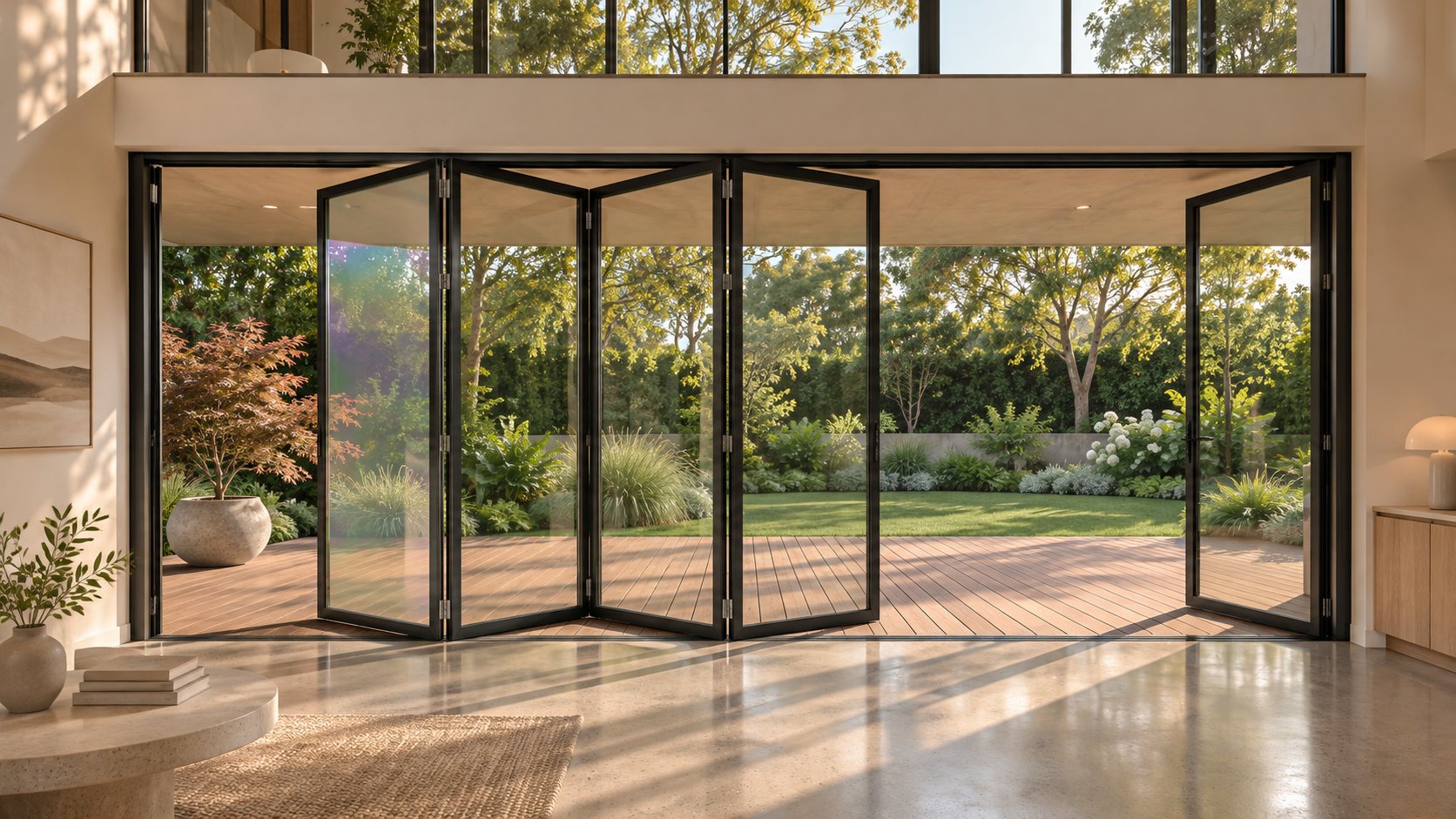
Glass Options for Black Bifold Doors
A black frame draws the eye. Glass decides what the eye sees once it gets there. Whether it is an uninterrupted garden view through a four-panel patio system or a soft wash of light filtering through a frosted bathroom divider, the glazing you choose shapes the entire experience of living with bifold doors with glass panels. Pick the wrong glass and you end up with a door that overheats a room, sacrifices privacy, or fails to meet the energy-performance requirements of the National Construction Code.
Glass selection splits neatly along the same interior-exterior divide that governs everything else about these doors. Interior panels tend to use single-pane glass lites chosen mostly for aesthetics. Exterior panels demand insulated glass units engineered for thermal control, acoustic dampening, and safety compliance. Both categories offer more variety than most buyers expect.
Clear, Frosted, and Obscure Glass
Clear glass is the default — and for good reason. It delivers maximum light transmission and completely unobstructed views, which is exactly what you want from an exterior bifold system opening onto a deck, pool area, or landscaped garden. Against a black aluminium frame, clear glass creates a striking contrast: the dark profiles act as a graphic outline around whatever scene lies beyond, almost like a picture frame. For interior applications, clear glass lites inserted into black panel doors let borrowed light travel between rooms without sacrificing the sense of separation a closed door provides.
Interior bifold doors from mainstream retailers typically feature clear glass arranged in specific lite patterns. A single-lite panel holds one large glass pane framed by the door stile and rails. A five-lite panel divides the glass area with horizontal muntins, creating a stacked grid that suits transitional and Hamptons-style interiors. A ten-lite panel — sometimes called colonial or French-style — breaks the glass into smaller rectangular panes. The lite pattern is largely a style choice rather than a performance one, but more muntins do mean more frame material and marginally less light per square metre of door area.
Frosted glass flips the priority from transparency to privacy. The surface is either acid-etched or sandblasted to create a translucent finish that allows light to pass through while obscuring direct sightlines. You get a gentle, diffused glow rather than a clear view — ideal for frosted glass bifold doors used as bathroom partitions, home-office dividers, or bedroom closet panels where you want light without exposing the contents behind the door. Against a black frame, frosted glass softens the overall look, tempering the boldness of the dark finish with a quieter, more understated character.
Obscure or textured glass takes privacy a step further by introducing a physical pattern — reeded, hammered, rain, or stippled — into the glass surface. These textures distort the image rather than simply blurring it, so shapes and colours behind the glass become abstract rather than recognisable. The decorative quality of textured glass pairs particularly well with black glass panel doors in heritage renovations or industrial-style interiors where plain frosted glass might feel too clinical. Availability varies: reeded glass has surged in popularity over recent years and is now offered by several Australian door and glass suppliers, while more niche patterns may require a custom order through a glazier.
Choosing between these three types comes down to a single question: how much do you want to see through the door? If the view matters, go clear. If light matters but privacy matters more, frosted is the answer. If you want privacy with visual personality, textured glass delivers both.
Double Glazing and Low-E Glass for Exterior Doors
Interior glass choices are mostly aesthetic. Exterior glass choices are heavily technical — and getting them wrong has consequences you will feel in every energy bill.
Double glazed bifold doors use insulated glass units (IGUs): two panes of glass separated by a sealed spacer bar and a gas-filled cavity, typically 12–20 mm wide. The cavity is usually filled with argon or, in premium units, krypton gas. Both are denser than air and significantly slower at conducting heat, which is why a double-glazed unit outperforms a single pane by a wide margin. In Australia, double glazing has become effectively standard for any new exterior door installation aiming to meet NCC Section J energy-efficiency provisions, particularly in climate zones 6 through 8 where winter heating loads are substantial.
Layer a Low-E (low-emissivity) coating onto one of those glass panes and the performance improves again. Low-E is a microscopically thin metallic oxide coating — invisible to the naked eye — applied to the interior surface of the outer pane or the exterior surface of the inner pane. Its job is to reflect radiant heat. In winter, it bounces interior warmth back into the room instead of letting it escape through the glass. In summer, it reflects a portion of incoming solar heat before it enters the living space. Low-E glass improves the thermal efficiency of the glazing unit without changing its appearance or reducing visible light transmission in any meaningful way.
For Australian conditions — where solar heat gain through west-facing glass can turn a living room into an oven by mid-afternoon — Low-E coatings are not a luxury add-on. They are a practical necessity on any exterior bifold system that includes significant glass area. WERS (Window Energy Rating Scheme) labels on compliant products will show both a heating and a cooling star rating, giving buyers a standardised way to compare how different glass-and-frame combinations perform across seasons.
Here is where the conversation takes a critical turn, and where many buyers — and, frankly, some salespeople — get tripped up.
Double glazing improves the thermal performance of the glass, but it does not fix a thermally inefficient frame. A non-thermally broken aluminium frame will still conduct heat directly through the metal, regardless of how advanced the IGU is. When evaluating exterior black bifold doors for energy efficiency, always assess the glass specification and the frame construction together — they function as a single thermal system, and upgrading one while ignoring the other limits the real-world result.
This distinction matters because a non-thermal aluminium frame lacks the insulating barrier — typically a polyamide strip — that separates the indoor and outdoor metal profiles. Without that barrier, the aluminium acts as a thermal bridge. On a cold winter morning, condensation forms on the interior frame surface. On a hot summer afternoon, the frame radiates heat into the room even while the double-glazed panel beside it holds firm. The glass might rate beautifully on its own, but the overall U-value of the door — the figure that actually determines energy performance under the NCC — accounts for frame, glass, and edge spacer losses combined.
Australian buyers should look for the overall door U-value rather than just the centre-of-pane figure. Some suppliers publish the more flattering centre-pane number because it is always lower (better) than the whole-door value. The whole-door U-value, which includes frame conduction and edge effects, is the honest measure of how the door will actually perform in your wall opening. If a product listing only quotes centre-pane U-values, ask for the full figure — or move on to a supplier who provides it upfront.
Glass is ultimately the largest surface area of any glazed bifold door, so its specification drives both how the door looks and how it performs thermally and acoustically. But glass sits inside panels, and panels need to fold — which brings us to the question of how many panels you actually need, how they fold, and where that folded stack ends up when the door is wide open.
Panel Configurations and Folding Directions Explained
Panel count is not just a number on a spec sheet — it dictates how wide your opening can be, how much wall space the folded stack consumes, and whether you can walk through the door every morning without unfolding the entire system. Get the configuration wrong and you end up with panels that block a light switch, crowd a piece of furniture, or stack so deeply they obscure half the window next to the opening. Get it right and the door disappears when you want it open, reappears when you want it closed, and never gets in anyone's way.
Understanding bifold door sizes and configurations starts with a simple relationship: the wider the opening, the more panels you need. But the way those panels fold — to one side, both sides, or around a traffic door — introduces choices that shape daily livability far more than the panel count alone.
Understanding 2-Panel Through 6-Panel Configurations
A 2-panel bifold is the simplest arrangement. Both panels hinge together and fold to one side of the opening. This is the classic wardrobe door setup — two panels covering an opening of roughly 610 mm to 910 mm wide, folding flat against the jamb on one side. Interior 2-panel sets are the most common bifold you will find on retailer shelves across Australia. Exterior versions handle slightly wider spans, typically up to about 1,800 mm, and suit small balcony openings or kitchen servery windows where a compact footprint matters.
Move to 3 panel bifold doors and the geometry shifts. Three panels cannot split evenly to both sides — one side gets two panels, the other gets one. That creates an asymmetric stack. In a 2+1 configuration, two panels fold together to one jamb while the third panel operates as an independent swing door on the opposite side. This daily door is a practical feature for exterior applications: it lets you step outside for a morning coffee without unlatching and folding the full system. Three-panel sets typically span openings from around 1,800 mm up to about 2,700 mm for interior use, and as wide as 3,600 mm in exterior aluminium systems.
The 4 panel bifold door is arguably the most versatile configuration. Four panels can fold as two pairs — two to the left and two to the right (a 2+2 split) — or all four can stack to a single side. The 2+2 arrangement keeps stack depth shallow at both ends and creates a symmetrical opening, which looks particularly clean when centred on a feature wall or aligned with a garden path. Folding all four panels to one side maximises the clear opening width but doubles the stack depth on that side. Interior 4-panel sets handle openings from roughly 1,200 mm to 1,800 mm, while exterior versions comfortably span 2,400 mm to about 4,800 mm.
At 5 and 6 panels, you are into wide patio and alfresco territory — multi panel bifold doors designed for openings that can stretch from 4,000 mm up to 6,000 mm or beyond. Five-panel systems require either an uneven split (3+2) or a swing traffic door on one end (4+1). Six-panel systems split cleanly as 3+3, distributing the folded stack evenly to both sides and balancing the load across the overhead track. These large configurations are almost exclusively exterior, built from aluminium, and fitted with heavy-duty top-hung track systems engineered to carry the cumulative panel weight smoothly.
The table below summarises each configuration, including the typical opening width range in metric, common folding directions, and the approximate stack-back depth you should plan for.
| Panel Count | Typical Opening Width (mm) | Common Folding Directions | Approximate Stack-Back Depth |
|---|---|---|---|
| 2 panels | 610–1,800 | All panels fold to one side | ~120–160 mm (2 panel thicknesses) |
| 3 panels | 1,800–3,600 | 3+0 (all to one side) or 2+1 (two fold + one traffic door) | ~180–240 mm on the folding side |
| 4 panels | 1,200–4,800 | 4+0 (all to one side), 2+2 (split to both sides), or 3+1 (three fold + one traffic door) | ~240–320 mm per stack side |
| 5 panels | 3,000–6,000 | 5+0, 3+2, or 4+1 (with traffic door) | ~300–400 mm on the larger stack |
| 6 panels | 3,600–7,200 | 6+0, 3+3 (balanced split), or 5+1 (with traffic door) | ~360–480 mm per stack side (3+3 split) |
Stack-back depths listed above are approximate. Actual figures depend on individual panel thickness — typically around 45–70 mm for exterior aluminium systems and 35–45 mm for interior timber or MDF doors — plus the clearance built into the hinge hardware. Always confirm the stacking dimension with the manufacturer for the specific system you are considering.
Stack-Back Space and Clearance Planning
Here is the detail that catches homeowners off guard more than almost any other in the bifold door specification process: folded panels do not vanish. They stack perpendicular to the wall, projecting into the space immediately beside the opening. That stacked block of folded glass and frame needs somewhere to go — and if you have not planned for it, it will go exactly where you do not want it.
Picture a 4 panel bifold door folding entirely to the left side of a 3,600 mm patio opening. Each panel might be roughly 60 mm thick. Folded together, those four panels create a stack about 280–320 mm deep sitting alongside the left jamb. If there is a window 200 mm to the left of the opening, that stack partially blocks it. If there is a light switch at the same height, it becomes unreachable. If you planned an outdoor planter or a barbecue bench against that wall, the folded door now competes for the same footprint.
Splitting the configuration — say, a 2+2 layout on the same 3,600 mm opening — halves the stack depth at each end to about 140–160 mm. That is a much easier dimension to absorb into a room layout, but it does require clear wall space on both sides of the opening rather than just one.
A practical rule of thumb from industry sizing guides: the stack-back depth roughly equals the width of one folded panel. So if each panel in your set is 900 mm wide and 60 mm thick, expect the full stack of panels folding to one side to project about one panel width from the jamb. Mark that zone on your floor plan before finalising the configuration, and verify it does not clash with furniture, pathways, switches, power points, or adjacent window openings.
Folding direction adds another variable, particularly for exterior doors. The choice between inward-folding and outward-folding panels affects three things simultaneously: usable interior floor space, weather seal performance, and threshold design.
Outward-folding panels are the more common choice in Australian exterior installations. The folded stack sits outside the building envelope, so it does not eat into living-room floor area. There is a weather-performance advantage too: wind pressure pushes outward-opening panels tighter against their seals, improving resistance to water and air infiltration during storms. The trade-off is that the stacked panels project into the outdoor zone — across a deck, verandah, or patio — and must not block escape routes or pedestrian pathways.
Inward-folding panels keep the exterior elevation clean when the door is open, which can matter on balconies with limited depth or in situations where council regulations restrict projections beyond the building line. The drawback is that the folded stack occupies interior floor space, and wind pressure works against the seal rather than reinforcing it, which may reduce weather performance in exposed locations.
For exterior doors used as a primary or secondary entry — and especially where accessibility requirements apply — threshold clearance deserves careful attention. A flush or low-profile sill creates the seamless indoor-outdoor transition that most homeowners want, but it must be paired with adequate overhead cover to prevent water pooling and ingress. The NCC and relevant Australian Standards set performance thresholds for water resistance under pressure, and the combination of sill design, folding direction, and overhang depth all factor into whether the installation meets those requirements. Checking these details early in the design phase avoids expensive remediation after the doors are fitted.
Configuration decisions — how many panels, which direction they fold, where the stack lands — shape the physical footprint of a bifold door in your home. But there is another layer of choices that sits closer to your fingertips: the hardware that makes those panels glide, lock, and look the part against a black frame.
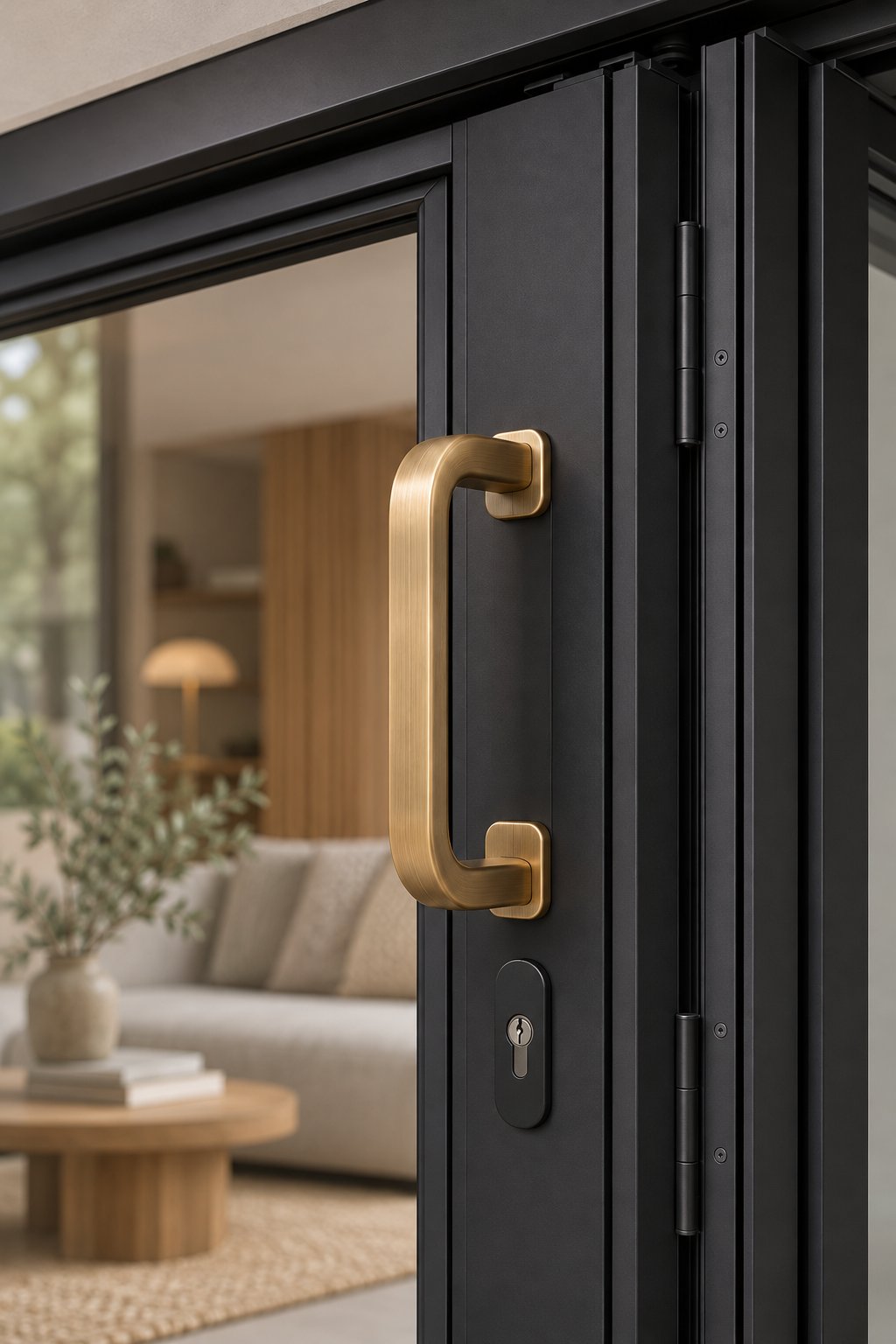
Hardware, Tracks, and Finish Coordination
Hardware rarely makes the mood board. Homeowners spend weeks deliberating over panel count, finish sheen, and glass type — then grab whatever handle and track system comes standard with the door. That is a missed opportunity. The track determines how smoothly the door operates every single day. The locking system determines how securely it closes at night. And the handle finish — a detail that occupies maybe 150 mm of the entire door — can either tie a black bifold door into the broader room design or quietly undermine it.
Getting the bifold door hardware black and polished to match your vision starts with understanding how the two main track systems differ, and why the one you choose affects far more than just the mounting method.
Track Systems and Pivot Hardware
Every bifold door rides on a track. The fundamental question is whether that track sits overhead or on the floor — and the answer shapes the door's operation, its maintenance demands, and the look of the threshold.
Top-hung systems suspend the panel weight from an overhead track using rollers concealed inside the header rail. The panels hang from above, glide laterally, and fold at the hinge points without bearing down on the floor. A floor-level guide track or pin is often included to prevent the panels swinging or drifting out of alignment, but it carries no load. Because all the weight travels through the overhead rail, top-hung doors tend to operate more smoothly than their floor-mounted counterparts. They are also easier to keep clean — there is no deep floor channel to trap dirt, leaves, pet hair, or grit that would otherwise jam rollers and drag panel movement.
The trade-off is structural. A top-hung bifold door track system requires a strong lintel or header beam capable of bearing the cumulative weight of every panel. For a six-panel exterior aluminium system with double glazing, that total load can exceed 200 kg. The header must be engineered accordingly, which is straightforward in new builds but can require reinforcement in renovation projects — particularly in older Australian homes where original lintels were sized for lightweight windows, not heavy bifold assemblies.
Bottom-rolling systems reverse the load path. Panels sit on rollers housed in a floor-mounted track, and a lightweight overhead guide keeps them upright and aligned. This approach demands far less from the structure above, making it a practical choice for conservatories, pergola enclosures, or retrofit situations where strengthening the overhead beam is difficult or prohibitively expensive. The downside is that the floor track is exposed to foot traffic, debris, and water. Sand, grit, or leaves that accumulate in the channel will eventually impede roller movement, causing the panels to drag, judder, or jump off track. Regular vacuuming of the channel and periodic lubrication of the rollers with a silicone-based spray keeps bottom-rolling systems running smoothly, but it is an ongoing maintenance commitment that top-hung systems largely avoid.
For most new exterior installations in Australia, top-hung is the preferred bifold door track system. The cleaner threshold profile integrates better with flush sill details, and the reduced floor-channel maintenance suits the low-upkeep expectation that comes with aluminium-framed doors. Bottom-rolling remains a valid option where overhead structural support is limited or where retrofitting into an existing opening rules out significant building work.
Soft-close mechanisms deserve a mention here because they address one of the most common complaints about bifold doors: slamming. A soft close bifold doors mechanism uses a hydraulic or pneumatic damper — usually integrated into the track or hinge assembly — to catch the panels in the final few centimetres of travel and draw them gently to a stop. The result is a quiet, controlled close that protects both the hardware and your nerves. Some exterior systems include soft-close as standard. For interior bifolds, aftermarket soft-close hinges are increasingly available, with adjustable damping speed controlled via a hex key. If you are fitting black bifold closet doors in a bedroom hallway or a shared living space, a soft-close upgrade is one of the most worthwhile additions you can make — both for noise reduction and for the longevity of the hinge and track components.
Security hardware adds another layer for exterior doors. Interior bifolds only need a basic latch or privacy bolt. Exterior systems, by contrast, require multi-point locking — a mechanism that engages bolts or hooks at multiple positions along the door frame (commonly five to eight locking points) when the handle is lifted and the key turned. Flush bolts at the top and bottom of fixed or semi-fixed panels prevent those panels from being levered open independently. For Australian homes, look for locking systems that comply with relevant provisions of AS 4145.2 (locksets for doors in buildings) and, ideally, carry a rating recognised by insurance providers. A beautifully finished black aluminium bifold door that cannot resist a pry bar is an expensive vulnerability.
Matching Handle Styles and Hardware Finishes
The handle is the one piece of hardware you touch every time you use the door. It is also the most visible hardware element, sitting at eye or hand height against the black frame. That makes handle finish a design decision as much as a functional one — and the pairing of handle colour against door colour sets the tone for the entire opening.
There is no single correct combination. The choice depends on the surrounding interior palette, the other metal finishes in the room (tapware, light fittings, cabinet pulls), and whether you want the handle to blend into the frame or stand apart from it. Here are the most popular pairings and what each one brings to the space:
- Matte black handles on a matte black frame — a seamless, monochrome look that makes the handle almost disappear into the door. This pairing suits minimalist and contemporary interiors where the goal is a clean, uninterrupted surface. The black bifold door handles merge with the frame, letting the architecture speak rather than the hardware.
- Brushed brass on a black frame — warm, rich contrast that has become one of the defining pairings in transitional and modern Australian interiors. The golden tone of brass lifts the black frame without competing with it. It coordinates naturally with brass pendant lights, tapware, and cabinet hardware. For homes blending contemporary lines with warmer material palettes — think timber flooring, stone benchtops, linen furnishings — this combination hits the mark.
- Polished chrome on a black frame — cool, sharp, and contemporary. Chrome reflects light crisply against the dark background, creating a high-contrast detail that suits sleek kitchens, monochrome bathrooms, and urban apartments. It pairs well with stainless steel appliances and chrome tapware.
- Satin nickel on a black frame — a subtler, more versatile option than chrome. Satin nickel has a soft silver tone without the mirror-like reflectivity of polished chrome, so it sits quietly against the black finish rather than drawing attention. It works across a wide range of interior styles without committing strongly to either warm or cool tones.
Interior bifold closet doors — the kind sold in standard sizes through hardware stores and online — almost always ship with basic hardware: a simple plastic or zinc-alloy knob, a stamped-metal pull, or a recessed finger grip. These factory-supplied handles do the job mechanically, but they rarely match the quality of the door's finish. Swapping them for a solid brass, stainless steel, or matte-black pull handle is one of the simplest and most effective upgrades you can make. A $30 handle replacement can transform a $200 wardrobe door from builder-basic to architect-specified in about ten minutes with a screwdriver.
Exterior aluminium bifold systems take a different approach. Their handles are typically integrated into the door's locking and sealing architecture. A lever handle on the primary traffic door engages the multi-point lock. Slave handles — sometimes called D-handles — sit flush against the secondary panels and allow you to pull them into the folded position. Because these handles interact directly with the lock barrel, weather gaskets, and compression seals, they are designed as part of the system rather than as aftermarket additions. Swapping an exterior bifold handle for a third-party fitting is possible in some cases, but it risks compromising the seal engagement and locking alignment. If handle finish matters on an exterior system — and it should — specify it at the point of order rather than trying to retrofit later.
One final thought on coordination: consistency across a room matters more than any single hardware choice. If your kitchen has brushed-brass cabinet pulls and a brass tap, extending that same brass tone to your black bifold door handles creates a visual thread that ties the space together. Mixing three or four different metal finishes in a single sightline fragments the design. Pick one or two complementary metals, carry them across every visible fitting, and the hardware will support the door rather than compete with it.
Choosing the right track, lock, and handle gets a black bifold door functioning and looking its best on day one. Keeping it that way over the years — especially in a colour that reveals every fingerprint, dust mote, and scratch — calls for a maintenance routine matched to the specific finish and material sitting behind that black surface.
Maintenance Tips and Common Concerns with Black Doors
Black doors look striking on installation day. The real question — the one that nags at every homeowner scrolling through inspiration photos — is whether they still look striking eighteen months later. The answer depends almost entirely on how you care for the finish. A five-minute weekly routine keeps a black bifold door looking showroom-fresh. Neglect it for a season and you are chasing dust halos, water spots, and the kind of dull haze that makes the whole opening feel tired. The good news is that none of this is complicated. It just requires matching your cleaning approach to the specific material and finish sitting behind that black surface.
Cleaning and Caring for Black Bifold Doors
Not every black door cleans the same way. The gentle wipe that keeps a powder-coated aluminium frame pristine can leave streaks on a painted MDF panel, and the glass cleaner that makes glazed lites sparkle will dull a satin timber finish if it drips down the rail and sits. Cleaning method should follow material — always.
Powder-coated aluminium frames are the easiest to maintain. A bucket of warm water with a few drops of mild dish soap, a soft sponge, and a clean microfibre cloth for drying — that is the entire toolkit. Wipe down the frame profiles, rinse with clean water (a damp cloth works fine indoors; a gentle hose rinse suits exterior doors), and dry thoroughly to prevent water spots. The key rule when cleaning powder coated doors is to avoid abrasive cleaners, scouring pads, and solvent-based products. Anything gritty or chemically aggressive will micro-scratch or dull the coating surface, turning a satin sheen patchy over time. For stubborn marks — bird droppings on an exterior frame, sticky fingerprints around handles — let the soapy water sit on the mark for a minute before wiping. Patience does what abrasion cannot, without the collateral damage.
Painted wood and MDF panels benefit from a damp microfibre cloth rather than a wet sponge. Excess moisture is the enemy here, especially on MDF edges and hinge mortises where the factory seal may be thinnest. Wipe in the direction of the panel profile — following any moulding lines or grooves — to avoid pushing grime into crevices. Mild detergent like dish soap is safe on sealed timber and composite doors, but rinse the cloth frequently and dry the surface promptly. Avoid leaving wet streaks on matte black finishes; they can leave faint tide marks that are visible under direct light.
Glass lites need their own step. Standard glass cleaner and a lint-free cloth handle the glazed areas. Spray the glass directly rather than the frame to keep cleaning solution off painted or coated surfaces where it does not belong. For exterior double-glazed panels, clean both sides — the interior pane picks up cooking grease and fingerprints while the exterior pane collects dust, pollen, and salt residue in coastal areas.
How often should you clean? Black door maintenance tips from experienced homeowners consistently point to the same rhythm: a quick weekly wipe-down of frames and handles, plus a monthly glass clean. Black surfaces reveal dust and water spots faster than lighter finishes — that is simply the nature of the colour. A weekly pass with a dry microfibre cloth takes under two minutes per door and prevents the gradual build-up that eventually requires a deeper clean. Think of it less as a chore and more as a brief habit, like wiping down a kitchen benchtop after cooking.
Preventing Fading, Scratching, and Wear
Cleaning handles what the door picks up from daily life. Fading and scratching are about what the environment and time do to the finish itself — and prevention is far simpler than repair.
UV fading is the primary long-term concern for exterior black bifold doors. Ultraviolet radiation breaks down the polymer binder at the coating surface, releasing pigment particles in a process known as chalking. The result is a powdery residue on the surface and a gradual lightening of the colour — particularly noticeable on dark and saturated colours where even small changes in pigment concentration are visually obvious. A well-specified powder coating with UV-stable pigments — ideally meeting super-durable polyester standards equivalent to Qualicoat Class 2 or AAMA 2605 — may take 15 to 20 years before significant chalking appears. A lesser-grade coating in a harsh UV environment can show visible fading within just a few years.
Australian conditions amplify this risk. North- and west-facing doors in Queensland, Western Australia, and inland NSW cop intense solar radiation for hours each day, particularly through summer. No organic coating is completely immune to UV degradation — it is an expected aging process, not a defect. But specifying high-quality coatings at the outset and maintaining them regularly dramatically extends the timeline. Where possible, architectural shading — eaves, pergola roofing, or deep verandah overhangs — reduces cumulative UV exposure on the door frames and buys years of additional finish life.
Scratches on powder-coated surfaces are the second most common concern. Minor nicks from furniture, garden tools, or a misplaced ladder can break through the coating and expose bare aluminium beneath. On a black frame, even a hairline scratch catches the light and draws attention. The fix is straightforward: touch-up paint matched to the original powder-coat colour, applied with a fine artist's brush, restores the appearance and — critically — re-seals the metal against moisture and corrosion. Address scratches promptly. In coastal environments, exposed aluminium will begin to oxidise, and once white corrosion pitting takes hold beneath a coating edge, the damage spreads.
Painted timber and MDF doors follow a different repair path. Light scratches through the topcoat can be sanded gently with fine-grit sandpaper (320 grit or higher), primed, and recoated with the matching black paint. Deeper damage — chips that reach bare MDF or timber — requires filling, sanding smooth, priming, and then repainting. The challenge, as noted in the earlier chapter on finish types, is matching the sheen exactly. A satin touch-up on a matte surface, or vice versa, is visible under any decent light. Keep a small tin of the original paint stored for touch-ups; if you are using a custom-mixed colour, note the formula on the tin lid.
Beyond cleaning and scratch repair, a handful of maintenance mistakes account for most premature wear on black bifold doors. Avoid these and your doors will age gracefully rather than deteriorate:
- Using harsh chemical cleaners — bleach, ammonia-based sprays, and solvent-heavy degreasers strip protective layers from powder coats and painted finishes alike. Stick to pH-neutral detergent and water.
- Neglecting bifold door track maintenance — dirt, sand, leaves, and grit accumulate in both floor and overhead tracks over time. That debris causes panel drag, increases stress on hinges and rollers, and eventually wears grooves into the track channel. Vacuum the track periodically and apply a light silicone-based lubricant to rollers and hinge pivot points. Avoid petroleum-based oils, which attract dust and create a sticky residue.
- Ignoring weatherstrip replacement on exterior doors — compression seals and brush strips degrade with UV exposure and repeated compression cycles. When they flatten, shrink, or crack, water and air infiltrate the frame. Replacing weatherstrips every few years is far cheaper than repairing water damage to flooring or wall framing behind the door.
- Failing to address minor scratches before corrosion starts — this applies specifically to aluminium frames. A scratch left untreated in a coastal or high-humidity environment becomes a corrosion site. What begins as a cosmetic blemish turns into a structural concern if the oxidation spreads beneath the surrounding coating.
Proper track maintenance deserves one final emphasis. A quick vacuuming of the track channel — once a month for exterior doors, every few months for interior ones — paired with a light spray of silicone lubricant on rollers, hinges, and pivot pins, keeps the entire system operating smoothly. Panels that glide freely place less stress on every component: tracks, rollers, hinges, handles, and locking mechanisms all last longer when friction stays low. It is the single easiest piece of bifold door track maintenance you can do, and the one most often skipped until something starts grinding or sticking.
A well-maintained black bifold door does not just look better — it operates better and lasts longer. And with the cleaning routine, fading prevention, and common pitfalls covered, the remaining step is pulling all of these decisions together: material, finish, glass, configuration, hardware, and maintenance into a single coherent selection process that matches the right door to your specific project.
How to Choose the Right Black Bifold Door for Your Space
Eight chapters of material choices, finish chemistry, glass specifications, panel geometry, and maintenance routines can feel like a lot to hold in your head at once. That is the nature of a product that sits at the intersection of architecture, engineering, and interior design — there are genuinely many moving parts, some of them literally. But the selection process itself does not need to be overwhelming. Strip it back and every black bifold door decision follows the same logical sequence, whether you are replacing a single wardrobe door in a Queenslander cottage or specifying a six-panel patio system for a new double-storey build in Sydney's inner west.
Matching the Right Door to Your Project
The checklist below walks through each decision point in the order that matters most. Tackle them in sequence and each step narrows the field, so by the time you reach the final item, your specification practically writes itself.
- Determine whether the application is interior or exterior. This single question eliminates roughly half the product market immediately. Interior doors — wardrobes, pantries, laundry cupboards, room dividers — can use lightweight MDF, composite, or timber panels with basic track hardware. Exterior doors require aluminium or clad-wood frames, weathersealing, structural headers, and multi-point locking. Mixing the two categories leads to doors that either underperform or overspend.
- Measure the opening and calculate panel count and stack-back clearance. Take width and height measurements at multiple points — top, centre, and bottom for width; left, centre, and right for height — and work from the smallest figure. Subtract fitting tolerance (typically 10–15 mm in both dimensions) to arrive at the net door size. Then select a panel count that suits the opening width, and mark the stack-back zone on your floor plan to confirm it does not block adjacent windows, switches, furniture, or pathways.
- Select the material based on location and budget. Powder-coated aluminium for exterior applications where durability and corrosion resistance are non-negotiable. Factory-painted MDF or composite for affordable interior projects. Solid timber for interior doors where tactile quality and material character justify higher maintenance. Clad wood for premium exterior installations that want timber warmth on the inside and aluminium toughness on the outside.
- Choose the finish sheen — matte, satin, or gloss. Satin delivers the best balance of looks and practicality for most Australian homes. Matte suits low-traffic feature applications where fingerprints are less of a concern. Gloss works in spaces where meticulous surface preparation is possible and regular cleaning is a given.
- Specify glass type if the door includes glazed panels. Clear glass for views and maximum light. Frosted for privacy with diffused light. Textured or obscure for decorative character. For exterior doors, confirm double glazing with Low-E coating and check the WERS rating to ensure compliance with NCC energy-efficiency provisions.
- Confirm hardware and track system compatibility. Top-hung tracks suit most new exterior installations and deliver smoother operation with less floor-channel maintenance. Bottom-rolling tracks work where overhead structural support is limited. Verify locking hardware meets security requirements — multi-point locking for exterior doors, simple latches or privacy bolts for interior. Choose a handle finish that coordinates with other metal tones in the room.
- Verify thermal and weatherproofing requirements for exterior installations. Double glazing improves the glass, but only a thermally broken frame prevents the aluminium itself from acting as a heat bridge. Check the overall door U-value — not just the centre-of-pane figure — and confirm weatherstrip ratings, water-resistance performance, and wind-load compliance for your specific climate zone. In cyclone-prone areas of northern Queensland, the Northern Territory, and parts of Western Australia, additional wind-load certification may be required under the NCC.
That seven-step sequence covers the technical territory. But there is one more practical question every buyer faces: where do you actually find and purchase these doors?
Where to Source Black Bifold Doors
Sourcing splits along the same interior-exterior divide that shapes every other aspect of this bifold door buying guide.
Interior black bifold closet doors are among the easiest door products to find in Australia. Bunnings, specialist door retailers, and online marketplaces stock standard-size panels in MDF, composite, and timber across a range of styles — flat slab, shaker profile, louvred, and glazed lite configurations. Prehung sets are available for common wardrobe and pantry openings, and slab-only panels suit non-standard or heritage openings that need custom fitting. Pricing sits at the accessible end of the market, and off-the-shelf availability means lead times are typically short. For most interior projects, the best black bifold doors are simply the ones that match your opening dimensions, finish preference, and budget without requiring custom fabrication.
Exterior black aluminium bifold doors are a different procurement exercise entirely. These are rarely off-the-shelf products. Because panel count, opening width, folding direction, glass specification, hardware, and colour must all be configured to the specific project, exterior systems are most commonly sourced through manufacturers or project-based suppliers who build to order. Lead times vary — four to ten weeks is a typical range in Australia depending on complexity and supplier — and pricing is quoted per configuration rather than per standard unit.
One example of this project-based supply model is the MEICHEN MA80 Bifold Door, a non-thermally broken aluminium folding system designed for indoor-outdoor openings. The MA80 operates on a fold-and-stack panel principle with listed double-glazing options and availability in Black Mall and other powder-coated finishes, paired with project-specific hardware. It illustrates the kind of configurable aluminium system that suits patio and alfresco applications where panel count, opening dimensions, and folding clearance are tailored to each site.
A few points of honest clarification are worth noting for anyone evaluating this or any similar system. The MA80's double-glazing options improve the thermal performance of the glass panels, but the frame itself is not thermally broken — a distinction this article has emphasised throughout. For projects where frame-level thermal insulation is a priority, particularly in cooler climate zones or where NatHERS modelling demands high-performance assemblies, a thermally broken system would be the more appropriate specification. Additionally, details such as screen compatibility, slim-sightline dimensions, and suitability as a primary entrance door are not confirmed on the product page and should be verified through direct inquiry before committing to an order. Opening dimensions, folding clearance, and overall performance specifications need to be reviewed for each proposed configuration — this is standard practice for any project-based aluminium bifold system, not a limitation unique to this product.
MEICHEN supplies on a project basis, so availability depends on location and delivery logistics. Do not expect a walk-in showroom experience — this is a manufacturer-direct model where specifications are discussed, drawings are reviewed, and doors are fabricated to the agreed configuration. For Australian homeowners and builders exploring where to buy bifold doors in black aluminium for exterior use, it represents one option worth requesting a quote on alongside other suppliers operating in the same project-configured space.
Beyond individual manufacturers, architectural window and door suppliers across major Australian cities — Sydney, Melbourne, Brisbane, Perth, Adelaide — carry multiple black aluminium bifold doors exterior systems from both domestic and international brands. Requesting quotes from at least two or three suppliers for the same opening specification gives you a realistic picture of pricing, lead times, and included features. Compare not just the per-door cost, but what is bundled: hardware, weatherseals, track systems, glazing upgrades, powder-coat quality grade, and warranty terms. A system that appears cheaper upfront but excludes multi-point locking, quality weatherstrips, or a durable powder-coat specification may cost more over its lifetime.
Whichever route you take — a quick purchase of standard interior panels from a national retailer or a configured exterior system from a specialist supplier — the principles covered in this guide apply equally. Match the material to the application. Choose a finish sheen you can live with and maintain. Verify that the glass, frame, and hardware work as a system rather than in isolation. Plan your stack-back clearance before you fall in love with a panel count. And commit to the modest, regular maintenance that keeps a black finish looking deliberate and sharp rather than dusty and neglected.
Black bifold doors earn their place in a home not because they follow a trend, but because they solve a spatial problem — folding flat to open up a room or a wall — while simultaneously creating the kind of bold architectural contrast that lighter finishes simply cannot deliver. The finish matters more than the frame, but only when both are chosen with care.
Frequently Asked Questions About Black Bifold Doors
1. Do black bifold doors show dust and fingerprints more than lighter colours?
Yes, black surfaces reveal dust, fingerprints, and water spots more readily than white or timber-toned finishes. However, the degree depends on the sheen level. Matte black is the worst offender because its light-absorbing texture makes even a thin dust film visible. Satin black handles dust noticeably better — its subtle sheen allows a quick wipe with a damp microfibre cloth to restore the surface without streaking. A brief weekly wipe-down of frames and handles is generally enough to keep black bifold doors looking sharp, regardless of whether they are interior closet panels or exterior aluminium patio systems.
2. What is the difference between interior and exterior black bifold doors?
Interior black bifold doors are lightweight panels — typically MDF, composite, or hollow-core timber — designed for wardrobes, pantries, laundry cupboards, and room dividers. They use simple overhead track systems and do not require weatherproofing. Exterior black bifold doors are engineered for patio and alfresco openings, built predominantly from powder-coated aluminium or clad timber. They must withstand rain, UV radiation, wind loads, and temperature swings, so they incorporate multi-point locking, compression weatherseals, double-glazed insulated glass units, and structural header support. The two categories share a folding mechanism and a colour, but almost nothing else in terms of materials, engineering, or cost.
3. Are black aluminium bifold doors thermally efficient?
That depends on whether the aluminium frame includes a thermal break — an insulating polyamide strip between the interior and exterior profiles. A thermally broken frame prevents the metal from conducting heat through the wall plane, significantly improving energy performance. A non-thermally broken aluminium frame acts as a thermal bridge, conducting heat in summer and cold in winter, even when paired with high-performance double glazing. Buyers should check the overall door U-value, which accounts for frame, glass, and edge spacer losses combined, rather than relying solely on centre-of-pane figures. For Australian climate zones with strict NCC energy requirements, a thermally broken system is the more appropriate specification.
4. How many panels do I need for my black bifold door opening?
Panel count depends on the width of your opening. A 2-panel set covers narrow openings from approximately 610 mm to 1,800 mm, suitable for standard wardrobes. A 4-panel configuration handles medium openings between 1,200 mm and 4,800 mm and offers the most flexibility — panels can fold as a 2+2 split to both sides or all to one side. For wide patio openings of 3,600 mm to 7,200 mm, 5- or 6-panel systems are typical. Always account for stack-back space: when panels fold open, they project perpendicular to the wall beside the opening. That stacked depth roughly equals the combined thickness of all folded panels and must be planned so it does not block windows, switches, or furniture.
5. What is the best black finish for bifold doors — powder coat, paint, or anodised?
Powder coating is the most versatile and widely used black finish for aluminium bifold doors. It is available in matte, satin, and gloss sheens, resists chipping and UV degradation, and can be touched up if scratched. Anodised black produces a distinctive metallic, dark bronze-black tone that is extremely hard and durable but difficult to repair if damaged, and it rarely achieves a true deep black. Painted finishes — applied to timber, MDF, and composite doors — offer the widest aesthetic range but require more ongoing maintenance, including periodic recoating on high-traffic surfaces. For most Australian residential projects, powder-coated satin black strikes the best balance of appearance, durability, and ease of upkeep.