
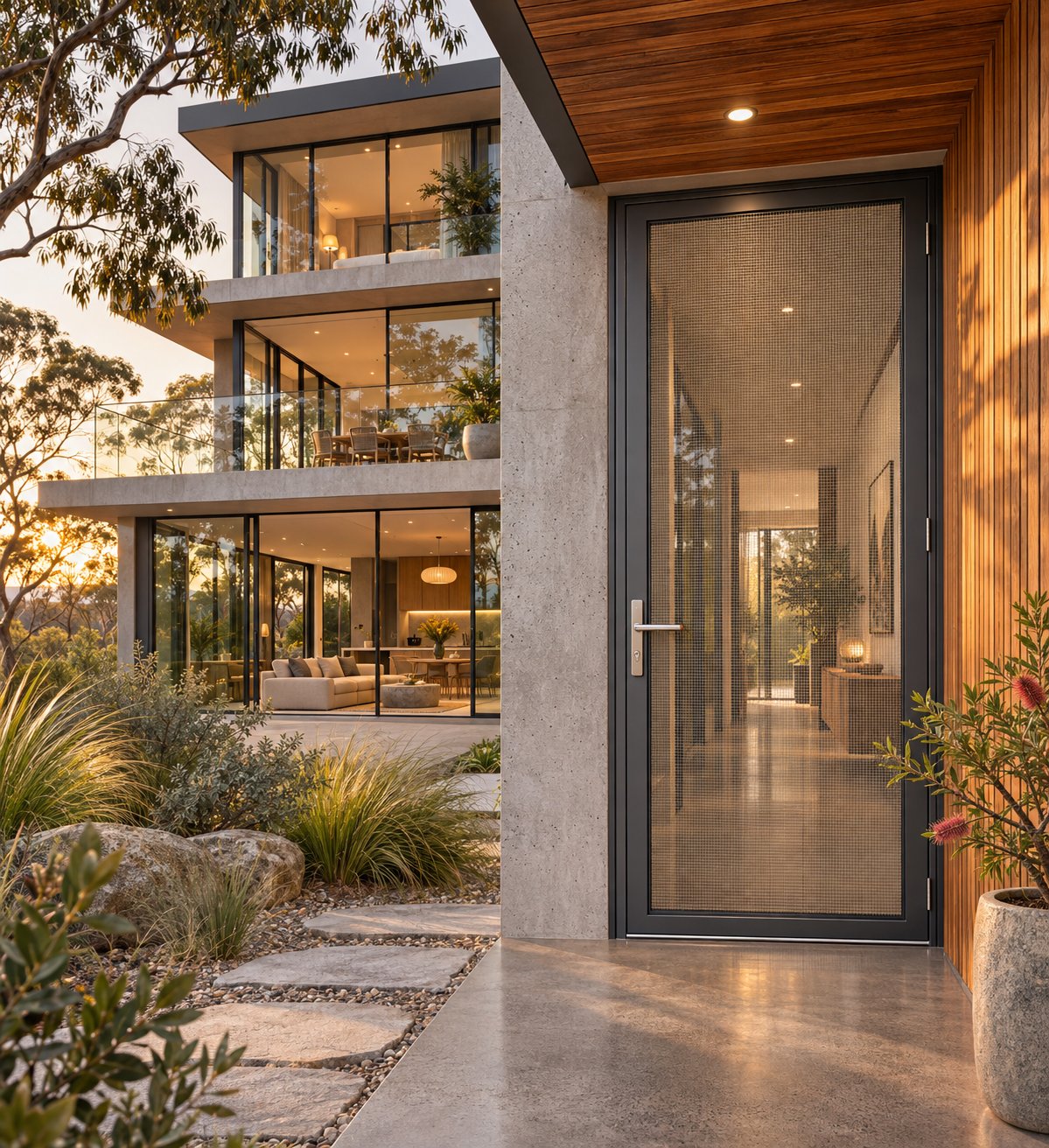
What an Aluminium Security Door Is and Why It Matters
A spec sheet lists dimensions, alloy grades, and lock types — but it rarely tells you whether a door will actually perform under real-world conditions. That gap between on-paper specifications and practical performance is exactly what this guide addresses. From alloy selection and certification standards through to climate resilience, installation pitfalls, and compliance documentation, every section ahead is designed to help you make a genuinely informed decision about your next aluminium security door.
What Exactly Is an Aluminium Security Door
An aluminium security door is an entry door system built around extruded aluminium frame sections and fitted with reinforced stainless steel mesh, perforated sheeting, or grille panels engineered to resist forced entry — while still allowing natural airflow and outward visibility.
Unlike a standard screen door, which uses lightweight fibreglass or plastic mesh purely for insect protection, a security screen door pairs its mesh with heavy-duty framing, multipoint locking hardware, and tamper-resistant hinges. The result is a barrier tested against knife-shear, jemmy, and impact attacks — not just mosquitoes. In Australia, these products are commonly tested to AS 5039, the standard specifically covering security doors and window grilles.
Why Aluminium Dominates the Security Door Market
Three material properties explain why aluminium has overtaken raw steel and timber as the preferred frame material for residential and light-commercial security doors across Australia.
- Strength-to-weight ratio: Aluminium weighs roughly one-third as much as steel, yet architectural-grade extrusions deliver more than enough rigidity for forced-entry resistance. Lighter frames are easier to operate daily, simpler to install, and place less stress on hinges and closers over time.
- Natural corrosion resistance: Aluminium forms a self-healing oxide layer the moment it contacts air. For coastal homes from the Gold Coast to the Mornington Peninsula, that built-in protection matters — steel security doors in similar environments often need additional galvanising or powder-coating to prevent rust.
- Design versatility: Extrusion allows virtually unlimited profile shapes, and modern powder-coat finishes offer dozens of colour options with strong UV stability. Whether you're matching a heritage Queenslander or a contemporary two-storey build, aluminium adapts without compromising structural performance.
Recyclability adds a quieter advantage. Aluminium can be remelted and re-extruded repeatedly with minimal quality loss, making it one of the more sustainable framing materials on the market. Overseas, shoppers browsing security doors Home Depot or other big-box retailers will find aluminium dominating the shelves for these same reasons — though Australian buyers benefit from locally fabricated products built to local standards rather than generic imports. That distinction between a generic product listing and a properly specified, tested door system is precisely what the sections ahead unpack — starting with the alloy grades hidden behind the marketing language.
Aluminium Alloy Types Used in Security Doors
Most product listings mention "aluminium" as though it were a single material. It isn't. The alloy series stamped into your door's extrusion profile shapes everything from how well the frame resists a jemmy attack to how cleanly a powder-coat finish adheres over a decade of UV exposure. Two alloy grades dominate the security door industry — and knowing the difference puts you ahead of most buyers.
6063 vs 6061 Aluminium Alloy in Door Frames
The 6063 alloy is so widely used in window and door frames that the extrusion industry informally calls it "architectural aluminium." Its composition — roughly 98.9% aluminium with modest magnesium and silicon content — makes it exceptionally easy to extrude into the complex profile shapes that custom security screen doors and front screen door frames require. It also accepts anodising and powder coating beautifully, which is why most residential security storm doors you see in showrooms use 6063 framing.
The 6061 alloy trades some of that surface finesse for raw mechanical strength. Higher copper, silicon, and chromium content pushes its tensile strength well above 6063, making it a logical pick for high-security commercial entries or specialist products like a heavy-duty Viewguard security screen door designed for public-facing buildings. The trade-off? 6061 is harder to extrude into intricate shapes, slightly less corrosion-resistant, and demands more care during welding to avoid solidification cracking.
| Property | 6063 (Architectural Grade) | 6061 (Structural Grade) |
|---|---|---|
| Ultimate Tensile Strength (T6 temper) | ~240 MPa | ~310 MPa |
| Corrosion Resistance | Superior — withstands harsh weather and coastal salt air | Good — slightly lower due to higher copper content |
| Extrudability | Excellent — first choice for complex and intricate profiles | Moderate — better suited to simpler, heavier sections |
| Finish Quality (Anodising / Powder Coat) | Excellent surface finish; ideal for decorative applications | Acceptable, though less refined than 6063 |
| Weldability | High — easy to weld and braze during assembly | Good — requires proper filler material to prevent cracking |
| Typical Security Door Applications | Residential hinged and sliding doors, decorative grilles | Commercial high-security entries, heavy-duty barrier doors |
Values reflect general engineering data for T6 temper conditions. Always request the supplier's specific alloy datasheet for the exact extrusion batch.
How Wall Thickness and Tempering Affect Security
Here is where marketing language can mislead. A supplier may emphasise a "6061 structural-grade frame" without mentioning that the extrusion walls are only 1.0 mm thick. Meanwhile, a competitor's 6063 frame with 1.6 mm walls and robust corner joinery could outperform it in every forced-entry scenario. Alloy grade alone does not determine security — wall thickness (gauge), corner construction method, and temper condition matter just as much.
Temper designations tell you how the aluminium was heat-treated after extrusion. The two you will encounter most often are T5 and T6. A T5 temper is air-cooled after extrusion and artificially aged — it offers good dimensional stability and lower production cost, but moderate strength. A T6 temper undergoes a full solution heat treatment followed by rapid water quenching and artificial ageing, producing significantly higher yield and ultimate tensile strength. In practical terms, a 6063-T6 extrusion with adequate wall thickness can deliver greater rigidity and impact resistance than a thinner 6061-T5 profile — a fact that disappears when a spec sheet lists only the alloy number.
The takeaway for anyone comparing products? Request the full section specification: alloy, temper, wall thickness in millimetres, and corner joinery method (welded, crimped, or mechanically fastened). That combination — not a single alloy marketing claim — determines whether your frame will hold up under a real forced-entry attempt. It is also the foundation for understanding the broader material comparison that follows: how aluminium stacks up against steel, wrought iron, and fiberglass across every dimension a buyer actually cares about.
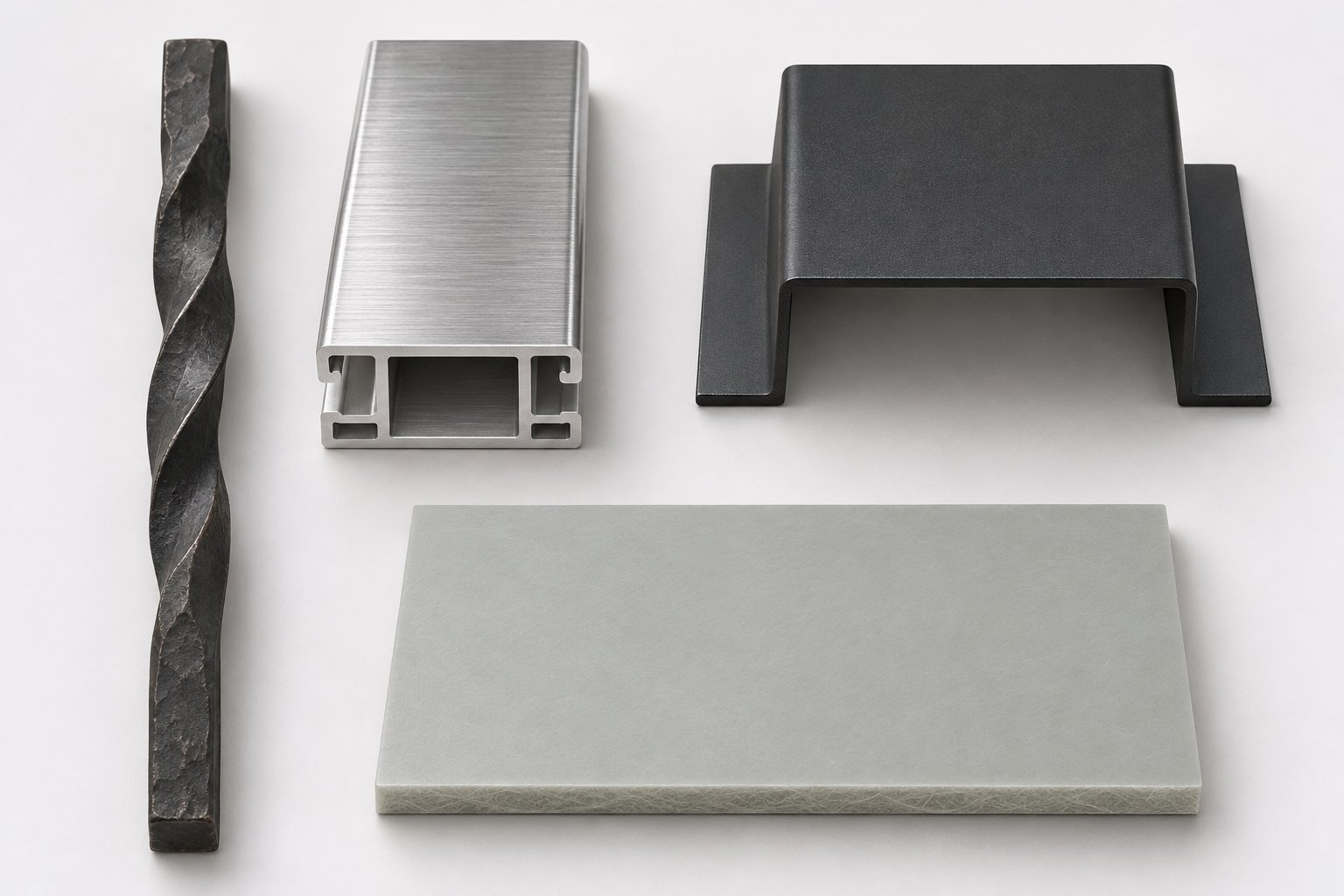
Aluminium vs Steel, Wrought Iron, and Fibreglass Compared
Alloy grades and wall thicknesses matter — but they only tell part of the story. The bigger decision many homeowners face isn't which aluminium extrusion to choose; it's whether aluminium is the right frame material at all. Steel, wrought iron, and fibreglass each have legitimate strengths, and dismissing any of them without a proper comparison leaves money or performance on the table. Here's how the four materials stack up across every dimension that actually influences a buying decision.
Aluminium vs Steel Security Doors
Steel is denser and harder than aluminium, full stop. A steel-framed security door with equivalent wall thickness will resist a greater direct impact force, which is why steel remains the go-to for high-security commercial entries and government buildings where sheer mass is a deterrent in itself. Hollow Metal Manufacturers Association (HMMA) data confirms that steel doors routinely pass the most demanding forced-entry test protocols and can last 30 years or more when properly maintained.
The catch? Steel weighs roughly three times as much as aluminium. That extra mass stresses hinges, makes daily operation heavier, and complicates retrofit installations — especially on older Australian homes with timber sub-frames that weren't designed for the load. Steel also requires protective treatment such as galvanising or powder coating to resist rust, whereas aluminium forms a protective oxide layer naturally. In coastal zones — think Sunshine Coast, Wollongong, or Fremantle — an untreated steel frame can show surface corrosion within a few years, while aluminium security doors in the same environment typically remain clean with little more than a quarterly wash.
Cost plays a role, too. Steel security doors sit at the premium end of the residential market, both in material price and installation labour, because the heavier panels demand more handling and sometimes structural reinforcement at the jamb. For the majority of Australian homes seeking solid everyday protection rather than fortress-level resistance, aluminium delivers the better balance of security, weight, and long-term upkeep cost. Steel earns its place when the threat model — or the specification — genuinely demands maximum impact resistance.
Aluminium vs Wrought Iron and Fibreglass Options
Wrought iron occupies the opposite end of the aesthetic spectrum. Its hand-forged scrollwork and ornamental grilles have historically symbolised elegance and brute-force security, and that reputation is well earned — a solid wrought iron gate or door is extraordinarily difficult to breach with hand tools. Yet the material carries real drawbacks for Australian conditions. Iron is the heaviest option on this list, requiring reinforced framing and heavy-duty hardware that inflate installation costs. It is also inherently prone to rust, demanding regular cleaning, inspection, and recoating to prevent corrosion from taking hold. For a beach house in Byron Bay or a Queenslander in Townsville, that ongoing maintenance burden makes wrought iron a harder sell compared to aluminium screen doors, which resist salt air without any additional surface treatment.
Fibreglass composite doors take yet another approach. They resist dents, insulate better than any metal option, and won't corrode. In theory, that sounds ideal. In practice, fibreglass lacks the structural rigidity needed for genuine forced-entry resistance. The National Association of Architectural Metal Manufacturers notes that fibreglass panels can be cracked, dented, and even broken down with enough physical force — a critical weakness for buildings where security is the primary concern. Fibreglass also struggles to accept heavy-duty multipoint locking hardware, and it's rarely available as a security metal screen door or an aluminium screen sliding door equivalent, since mesh-and-frame security systems depend on the rigidity that metal extrusions provide. Sliding security doors, in particular, need frames that maintain tight tolerances under repeated use, and fibreglass composites tend to flex more than metal under sustained lateral load.
| Dimension | Aluminium | Steel | Wrought Iron | Fibreglass |
|---|---|---|---|---|
| Weight | Light — roughly one-third the weight of steel | Heavy — the densest common door metal | Very heavy — often the heaviest option | Light — comparable to aluminium |
| Corrosion Resistance | Excellent — natural oxide layer; ideal for coastal zones | Moderate — requires galvanising or powder coating | Low — prone to rust without ongoing treatment | Excellent — non-metallic; will not corrode |
| Forced-Entry Resistance | Good to high — depends on mesh grade, wall thickness, and lock hardware | High — superior absolute strength per section | Very high — extremely difficult to breach with hand tools | Low to moderate — can crack or shatter under sustained force |
| Maintenance | Low — periodic wash and lock lubrication | Moderate — protective coatings must be maintained | High — regular rust prevention and recoating required | Low — occasional cleaning; no corrosion treatment needed |
| Indicative Cost (AUD, supply and install) | $400 – $1,500 per door (standard residential) | $800 – $2,500+ per door | $2,000 – $5,000+ per door (custom ornamental) | $500 – $1,800 per door (composite panel type) |
| Design Variety | Very high — unlimited extrusion profiles, wide powder-coat colour range | High — decorative and heritage styles available | Very high — hand-forged custom scrollwork | Moderate — moulded panel designs; fewer security-specific options |
| Recyclability | High — infinitely recyclable with minimal quality loss | High — widely recycled through scrap streams | High — recyclable, though production is energy-intensive | Low — composite materials are difficult to recycle |
Cost ranges are indicative for the Australian market and vary by size, specification, and region. Always request itemised quotes for your specific opening.
No single material wins on every count. Aluminium offers the strongest all-round balance for typical residential use — lightweight, corrosion-proof, cost-effective, and highly customisable. Steel steps in when the security brief demands maximum brute-force resistance. Wrought iron suits heritage properties where aesthetics justify the upkeep investment. Fibreglass, while excellent for insulation and dent resistance, remains a poor fit for any scenario where forced-entry performance is a genuine requirement.
Material choice, however, is only the starting point. A beautifully extruded aluminium frame paired with a high-grade stainless steel mesh still needs to pass real-world testing before it earns the label "security door" — and the certification landscape behind that label is far less straightforward than most buyers expect.
Security Certification Standards and What They Actually Mean
Here's a fact that catches most buyers off guard: the term "security door" has no single universal legal definition. A manufacturer can stamp that label on a product without submitting it to any independent forced-entry test. The difference between a genuine security screen door and a glorified lockable screen door with decorative grillework comes down entirely to whether the product has been tested — and to which standard. Understanding the certification landscape is the single most important step before handing over your money.
Forced-Entry Resistance Grades Explained
Australia and North America approach security testing from fundamentally different angles, which creates confusion for anyone comparing products across regions — or reading US-sourced marketing material on Australian retail sites.
In North America, the ANSI/BHMA grading system assigns Grade 1, 2, or 3 to door hardware (locks, closers, hinges), with Grade 1 representing the highest performance. These grades are determined through laboratory testing across operational, cycle, strength, security, material evaluation, and finish categories. A Grade 1 mortise lock, for example, must survive one million mechanical cycles and withstand ten blows of 100 joules from a ram impact to the cylinder face — compared to just two blows for Grade 3. The system is useful for specifying lock hardware, but it evaluates components, not the assembled door-and-frame system as a whole. A US homeowner searching for security screen doors Lewisville TX, for instance, might see ANSI/BHMA grades referenced on product pages — yet those grades say nothing about whether the mesh, frame, or fixings will resist a jemmy or knife attack.
Australia's approach is more holistic. AS 5039-2023 tests the complete assembled product — frame, mesh, fixings, and lock — against six attack simulations designed to replicate real break-in methods:
- Knife Shear Test — A heavy-duty blade is driven into the mesh three times; the incision must not exceed 150 mm.
- Impact Test — A pendulum generates 100 joules of energy (simulating a kick or shoulder charge) across five impacts.
- Jemmy Test — A mechanical lever attempts to pry the door open between the lock stile and the mounting frame.
- Pull Test — If the jemmy test creates a gap, a bracket simulates an intruder pulling the screen outward.
- Probe Test — A deflecting force of 1.5 kN is applied to each side of the opening to see whether a hand could reach through.
- Shear Test — Cutting-plier pressure is applied to a mesh strand until it breaks.
A product must pass every applicable test to be classified as a security screen under AS 5039. If it fails even one, it falls into the "safety screen" or "barrier screen" category — products that offer insect protection and a visual deterrent but carry no certified resistance to forced entry. This distinction is critical: most diamond grille screens and mass-produced interior screen door products from big-box retailers have never been submitted for AS 5039 testing and should not be relied upon for genuine security.
It is also worth noting that AS 5039-2023 is the product standard. A separate installation standard, AS 5039.2:2024, governs how the tested product must be fitted to the building frame. Both must be satisfied for full compliance — a point we'll revisit in the installation section later.
General glazing and structural standards such as AS 2047 (windows and external glazed doors) and AS 1288 (safety glazing) address wind loading, water penetration, and human-impact safety glazing. They are not evidence of forced-entry resistance, ballistic performance, or fire rating. If a supplier references AS 2047 compliance as proof that their security sliding screen doors or security sliding door screen will stop a break-in attempt, treat that claim with extreme caution — the standard was never designed to test for that purpose.
Ballistic Ratings and When They Apply
Some online searches return products marketed as "bulletproof aluminium doors," which can skew expectations for everyday residential buyers. Ballistic-rated doors are a real — but niche — product class, and they operate under entirely different testing frameworks.
The most widely referenced standard is UL 752, a US-based protocol that rates materials by the firearm calibre they can stop. Levels 1 through 3 cover handgun rounds (9 mm up to .44 Magnum), while Level 8 addresses 7.62 mm rifle rounds. Products achieving these ratings typically use laminated polycarbonate, glass-clad polycarbonate panels, or specialised composite constructions — far beyond the stainless steel mesh or perforated aluminium found in standard residential security doors.
For Australian homeowners, a ballistic-rated door is almost never necessary. The vast majority of residential break-ins involve forced entry with hand tools or body force, not firearms. Matching your actual threat model to the right rating tier avoids both overspending on unnecessary protection and, more dangerously, underspending on a product that carries no forced-entry certification at all.
The summary below clarifies what each major standard does — and does not — prove:
- AS 5039-2023 (Australia) — Proves the assembled screen resists knife-shear, impact, jemmy, pull, probe, and shear attacks. Does not prove ballistic, fire, or cyclone resistance.
- ANSI/BHMA A156 series (North America) — Proves individual hardware components (locks, closers, hinges) meet graded performance benchmarks. Does not prove whole-door forced-entry resistance or mesh durability.
- UL 752 (Ballistic, US-based) — Proves the material stops specific firearm calibres at defined levels. Does not prove forced-entry resistance; a door that stops a bullet can still be pried open with a crowbar if the frame and hardware are inadequate.
- AS 2047 / AS 1288 (Australia) — Proves structural adequacy for wind and weather loads and safety glazing compliance. Does not prove forced-entry, ballistic, or fire performance.
- AS/NZS 1170.2 or Miami-Dade protocols (Wind/Debris) — Proves resistance to wind-borne debris impact. Does not prove forced-entry or ballistic resistance.
Certification tells you what a door has been proven to do under controlled conditions. Climate, though, introduces variables that no single lab test can fully replicate — and the way an aluminium security door performs across Australia's wildly varied environments deserves its own close look.
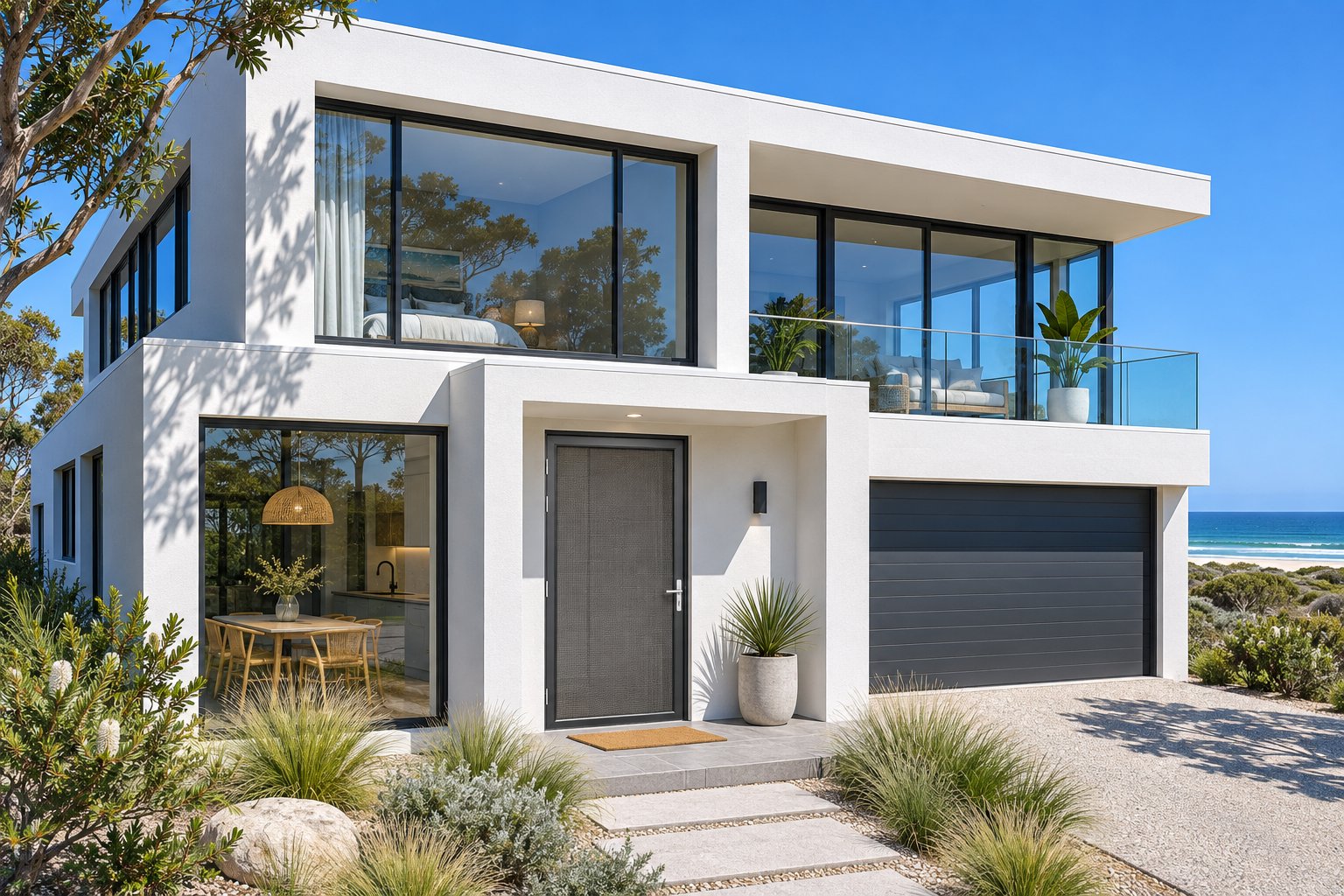
How Climate Affects Aluminium Security Door Performance
Australia spans tropical monsoon zones, arid deserts, temperate coasts, and alpine cold — sometimes within the same state. A door that performs flawlessly on a sheltered Melbourne street may deteriorate rapidly on a beachfront balcony in Cairns. Yet most spec sheets list materials and dimensions without ever addressing the environment the product will actually live in. Climate is the variable that separates a lasting investment from a premature replacement, and it deserves far more attention than most buyers give it.
Coastal and Salt-Air Environments
Aluminium's most celebrated advantage in marine-adjacent locations is its self-healing oxide layer. The moment a fresh aluminium surface contacts air, it forms a thin aluminium-oxide film — typically 4–10 nanometres thick on untreated profiles — that shields the metal beneath from further attack. Unlike steel, which requires galvanising or powder coating to survive salt air, aluminium resists chloride-driven pitting natively. That's a significant edge for homes along the Sunshine Coast, the Illawarra, or Perth's western suburbs, where airborne salt concentrations can accelerate corrosion by an order of magnitude compared to inland sites.
The protection isn't unlimited, though. Projects within roughly 500 metres of breaking surf fall into the most severe coastal exposure class, and even aluminium frames benefit from a marine-grade powder coat — ideally applied over a Class I anodise base layer — to extend service life in those conditions. IQ Glass International recommends a minimum powder coat thickness of 50 µm for coastal projects, with 60 µm over anodise for the harshest zones.
Here's the detail that trips up many buyers: the frame may be perfectly specified, but the hardware lets the system down. Hinges, closers, and lock cylinders made from zinc die-cast or 304-grade stainless steel can develop surface corrosion surprisingly fast in salt air. A door metal screen assembly is only as durable as its weakest component, and that component is almost always a lesser-metal fitting hidden behind a branded faceplate. Coastal buyers should verify that all hardware — not just the frame — is rated to 316-grade stainless steel or equivalent. Titon Hardware identifies 316 stainless as the baseline marine-grade material for window and door fittings, thanks to its 2–3% molybdenum content that resists chloride attack far better than the more common 304 grade. Even something as small as a screen door lock with key mechanism can become a corrosion initiation point if it's made from unrated metal.
Galvanic corrosion adds another layer of risk. Wherever aluminium touches a dissimilar metal — steel masonry anchors, copper flashing, brass hinges — an electrochemical reaction can eat into the aluminium side of the joint within months. Non-absorbent neoprene or polymer isolators at every contact point are non-negotiable in coastal installations.
Extreme Heat, Cold, and Humidity Performance
Aluminium has a higher coefficient of linear thermal expansion than steel — roughly 21–24 × 10⁻⁶/°C for aluminium alloys versus 11–13 × 10⁻⁶/°C for carbon steel. In plain terms, a 2-metre aluminium frame exposed to a 40°C temperature swing (common between a cold winter morning and a summer afternoon in inland NSW or Victoria) will expand or contract by roughly 1.6–1.9 mm. That movement is manageable — provided the installation allows for it. Frames screwed rigidly into masonry with no clearance gaps or flexible sealant joints can bind, warp, or pull fasteners loose over repeated thermal cycles. Proper tolerances and the right sealant selection eliminate the issue entirely, but it's a detail that poorly planned retrofit jobs often miss.
UV stability matters just as much for long-term appearance. Quality powder-coat finishes — particularly those meeting AAMA 2604 or AAMA 2605 specifications — retain colour and gloss even under Australia's punishing UV index. Cheaper finishes can chalk, fade, or delaminate within a few years, particularly on north-facing doors that cop direct afternoon sun. If a supplier can't tell you the specific coating standard their product meets, treat that as a red flag.
In hot, humid climates — think Darwin, Townsville, or the Kimberley — aluminium security doors with perforated or woven stainless steel mesh offer a practical dual benefit: they maintain cross-ventilation through the house while blocking insects and debris. That airflow advantage disappears with solid-panel doors, which is one reason mesh-based aluminium security doors remain the dominant choice across tropical Australia.
Storm-prone regions introduce yet another consideration. An aluminium storm door can double as debris protection during severe weather, shielding the primary entry door from wind-borne projectiles. However, that protection only counts if the product has been independently tested for wind-borne debris impact. In the US, the Miami-Dade County protocol (TAS 201, 202, 203) sets the benchmark for hurricane-zone openings, testing against large missile impact, static air pressure, and cyclic wind loading. The Australian equivalent falls under AS/NZS 1170.2 for wind loading and relevant cyclone-rating protocols in northern regions. A generic security door — even a well-built one — should never be marketed or purchased as a cyclone-rated product without specific test evidence to that standard. The two product classes overlap in appearance but diverge sharply in engineering and certification.
Frame material alone does not determine climate suitability. Hardware corrosion ratings, seal quality, powder-coat specification, installation tolerances, and fastener grades collectively decide whether an aluminium security door thrives or deteriorates in your specific environment. Specify the full system — not just the frame alloy.
Climate resilience, ultimately, is a systems question. The best aluminium extrusion paired with the wrong hardware, a substandard finish, or a sloppy installation will underperform a modest frame that's been thoughtfully specified and properly fitted. That fitting process — what it involves, what can go wrong, and how to recognise competent work — is the logical next piece of the puzzle.
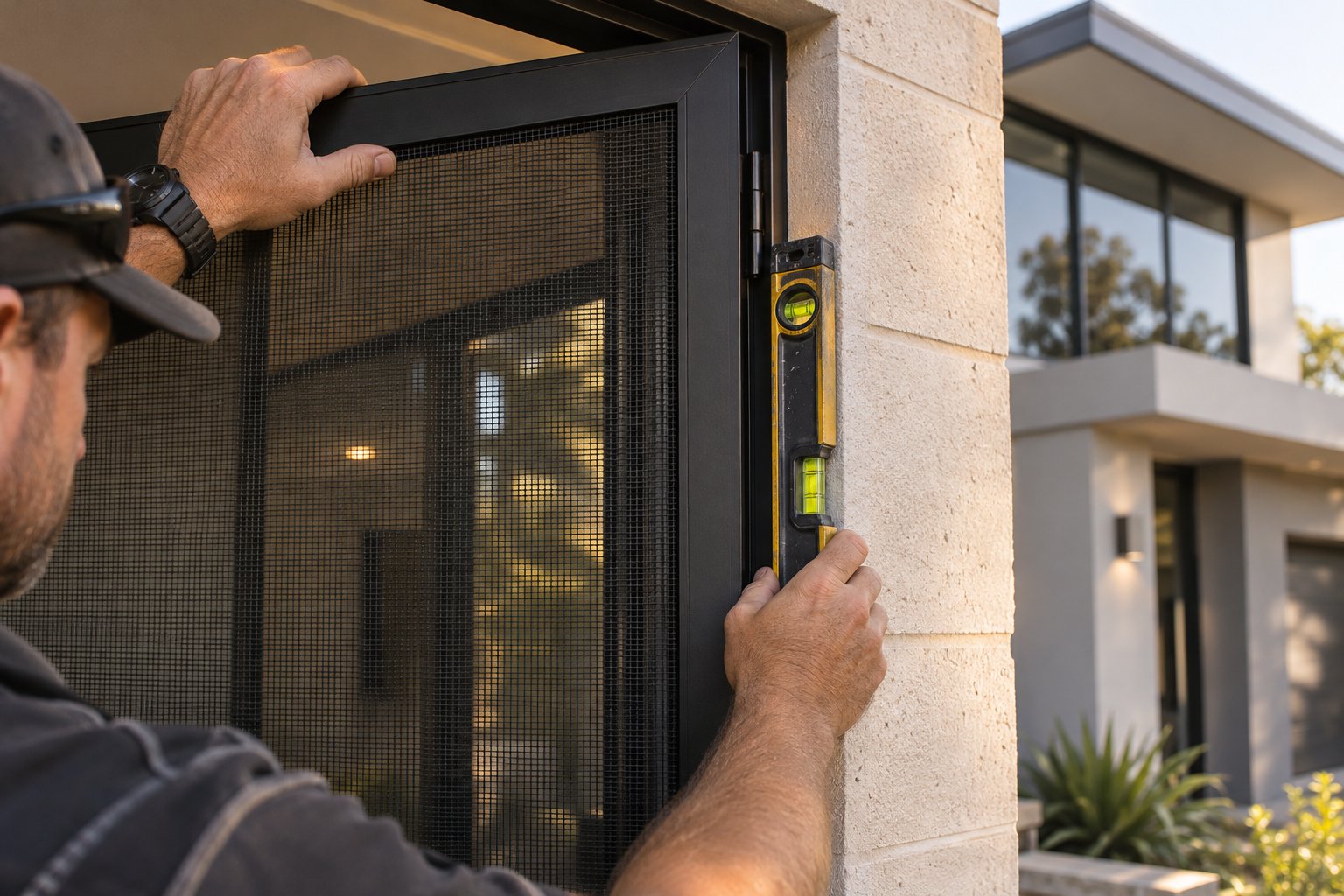
Installation Overview from Measurement to Final Fit
A perfectly specified aluminium security door — right alloy, right mesh grade, right hardware — can still fail spectacularly if the installation is botched. Improper anchoring is the single most common failure point in the field, and it renders every other specification meaningless. A strong door bolted into a weak or misaligned frame offers no real security; it just looks like it does. Whether you're fitting a hinged entry, a sliding security door for a back patio, or replacing ageing aluminium doors across an entire property, the installation process follows a predictable sequence — and knowing that sequence helps you distinguish competent work from a rushed job.
Pre-Installation Measurement and Frame Preparation
Accurate measurement is the foundation everything else rests on. It sounds obvious, yet even small errors — a few millimetres off — can cause fitting problems that compromise both operation and security. Three dimensions matter: width, height, and diagonal.
Measure the inside of the door frame at three points for width (top, middle, bottom) and record the narrowest figure. Do the same for height on both sides, noting the shortest reading — floors are rarely perfectly level, especially in older Australian homes. Then measure the diagonals corner to corner. If those two diagonal measurements don't match, the opening isn't square, and the installer will need to account for the discrepancy with shimming or packing.
Beyond raw dimensions, the condition of the existing sub-frame or reveal deserves careful inspection. Retrofit installations on weatherboard cottages, fibro homes, or ageing brick veneer often reveal rotted timber reveals, crumbling mortar, or jambs that can't support the additional weight and lock-strike forces of a security door. In those cases, the sub-frame may need replacement or structural reinforcement before the new door goes anywhere near the opening. Skipping this step to save time or cost is how you end up with a door that rattles loose within a season. The structural lintel above the opening also needs verification — it must carry the header load without sagging, particularly for wider sliding security door configurations where the track span is greater.
For anyone ordering custom security screen doors, precise measurements matter doubly. Made-to-measure fabrication means there's no trimming or adjusting on site; the door arrives built to your exact figures. That precision is a strength — but only if the figures are right. Many installers now use laser measuring tools to eliminate human error, and it's worth confirming that your chosen installer does the same. Lead times for custom orders typically run longer than off-the-shelf products, so factor in two to six weeks of manufacturing time depending on specification complexity.
What to Expect During Professional Installation
A competent installer follows a methodical sequence. Rushing any step — or skipping it entirely — is a warning sign. Here's what the process should look like from start to finish:
- Trial fit — The door is positioned in the opening without permanent fixings to check clearances, alignment, and handle-side operation. This dry run catches sizing issues before any holes are drilled.
- Plumb and level adjustment — Using a spirit level, the installer ensures the frame sits perfectly vertical (plumb) and the head is horizontal (level). Shims or packers are inserted behind the frame where needed to correct irregularities in the reveal.
- Mechanical fixing to the structure — The frame is anchored into masonry, timber, or steel sub-framing using appropriate fasteners. For masonry, concrete screws or sleeve anchors are typical; for timber reveals, heavy-gauge coach screws or structural screws are used. Proper anchoring at multiple points — not just top and bottom — prevents the frame from flexing under force. This stage is critical: even home depot security screen doors or low cost screen doors with basic specifications will outperform a premium product if the premium product is poorly anchored.
- Lock and closer fitting — Multipoint locks, deadbolts, and hydraulic closers are installed and adjusted. Strike plates must align precisely with the locking points; even a 2 mm misalignment can prevent a multipoint system from engaging fully.
- Seal and weatherstrip installation — Perimeter seals are fitted between the door frame and the reveal to block draughts, water, and insects. Flexible sealant (typically neutral-cure silicone) is applied at the junction between the outer frame and the wall surface.
- Final operation check — The installer opens and closes the door repeatedly, testing latch engagement, closer speed, lock throw, and clearance at all edges. Any binding, dragging, or incomplete locking is corrected before sign-off.
Each of these stages applies whether you're fitting a single hinged entry or a full-width sliding security door across a rear opening. The difference with sliding configurations is that track alignment and roller adjustment become additional focus points — a track that's even slightly out of level will cause the door to drift or jam over time.
One final consideration that rarely appears on a quote but significantly affects real-world performance: the installer should confirm that the finished door complies with local council requirements for egress, accessibility, and fire safety where applicable. A security door that blocks emergency exit — because it locks from the outside without an internal thumb-turn release, for instance — can create a serious code violation and a genuine life-safety hazard. The door's job is to keep intruders out, not to trap occupants in.
Installation quality, in short, is the bridge between what a product promises on paper and what it delivers on your doorstep. But even a flawlessly fitted door won't stay that way forever without some ongoing attention — and the maintenance requirements for aluminium, while modest, aren't zero.
Maintenance and Long-Term Care for Lasting Performance
Low-maintenance and no-maintenance are not the same thing. Aluminium security doors demand far less upkeep than steel or wrought iron — there's no rust treatment schedule, no recoating cycle to track — but neglect them entirely and you'll watch powder-coat finishes dull, lock cylinders seize, and mesh panels trap moisture that shouldn't be there. Ten minutes of attention every few months is the difference between a door that still looks and functions like new after a decade and one that needs a full service call within three years.
Cleaning Methods and Frequency
The goal with any screen security door is to remove contaminants before they bond to the finish — not to scrub damage into the surface trying to remove stains that have already set. A quarterly wash is a sensible baseline for most Australian homes. Properties in coastal, high-traffic, or dusty environments benefit from monthly rinses, particularly during dry, windy stretches when salt and grit settle invisibly on every exterior surface.
The process itself is straightforward: rinse the frame and mesh with plain water to dislodge loose dirt, then wash with a soft cloth or sponge and a mild pH-neutral detergent. Rinse thoroughly and dry with a clean microfibre cloth to prevent mineral deposits from water drying back onto the powder coat. Avoid cleaning in direct hot sun — the detergent dries too quickly and leaves streaks that are harder to remove than the original grime.
For security mesh or perforated screen panels, a soft-bristle brush works better than a flat cloth. The weave traps fine debris — pollen, cobwebs, airborne grease near barbecue areas — that holds moisture against the stainless steel strands. Left unchecked, that moisture creates the conditions for tea-staining, which is cosmetic rather than structural but unsightly all the same. Crucially, abrasive cleaners, scouring pads, steel wool, and high-pressure washers at close range are all off-limits. They scratch the powder coat, reduce gloss, and create micro-grooves where grit and moisture accumulate faster than on an undamaged surface.
Hardware Lubrication and Screen Replacement
Locks and hinges do the hardest mechanical work on any door, yet they're the components most often ignored until something binds or breaks. Maintenance specialists recommend using light machine oil on hinges and powdered graphite — not penetrating oil — inside lock cylinders. A silicone-based spray works well for multipoint locking rods and door closer mechanisms, keeping the moving parts sliding smoothly without attracting dust that accelerates wear. Annual lubrication is sufficient for most residential doors; a screen door with lock hardware that gets heavy daily use (think a busy front entry opened dozens of times a day) benefits from a six-monthly schedule instead.
Damaged or corroded mesh panels don't always mean the entire door needs replacing. In many cases, the security fabric can be re-sheeted into the existing aluminium frame — a far cheaper repair than a full door swap. The key is confirming replacement screen compatibility with the original manufacturer. Security mesh is not interchangeable the way flyscreen is; the mesh grade, tensile rating, and retention method (wedge, screw-clamp, or proprietary clip) must match the original specification to preserve the door's tested performance under AS 5039. Using a cheaper, thinner mesh to save on a repair quietly downgrades your door from a certified security product to an untested barrier — a false economy that defeats the purpose entirely.
One detail worth noting: even well-maintained hardware eventually wears out. Cycle count matters more than calendar age. A door opened fifty times a day accumulates wear far faster than a side entry used twice a week. Keep manufacturer part numbers on file so that replacement cylinders, hinges, or closer cartridges can be matched exactly when the time comes.
Seasonal Maintenance Checklist
A quick run-through each season keeps small issues from becoming expensive repairs. Here's a practical checklist you can follow quarterly — or monthly in harsh coastal or tropical environments:
- Clean frame and mesh — Rinse, wash with mild detergent, rinse again, and dry. Use a soft brush on mesh panels to clear embedded debris.
- Inspect seals and weatherstrips — Check perimeter seals for cracking, compression, or gaps. A simple paper-strip test (shut the door on a strip of paper and tug — even resistance all around means the seal is intact) flags problem areas quickly.
- Lubricate locks and hinges — Apply powdered graphite to lock cylinders and light machine oil or silicone spray to hinges, multipoint rods, and latch mechanisms.
- Check closer tension — The door should close fully and latch without slamming. Adjust the closer's sweep and latch speeds if the door drifts open or bangs shut.
- Inspect mesh for damage — Look for dents, punctures, loose edges, or early signs of tea-staining. Any breach in the mesh compromises the door's forced-entry rating.
- Clear the threshold — Remove grit, leaves, and debris from the bottom track or threshold. Grit acts like sandpaper on the bottom capping every time the door swings, accelerating wear on both the seal and the frame.
Keeping a simple log of what you checked and when might sound excessive — until you need to support a warranty claim or demonstrate maintenance history during a property sale. Consistent care protects both the door's performance and its provable value. Still, even the most diligent maintenance routine can't compensate for a poor purchasing decision made months earlier — and certain buying mistakes are far more common than they should be.
Common Mistakes to Avoid When Choosing a Security Door
A well-maintained door can last fifteen years or more — but only if the right product was chosen in the first place. The most expensive maintenance regime in the world won't fix a door that was under-specified, incorrectly coded, or fitted with hardware that undermines the very security the frame was designed to provide. These five mistakes crop up repeatedly across Australian homes, and every one of them carries a practical consequence far more costly than the shortcut that caused it.
Choosing the Wrong Gauge or Mesh Grade
Budget aluminium screen doors flood the market at price points that seem almost too good to pass up — and they usually are. A $250 hinged door from a clearance bin may look similar to a $900 certified product, but the similarities end at the surface. Thinner extrusion walls (often 1.0 mm or less instead of the 1.4–1.6 mm typical of tested products), lightweight diamond grilles in place of woven stainless steel mesh, and aluminium rivets spaced too far apart all add up to a product that has never passed — and likely couldn't pass — a single forced-entry test under AS 5039.
The practical consequence? Zero actual security improvement. You've spent money, disrupted your front entry, and gained nothing beyond a visual deterrent that any determined intruder can defeat with common hand tools. Even stainless steel security screen doors — widely regarded as one of the more robust mesh options — vary enormously in strand gauge and weave density. A product using 0.7 mm stainless wire woven at a loose pitch will not perform the same as one using 0.9 mm wire in a tight 11-mesh weave, even though both can legally carry the label "stainless steel mesh." The only reliable way to verify performance is to request the product's AS 5039 test report — the actual certificate, not a marketing claim that it's "equivalent" to a better-known brand. As CHOICE notes, equivalency claims can be hard to verify; if in doubt, check directly with the company being used as the comparison.
Anyone shopping for a security screen door for front door protection should treat the absence of an independently issued test report as a disqualifying factor — regardless of how attractive the price looks on the quote.
Ignoring Local Building Codes and Lock Hardware Quality
Security isn't just about keeping people out. It's also about letting people get out safely. Many Australian councils require development applications or building approvals for new external door installations, and the National Construction Code (NCC) mandates specific egress, fire-safety, and accessibility provisions that a security door must not compromise.
Here's a scenario that plays out more often than you'd expect: a homeowner installs a keyed-alike deadlock on both the security screen and the primary door, with no thumb-turn or quick-release mechanism on the inside. In a fire or medical emergency, occupants are trapped behind two locked barriers while fumbling for a key in the dark. Life-safety codes universally require that door leaves be openable from the egress side without a key, special tool, or special knowledge whenever the building is occupied. A screen door with lock and key access only — no internal quick-release — can create both a code violation and a genuine life-safety hazard.
Lock hardware quality introduces a parallel risk. Pairing a strong aluminium frame and certified mesh with a single-point wafer lock is like fitting a vault door with a luggage padlock. Industry guidance recommends five-pin cylinder locks at minimum, with three-point (multipoint) locking systems strongly preferred for front door and screen combinations. Multipoint locks engage at the top, middle, and bottom of the frame simultaneously, spreading force across the full height of the door and making it far more resistant to being wrenched open at a single weak spot. Some stainless steel security screen doors now ship with integrated multipoint hardware as standard — a welcome trend that eliminates the mismatch risk at the point of sale rather than leaving it to the homeowner's discretion.
The Five Mistakes That Cost the Most
Every error above — and the three below — shares a common thread: the upfront saving is always smaller than the downstream cost. Whether that cost is measured in dollars, safety, or compliance headaches, the pattern holds.
- Selecting on price alone without checking test evidence — A door that hasn't passed AS 5039 testing offers insect screening, not security. Request the full test certificate before signing a quote, and confirm the certificate covers the exact product configuration (mesh type, frame series, lock model) you're purchasing.
- Ignoring council approval and permit requirements — External door changes may trigger a development application or require compliance with NCC provisions for egress width, accessibility, and fire safety. Proceeding without checking can result in removal orders, fines, or insurance complications.
- Using inadequate locking hardware — A single-point wafer lock or basic cylinder deadlock undermines the whole system. Specify multipoint locking with a minimum five-pin cylinder, and ensure the internal side includes a thumb-turn or quick-release lever for emergency egress.
- Neglecting weatherproofing and seals — Gaps between the door frame and the reveal invite draughts, water ingress, and insect entry. Proper perimeter seals and flexible sealant at the frame-to-wall junction are not optional extras — they're functional components that affect both comfort and durability.
- Skipping professional installation on structural openings — DIY fitting may work for a lightweight flyscreen, but a security door exerts significant lateral and impact forces on the surrounding structure. Incorrect anchoring, out-of-plumb framing, or inadequate fixing into masonry can turn a certified product into a liability. The installation standard (AS 5040 / AS 5039.2:2024) exists for a reason — and CHOICE recommends requesting a written guarantee from the installer that their work complies.
Each of these mistakes is entirely avoidable with a straightforward discipline: ask for documentation before committing. Test reports, compliance certificates, installation guarantees, and hardware specifications exist precisely so that buyers don't have to take marketing language on faith. How to request and evaluate that documentation — and where to start when a supplier's claims need independent verification — is the final piece worth unpacking.
How to Verify Compliance Documentation Before You Buy
Marketing copy is persuasive by design. Compliance documentation is not — it's dry, technical, and sometimes buried behind a login page or available only on request. That's precisely why it matters more than anything on a product brochure. Whether you're a homeowner comparing residential security screen doors for a front entry, a builder specifying security doors with screen panels across a multi-unit development, or an architect documenting screen door security for a commercial fitout, verifying the paperwork is the single most reliable way to separate proven products from unsubstantiated claims.
What Documentation to Request from Any Supplier
A credible supplier should produce the following documents without hesitation — and without you needing to ask twice. If any item draws a vague answer or a redirect to a generic brochure, treat that as a signal worth acting on.
- Assembly-specific test report (e.g., AS 5039) — This must cover the complete product as sold: frame series, mesh type, fixing method, and lock model tested together as a system. A component-level certificate for the mesh alone, or a test report for a different frame configuration, does not extend to the product you're purchasing.
- Current product certification schedule — Certifications expire or are superseded. A test report from 2014 referencing a product line that has since changed mesh suppliers or lock hardware may no longer represent what's rolling off the factory floor. Confirm the certificate is current and covers the exact specification on your quote.
- Glazing compliance evidence (where applicable) — If your door includes glass panels — common on an entry door with built-in screen and operable window, for instance — the specific glass-and-frame combination must comply with AS 2047 for structural performance and AS 1288 for safety glazing. Request evidence for the actual combination, not a blanket statement that the supplier's products "comply with Australian Standards."
- Hardware-level test results — Where forced-entry resistance, fire rating, or cyclone impact performance is claimed, the lock, hinges, and closer must each carry their own relevant test evidence. A multipoint lock marketed as "high security" should be backed by a test report to the appropriate standard — not just a product photo showing a three-point mechanism.
- Installation compliance confirmation — Under AS 5039.2:2024, installation method directly affects whether the tested performance of the product is preserved. Ask the installer for written confirmation that their fixing method matches the conditions specified in the product's test report.
One point deserves particular emphasis: AS 2047 and AS 1288 are not security standards. They address structural adequacy under wind and weather loads and mandate safety glazing to reduce injury risk from human impact. They do not test for — and therefore cannot prove — forced-entry resistance, ballistic performance, fire rating, or wind-borne debris impact resistance. If a supplier cites AS 2047 compliance as evidence that their white security door or any other product will stop a break-in attempt, that claim is misleading. The same applies to historical compliance schedules or individual training certificates — neither constitutes proof of current product certification for a specific performance claim.
For builders and procurement teams working to tight project timelines, the temptation to accept a supplier's general compliance statement and move on is real. Resist it. A few hours spent reviewing assembly-specific documentation now can prevent months of rectification work, insurance disputes, or council orders later — particularly on projects where security screen doors home depot-style generic imports won't meet the specification and locally certified products are required.
Using Supplier Compliance Resources as a Starting Point
Some manufacturers and suppliers publish compliance and technical documentation references on their websites, which can accelerate the early stages of a project review. MEICHEN's compliance page, for example, provides published references that builders, architects, consultants, and procurement teams can use to begin reviewing aluminium door systems against project-specific glazing, structural, weather, and safety requirements. These references offer a useful starting point — particularly when comparing multiple suppliers against a specification — but they serve a specific, limited purpose.
Published compliance references help you determine whether a supplier's product range is potentially relevant to your project. They do not, by themselves, establish that the supplier offers a verified fire-rated, impact-rated, or security-rated door for your specific opening. The gap between a general compliance reference and an assembly-specific test report is the gap between possibility and proof. Availability of specialist products — and the test evidence to back them — must be confirmed directly with the supplier before any such product is specified or recommended.
Published compliance references are a starting point for enquiry, not a substitute for project-specific test evidence. Always confirm that the documentation covers the exact frame, glass, hardware, and configuration your project requires before finalising a specification.
The discipline is straightforward: start with what a supplier publishes, then request what your project demands. Every legitimate manufacturer expects that process and has documentation ready for it. Any supplier who can't — or won't — provide assembly-specific evidence for the performance claims on their quote is telling you something important about the reliability of those claims. In an industry where the word "security" carries real consequences for the people behind the door, documentation isn't bureaucracy. It's accountability.
Frequently Asked Questions About Aluminium Security Doors
1. What is the difference between a security screen door and a regular screen door?
A regular screen door uses lightweight fibreglass or plastic mesh designed solely for insect protection. An aluminium security screen door pairs heavy-duty extruded aluminium framing with reinforced stainless steel mesh, multipoint locking hardware, and tamper-resistant hinges. In Australia, genuine security screen doors are tested to AS 5039, which subjects the complete assembled product to knife-shear, jemmy, impact, pull, probe, and shear attacks. If a door has not passed these tests, it functions as an insect barrier rather than a security barrier — regardless of how it is marketed.
2. Which aluminium alloy is best for security doors?
The two most common alloys are 6063 (architectural grade) and 6061 (structural grade). For most residential security doors, 6063-T6 is the preferred choice because it extrudes into complex profiles easily, accepts powder-coat finishes beautifully, and delivers strong corrosion resistance — especially important in coastal Australia. The 6061 alloy offers higher tensile strength and suits heavy-duty commercial entries. However, alloy grade alone does not determine security performance. Wall thickness, temper condition (T5 vs T6), and corner joinery method are equally important. A thicker-walled 6063-T6 extrusion can outperform a thinner 6061 profile in forced-entry scenarios.
3. How long do aluminium security doors last in coastal environments?
Aluminium security doors are well suited to coastal zones because the metal forms a self-healing oxide layer that resists salt-spray corrosion naturally. With a marine-grade powder coat of at least 50 micrometres thickness and 316-grade stainless steel hardware, an aluminium security door in a coastal location can deliver a service life of 15 years or more. The critical factor is specifying corrosion-resistant components throughout the entire assembly — including hinges, lock cylinders, and closers — since lesser-metal fittings are typically the first point of failure, not the aluminium frame itself.
4. Do I need council approval to install a security door in Australia?
Requirements vary by local council and state, but many jurisdictions do require permits or development applications for new external door installations. The National Construction Code also mandates specific egress, fire-safety, and accessibility provisions that a security door must not compromise. For example, a security door must allow occupants to exit without a key or special tool during an emergency. Before purchasing, check with your local council and ensure any product you select includes an internal thumb-turn or quick-release mechanism for safe egress.
5. What documents should I request before buying an aluminium security door?
Request five key documents from any supplier: an assembly-specific AS 5039 test report covering the exact product configuration you are purchasing, a current product certification schedule confirming the certificate has not expired, glazing compliance evidence for the specific glass-and-frame combination if applicable, hardware-level test results for any claimed forced-entry or fire-resistance ratings, and written installation compliance confirmation from the installer. General standards like AS 2047 and AS 1288 cover structural and safety glazing performance but do not prove forced-entry resistance. Suppliers such as MEICHEN publish compliance references online at meichenwindows.com.au/compliance/ as a starting point, though project-specific test evidence must always be confirmed directly.