
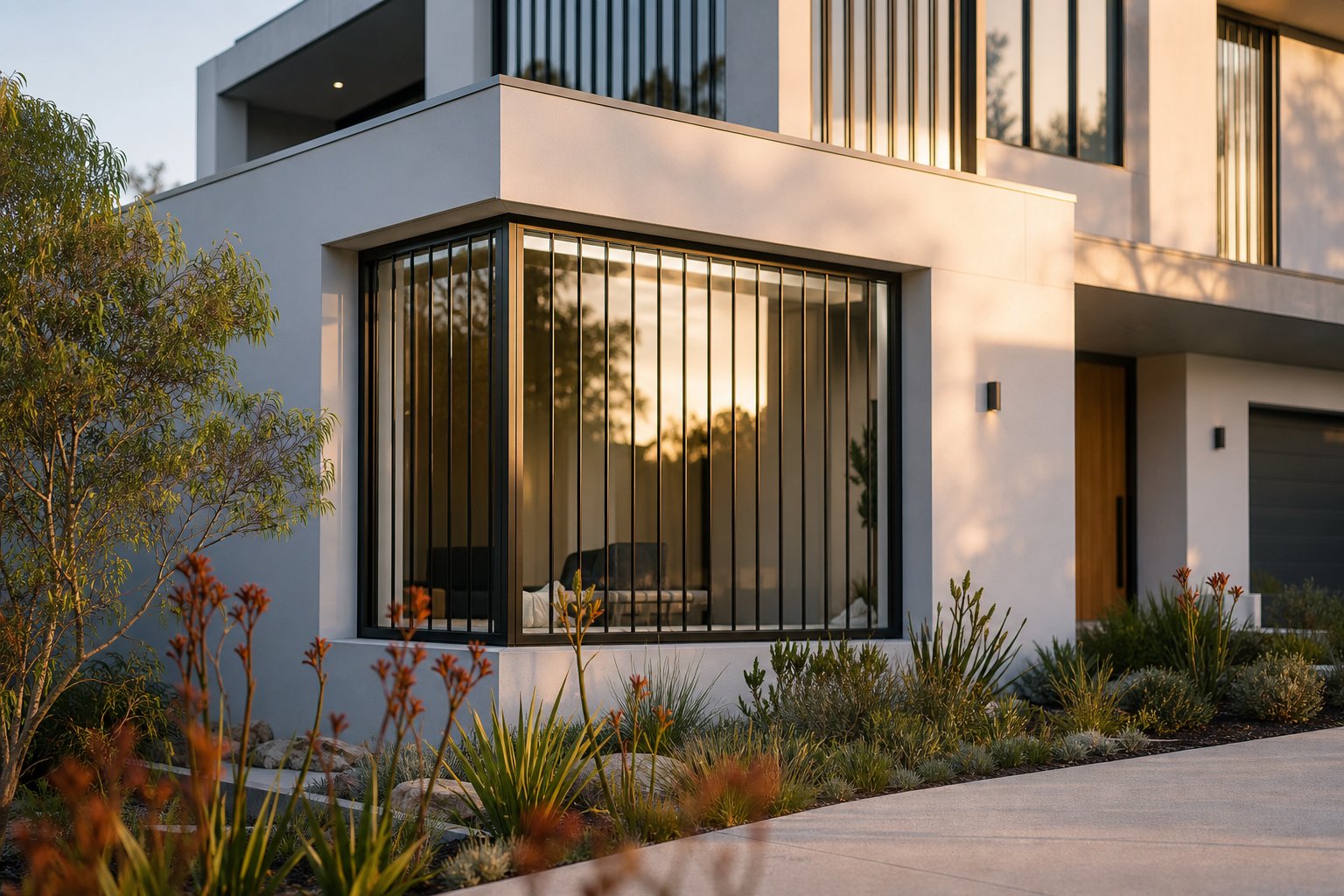
What Aluminium Window Burglar Bars Are and Why They Matter
Large glass openings look stunning, but they also present an obvious vulnerability. Aluminium window burglar bars exist to close that gap between aesthetics and safety, offering a physical deterrent without turning your home into something that feels institutional.
Aluminium window burglar bars are lightweight, corrosion-resistant grilles or bars fixed over or inside window openings to prevent forced entry. They serve as a physical security bar between intruders and your glass, while offering rust-free longevity that traditional steel cannot match without ongoing maintenance.
What Are Aluminium Window Burglar Bars
At their simplest, burglar bars are metal barriers mounted across a window to stop someone climbing or reaching through. What sets aluminium versions apart is the material itself. Aluminium naturally forms a protective oxide layer on its surface, which means the window bars resist corrosion without needing galvanising or frequent repainting. They are lighter than steel equivalents, easier to handle during installation, and available in a wider range of powder-coated finishes that blend with modern architecture.
Unlike generic security bars made from mild steel or wrought iron, aluminium options cater to homeowners who want protection that does not compromise on appearance. The bars can be shaped into slim profiles, custom colours, and contemporary patterns that sit flush with the window frame rather than bolting on as an obvious afterthought.
Why Homeowners Are Choosing Aluminium
Several practical advantages drive the shift. Aluminium window burglar bars do not rust in coastal salt air, weigh roughly a third of their steel counterparts, and require minimal upkeep over a 20-year-plus lifespan. For Australian homes along the coastline or in humid subtropical climates, that corrosion resistance alone justifies the choice. Add in the design flexibility — colour-matched finishes, curved or flat profiles, even near-invisible options — and it becomes clear why aluminium has moved from commercial fitouts into everyday residential security.
The real question most homeowners face is how aluminium stacks up against steel in raw strength and long-term value, which comes down to specific alloy grades, bar thickness, and installation method.
Aluminium vs Steel Burglar Bars Compared
Steel has dominated security fabrication for decades, and for good reason — it is hard, rigid, and difficult to cut through. But hardness alone does not make a material the right choice for every window. When you factor in climate, maintenance burden, and total cost over 15 to 20 years, the comparison between aluminium and steel window bars becomes far more nuanced than a simple strength contest.
Strength and Security Performance
Steel is the stronger material in absolute terms. It offers higher tensile strength, greater impact resistance, and better performance against sustained prying force. For high-security commercial applications — think warehouses, server rooms, or ground-floor retail — steel window security bars remain the default.
Aluminium alloys used in security products, however, are not the soft drink-can metal many people imagine. The 6061-T6 alloy delivers an ultimate tensile strength of at least 290 MPa (around 42,000 psi), while the 6063-T6 alloy commonly used in architectural extrusions reaches approximately 193 MPa. When bar diameter and wall thickness are sized appropriately — typically 20 mm to 30 mm solid round bar or heavy-wall rectangular tube — aluminium provides meaningful resistance to cutting and prying that exceeds what a casual intruder can overcome with basic hand tools. Manufacturer specifications for specific products will confirm rated force resistance, so always check these before purchasing.
The practical reality for residential break-ins is that intruders target the path of least resistance. They attack glass, latches, and poorly anchored frames rather than sawing through metal bars for windows. A properly installed aluminium grille with adequate bar spacing and secure fixings deters the vast majority of opportunistic burglaries.
Corrosion Resistance and Lifespan
This is where aluminium pulls ahead decisively, particularly for Australian conditions. Aluminium naturally forms a stable oxide layer on its surface that prevents further degradation. It does not rust. Period. Add a quality powder coat finish and you have a product that performs for 30 to 50 years in inland environments with little more than an annual wash.
Steel, by contrast, rusts readily when its protective coating is compromised. Standard mild steel or wrought iron window bars require galvanising plus paint, and even then, scratches or chips expose bare metal to moisture. In coastal areas — think anywhere within 10 kilometres of the shoreline across Sydney, Melbourne, Brisbane, Perth, or regional towns along the coast — steel can show visible rust within a few years without annual maintenance. Repainting every three to five years, sanding rust spots, and eventually replacing corroded sections all add up. Over a 20-year window, the total cost of ownership for steel bars often exceeds the initial outlay for aluminium despite steel's lower upfront price.
Weight and Installation Practicality
Aluminium weighs roughly one-third as much as steel. For bars for windows on upper storeys, lightweight material means less structural load on the window frame, easier handling on scaffolding or ladders, and faster installation overall. Timber-framed windows and older brick veneer homes benefit especially, since heavy steel window bars can stress mounting points and require additional reinforcement.
The lighter weight also helps with automated or folding designs — hinges, tracks, and locking hardware all experience less wear when the panel they support weighs significantly less.
| Factor | Aluminium | Steel (Mild/Galvanised) |
|---|---|---|
| Corrosion resistance | Excellent — naturally oxide-protected, no rust | Poor to moderate — requires galvanising and paint |
| Weight | Light (approx. one-third of steel) | Heavy — adds load to frames and fixings |
| Tensile strength | Moderate — adequate for residential security with correct bar sizing | High — superior raw strength |
| Maintenance frequency | Low — annual wash, occasional hardware check | High — repaint every 3-5 years, rust treatment |
| Expected lifespan (coastal) | 30-50 years | 10-20 years with diligent maintenance |
| Expected lifespan (inland) | 40-60 years | 30-50 years with regular maintenance |
| Upfront cost | Moderate to high | Low to moderate |
| Total cost of ownership (20 years) | Lower — minimal maintenance spend | Higher — ongoing paint, labour, potential replacement |
Neither material is universally superior. Steel still wins on brute force, and budget-conscious inland projects where the owner commits to maintenance can get solid value from galvanised metal window bars. But for most Australian homeowners — especially those near the coast or those who simply want to install and forget — aluminium delivers the better long-term equation.
Material choice is only half the decision, though. The style of bar you select shapes how your windows look, how they operate day to day, and whether they meet fire safety codes.
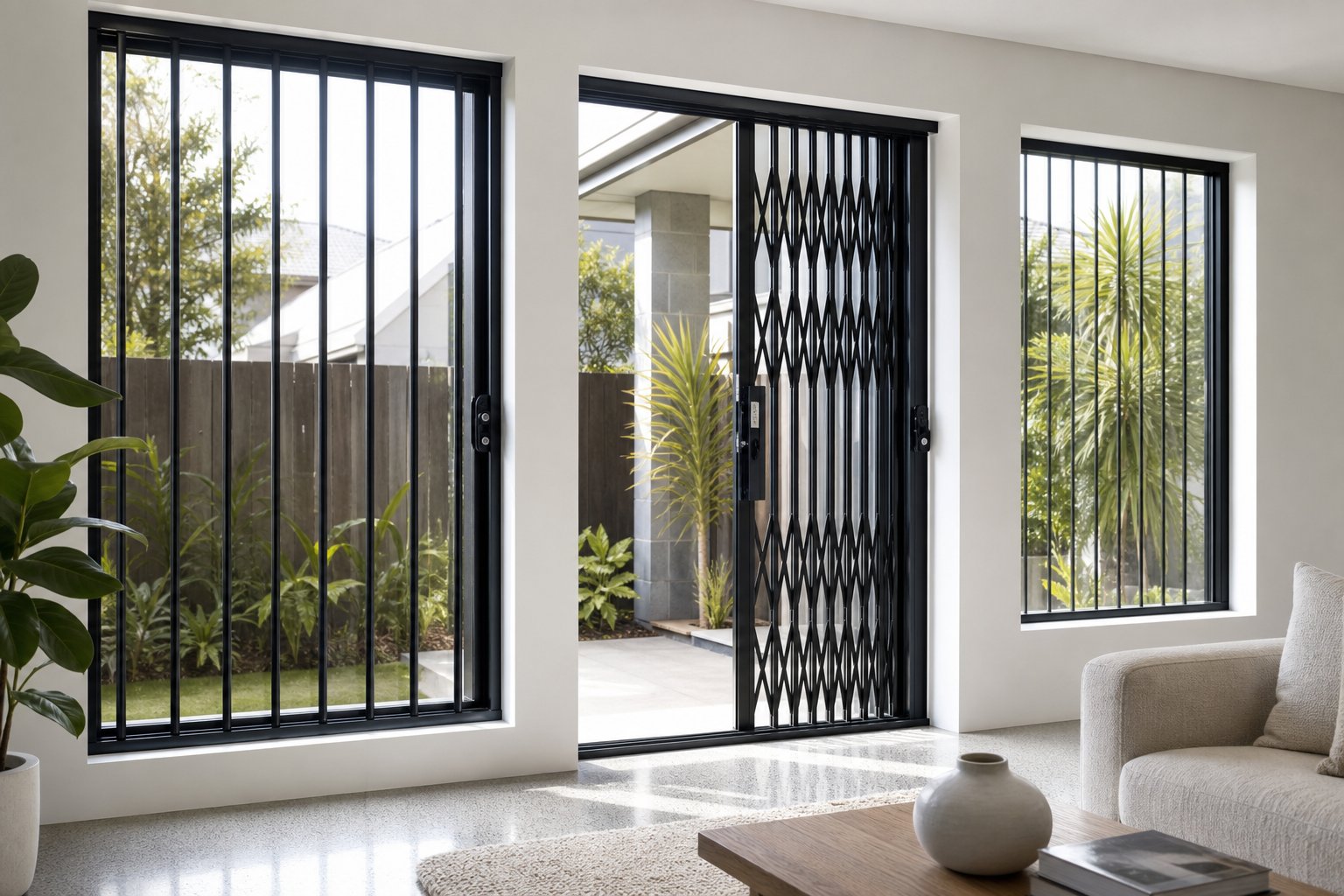
Types of Aluminium Burglar Bar Designs
Aluminium burglar bars come in more configurations than most people realise. The right design depends on where the window sits, how often you need access, and how visible you want the security layer to be. Here is what is available across the three main categories.
Fixed Aluminium Burglar Bars
Fixed bars are the most common and straightforward option. They consist of permanently mounted vertical or horizontal bars — sometimes in a trellis pattern — bolted to the wall or window reveal with set spacing (typically 100 mm to 125 mm between bars). There are no hinges, no tracks, and no moving parts to wear out.
This simplicity is their greatest strength. Fewer mechanical components means fewer potential failure points for an intruder to exploit. Fixed designs suit ground-floor windows facing laneways or fences, storeroom windows, garages, and any opening where you do not need emergency escape access.
Pros
- Highest structural rigidity — no joints or hinges to attack
- Lowest cost among all design types
- Zero mechanical maintenance beyond cleaning
- Widest range of decorative patterns available
Cons
- Cannot open for emergency egress
- Makes window cleaning and glass replacement more difficult
- May not comply with building codes in bedrooms or habitable rooms
Sliding and Folding Security Bars
For homeowners who want security bars for windows that open, sliding and folding designs offer the best of both worlds. These function much like a window gate — the bars concertina or slide to one side when unlocked, giving full access to the opening. When locked, they present the same physical barrier as fixed bars.
Locking mechanisms vary. Key locks are the most secure but require the key to be kept accessible (and known to all household members). Slam locks engage automatically when closed, which prevents you from accidentally leaving the bars open. Child-safe releases use a latch positioned beyond a child's reach or requiring adult dexterity, addressing a common concern for upper-storey windows.
The trade-off is mechanical complexity. Folding bars have more pivot points, track rollers, and locking hardware than fixed alternatives. Over time, these components can wear, particularly on coastal properties where salt residue builds on tracks. Regular lubrication and hardware inspection keep them operating smoothly.
Pros
- Allows full window access for cleaning, ventilation, and escape
- Compliant with emergency egress requirements when unlocked from inside
- Can protect an entire window — both fixed and opening panes — with a single unit
Cons
- More expensive than fixed bars due to additional hardware
- Requires periodic maintenance of tracks and locking mechanisms
- More potential failure points than a welded fixed frame
Security gates for windows in the sliding style are particularly popular in Australian homes where bedrooms face a backyard or side passage. They provide peace of mind at night yet fold away completely during the day.
Invisible and Low-Profile Options
Not every property suits visible bars. Heritage-listed homes, strata buildings with facade restrictions, and homeowners who simply prefer a clean look can turn to invisible burglar bars and low-profile alternatives.
Transparent polycarbonate strip systems use high-impact polymer panels mounted in an aluminium frame. The material resists cutting and blunt force, yet appears almost invisible from the street. Ultra-thin aluminium bar designs achieve a similar effect by using slender round or flat profiles (as narrow as 8 mm to 10 mm) with wide spacing, positioned to align with the window frame's shadow lines so they virtually disappear at a distance.
Interior window security bars mounted on the room side of the glass are another option for maintaining external aesthetics. These are less visible from outside and keep the property's facade unaltered — useful where body corporate rules or council heritage overlays restrict external modifications.
Pros
- Minimal visual impact — preserves property streetscape
- Suitable for heritage or strata-controlled buildings
- Polycarbonate options also block monkeys and wildlife in semi-rural areas
Cons
- Typically more expensive per square metre than standard bars
- Thinner profiles offer less resistance to sustained attack than heavier bars
- Polycarbonate may discolour over many years of UV exposure without proper coatings
Each design category serves a different balance of security, access, and appearance. The right choice often comes down to where you live, who lives in the home, and which rules — council, strata, or building code — apply to your specific property.
Matching Burglar Bars to Your Situation
Knowing what types exist is one thing. Knowing which type fits your property is the decision that actually matters. Your floor level, climate, ownership status, and aesthetic priorities all push toward different solutions — and getting the match wrong means either overspending on security you do not need or underprotecting the windows that face the greatest risk.
Ground Floor vs Upper Floor Considerations
Ground-floor and basement windows are where intrusion attempts concentrate. Research into burglary patterns shows that ground-level openings — particularly those hidden by fences, shrubs, or side passages — are overwhelmingly the first point of attack. For these windows, fixed or heavy-duty folding bars with robust locking mechanisms provide the strongest deterrent. Basement window security deserves special attention in homes with sub-floor storage or rumpus rooms; security bars for basement windows should use solid bar profiles and through-frame bolting since these openings are often below sightlines and easy to approach unnoticed.
Upper storeys face a different risk profile. Break-ins above ground level are relatively uncommon, so the priority shifts from intrusion prevention to child safety and fall prevention. Lighter home window bars or window guards for home safety — designed to stop a child from pushing through an open window — are often sufficient. These can be slimmer, more discreet, and easier to operate from inside since brute-force resistance is less critical when the window sits three or more metres above ground.
Coastal vs Inland Environments
Australia's coastline stretches thousands of kilometres, and a huge proportion of the population lives within a few kilometres of the ocean. Salt-laden air accelerates material degradation, and even aluminium — despite its natural oxide protection — is not entirely immune. If the powder coating chips or is scratched during installation, salt spray can cause pitting corrosion at the exposed point, particularly within 500 metres of the shoreline.
For coastal properties in areas like the Gold Coast, Sydney's Northern Beaches, or Perth's western suburbs, specify marine-grade alloy (6063-T6 or higher) with a minimum 80-micron powder coating — preferably thicker. Use Grade 316 stainless steel fixings rather than standard hardware, and commit to quarterly fresh-water rinses to remove salt buildup from tracks and hinges.
Inland properties enjoy far less corrosive conditions. Standard powder-coated aluminium with regular fixings will perform reliably for decades. A simple annual wash with mild detergent is all the care they need. The savings on coating thickness and hardware grade can be redirected toward a better locking mechanism or a wider colour choice.
Rental Properties and Body Corporate Rules
Ownership changes everything about what you can install. Renters in most Australian states need written landlord consent before fixing anything to walls or window frames. Even with approval, damage to reveals or brickwork at move-out can come out of your bond. Removable or internal-mount options — such as tension-fit bars or reveal-fixed grilles that leave minimal trace — are usually the only realistic route for tenants.
Body corporates and strata schemes add another layer. Many by-laws restrict external modifications to maintain a uniform building appearance. You may find that internal burglar bars or low-profile invisible systems are the only compliant choice. Before purchasing anything, submit a written request through your strata committee and confirm what is permitted. Some homeowners in these situations explore how to secure windows without bars altogether — using security film, reinforced locks, or alarm sensors as alternatives that require no external hardware visible from common areas.
Use Case Matching
Rather than guessing, work through this decision checklist in order. Each factor narrows down the options until you arrive at the right product category for your specific situation:
- Property type — Freestanding house, townhouse, apartment, or commercial premises? Freestanding homes have the most freedom; apartments and townhouses often face strata restrictions.
- Floor level — Ground floor or basement (prioritise strong fixed or folding bars), upper floors (prioritise child safety and lighter profiles).
- Climate zone — Coastal within 5 km of the ocean (specify marine-grade alloy and thicker coatings) or inland (standard specifications are fine).
- Ownership status — Owner-occupier (full flexibility), landlord installing for tenants (consider quick-release for compliance), or tenant (removable or internal-mount only).
- Aesthetic priority — Heritage facade or strata restrictions (invisible or internal options), modern architectural look (slim colour-matched profiles), or security-first with appearance secondary (heavy-duty fixed bars).
Working through these five points before contacting an installer ensures you get accurate quotes, avoid products that will not pass body corporate approval, and end up with basement security window bars or upper-floor guards that actually match the threat you are addressing.
Choosing the right bar type for your situation is only part of the equation, though. Any security measure that blocks a window also affects your ability to escape during a fire — a tension that building codes take seriously and that every homeowner should understand before installation day.
Fire Safety and Emergency Egress Compliance
A window that stops a burglar from getting in also stops you from getting out. That single tension sits at the heart of every burglar bar installation, and it is the reason building codes across Australia place strict limits on how and where permanent window barriers can be fitted.
Emergency Egress Requirements
The National Construction Code (NCC) requires habitable rooms — particularly bedrooms — to provide occupants with a means of escape in the event of fire or emergency. Windows serve as critical secondary exits when doors are blocked by smoke or flame. Any window safety bars that permanently obstruct this escape route can put your household at serious risk and may breach regulatory requirements.
The general principle is straightforward: if a room is used for sleeping, at least one window must offer an unobstructed opening large enough for a person to pass through. Fixed burglar bars bolted permanently in place, with no internal release, directly conflict with this requirement. They turn a potential escape route into a dead end.
Specific code clauses and minimum opening dimensions vary between states and local council jurisdictions. Queensland's building legislation, for example, addresses openable areas differently to Victoria's requirements for bushfire-prone zones. Before installing any window security bars, verify the egress provisions that apply to your property through your local council or a licensed building certifier. Do not rely on assumptions — a compliant installation in one jurisdiction may fail inspection in another.
The stakes are not abstract. In an emergency, every second counts, and a window blocked by a permanent barrier can turn a survivable situation into a fatal one. This reality drives the engineering behind quick-release systems.
Quick-Release Mechanisms for Fire Safety
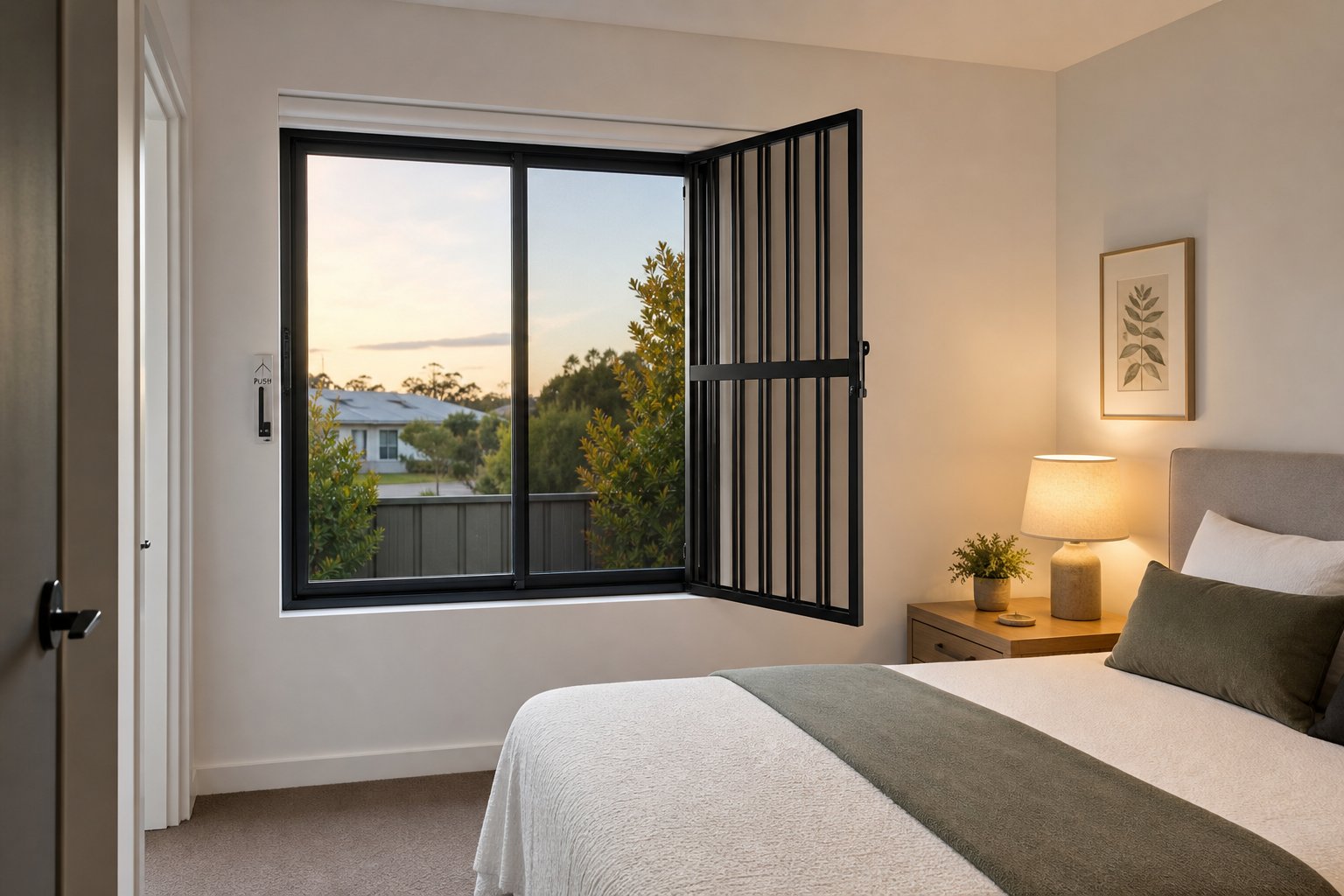
Quick-release burglar bars solve the egress problem without abandoning security. These systems use an internal lever, latch, or hinge mechanism that allows occupants to swing open, fold back, or completely detach the bars from inside the room — no tools, no keys, and no special knowledge required.
Two common configurations dominate the Australian market:
- Hinged panels with internal latch — The entire bar assembly is hinged on one side. A simple lever or slam latch on the opposite side releases the panel, which swings outward like a gate. This works well for medium-sized windows and is popular in children's bedrooms.
- Lift-and-slide removal — The bar panel sits in a channel and is held by spring-loaded pins. Pulling an interior handle retracts the pins, letting the occupant lift the panel out entirely. This suits narrower windows where a swinging panel would obstruct the escape path.
A window lock bar or keyed mechanism on the exterior side can still provide tamper resistance from outside, so intruders cannot exploit the release system from the street. The critical distinction is direction of operation — the release works from inside only, while remaining secure against external manipulation.
For children's bedrooms, quick-release safety bars for windows are not optional — they are essential. Young children may not be able to navigate complex locks under stress, so the mechanism must be intuitive. Some systems use a colour-coded lever or a single downward push that even a child over five can manage. If your household includes elderly residents or anyone with reduced mobility, prioritise systems that require minimal grip strength.
Building codes generally mandate that security coverings on egress windows must open from inside without tools or keys, and should be operable by any occupant regardless of age or ability. Testing the mechanism regularly — at least every six months — ensures it has not seized from disuse or accumulated grime in the track.
Balancing Security With Safety
The ideal outcome is a window that resists attack from outside yet opens freely from inside. Achieving this balance means choosing window security bars that open from inside and pairing them with disciplined household habits.
Start with product selection. Aluminium folding or hinged bars with a certified quick-release mechanism give you a physical deterrent that satisfies security concerns while maintaining a viable escape route. Look for products tested to relevant Australian Standards, and confirm that the release mechanism is accessible from seated or crouching positions — you may be crawling below smoke when you need it most.
Product choice alone is not enough. Every person in the household needs to know how window safety guards operate. Run a drill at least twice a year: have each family member (including older children) practise locating and operating the release mechanism in low light. Time it. If anyone takes longer than ten seconds, reassess whether the mechanism is truly intuitive or whether its position needs adjustment.
Security should never trap occupants inside during an emergency. A burglar bar that cannot be opened from within is not a security feature — it is a fire hazard. Always prioritise systems with internal quick-release, and ensure every household member knows how to use them.
Keep the release mechanism clear of furniture, curtains, and stored items that could block access under pressure. Ensure keys (if used for day-to-day locking of folding bars) are stored on a hook within arm's reach of the window — never hidden in another room. For rental properties, landlords have a duty of care to ensure tenants understand how any installed window safety guards function; a brief walkthrough at lease signing takes five minutes and could save a life.
Getting the safety equation right gives you confidence that your burglar bars work for you rather than against you. From here, the conversation shifts to something lighter — making those bars look good through colour, finish, and seamless integration with your window frames.
Powder Coating and Colour Matching Your Burglar Bars
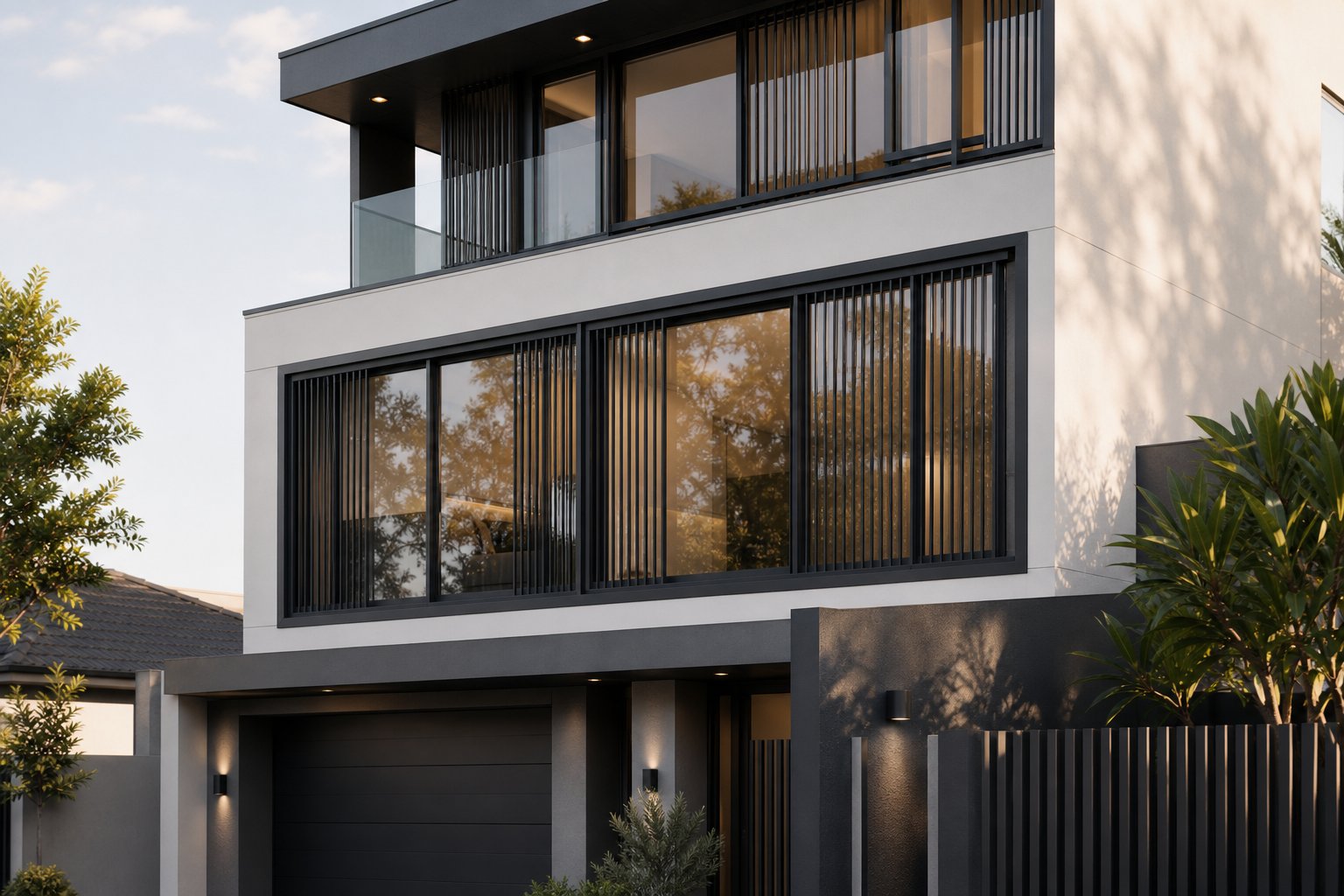
The fastest way to make barred windows disappear visually is to make them blend with their surroundings. Colour and finish do more heavy lifting here than bar thickness or spacing ever will — a mismatch between frame and security grille screams "retrofit," while a coordinated palette makes the entire assembly look intentional. This is where powder coating earns its place as the standard finish for aluminium burglar bars.
Powder Coating Finishes and Durability
Powder coating is a dry finishing process where finely ground resin powder is applied to the aluminium surface using an electrostatic charge, then cured in an oven at approximately 180 to 200 degrees Celsius for 10 to 20 minutes. The heat melts and fuses the powder into a continuous, chemically bonded film that is far tougher than conventional spray paint. No solvents, no VOCs, no runs or drips — just a uniform protective shell.
For outdoor-exposed metal window guards, the finish needs to handle UV radiation, rain, temperature swings, and (in coastal regions) salt-laden air. Quality powder coatings on aluminium can last 15 to 25 years depending on exposure, with some architectural-grade systems rated even longer under Qualicoat Class 2 or AAMA 2605 standards. That durability eliminates the repainting cycle that plagues traditional wrought iron window guards and standard painted steel.
The finish type you choose affects both appearance and performance:
- Matte (0-20% reflectivity) — Subdued, contemporary look with minimal glare. Hides fingerprints and minor surface imperfections well. Ideal for modern facades and industrial-style homes.
- Satin (20-40% reflectivity) — A subtle sheen that balances low glare with a refined appearance. The most popular choice for residential window security grill applications where a flat matte feels too raw but gloss feels too loud.
- Gloss (60%+ reflectivity) — Smooth, reflective surface that is easier to wipe clean. Works well on feature windows or where the bars sit behind louvre shutters and need minimal visual weight.
- Textured (sand or wrinkle) — Adds tactile depth and conceals any minor fabrication marks. Particularly effective on thick-profile bars where a perfectly smooth finish can look plastic.
For most Australian homes, satin or matte finishes in the 40 to 80 micron thickness range deliver the best balance of durability, UV resistance, and unobtrusive appearance. Coastal properties should push toward the upper end of that range — 80 microns or more — to add extra protection against salt spray working into microscopic pores.
Colour Matching to Window Frames
The single most effective aesthetic decision is matching your burglar bars to the existing window frame colour. When the bar profile sits in the same shade as the frame surrounding it, the eye reads the entire assembly as one element rather than a security add-on bolted to an otherwise clean opening. The bars become part of the window rather than a window fence layered in front of it.
Powder coating supports the full RAL colour palette — hundreds of shades in matte, satin, or gloss — so precise matching is entirely achievable. The most popular architectural colours for Australian homes fall into a handful of categories:
- Charcoal and monument grey — The dominant choice for contemporary builds. Recedes against dark window frames and matches Colorbond roof tones common across new estates in Sydney, Melbourne, and Brisbane.
- Satin black — Provides sharp contrast against light render or exposed brick. Reads as sophisticated rather than heavy when paired with slim bar profiles.
- Pearl white and surfmist — Blends seamlessly with white aluminium or timber-look window frames. Softens the visual impact of bars, particularly on federation and Queenslander-style homes.
- Bronze and dark brown — Complements timber-grain window frames and earthy colour palettes. Works especially well on mid-century or coastal homes with natural material accents.
- Natural anodised silver — Matches raw aluminium frame finishes commonly found in commercial buildings and older apartment blocks. Low-maintenance and neutral.
The key is coordination at the planning stage. Homeowners who select their aluminium window systems with colour and hardware integration in mind — such as MEICHEN's custom aluminium window range — can specify frame colour, hardware finish, and burglar bar coating as a unified package from the outset. This avoids the common frustration of trying to colour-match a security product to a frame that was chosen years earlier, where batch variations in powder coat can produce a visible mismatch under natural light.
Even on existing windows, a skilled powder coater can pull a sample from the frame's manufacturer code and produce a near-exact match. Bring your window supplier's colour specification sheet (usually a RAL or proprietary code) to your security installer and request a test swatch before committing to a full batch. The small effort of verifying colour consistency prevents that jarring "almost but not quite" result that draws attention to the bars rather than away from them.
A well-matched colour turns functional metal window guards into something that reads as architectural detailing. Visitors notice the home's design. They rarely notice the security — which is exactly the point. The next consideration is making sure those bars are measured, installed, and maintained correctly so the finish lasts as long as the aluminium beneath it.
Installation and Maintenance Done Right
A perfectly chosen security bar for window protection is only as good as its installation. Sloppy measuring leads to gaps an intruder can exploit. Weak fixings let the entire assembly pull away from the wall under force. And even the best powder-coated aluminium will look tired within a few years if basic upkeep is ignored. Getting the practical details right from day one protects both your investment and your household.
How to Measure Windows for Burglar Bars
Window openings are rarely perfectly square. Brickwork settles, timber frames swell with moisture, and render thickness varies from one side to the other. Assuming a rectangle and ordering bars to a single measurement is the fastest route to a product that either does not fit or leaves exploitable gaps at the edges.
Here is how to measure accurately:
- Width — Measure the internal reveal (the distance between the two side walls of the window opening) at three points: top, middle, and bottom. Record the narrowest measurement for reveal-fixed bars inside windows, or the widest measurement if you are face-fixing externally with an overlap.
- Height — Measure from the sill to the lintel at three points: left side, centre, and right side. Again, take the narrowest for internal reveal fixing or the widest for external face fixing.
- Depth of recess — Measure how deep the window reveal is from the outer wall face to the window frame. This determines whether bars can sit within the reveal or need to project outward. For indoor window security bars, measure the depth from the internal wall face to the glass to confirm clearance for locking hardware.
- Allowance for hardware — Add 10 mm to 15 mm clearance on each side for mounting brackets and adjustment. Telescopic or adjustable bar systems are more forgiving here, but made-to-measure grilles need precise figures.
Use a steel tape measure rather than a fabric one, and measure in millimetres to avoid rounding errors. If you are ordering custom-fabricated bars for window openings across the house, measure every window individually — even windows that look identical from a distance often differ by 5 mm to 15 mm once you check. Wrongly sized made-to-measure window bars can be a costly mistake, especially for powder-coated aluminium where colour-batch consistency depends on ordering the full set at once.
For masonry walls, also identify the material behind the render. Solid brick, double brick, lightweight block, and concrete all require different anchoring strategies that affect where you can place fixings and how much weight the wall will carry.
Professional vs DIY Installation
Not every burglar bar installation demands a tradesperson, but some situations genuinely do. The deciding factors are wall material, window size, and whether the system includes moving parts.
When professional installation is warranted:
- Masonry or concrete walls requiring core-drilled anchors — incorrect drilling can crack render, miss the structural substrate, or hit concealed services.
- Large openings over 1500 mm wide where the weight of the assembled grille makes solo handling unsafe.
- Quick-release or folding systems where incorrect alignment compromises both the locking mechanism and emergency egress function.
- Multi-storey access requiring scaffolding or elevated work platforms — working at height carries genuine safety risk.
- Any installation where compliance certification is needed (rental properties, strata, or insurance requirements).
When competent DIY is feasible:
- Timber-framed windows where coach screws can anchor directly into structural framing — no masonry skills needed.
- Standard fixed bars on small to medium windows (under 1200 mm wide) at ground level.
- Internal reveal-fixed bars inside windows, particularly telescopic systems designed for homeowner installation with basic tools.
Three common mounting methods apply regardless of who does the work:
- Face-fix — Brackets mount flat against the internal wall face or window frame. Fixings are concealed from outside, making them tamper-resistant. Best for solid walls with reliable anchoring depth.
- Reveal-fix — Brackets attach to the sill at the bottom and the lintel at the top within the window opening. Visible from inside but often the simplest method for DIY installation since no drilling into brickwork is required if the lintel is accessible.
- Through-frame bolting — Bolts pass entirely through the window frame or wall and are secured with a backing plate on the opposite side. The strongest method, commonly used for high-security commercial applications or where wall substrate is unreliable.
Whichever method you use, non-reversing security screws (one-way or pin-hex heads) prevent an intruder from simply unscrewing the fixings from outside. Standard Phillips or hex-head screws are a security vulnerability regardless of how strong the bars themselves are.
Position the bars using a spirit level before marking any holes. Even a few millimetres of tilt compounds across a wide opening, leaving uneven gaps that look unprofessional and potentially create a weak point. Mark all fixing positions, drill pilot holes, then fit anchors before mounting the bars in their final position. For masonry, drill slowly with a masonry bit and periodically cool it in water to prevent overheating and bit failure.
Long-Term Maintenance for Aluminium Bars
Aluminium's reputation as "low maintenance" is accurate, but low does not mean none. Neglecting basic care — especially on folding or sliding systems — leads to seized mechanisms, powder coat degradation, and hardware that fails precisely when you need it to work in an emergency.
Properties near the coast or in areas with high pollution need more frequent attention than sheltered inland homes. Salt residue, pollen, and airborne grit all settle on bar surfaces and into locking tracks where they accelerate wear if left unchecked.
Follow this maintenance schedule to keep your window bars inside and out performing at their best:
- Monthly (coastal) or quarterly (inland) — Wash frames and bars
Use warm water with a mild detergent (dish soap works fine) and a soft cloth or non-abrasive sponge. Wipe down all bar surfaces, paying attention to corners and bracket junctions where grime accumulates. Rinse with clean water and dry with a microfibre cloth to prevent water spots. Avoid abrasive cleaners, steel wool, or acidic solutions — these damage the powder coat and the protective oxide layer beneath it. - Quarterly — Inspect locking mechanisms and hinges
Open and close any folding or sliding sections. Check that latches engage fully, quick-release levers move freely, and slam locks click positively into their keepers. If anything feels stiff or gritty, clean the mechanism with a dry brush before lubricating. - Every six months — Lubricate moving parts
Apply a silicone-based spray lubricant to hinges, track rollers, lock barrels, and pivot points on folding bars. Avoid petroleum-based greases — these attract dust and form a paste that actually increases friction over time. Work the mechanism open and closed several times after lubricating to distribute the product evenly, then wipe away any excess. - Annually — Check powder coat condition
Inspect all bar surfaces and brackets for chips, scratches, or areas where the coating has thinned. Small damage spots can be touched up with a matching spray paint before corrosion starts. Pay special attention to edges, weld points, and any areas that contact other metal surfaces (galvanic contact zones). If you find widespread coating failure, consult a powder coater about stripping and re-finishing the bars rather than patching multiple spots. - Annually — Test emergency release
Operate every quick-release mechanism in the house. Confirm they open smoothly, that all household members can locate and activate them, and that no furniture or curtains block access. This is not just maintenance — it is a life-safety check. - Every two to three years — Check fixing integrity
Grip each bar assembly and apply moderate force in all directions. There should be zero movement at the mounting points. If you detect any looseness, tighten fixings immediately. On masonry, loose anchors may indicate that the original plug has deteriorated and needs replacing with a larger anchor.
This schedule adds up to perhaps two hours of effort per year for a typical home — a negligible investment compared to the cost of replacement or, worse, a mechanism that fails during an emergency. Aluminium rewards this small commitment with decades of reliable service, maintaining both its structural integrity and the clean visual finish that made it your choice in the first place.
Maintenance keeps your existing installation performing. But the strongest security bar for window protection is ultimately only as solid as the frame it attaches to — which brings the conversation back to the window system itself and what to prioritise when selecting the right one.
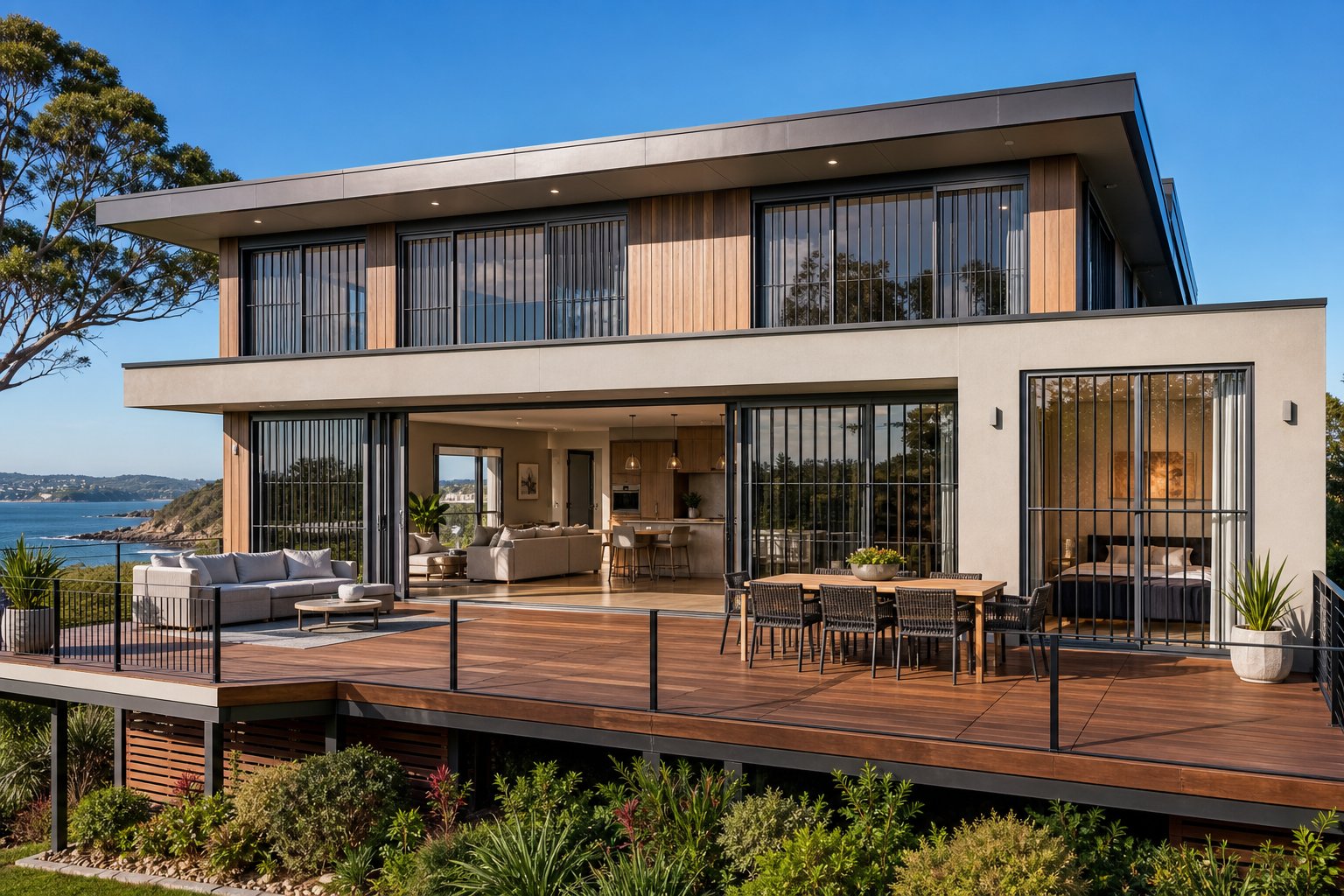
Choosing the Right Aluminium Windows for Security
Every detail covered so far — alloy selection, bar design, fire egress, colour matching, fixing methods — converges on a single practical question: what should you actually prioritise when you are ready to buy? The answer is a short list, ordered by impact on real-world performance.
Key Factors to Prioritise When Buying
Security bars for windows fail for predictable reasons. The bars themselves are rarely the weak link. Instead, it is an undersized fixing, a cheap lock, or a flimsy window frame that gives way first. Keep these criteria front of mind, ranked from most critical to least:
- Fire safety compliance — Any bedroom or habitable room needs a quick-release mechanism operable from inside without tools. Non-negotiable.
- Alloy grade and bar thickness — Specify 6063-T6 or 6061-T6 aluminium in solid round or heavy-wall tube profiles of at least 20 mm. Marine-grade alloy for coastal zones.
- Bar spacing — Maximum 100 mm to 125 mm between bars prevents reach-through and satisfies child safety requirements on upper floors.
- Locking mechanism quality — Multi-point engagement, anti-tamper hardware, and smooth operation under load. Test the lock before accepting installation.
- Powder coat thickness — Minimum 60 microns inland, 80 microns or more within 5 km of the coast. Request the applicator's film thickness certificate.
- Fixing method and substrate — Through-frame bolting or face-fixed brackets with one-way security screws into solid substrate. No amount of bar strength compensates for loose anchors in crumbling mortar.
- Window frame integrity — The frame carries the load. A weak, corroded, or poorly anchored frame undermines even the strongest security window bars bolted to it.
That last point deserves emphasis. Burglar bars for windows transfer force directly into the surrounding frame when someone attempts to pry or lever them. If the frame flexes, pulls away from the wall, or cracks under load, the bars become cosmetic rather than functional. Burglar proof windows start with the frame, not the bars bolted over them.
Starting With the Right Window System
If you are planning a renovation, new build, or window replacement, the smartest security decision happens before the burglar bars are even quoted. Selecting an aluminium window system engineered for performance — with robust frame sections, quality hardware, and custom sizing — gives aftermarket window bars security a solid foundation to anchor into.
A window designed with hardware integration and structural rigidity from the outset accepts security additions without compromise. Frames that are custom-sized to your openings eliminate the gaps and shims that create weak points. Coordinated colour options mean your bars match from day one rather than requiring a separate colour-matching exercise later.
MEICHEN's aluminium window range offers exactly this kind of starting point — custom-sized systems with performance-focused profiles, hardware specifications suited to Australian conditions, and a broad colour palette that pairs seamlessly with aftermarket security additions. For homeowners, builders, and architects planning a project where security matters, beginning with the right window system means every subsequent decision — bar type, finish, fixing method — falls into place more easily.
Whether you are securing a single ground-floor opening or specifying window bars security across an entire home, the principle remains the same: work from the frame outward, prioritise compliance and quality over cost-cutting, and invest the small ongoing effort that keeps everything performing for decades.
Frequently Asked Questions About Aluminium Window Burglar Bars
1. Are aluminium burglar bars strong enough to stop a break-in?
Aluminium alloys used in security bars, particularly 6061-T6 and 6063-T6, provide meaningful resistance to cutting and prying when bar thickness is adequate (20 mm to 30 mm solid profiles). While steel offers higher raw tensile strength, most residential burglaries target the path of least resistance — glass, latches, or weak frames — rather than sawing through metal bars. Properly installed aluminium bars with secure fixings and appropriate bar spacing (100 mm to 125 mm) deter the vast majority of opportunistic intrusions. For maximum protection, pair quality aluminium bars with one-way security screws and solid substrate anchoring.
2. Do burglar bars on windows comply with fire safety regulations in Australia?
Fixed burglar bars that cannot be opened from inside may violate the National Construction Code (NCC), which requires habitable rooms — especially bedrooms — to have at least one emergency escape opening. Quick-release mechanisms solve this by allowing occupants to swing open or remove bars from inside without tools or keys. If you install bars on any window in a sleeping area, a certified quick-release system is essential. Requirements vary by state and local council, so confirm egress provisions with your building certifier before installation.
3. How long do aluminium burglar bars last compared to steel?
Aluminium burglar bars typically last 30 to 50 years in coastal environments and 40 to 60 years inland, with minimal maintenance beyond annual washing. Steel bars, by contrast, last 10 to 20 years near the coast and 30 to 50 years inland — but only with diligent upkeep including repainting every three to five years and rust treatment. Aluminium's natural oxide layer prevents rust entirely, which eliminates the ongoing maintenance cycle that drives up steel's total cost of ownership over time.
4. Can aluminium burglar bars be colour-matched to my window frames?
Yes. Powder coating supports the full RAL colour palette in matte, satin, or gloss finishes, so precise colour matching to existing window frames is entirely achievable. Popular architectural colours include charcoal, monument grey, satin black, pearl white, and bronze. For the best result, bring your window manufacturer's colour specification code to your security installer and request a test swatch before committing. Homeowners planning new builds or renovations can coordinate frame colour, hardware, and bar finish as a unified package by selecting aluminium window systems — such as MEICHEN's custom range — that offer broad colour options from the outset.
5. Can I install aluminium burglar bars myself or do I need a professional?
Competent DIY installation is feasible for standard fixed bars on timber-framed windows at ground level, particularly telescopic or reveal-fixed systems designed for homeowner fitting. Professional installation is recommended for masonry walls requiring core-drilled anchors, large openings over 1500 mm wide, quick-release or folding systems where alignment affects both locking and egress function, and any multi-storey work requiring scaffolding. Regardless of who installs them, always use non-reversing security screws, check measurements at multiple points across each opening, and verify the frame substrate can support the anchoring method you choose.