

What Aluminium Window Replacement Parts Actually Include
A sticking sash, a persistent rattle on windy nights, a draft creeping past the frame—these are the symptoms that send most homeowners searching online. Rarely does anyone type a specific part name into a search bar. They start with a problem and work backwards toward a component.
Defining Aluminium Window Replacement Parts
Aluminium window replacement parts refer to every individual, serviceable component within an aluminium window system that can be removed and replaced without discarding the frame itself. This includes operational hardware (locks, handles, hinges, friction stays), movement components (rollers, balances, tracks), sealing elements (weatherstripping, glazing gaskets, EPDM seals), and structural glazing elements (insulated glass units, glazing beads, drainage caps).
That definition covers a broad aluminium window hardware components list—dozens of individual pieces, each with a specific job. Some keep water out. Others let the sash glide. A few hold everything secure at night. When one fails, the whole window feels broken, even though the frame itself remains perfectly sound.
Why a Problem-First Approach Matters
Most guides dump a parts catalogue on you and expect you to know what you need. That approach ignores reality. What parts can be replaced on aluminium windows depends entirely on what has actually gone wrong. A draft points to weatherstripping or a perimeter seal. A sash that won't budge suggests rollers or a seized balance. A handle spinning freely means a worn spindle or cam mechanism.
This aluminium window spare parts guide works differently. It starts with the fault, walks through diagnosis, and lands on the exact replacement parts for aluminium window frames that solve the issue. Along the way, you will learn how to measure components accurately, decide between OEM and aftermarket options, and know when a part swap makes sense versus a full unit replacement. The frame is rarely the problem—so let's find the part that is.
Common Failure Modes by Window Age and Climate
Knowing which part has failed is half the job. The other half is understanding why it failed—and that almost always comes down to two factors: how old the window is and what environment it lives in. These two variables predict which aluminium window parts wear out first with surprising accuracy.
How Window Age Predicts Part Failures
Aluminium windows installed across different decades used different hardware systems, seal materials, and manufacturing tolerances. Each generation has its own weak points. If you can date your windows roughly by the era your home was built or last renovated, you can narrow down the likely culprits before you even pick up a screwdriver.
Windows from the 1960s through the 1980s—common in older brick veneer and fibro homes across Australia—tend to show corroded hardware and worn-out spring balances first. The zinc-plated steel components used in that era lose their protective coating over time, and the coil or spiral balances fatigue after decades of use. Locks and catches from this period often seize or snap entirely.
Units installed during the 1990s and early 2000s generally hold up better structurally, but their rubber weatherstrips compress and harden with age. Rollers in sliding sashes also degrade as the nylon wheels develop flat spots or the housings crack. These windows often still look fine from the outside while performing poorly.
Newer aluminium windows—those installed within the last ten to fifteen years—rarely need hardware replacement yet. Their most common service items are glazing gaskets that shrink slightly and perimeter seals that dry out in high-UV environments.
| Window Era | Most Likely Parts Needing Replacement | Typical Symptoms |
|---|---|---|
| 1960s–1980s | Balances, locks, catches, riveted handles | Sash drops or won't stay open, hardware seized or snapped, loose handles |
| 1990s–2000s | Weatherstrips, rollers, keeper strikes | Drafts around sash edges, sliding panel sticks or jumps track, rattling when locked |
| 2010s–present | Glazing gaskets, EPDM perimeter seals, drainage flaps | Minor air leakage, water weeping at sill corners, slight whistling in wind |
This breakdown of old aluminium window replacement parts by decade gives you a realistic starting point. Rather than guessing, you can inspect the components most statistically likely to have degraded given your window's age.
Climate and Environmental Wear Factors
Age alone does not tell the full story. How climate affects aluminium window hardware can accelerate or slow degradation dramatically depending on where in Australia your home sits.
Coastal properties cop the worst of it. Salt-laden air attacks metal hardware, corroding screws, springs, and lock mechanisms years ahead of schedule. Coastal aluminium window corrosion parts—particularly stainless steel friction stays and zinc-alloy handles—pit and seize in as little as five to eight years without regular maintenance. Homes within a few kilometres of the shoreline in areas like coastal Queensland, the NSW South Coast, or Perth's western suburbs see this pattern repeatedly.
Intense UV exposure, common across most of Australia, degrades rubber and synthetic seals faster than in temperate climates. Weatherstrips that might last fifteen years in a shaded, mild environment can harden and crack within eight to ten years on a north-facing elevation with full sun. The material loses elasticity, compresses permanently, and stops forming an effective air barrier.
Temperature cycling adds another layer. In regions with large daily temperature swings—think inland NSW, parts of Victoria, or the Adelaide Hills—aluminium frames expand and contract measurably each day. Over thousands of cycles, this movement loosens fasteners, fatigues spring mechanisms, and gradually works seals out of their channels. The frame itself tolerates this movement well, but the smaller components bolted or clipped to it do not.
Understanding these environmental pressures helps you anticipate replacements rather than react to failures. A window facing the ocean in a tropical climate will need roller and seal service far sooner than an identical unit on a sheltered, south-facing wall in Melbourne. The parts are the same—the timeline is not.
Anatomy of an Aluminium Window Frame
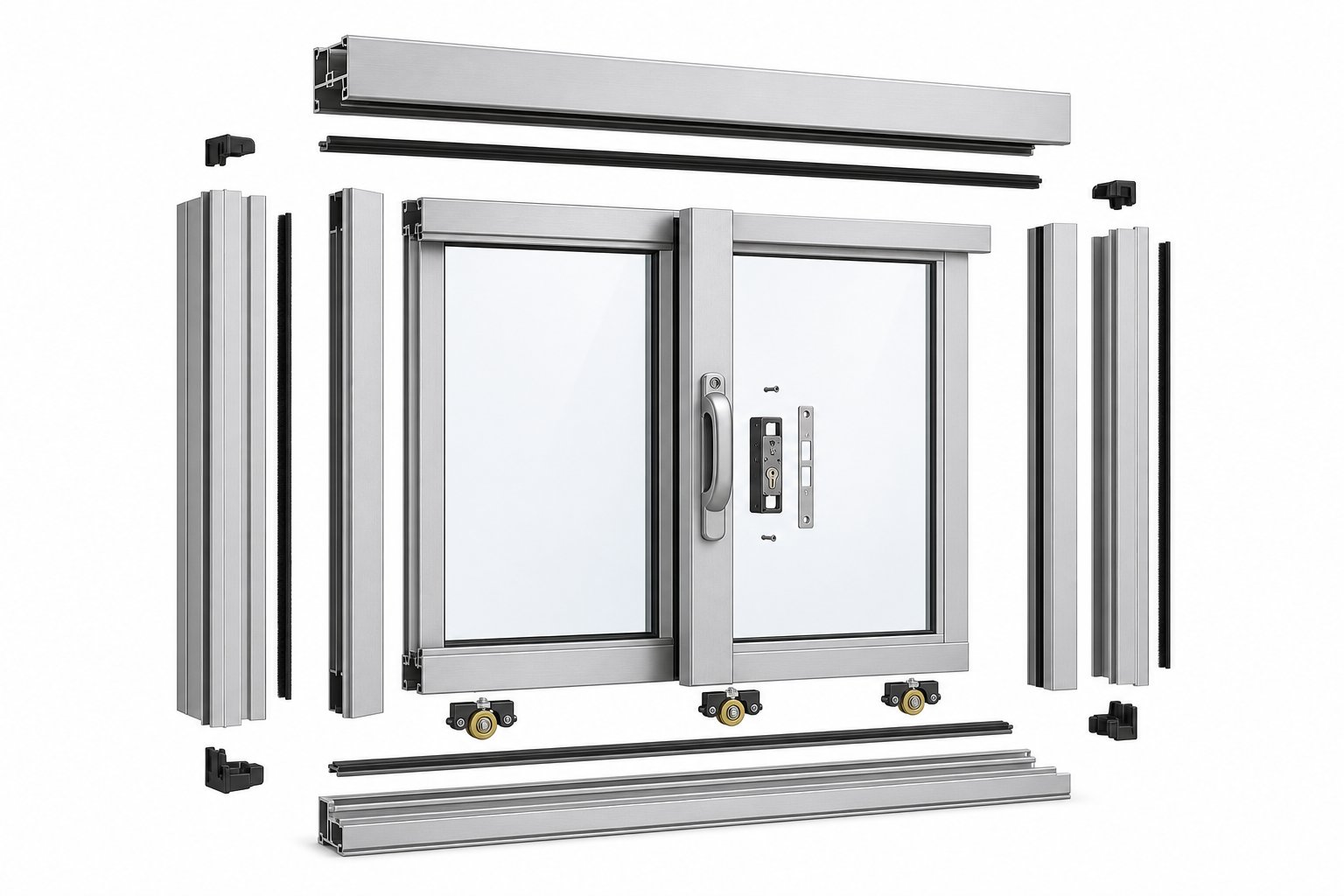
Predicting which part will fail is useful, but replacing it accurately requires something more fundamental—knowing exactly what each piece is called and where it sits within the assembly. An aluminium window might look like a simple rectangle of metal and glass, yet it contains dozens of individual components, each with a specific name and a defined role. Getting familiar with this anatomy is the difference between ordering the right part on the first attempt and ending up with a drawer full of returns.
Frame and Sash Components Explained
Every aluminium window starts with two primary structures: the fixed frame and the moveable sash. The frame anchors into the wall opening and stays put for the life of the window. The sash holds the glass and either slides, swings, or pivots depending on the window type.
The frame itself consists of four extruded aluminium profiles. The head runs horizontally across the top. The sill sits at the bottom, shaped with a slight slope or drainage channel to direct water outward. Two vertical jambs connect head to sill on each side, forming the structural rectangle that carries the load and seals against the wall.
Within the sash, the vertical members are called stiles and the horizontal members are rails—a top rail and a bottom rail. On double-hung or sliding windows, the point where two sashes overlap is the meeting rail, a critical zone for both weathersealing and locking. In larger window configurations, vertical mullions and horizontal transoms divide the opening into separate panels, each housing its own sash or fixed glazing.
These aluminium profiles are extruded to precise cross-sectional shapes unique to each manufacturer's system. That geometry matters when sourcing aluminium window replacement parts because a glazing bead or weatherstrip designed for one extrusion profile will not clip into another, even if the overall window dimensions match. Knowing whether you are dealing with frame components or sash components narrows your search immediately.
Hardware and Sealing Elements
Bolted, clipped, or pressed into the frame and sash are the parts that actually make the window do something—open, close, lock, seal, and drain. These are the components that wear, and they fall into four functional categories.
Operation parts handle movement. They let you open and close the sash smoothly:
- Rollers — nylon or stainless steel wheels housed in the bottom rail of sliding sashes, allowing horizontal travel along the track
- Balances — spiral or constant-force spring mechanisms in hung windows that counterweight the sash so it stays at any height
- Friction stays — scissor-arm hinges on awning and casement windows that hold the sash open at various angles
- Hinges — pivot points connecting the sash to the frame on side-hung or top-hung windows
- Handles and winders — the lever or crank you grip to operate the sash, connected via a spindle to the locking or opening mechanism
Sealing parts keep weather out and conditioned air in:
- Weatherstripping — compressible rubber, EPDM, or mohair strips fitted into channels along the sash perimeter to block air and water infiltration
- Glazing gaskets — rubber or silicone seals that cushion the glass within the sash and prevent moisture ingress around the pane edges
- Glazing beads — aluminium or PVC strips that snap into the sash to hold the glass firmly against the gaskets
- Drainage flaps and caps — small one-way valves or covers over weep holes that let trapped water escape without allowing wind-driven rain back in
Security parts keep the window locked and resist forced entry:
- Sash locks — cam or lever mechanisms that draw the meeting rails together or secure the sash to the frame
- Keepers (striker plates) — metal receivers fixed to the frame that engage with the lock tongue or bolt
- Multi-point locking systems — espagnolette-style rods that secure the sash at two or more points simultaneously
- Restrictor stays — limit arms that prevent the sash from opening beyond a safe width, common on upper-storey windows
Structural parts maintain the window's physical integrity:
- Corner cleats and brackets — internal aluminium or steel pieces that join frame sections at mitre or butt joints
- Mullion and transom connectors — mechanical fixings that tie dividing bars into the main frame
- Insulated glass units (IGUs) — the sealed double- or triple-glazed panel itself, which contributes rigidity to the sash
- Sub-sill and sill nosings — additional profiles that protect the bottom frame member and direct water away from the wall
Each item on this list is individually replaceable without removing the frame from the wall. That is the core principle behind sourcing aluminium window lock and handle parts, rollers, seals, or any other component—you swap the failed piece and leave the rest intact.
Grasping this parts-of-an-aluminium-sliding-window breakdown, or the equivalent layout for awning and casement types, gives you the vocabulary to describe exactly what you need when contacting a supplier. It also prevents a common and costly mistake: replacing a perfectly good lock when the actual problem is a worn keeper, or fitting new weatherstrip when the real issue is a roller that no longer holds the sash at the correct height against the seal. Accurate identification is the first step toward an accurate fix—and the next challenge is matching a specific symptom to the right component on this list.
Troubleshooting Window Problems to Find the Right Part
You know the names. You know where each component sits. The real question is: which one has actually failed in your window? The fastest way to identify which window part is broken is to start with what the window is doing wrong and trace the symptom back to a specific component.
Diagnosing Drafts and Air Infiltration
If your aluminium window is drafty, the culprit almost always sits along the seal line between sash and frame. Cold air does not pass through solid aluminium—it sneaks through gaps where a flexible seal has lost its ability to compress and spring back.
- Locate the draft. Hold a lit incense stick or a thin strip of tissue paper along the sash perimeter on a windy day. Watch where the smoke deflects or the paper flutters—that pinpoints the infiltration zone.
- Inspect the weatherstrip. Open the sash and examine the rubber or mohair seal in that area. Look for hardening, cracking, permanent compression (flat spots), or sections that have pulled free from their channel.
- Check the glazing gasket. If the draft seems to originate from around the glass rather than the sash edge, press gently on the glazing bead. A loose bead or shrunken gasket allows air to bypass the glass-to-sash seal.
- Identify the replacement part. Perimeter drafts point to weatherstripping. Drafts around the glass itself indicate a failed glazing gasket or a glazing bead that needs re-seating.
Deteriorated weather seals lose flexibility due to UV exposure and temperature cycling, particularly on sun-drenched elevations. Replacing the strip—rather than the entire sash—restores the air barrier at a fraction of the cost.
Fixing Sticking Sashes and Hard Operation
An aluminium sliding window that is hard to open rarely has a frame problem. The issue almost always lives in the bottom rail or the track beneath it. Awning and casement windows follow a similar logic—friction stays or hinges bind rather than the frame warping.
- Clean the track first. Vacuum debris from the sill channel and wipe it down. Built-up grit acts like sandpaper against rollers and can mimic a mechanical fault.
- Inspect the rollers. Lift or tilt the sliding sash slightly and spin each roller by hand. A roller with a flat spot that no longer turns freely needs replacing, not just lubricating.
- Test the balance (hung windows). If a double-hung sash slams down or refuses to stay open, the spiral or constant-force balance has lost tension. Disconnect one side and check for broken cords or fatigued springs.
- Try adjustment before replacement. Most roller housings have an adjustment screw on the sash underside. Turning it raises or lowers the sash height relative to the track. If adjustment restores smooth travel, the rollers still have life in them.
- Identify the replacement part. Sliding windows need new rollers. Hung windows need a new balance. Awning or casement windows that bind typically need replacement friction stays or hinge assemblies.
Applying a silicone-based lubricant to the roller axle and conditioning the mohair weatherstrip on the sash edge reduces friction further once the mechanical components are sorted.
Resolving Rattles and Security Issues
A window that rattles in the wind or feels loose when locked is telling you the sash is no longer being pulled tight against the frame. This is a security concern as much as a noise issue.
- Lock the window and push the sash. If it moves or flexes inward, the lock is not drawing the meeting rails together firmly enough.
- Inspect the keeper (striker plate). The keeper is the small metal receiver on the frame that the lock tongue engages. Worn keepers allow play even when the lock mechanism itself is fine.
- Check the lock cam or tongue. Rotate the handle and watch the cam or bolt. If it no longer extends fully, or the handle spins without resistance, the internal mechanism has worn out.
- Identify the replacement part. Rattling with a functional lock usually means a worn keeper that needs shimming or replacing. A lock that no longer latches firmly points to the sash lock mechanism or a stripped handle spindle.
Aluminium window rattling replacement parts are among the cheapest components to buy—keepers and cam locks typically cost only a few dollars each—yet they make an outsized difference to both acoustic comfort and break-in resistance.
Condensation Between Panes
Fog or moisture trapped between double-glazed panes sits in a different category from the hardware faults above. You cannot wipe it away because it is inside the sealed unit.
- Confirm the location. Run your finger across both the interior and exterior glass surfaces. If neither side is wet, the moisture is between the panes—inside the insulated glass unit (IGU).
- Understand the cause. The perimeter seal of the IGU has failed, allowing humid air to enter the cavity while the insulating argon gas escapes.
- Assess the frame condition. Check whether the aluminium sash and glazing beads are still in good shape. If the frame is sound, only the glass unit needs replacing—not the entire window.
- Identify the replacement part. The failed component is the insulated glass unit itself. A glazier can remove the glazing beads, extract the old IGU, and fit a new sealed unit into the existing sash.
Aluminium window condensation between panes repair does not require a new frame or sash—just a replacement IGU sized to the existing rebate. The aluminium structure around it is unaffected and will outlast multiple glass units over its lifetime.
Each of these diagnostic pathways leads to a specific, named component. The next challenge is making sure the replacement you order actually fits—and that comes down to precise measurement and understanding how different extrusion profiles affect compatibility.
How to Measure for Correct Replacement Parts
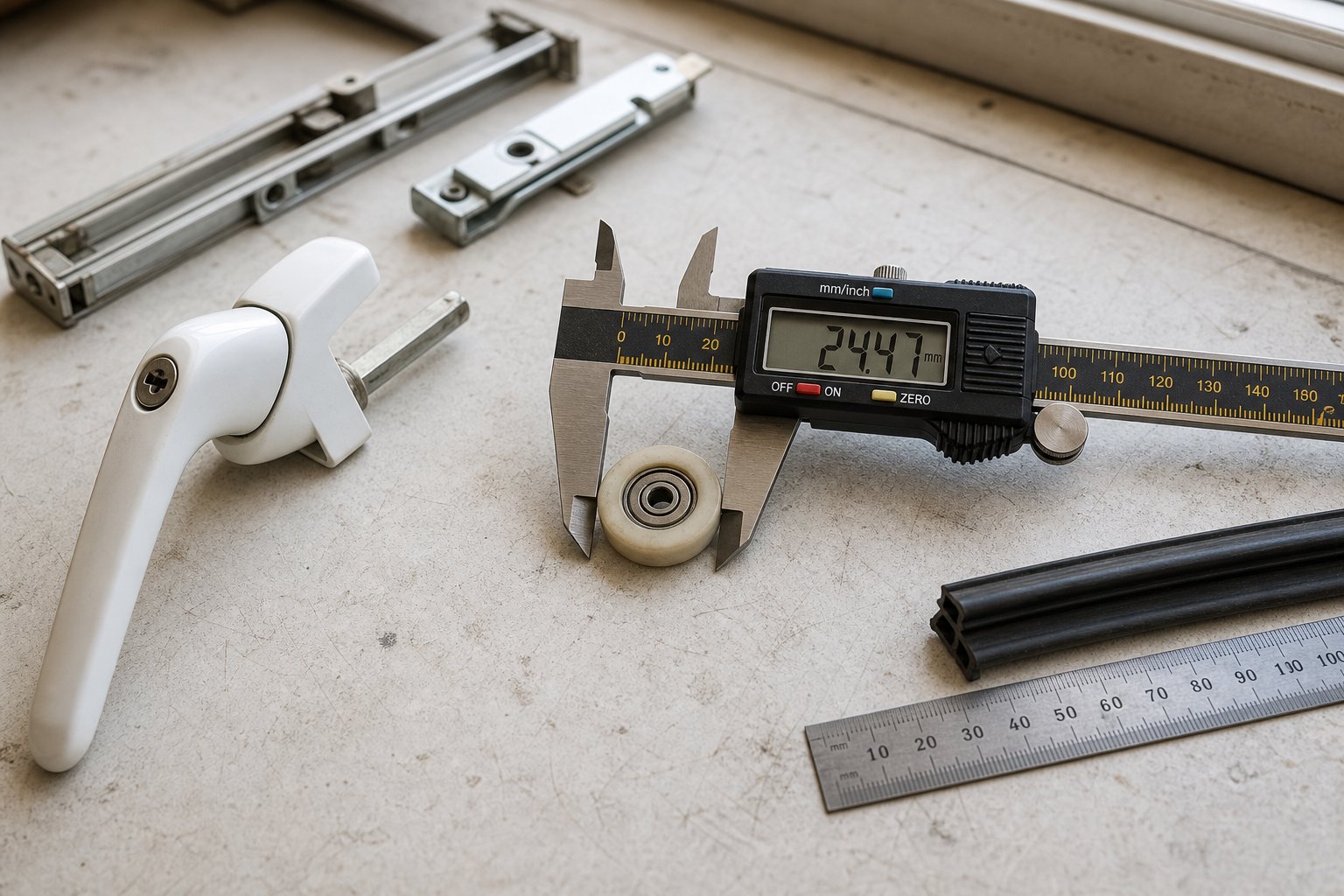
Identifying the failed component is only half the battle. The single most common reason aluminium window replacement parts arrive and do not fit is inaccurate measurement. A weatherstrip that is 1 mm too narrow leaves gaps. A roller 2 mm too tall jams the sash against the head. A handle spindle half a millimetre off in diameter wobbles in the mechanism. Precision matters here more than almost anywhere else in home maintenance, and the good news is you do not need expensive equipment to get it right.
Before measuring anything, gather a few basic tools:
- Digital or dial caliper — essential for cross-section profiles, spindle diameters, and small component dimensions (accurate to 0.01 mm)
- Steel ruler or tape measure — for overall lengths of balances, weatherstrip runs, and track channels
- Sharp utility knife or scissors — to cut a clean sample of weatherstrip or seal for comparison
- Smartphone camera — photograph every part before removal, including its orientation and any stamped markings
- Permanent marker and masking tape — label parts and positions so nothing gets mixed up during reassembly
Measuring Weatherstrips and Seals Accurately
Knowing how to measure aluminium window weatherstrip size correctly prevents the most frequent ordering mistake. Weatherstrips are defined by two dimensions: the base width (the flat fin that slides into the aluminium channel) and the pile height or seal height (the compressible portion that contacts the opposing surface).
Pull a short sample—around 50 mm is enough—from a straight section of the channel. Common base widths for mohair weatherstrip in Australian aluminium windows are 4.8 mm, 6.5 mm, and 7.5 mm, with pile heights typically ranging from 5 mm to 10 mm. Use your caliper's outside jaws to measure the base width, then measure the pile height from the top of the base to the tip of the fibres or rubber lip—do not include the backing in this measurement.
If the old strip is too compressed or damaged to measure reliably, measure the slot it sits in instead. The channel width gives you the base dimension directly. For the pile height, close the window and measure the gap between the sash face and the frame face at the seal line—that gap is what the new pile needs to bridge with slight compression.
Rubber and EPDM seals work the same way, except their cross-section profiles can be more complex—bulb shapes, P-profiles, or wedge forms. Cut a clean cross-section with a sharp blade and either trace it onto paper at 1:1 scale or photograph it next to a ruler. Suppliers can match the profile from a clear image.
Roller and Balance Measurements That Matter
For aluminium window roller diameter measurement, three figures define the part: wheel diameter, axle height (centre of the wheel to the base of the housing), and housing width (the body that sits inside the sash rail channel). Remove the roller assembly from the sash—usually held by one or two screws—and use your caliper's outside jaws for the wheel diameter and a depth or step measurement for the axle height. Common wheel diameters in Australian residential windows range from 18 mm to 25 mm, though commercial systems can run larger.
Balances require two measurements: the channel width (the track the balance tube or tape rides in) and the overall length from mounting bracket to sash attachment point. Measure the channel with the caliper's inside jaws. For length, extend a tape measure along the full travel of the balance with the sash removed. Getting the length wrong by even 10 mm can mean the sash will not reach full open or full closed position.
Handle spindles and lock mechanisms add another layer. To find the correct replacement window handle spindle, measure the spindle diameter (typically 7 mm square in Australian residential hardware), the spindle length from the handle base to the tip, and the backset distance—the measurement from the face of the sash to the centre of the spindle hole. Lock tongue throw length (how far the bolt extends when engaged) determines whether the lock will reach the keeper on the frame. A throw that is too short leaves the window insecure; too long and it will not retract cleanly.
Why Extrusion Profiles Affect Compatibility
Here is where many DIYers get caught out. Two aluminium windows can share identical overall dimensions—same height, same width, same glass thickness—yet use completely different internal extrusion profiles. The cross-sectional shape of the aluminium channel that holds a weatherstrip, roller housing, or glazing bead is proprietary to each manufacturer's system. Aluminium window extrusion profile compatibility is not universal.
A weatherstrip base designed for a 6.5 mm wide channel with a square-bottomed groove will not lock into a 6.5 mm channel with a dovetail or T-shaped slot. A roller housing shaped for one brand's bottom rail cavity may be too wide, too narrow, or the wrong depth for another brand's rail—even if the wheel diameter matches perfectly.
This is why taking a physical sample to compare when ordering is so important. Bring the old roller, the cut section of weatherstrip, or the removed handle to your supplier. A reputable specialist can cross-reference the profile against their catalogue and confirm compatibility before you commit. Photographs help for remote orders, but nothing beats a physical sample sitting side by side with the proposed replacement.
Measure twice, order once. The few minutes spent with a caliper and a sample piece save days of waiting for exchanges—and ensure the replacement part restores your window to full function the first time around.
OEM Parts vs Universal Aftermarket Alternatives
Armed with accurate measurements and a sample piece in hand, the next decision is where that replacement actually comes from. Not all aluminium window replacement parts are created equal—some are manufactured by the original window brand, while others are produced by third-party suppliers to fit across multiple systems. Choosing between OEM aluminium window parts vs aftermarket options depends on the component type, your window's age, and whether the original manufacturer still supports your system.
When OEM Parts Are Worth the Effort
OEM (Original Equipment Manufacturer) parts come directly from the company that built your window. They are engineered to the exact extrusion profile, tolerance, and finish of your specific system. For certain components, nothing else will do.
Proprietary multi-point locking mechanisms top this list. These systems use brand-specific espagnolette rods, lock bodies, and keeper geometries that aftermarket suppliers rarely replicate. Branded friction stays—particularly those with integrated restrictor functions—also fall into the OEM-only category because the pivot geometry and arm length must match the original design precisely for safe operation. Spiral balances from manufacturers who use non-standard tube diameters or mounting brackets similarly demand OEM replacements.
If your window is still in current production and the manufacturer maintains an active parts supply chain, OEM is the cleanest path. You get guaranteed fit, consistent finish colour matching, and no guesswork about compatibility.
Universal Parts That Work Across Systems
The reality is that many window hardware components are standardised across the industry, making them interchangeable between different brands. This aftermarket aluminium window hardware compatibility extends further than most homeowners expect.
Standard mohair weatherstrip profiles, for example, fit any channel of the same base width regardless of who extruded the frame. Common roller sizes with universal housing dimensions work across dozens of sliding window systems from different manufacturers. Generic cam locks, sash lifts, and basic lever handles use industry-standard spindle sizes and backset distances that make them universal replacement parts for aluminium windows without modification.
The advantages are practical: broader availability, lower cost, and faster delivery. When a component follows an industry-standard dimension rather than a proprietary design, aftermarket options perform identically to OEM at a fraction of the price and lead time.
| Factor | OEM Parts | Universal / Aftermarket Parts |
|---|---|---|
| Fit precision | Exact match to original system | Matches standard dimensions; may need verification against extrusion profile |
| Availability | Dependent on manufacturer still producing the line | Broadly available from multiple suppliers |
| Cost | Typically 30–60% higher than aftermarket equivalents | More competitive pricing due to wider production volumes |
| Lead time | Can be weeks if ordered through distributor networks | Often available off the shelf from specialist retailers |
| Warranty implications | Maintains original manufacturer warranty where applicable | May void remaining warranty on newer windows; irrelevant on older systems |
| Colour and finish match | Identical to existing hardware | May differ slightly in shade or texture |
Finding Parts for Discontinued Window Brands
The real challenge emerges when the original manufacturer no longer exists or has dropped your window system from production. Discontinued aluminium window brand replacement parts require more creative sourcing, but they are rarely impossible to find.
Some legacy brands have spawned dedicated aftermarket ecosystems. Specialist suppliers stock obsolete parts for brands like Alenco, Capral legacy systems, and dozens of other discontinued lines, often holding old stock or manufacturing compatible reproductions. These specialists typically offer parts identification services—send them a photo and measurements, and they will cross-reference against their database of historical systems.
For truly orphaned windows where no aftermarket equivalent exists, the options narrow to two: find a universal part that can be adapted to fit (sometimes requiring minor modification to the housing or mounting), or commission custom fabrication from a specialist aluminium window supplier. The latter path costs more but delivers a component engineered to your exact profile.
Whether you go OEM, aftermarket, or custom depends on the specific part and how critical precise fit is to its function. A weatherstrip can tolerate slight variation. A multi-point lock cannot. Match the sourcing strategy to the component's tolerance requirements, and you will get the right result without overspending on parts that did not need to be brand-specific in the first place.
Where to Source Aluminium Window Replacement Parts
Deciding between OEM and aftermarket is one thing. Actually finding the part—especially for an older or discontinued system—is another challenge entirely. Where to buy aluminium window replacement parts depends on what you need, how urgently you need it, and whether the component is still in active production. Each sourcing channel has distinct strengths, and knowing which to try first saves time and frustration.
Ranked by reliability for different scenarios, here is how the main channels stack up:
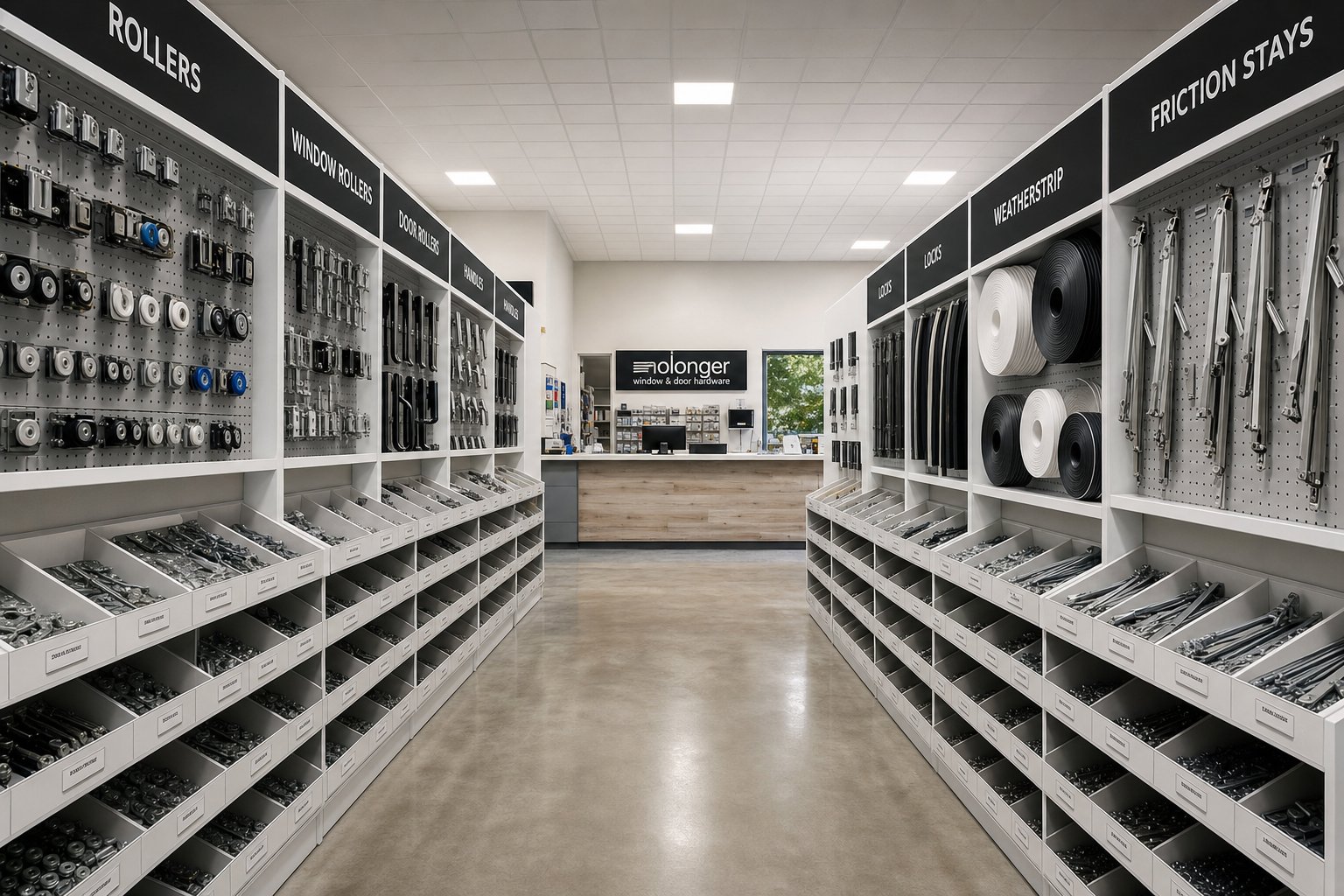
- Specialist window hardware suppliers — the broadest range for older and current systems alike. These businesses exist solely to stock, identify, and cross-reference window components. They carry parts across dozens of brands and eras, offer identification services from photos and samples, and understand extrusion profile compatibility in ways a general retailer never will.
- Manufacturer direct — the best option when your window system is still in current production. Contact the original brand's distributor or parts department with your window series name and the component you need. Fit is guaranteed, though lead times can stretch to several weeks.
- General hardware retailers — useful for universal items like standard mohair weatherstrip rolls, basic cam locks, and common roller sizes. Limited by range—they stock high-turnover items and rarely carry anything system-specific or legacy.
- Salvage yards and architectural recyclers — a viable path for how to source discontinued aluminium window components when no aftermarket reproduction exists. Demolition salvage yards occasionally hold old stock or pull hardware from identical windows being removed from renovation projects. Availability is unpredictable, but the price is usually low.
- Custom fabrication — the last resort when no off-the-shelf option fits, but also the most precise solution for truly orphaned systems.
Specialist Suppliers vs General Hardware Stores
The gap between these two channels is wider than most people expect. A general hardware store might carry three or four roller types and a couple of weatherstrip profiles. A specialist aluminium window hardware supplier stocks hundreds of variants—different wheel diameters, axle heights, housing widths, and materials—because they understand that a 20 mm roller is not interchangeable with a 22 mm roller, even though both technically fit a sliding window.
Specialists also provide something no hardware chain can: expertise in matching unknown parts. Send them a photograph of your old roller or a cross-section of your weatherstrip, and they will identify the correct replacement from their catalogue. That service alone justifies any small price premium over a big-box retailer, because it eliminates the trial-and-error cycle of buying, testing, returning, and reordering.
For standard consumables—a roll of 6.5 mm mohair, a tube of silicone lubricant, a generic sash lift—hardware stores are perfectly adequate. For anything system-specific, go specialist first.
When Custom Fabrication Becomes Necessary
Some windows fall through every sourcing channel. The manufacturer closed decades ago. No aftermarket supplier has reproduced the part. Salvage yards have nothing matching. In these situations, custom fabrication aluminium window parts become the only viable path forward.
Custom fabrication typically applies to extruded aluminium components—unique glazing beads, non-standard sub-sill profiles, proprietary track sections, or complete sash replacements where the frame remains sound but the moving parts are beyond repair. A specialist fabricator takes your existing profile (or a sample section), creates or sources a matching die, and extrudes new material to the exact cross-section your system requires.
This is where project-capable suppliers add genuine value. A company like MEICHEN, for example, supports the full process from drawings and system recommendations through to material calculation, manufacturing coordination, and delivery planning. For homeowners or builders who discover their window system needs custom-profiled parts—or where enough components have failed that a complete new sash or panel makes more sense than piecemeal repairs—this kind of end-to-end fabrication support solves sourcing problems that no hardware store or parts catalogue can address.
Custom work costs more than off-the-shelf components, naturally. Lead times run longer. But for a window system worth preserving—heritage homes, architecturally significant facades, or large commercial installations where matching existing aesthetics matters—fabrication delivers a result that no compromise part ever could.
The sourcing strategy, then, is sequential: start with specialists, check manufacturer availability, try general retail for universal items, explore salvage for discontinued lines, and escalate to custom fabrication only when every other channel comes up empty. Most residential repairs resolve at step one or two. Knowing the full ladder exists means you are never truly stuck—even with the most obscure system.
Repair Individual Parts or Replace the Whole Window
Sourcing the right part solves most window problems. But sometimes the honest answer is that individual components are not the issue—the window itself has reached the end of its serviceable life. Knowing where that line sits saves you from two equally costly mistakes: replacing an entire window when a $30 roller would have fixed it, or sinking money into parts for a frame that is structurally compromised.
If the cost of replacing all failed components exceeds 50–70% of a new window unit, or if the aluminium frame shows structural corrosion, bowing, or corner joint separation, full replacement is the more economical long-term path.
That rule gives you a practical threshold. Below it, repair aluminium window or replace entire unit decisions lean heavily toward repair. Above it, you are paying near-new-window money for a result that still carries the limitations of an ageing frame.
Signs That Individual Part Replacement Is Sufficient
Most aluminium windows fall firmly in the repair-worthy category. The frame material itself is remarkably durable—aluminium does not rot, warp from moisture, or lose structural strength the way timber can. If the frame passes a few basic checks, parts replacement will extend its useful life by a decade or more.
Look for these indicators that repair makes sense:
- Frame integrity is intact. Run your hand along the jambs, head, and sill. The aluminium feels solid, with no soft spots, deep pitting, or flaking. Surface oxidation (a chalky white residue) is cosmetic, not structural.
- Corner joints are tight. Press firmly at each corner where the frame members meet. No movement, cracking, or visible gaps means the internal cleats and sealant are still doing their job.
- Only one or two components have failed. A worn roller plus a tired weatherstrip is a straightforward parts job. The frame is not the problem—the consumables bolted to it are.
- The sash sits square in the frame. Close the window and check the gap between sash and frame on all four sides. Roughly even gaps indicate the frame has not distorted.
When these conditions hold, restoration and parts replacement typically costs 30 to 50% of full replacement—a significant saving, especially across a whole house with ten or fifteen openings.
When Full Window Replacement Makes More Sense
The calculus shifts when the frame itself is the weak link. Aluminium window frame corrosion repair or replace decisions hinge on whether the damage is cosmetic or structural. Here is what pushes a window past the tipping point:
- Deep pitting or perforation. If corrosion has eaten through the aluminium wall thickness—common in coastal properties exposed to persistent salt spray—no amount of hardware replacement restores weathertightness or strength.
- Frame bowing or distortion. A frame that has bowed outward under wind load or foundation movement will not hold a sash at correct alignment. New rollers and seals cannot compensate for geometry that is no longer square.
- Corner joint failure. Separated mitre joints allow water ingress into the wall cavity and compromise the frame's ability to support glass weight safely.
- Multiple simultaneous failures. When rollers, seals, locks, and the IGU all need replacing on the same window, the cumulative cost of replacing parts vs new aluminium window often favours a complete unit—particularly when modern replacements offer improved thermal performance and security ratings.
When to replace aluminium windows instead of parts also depends on performance goals. If you are upgrading to meet current NCC energy efficiency requirements, or you need a thermally broken frame for comfort in a climate zone that demands it, retrofitting parts into an old single-channel frame will never bridge that gap. A new window system is the only path to modern thermal and acoustic performance.
For homeowners who reach this conclusion, the next step is finding a supplier who can manage the full scope—custom sizing to existing openings, system recommendations suited to your climate zone, and coordination from drawings through to delivery. Project-capable partners like MEICHEN support this process end to end, handling material calculation, manufacturing, and logistics so the transition from failed parts to new windows does not become a project management headache.
Whether you land on a $15 keeper or a full window replacement, the decision framework is the same: assess the frame first, tally the component costs second, and compare against the price of new. Most of the time, the frame wins and a targeted part swap is all you need. When it does not, at least you are spending money on a genuine upgrade rather than propping up a structure that has run its course.
Maintaining Parts to Extend Their Working Life
Replacing a failed component fixes today's problem. Preventing that failure in the first place is cheaper, faster, and far less disruptive. A basic aluminium window parts maintenance schedule—performed consistently—can double the service life of rollers, seals, and hardware, pushing replacements years into the future rather than dealing with them prematurely.
Lubrication and Cleaning Best Practices
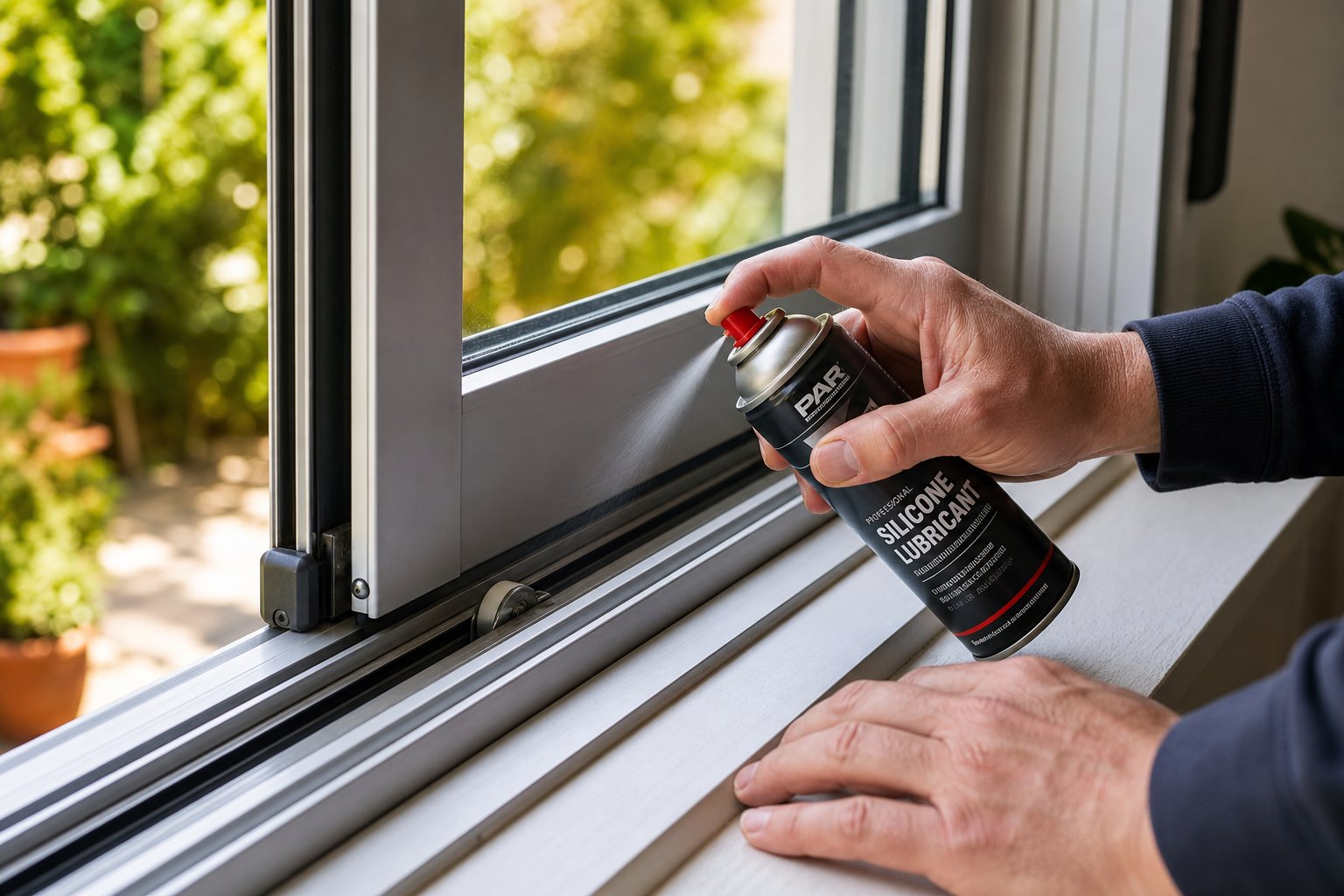
The single highest-return maintenance habit is keeping moving parts clean and lubricated. Dirt and grit act as abrasives inside roller housings, hinge pivots, and lock mechanisms. Left unchecked, they grind components down far faster than normal use ever would.
To maintain aluminium window rollers and hardware effectively, follow this seasonal checklist twice a year—ideally in spring and autumn when temperature shifts affect how smoothly everything operates:
- Vacuum tracks and sill channels — remove sand, dust, and leaf debris that accumulates in sliding tracks and drainage slots. A small brush attachment works well for tight corners.
- Clear weep holes — use a fine probe or compressed air to ensure drainage openings are unblocked. Clogged weep holes trap water inside the frame, accelerating corrosion of internal hardware.
- Lubricate rollers, hinges, and friction stays — apply a silicone-based dry lubricant rather than oil or grease. Silicone does not attract dust the way petroleum-based products do, so it keeps surfaces cleaner between services.
- Lubricate lock mechanisms and handle spindles — a short spray into the keyhole or cam housing, followed by several open-close cycles to distribute the lubricant across internal contact surfaces.
- Wipe excess lubricant — any residue left on external surfaces collects airborne grit and accelerates soiling.
- Inspect weatherstrips — press the seal with a fingertip. It should spring back immediately. If it stays compressed, feels hard, or shows cracking, schedule replacement before air infiltration worsens over winter.
- Clean gaskets and seals — wipe with a damp cloth and mild detergent, then apply a silicone-based rubber conditioner to restore flexibility and delay embrittlement.
- Check fasteners — tighten any loose screws on handles, hinges, and keeper plates. A loose fastener today becomes a stripped hole next year.
- Wash frame surfaces — use warm water with a pH-neutral detergent and a soft cloth. In coastal areas, increase this to quarterly to prevent aluminium window part failure caused by salt deposit buildup attacking hardware finishes.
This routine takes fifteen to twenty minutes per window. Spread across a house, it is a single afternoon's work that pays for itself many times over in deferred part costs.
Expected Part Lifespans and Replacement Planning
Knowing how long aluminium window seals last—and how long other components typically survive—lets you plan replacements proactively rather than reacting to failures after comfort or security has already been compromised.
Under normal conditions with regular maintenance, typical lifespans for common components are:
| Component | Normal Conditions (maintained) | Harsh Environments (coastal/high UV) |
|---|---|---|
| EPDM weatherstrips and gaskets | 10–20 years | 7–12 years |
| Sliding track rollers | 8–12 years | 5–8 years |
| Friction stays | 10–15 years | 7–10 years |
| Hinges | 12–18 years | 8–12 years |
| Locks and handles | 15–20 years | 10–15 years |
| Insulated glass unit seals | 20–30 years | 15–20 years |
| Perimeter silicone sealant | 15–20 years | 8–12 years |
These figures shift dramatically without maintenance. Neglected rollers in grit-filled tracks can fail in as little as five years, while the same roller in a clean, lubricated track lasts twice that. Friction stays that are never lubricated fatigue at the lower end of their range because dry pivot points increase the force required to operate the sash, accelerating wear on the arm mechanism.
For properties in coastal Queensland, the NSW shoreline, or Perth's ocean-facing suburbs, treat the "harsh environment" column as your planning baseline. Budget for weatherstrip replacement every eight to ten years, roller service every five to seven, and a full hardware inspection annually. Inland properties in temperate climates can stretch intervals toward the upper figures comfortably.
The pattern is clear: proactive maintenance is the most cost-effective strategy for aluminium window longevity. A well-maintained window frame can deliver forty to fifty years of reliable service, cycling through two or three sets of seals and rollers along the way—each replacement costing a fraction of what a new window would. The frame endures. The parts are consumables. Treat them that way, replace them on schedule rather than at failure, and the frame never needs to be the conversation.
Frequently Asked Questions About Aluminium Window Replacement Parts
1. What parts can be replaced on aluminium windows without removing the frame?
Nearly every functional component within an aluminium window is individually replaceable while the frame stays in the wall. This includes rollers, balances, friction stays, hinges, handles, locks, keeper plates, weatherstripping, glazing gaskets, glazing beads, drainage flaps, and even the insulated glass unit itself. The aluminium frame is the most durable element of the system and rarely needs replacement. Most repairs involve swapping one or two worn consumable parts—such as a seized roller or hardened weatherstrip—to restore full window performance at a fraction of the cost of a new unit.
2. How do I know which aluminium window replacement part I need?
Start with the symptom rather than the part name. Drafts and air leaks typically point to failed weatherstripping or glazing gaskets. A sash that sticks or is hard to slide usually means worn rollers or a dirty track. Rattling when the window is locked suggests a worn keeper plate or failing lock cam. Condensation trapped between double-glazed panes indicates a failed insulated glass unit seal. Once you identify the symptom, inspect the corresponding component visually and by touch—look for cracking, flat spots on rollers, hardened seals, or loose hardware to confirm which part needs replacing.
3. Can I use aftermarket parts instead of OEM for my aluminium windows?
Yes, for many components. Standard mohair weatherstrips, common roller sizes, generic cam locks, and basic handles use industry-standard dimensions that work across multiple window brands without modification. However, proprietary multi-point locking systems, branded friction stays with integrated restrictors, and non-standard spiral balances often require OEM parts for correct fit and safe operation. The deciding factor is whether the component follows an industry-standard dimension or uses a manufacturer-specific design. Taking a physical sample to a specialist supplier lets them confirm compatibility before you commit to either option.
4. How often should aluminium window parts be maintained or replaced?
With regular maintenance performed twice yearly, most aluminium window components last well beyond their minimum lifespan. EPDM weatherstrips and gaskets typically last 10 to 20 years in normal conditions but only 7 to 12 years in coastal or high-UV environments. Sliding rollers last 8 to 12 years when tracks are kept clean and lubricated. Locks and handles can serve 15 to 20 years. A seasonal routine of vacuuming tracks, lubricating moving parts with silicone spray, inspecting seals for compression, and tightening fasteners takes about 15 to 20 minutes per window and can effectively double the service life of these consumable components.
5. Where can I find replacement parts for old or discontinued aluminium windows in Australia?
Specialist window hardware suppliers offer the broadest range and can identify unknown parts from photos or physical samples. For current production systems, contact the original manufacturer's distributor directly. General hardware stores stock universal items like standard weatherstrip rolls and common rollers. Architectural salvage yards occasionally hold old stock for discontinued brands. When no off-the-shelf option exists, project-capable fabricators like MEICHEN can produce custom-profiled aluminium components matched to your exact extrusion system, supporting the process from drawings through to manufacturing and delivery.