
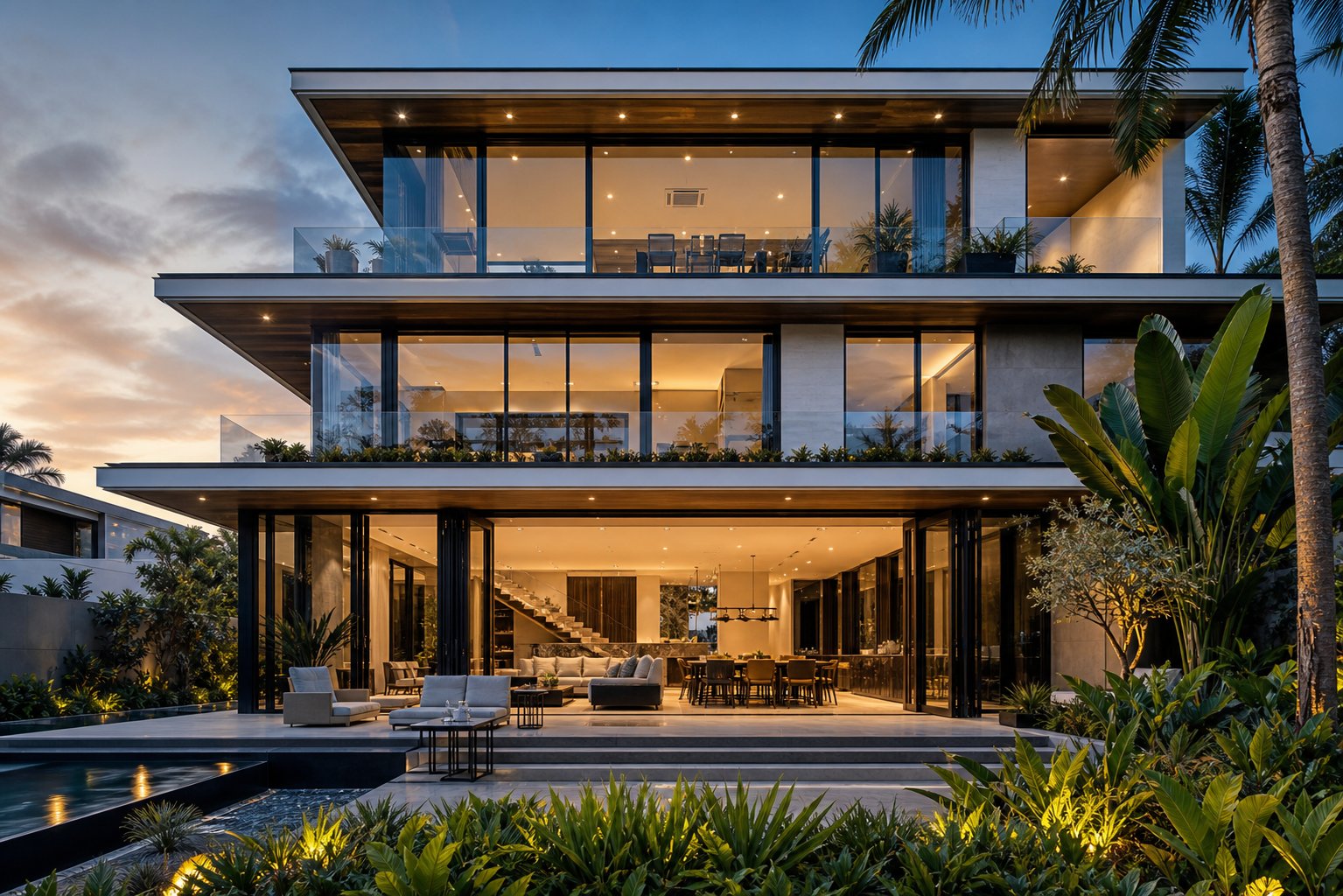
What Makes Aluminium Glass Windows and Doors Different
Every material choice in a building envelope carries consequences that compound over decades. Aluminium glass windows and doors sit at the intersection of structural performance and architectural ambition, and getting the selection wrong means living with the fallout for 40 years or more. This guide covers both windows and doors in one unified resource because, in practice, they share the same frame technology, the same glass options, and the same climate challenges.
What Are Aluminium Glass Windows and Doors
Aluminium glass windows and doors are fenestration systems built from extruded aluminium alloy frames fitted with sealed glass units. Their high strength-to-weight ratio allows slimmer sightlines and larger glass panels than timber, vinyl, or steel alternatives, making them the dominant choice in contemporary residential and commercial architecture.
A quick note on spelling: "aluminium" is standard in Australian and British English, while "aluminum" is the American form. Both refer to the same element. You will see references to an aluminum window or aluminum door in international specifications, but the material and performance are identical regardless of which spelling appears on the datasheet.
Why Aluminium Dominates Modern Architecture
Three properties set aluminium windows and doors apart from competing frame materials. First, aluminium's strength allows profiles as narrow as 45 mm to support floor-to-ceiling glass spans that timber or PVC simply cannot hold without bulky reinforcement. Second, the material is 100% recyclable without any loss of properties, and recycled aluminium requires only 5% of the energy used in primary production. Third, aluminium resists corrosion naturally by forming a protective oxide layer, meaning an aluminium door or window frame won't rot, warp, or degrade the way organic materials do over time.
These qualities explain why windows in aluminium now appear across everything from coastal holiday homes to multi-storey commercial towers. But raw material advantages only matter if you pair them with the right glass, the right thermal technology, and the right supplier for your specific climate zone.
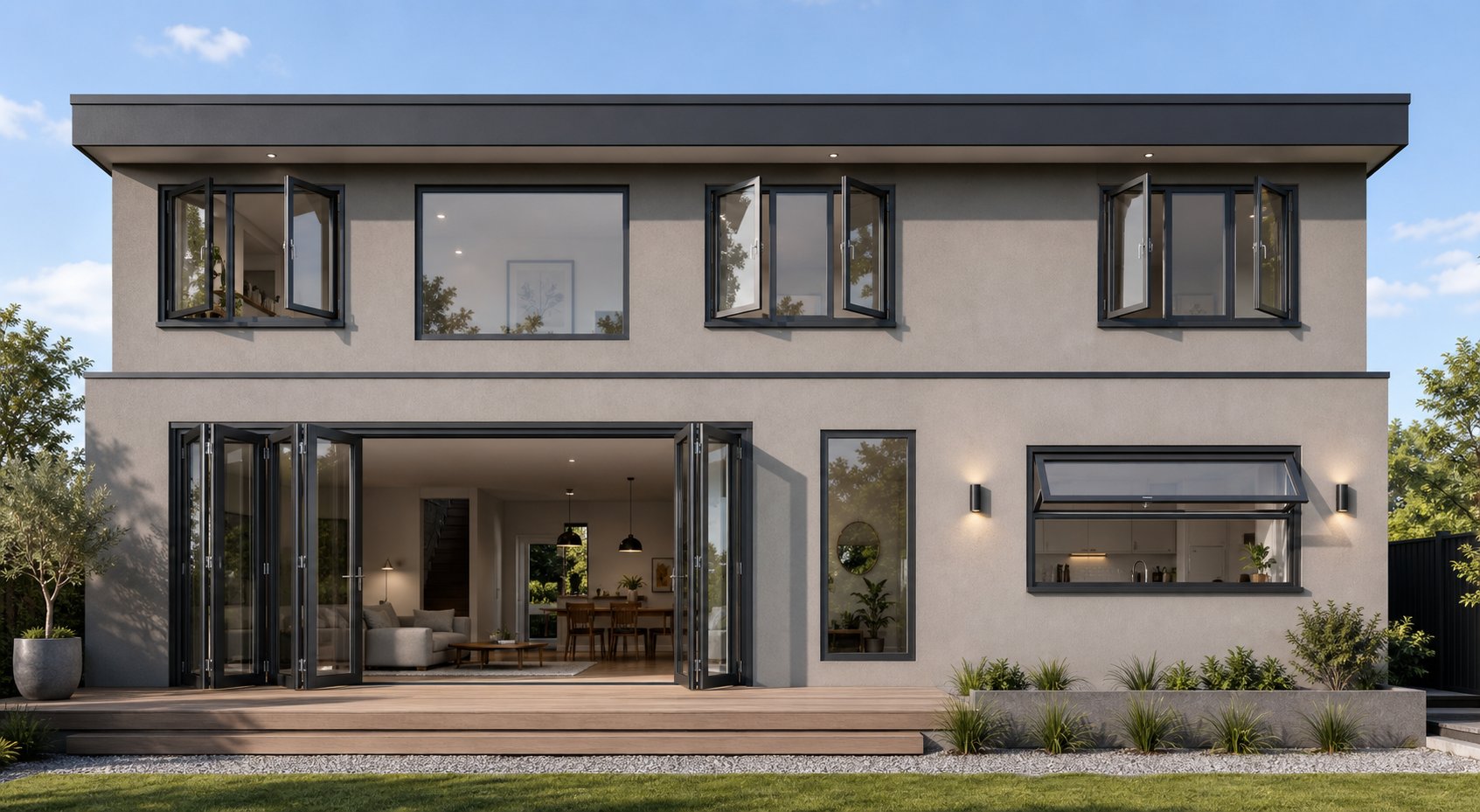
Every Type of Aluminium Window and Door Explained
Aluminium's strength-to-weight ratio is the reason these systems come in so many configurations. A frame profile as slim as 45-55 mm can support glass panels weighing hundreds of kilograms, which means designers aren't forced to choose between structural integrity and visual lightness. Timber and vinyl frames need significantly more bulk to achieve the same spans, eating into your glass area and blocking natural light. That structural advantage translates directly into variety: more opening styles, larger panels, and thinner sightlines across the board.
Aluminium Window Types and Where They Work
Each window style suits a different combination of ventilation needs, wall space, and aesthetic goals. Here are the major types you will encounter in the Australian market:
- Casement windows — Hinged at the side and opening outward via a crank or lever. Aluminium casement windows deliver maximum airflow and form a tight seal when closed, making them a strong all-rounder for bedrooms, living areas, and kitchens.
- Awning windows — Hinged at the top, opening outward at the base. Ideal above benchtops, in bathrooms, or anywhere you want ventilation during light rain without water entering the room.
- Sliding windows — Panels glide horizontally along a track. Aluminium sliding windows suit spaces where a projecting sash would obstruct a walkway, balcony, or outdoor entertaining area.
- Double-hung windows — Two sashes that slide vertically within the frame. Aluminum double hung windows work well in heritage-style homes and streetfront elevations where council guidelines restrict outward-opening sashes.
- Fixed windows — Non-operable panels designed purely for light and views. Often paired with operable windows in a combination unit, they allow the slimmest possible frame profiles and the largest uninterrupted glass areas.
- Louvre windows — Horizontal glass blades that tilt open to control airflow and privacy. Particularly popular in Queensland and northern Australia where maximising cross-ventilation reduces reliance on air conditioning.
A related option worth noting is the aluminum single hung window, which operates like a double-hung but only the bottom sash moves. It is less common in Australian residential projects but appears in commercial and multi-residential builds where simplified hardware reduces maintenance across many units.
Aluminium Door Types for Every Opening
Doors demand more from a frame than windows do. They carry heavier glass, endure daily operation, and must seal against weather at floor level. Aluminium handles all of this without the frame distortion that affects timber over time.
- Sliding doors — Two or more panels on a track, with lift-and-slide mechanisms for effortless operation on larger sizes. Best for rear living areas opening onto decks and patios where you want wide views without sacrificing floor space.
- Bi-fold doors — Multiple panels fold concertina-style to stack against one or both sides, opening up roughly 90% of the aperture. The go-to choice for indoor-outdoor entertaining zones and open-plan kitchen extensions.
- French doors — A pair of side-hinged panels opening inward or outward from the centre. Suited to traditional and transitional homes where a symmetrical, elegant opening is preferred over a wide-span system.
- Pivot doors — A single large panel rotating on an off-centre pivot point. Creates a dramatic architectural statement for front entries or feature internal transitions, with panel widths exceeding what standard hinges can support.
- Entry doors — Side-hung single or double-leaf doors built for security, weather resistance, and street presence. An aluminum entry door typically features a solid or partially glazed panel with multi-point locking hardware.
- Stacking doors — Panels slide and stack behind one another or into a pocket, leaving the opening completely clear. Aluminium stacking doors are ideal for wide openings where bi-fold panels stacking to the side would intrude on usable space.
The common thread across every type is that aluminium lets you go bigger and thinner than other frame materials at the same structural rating. That matters most when you are trying to maximise glass area, because the glass itself is where thermal performance, acoustic control, and solar management actually happen.
Thermal Break Technology and Why It Matters
Glass may dominate the surface area of a window, but the frame is where energy performance quietly succeeds or fails. Aluminium conducts heat roughly 1,000 times faster than timber and 200 times faster than PVC. Without intervention, aluminium window frames act as thermal highways, funnelling heat straight through the building envelope. That intervention is called a thermal break, and it is the single most important factor separating a high-performance aluminium system from an energy liability.
How Thermal Breaks Work Inside Aluminium Frames
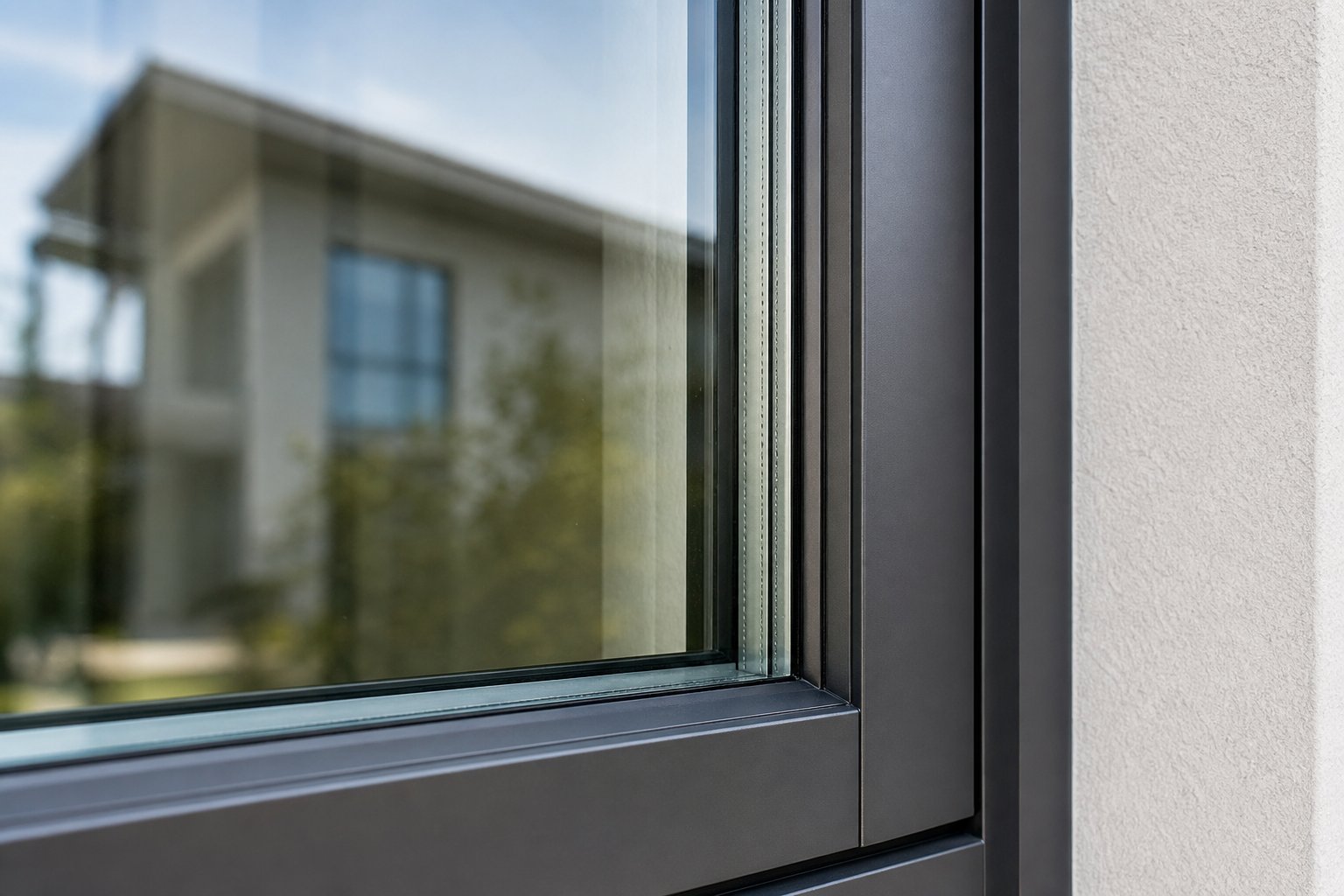
A thermal break splits the aluminum window frame into two separate sections — one facing the exterior, one facing the interior — connected by a low-conductivity barrier rather than continuous metal. The barrier is typically a polyamide (nylon) strip reinforced with glass fibres, though some manufacturers use a pour-and-debridge method where liquid polyamide is poured into machined channels, cured into a solid, and then the aluminium bridge between the two halves is cut away.
Either approach achieves the same goal: eliminating the direct metal pathway that allows rapid heat transfer. The components of a thermally broken frame stack together like this:
- Outer aluminium shell — faces the weather, carries structural loads, and accepts powder-coated or anodised finishes.
- Polyamide thermal barrier — the insulating strip (typically 20-35 mm wide) with thermal conductivity around 0.3 W/mK versus aluminium's 237 W/mK.
- Inner aluminium shell — remains close to room temperature, reducing condensation risk on interior surfaces.
- Sealed glass unit — sits within the frame assembly, with its own insulating properties from gas fills and coatings.
The wider the polyamide barrier, the better the insulation. Premium aluminum frame windows now feature multi-chamber profiles where additional air pockets within the frame further slow heat movement, pushing performance into territory that rivals timber and exceeds vinyl.
Why Thermal Breaks Matter for Energy Bills
Traditional metal frame windows without thermal breaks typically produce U-values of 4.0-6.0 W/(m²K). Thermally broken aluminium systems routinely achieve 0.8-2.0 W/(m²K) — a 70-85% improvement in thermal efficiency. That gap translates directly into heating and cooling loads. In a climate like Melbourne's, where you need insulation against winter cold and summer heat gain, a poorly performing metal window frame bleeds energy in both directions year-round.
Aluminum framed windows with quality thermal breaks also eliminate the cold-spot condensation that damages paint, timber reveals, and plasterboard around window openings. The interior face of the frame stays closer to room temperature, so moisture in the air doesn't condense on the surface.
One important note: energy performance data such as U-values and Solar Heat Gain Coefficient (SHGC) ratings vary significantly between profiles. Always source these figures from the manufacturer's specifications for the exact window frame metal profile you are considering, rather than relying on generic material claims. A WERS rating specific to the product gives you the most reliable comparison for Australian compliance requirements.
Choosing the Right Glass for Aluminium Frames
A thermally broken frame solves the conduction problem through the aluminium itself, but here is the reality most people overlook: the glass unit accounts for 70-80% of the total window or door area. That means your glazing selection has a bigger impact on energy performance, noise control, and safety than the frame material ever will. Get the frame right and the glass wrong, and you have still paid for decades of underperformance.
Glass Types That Pair with Aluminium Frames
Whether you are specifying an aluminium frame glass door for a rear entertaining area or a fixed picture window for a living room, the same core glass options apply. Each type addresses a different combination of thermal control, acoustic dampening, safety, and visual effect.
| Glass Type | Thermal Performance | Acoustic Rating | Safety Level | Ideal Application |
|---|---|---|---|---|
| Double-glazed (IGU) | Good — Ug around 1.1-1.4 W/(m²K) with Low-E and gas fill | Moderate (STC 28-32) | Standard | General residential use across most Australian climate zones |
| Triple-glazed | Excellent — Ug as low as 0.5-0.7 W/(m²K) | Good (STC 32-38) | Standard | Cold climates, passive house projects, south-facing elevations in southern states |
| Low-E coated | High — reflects up to 95% of infrared radiation while transmitting visible light | Same as base IGU | Standard | All climates; essential for NCC Section J compliance in most zones |
| Tinted | Moderate — reduces solar heat gain by absorbing radiation | Same as base IGU | Standard | West-facing glazing, high-glare environments, privacy without obscuring views |
| Laminated | Same as base IGU | Very good (STC 34-40) | High — holds together when broken | Acoustic control, security glazing, BAL-rated bushfire zones, aluminum doors with glass near ground level |
| Tempered (toughened) | Same as base IGU | Same as base IGU | High — breaks into small granules | Doors, low-level panels, wet areas, any glazing within 300 mm of a door as required by AS 1288 |
Most aluminum glass doors and windows in practice combine several of these options. A typical aluminium and glass door for a coastal Queensland home might use toughened, Low-E coated, double-glazed units with a tinted outer pane — layering thermal control, safety compliance, and glare reduction into a single sealed unit.
Matching Glass Performance to Your Climate
Two technologies inside the sealed glass unit do the heavy lifting on thermal performance: gas fills and Low-E coatings.
The cavity between panes in a standard IGU can be filled with air, argon, or krypton gas. Argon is denser than air and reduces convective heat transfer within the cavity. When 90% argon gas fill replaces air in a Low-E IGU, insulating performance improves by up to 16%. Krypton pushes that figure to 27%, though its scarcity makes it roughly 40 times more expensive than argon and impractical for most residential projects. Argon remains the standard choice in Australia, delivering meaningful gains at a modest cost premium.
Low-E (low-emissivity) coatings are microscopically thin metallic oxide layers applied to one or more glass surfaces within the IGU. They reflect infrared radiation — the wavelength that carries heat — while allowing visible light to pass through largely unimpeded. In winter, the coating bounces radiant heat back into the room. In summer, it reflects solar infrared before it enters. The position of the coating on surface two or surface three of the IGU determines whether the glass is optimised for heating climates, cooling climates, or a balance of both.
For a glass aluminum door or window facing west in Perth or north in Brisbane, a low SHGC (Solar Heat Gain Coefficient) paired with a low U-value keeps cooling loads manageable without sacrificing daylight. In Melbourne or Hobart, a slightly higher SHGC on north-facing glass captures free winter warmth while the Low-E coating still limits summer overheating. The key takeaway: aluminum frame glass performance is defined far more by what sits inside the sealed unit than by the metal surrounding it.
Aluminium vs Wood vs Vinyl vs Fiberglass Frames
Glass selection determines most of a window's thermal and acoustic behaviour, but the frame still matters enormously. It dictates structural capacity, profile width, maintenance burden, lifespan, and end-of-life environmental impact. Choosing between aluminium, wood, vinyl, and fiberglass is not simply a question of upfront cost — it is a 40-year commitment that affects everything from energy bills to kerbside appeal.
Aluminium Compared to Vinyl and Wood Frames
Each material brings genuine advantages and real trade-offs. The table below lays them out side by side so you can weigh what matters most for your project.
| Criteria | Aluminium (thermally broken) | Vinyl (uPVC) | Wood (timber) | Fiberglass |
|---|---|---|---|---|
| Durability | Excellent — resists corrosion, warping, and UV degradation. 40-60 year lifespan with minimal care. | Good — resistant to moisture, but can warp or become brittle after prolonged UV exposure. 20-25 year lifespan typical. | Variable — 20-60 years depending on species, finish quality, and maintenance commitment. Susceptible to rot, swelling, and termite damage. | Very good — dimensionally stable, resists rot and corrosion. 30-50 year lifespan. |
| Thermal Performance (without thermal break) | Poor — U-values 4.0-6.0 W/(m²K). Aluminium conducts heat roughly 1,000 times faster than timber. | N/A | N/A | N/A |
| Thermal Performance (with thermal break / standard) | Very good — U-values 0.8-2.0 W/(m²K) with polyamide thermal breaks. | Good — inherently low conductivity delivers U-values around 1.3-2.0 W/(m²K). | Good — natural insulator with U-values around 1.2-1.8 W/(m²K). | Very good — low conductivity, U-values 1.0-1.8 W/(m²K). |
| Maintenance | Low — occasional wipe-down and hardware lubrication. Powder coat finish holds colour for decades. | Very low — wash with soapy water. Cannot be painted; faded colour is permanent. | High — requires sanding, repainting or restaining every 3-5 years. Must be sealed against moisture. | Low — similar to vinyl. Can be painted if colour change is desired. |
| Upfront Cost (AUD, supply and install, standard size) | Moderate to high — generally $800-$2,000+ per window depending on profile and thermal break system. | Low to moderate — generally $600-$1,200 per window. Lowest entry price of all materials. | High — generally $1,500-$3,500+ per window depending on timber species. Hardwoods like cedar and spotted gum push costs further. | Moderate to high — generally $1,200-$2,500+ per window. |
| Long-Term Value | Excellent — near-zero maintenance costs over a 40-60 year lifespan flatten the per-year price significantly. | Moderate — low upfront cost offset by shorter lifespan and potential replacement at 20-25 years. | Good if maintained — poor if neglected. Maintenance costs accumulate over decades. | Very good — long lifespan with low maintenance, though higher upfront outlay. |
| Aesthetics and Design Flexibility | Excellent — slim sightlines (45-55 mm), virtually unlimited powder coat colours, supports the largest glass spans. | Limited — bulkier profiles required for structural rigidity. Restricted colour range; cannot be easily repainted. | Excellent — warm, natural appearance. Fully customisable with stains and paints. Bulkier profiles than aluminium for equivalent spans. | Good — can mimic wood grain finishes. Slimmer than vinyl but wider than aluminium profiles. |
| Environmental Impact | High initial energy for primary production, but infinitely recyclable with no loss of properties. Recycled aluminium uses only 5% of primary production energy. | Moderate initial impact. Recyclable in theory, but degrades with each cycle. Limited end-of-life recycling infrastructure in Australia. | Low initial impact if sustainably sourced. Biodegradable but often treated with chemicals. Renewable resource. | Moderate initial impact. Difficult to recycle; typically ends in landfill. |
| Recyclability | Infinite — roughly 75% of all aluminium ever produced is still in use today. | Limited — can be recycled a small number of times before material degrades. | Biodegradable but not recyclable as a window product. Often contaminated with paint and sealants. | Very limited — composite material makes separation and recycling impractical. |
A few honest realities deserve emphasis. Without thermally broken profiles, a metal window in aluminium performs poorly as an insulator — a genuine weakness that older or budget-grade systems still carry. Aluminium also costs more upfront than vinyl, which makes it a harder sell on tight renovation budgets. And while metal framed windows can scratch during cleaning if abrasive tools are used, the underlying material does not degrade the way vinyl or timber can.
Hybrid options attempt to capture the best of both worlds. Wood clad aluminum windows pair a structural aluminium exterior with a timber interior face, giving you weather resistance outside and warmth inside. The reverse approach — aluminum clad wood windows — wraps a timber frame in an aluminium outer skin to protect against moisture and UV while preserving timber's natural insulating properties. Metal clad windows like these bridge the gap, though they come with higher costs and more complex manufacturing. Aluminum clad systems have become particularly popular in premium residential projects where architects want timber aesthetics internally without the exterior maintenance burden.
Long-Term Value and Sustainability Factors
Cost comparisons only tell a partial story when they focus on purchase price alone. Metal windows built from aluminium routinely last 40-60 years with nothing more than a periodic wipe-down and hardware lubrication. Vinyl frames, while cheaper to buy, typically last 20-25 years and cannot be repainted when colours fade. Timber frames can match aluminium's lifespan, but only with consistent maintenance — sanding, sealing, and recoating every few years. Skip a few seasons and rot sets in.
Spread those replacement cycles over the life of a home, and the long-term economics shift. A single set of thermally broken aluminium frames can outlast two complete sets of vinyl windows, making the per-year cost comparable or lower despite the higher initial outlay.
The sustainability argument further strengthens aluminium's position. Primary aluminium production is energy-intensive, but the material is infinitely recyclable without any loss of its inherent properties. Recycled aluminium requires only about 5% of the energy needed for primary production — a dramatic reduction that compounds with every reuse cycle. The Aluminum Association reports that roughly 75% of all aluminium ever produced remains in active use, a figure no polymer-based material comes close to matching. Vinyl degrades with each recycling attempt, and fiberglass composites are notoriously difficult to separate and reprocess, with most ending up in landfill.
For Australian homeowners weighing a decision that will shape their home's comfort, appearance, and running costs for decades, the frame material comparison is ultimately a question of priorities. Vinyl wins on upfront affordability. Timber wins on natural warmth. Fiberglass wins on set-and-forget stability. Aluminium wins on the combination of structural performance, design freedom, colour permanence, and circular-economy credentials — especially when paired with modern thermal break technology that neutralises its one historic weakness.
That said, even the right frame material underperforms if it is not matched to your local climate. Coastal salt air, tropical humidity, bushfire exposure, and extreme cold each demand different finish specifications and glazing configurations from the same aluminium system.
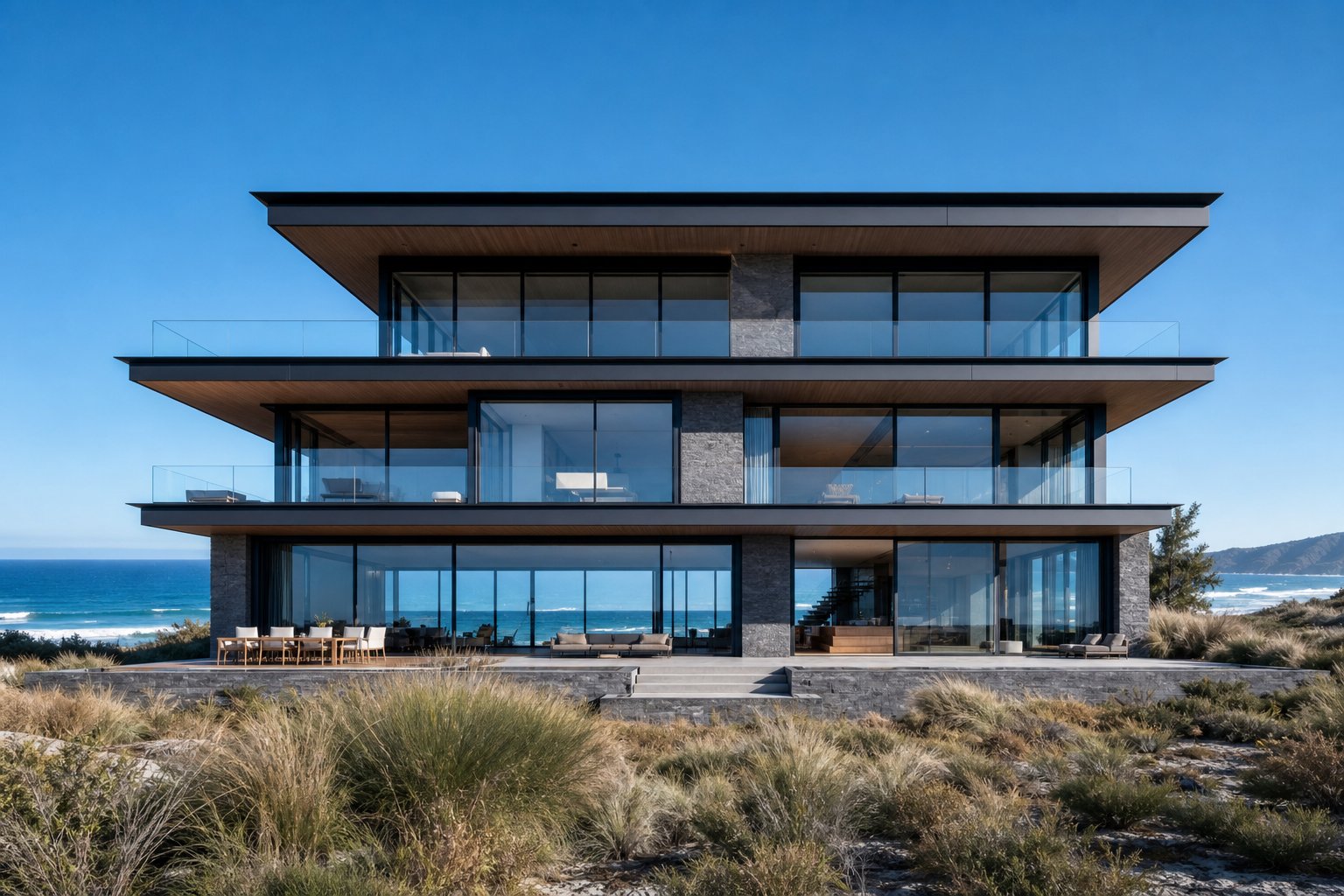
How Climate Affects Aluminium Window and Door Selection
Australia spans eight NCC climate zones, from tropical Darwin to alpine Thredbo. The same aluminium profile that thrives on a Sunshine Coast beachfront can underperform in a Hobart winter if it carries the wrong finish, glazing, or thermal specification. Climate is not a secondary consideration — it dictates nearly every decision about exterior aluminum doors and frames, glass configuration, and hardware selection.
Performance in Coastal and Humid Climates
Salt spray is relentless. It coats surfaces, accelerates corrosion on unprotected metals, and degrades seals faster than inland environments ever will. Aluminium's natural oxide layer provides baseline resistance, but homes within five kilometres of the coast need more. Marine-grade powder coatings and stainless steel hardware are non-negotiable in these zones — standard zinc-plated fittings pit and fail within a few years of salt exposure.
Tropical and subtropical regions add high humidity to the equation. Aluminium external doors and windows handle moisture far better than timber, which swells and warps in persistently humid air, but condensation management still matters. Thermally broken frames keep the interior face above dew point, preventing moisture build-up that damages reveals and encourages mould growth.
Here is a climate-by-climate framework for specifying aluminium systems correctly:
- Coastal (salt air exposure) — Marine-grade powder coat minimum 60-70 microns thick, stainless steel or marine-grade hardware, laminated safety glass for cyclone-prone areas, regular fresh-water wash-down schedule.
- Hot and arid (inland QLD, WA, SA) — Low-E glass with low SHGC to reject solar heat, lighter frame colours to reduce surface temperature, awning or louvre windows for ventilation without direct sun entry.
- Cold (VIC highlands, TAS, ACT, alpine NSW) — Thermally broken frames mandatory, double or triple glazing with argon fill, higher SHGC on north-facing glass to capture passive solar warmth.
- Humid tropical (Far North QLD, NT, northern WA) — Maximise ventilation with louvre and casement configurations, Low-E glass to manage heat gain, corrosion-resistant hardware rated for high-humidity environments.
- Bushfire-prone (BAL-rated areas) — Comply with AS 3959 requirements for the relevant BAL rating, use metal screens or bushfire-rated shutters, tempered or laminated glass depending on BAL level, no exposed plastic components in frames.
A common misconception persists that aluminium performs poorly in cold climates. This was true decades ago, before thermal break technology matured. Modern thermally broken aluminium systems achieve U-values comparable to timber and fiberglass, making them entirely viable for an aluminum outside door or window in Canberra's sub-zero winter mornings or Tasmania's prolonged cold seasons. The key is specifying the right thermal break width and glazing combination — not avoiding the material altogether.
Powder Coating and Finish Options for Longevity
Two primary finish technologies protect aluminium frames from environmental degradation: powder coating and anodising. Each serves different aesthetic and performance goals.
Powder coating applies a thermoset polymer layer electrostatically, then cures it in an oven to form a continuous protective film. It offers virtually unlimited colour options — from crisp whites and deep black aluminum windows to warm bronze aluminum windows and custom RAL-matched tones. High-quality polyester powders resist UV degradation for decades without chalking or fading, which matters enormously on sun-drenched north and west elevations. For architectural-grade durability, look for coatings that meet or exceed the Qualicoat Class 2 standard, which requires resistance to 1,000 hours of accelerated weathering.
Anodising takes a different approach. Rather than adding a coating on top, it converts the aluminium surface itself into a hard oxide layer through an electrochemical process. Anodised finishes deliver superior abrasion resistance and UV stability, preserving a natural metallic appearance that many architects prefer. The trade-off is a limited colour palette — typically silver, bronze, black, and champagne tones. Anodised aluminium performs exceptionally well in marine environments, making it a strong choice for a metal exterior door with window facing the ocean.
Building code compliance ties directly to climate zone. NCC Section J energy efficiency requirements become progressively stricter in extreme climate zones, and NatHERS assessments penalise poorly performing windows heavily. A WERS-rated system with verified U-value and SHGC data for your specific climate zone ensures compliance without over-specifying — or under-specifying — the glazing package. In BAL-rated bushfire areas, AS 3959 adds further constraints on frame materials, glass types, and gap tolerances that override standard specifications entirely.
Residential vs Commercial Aluminium Systems
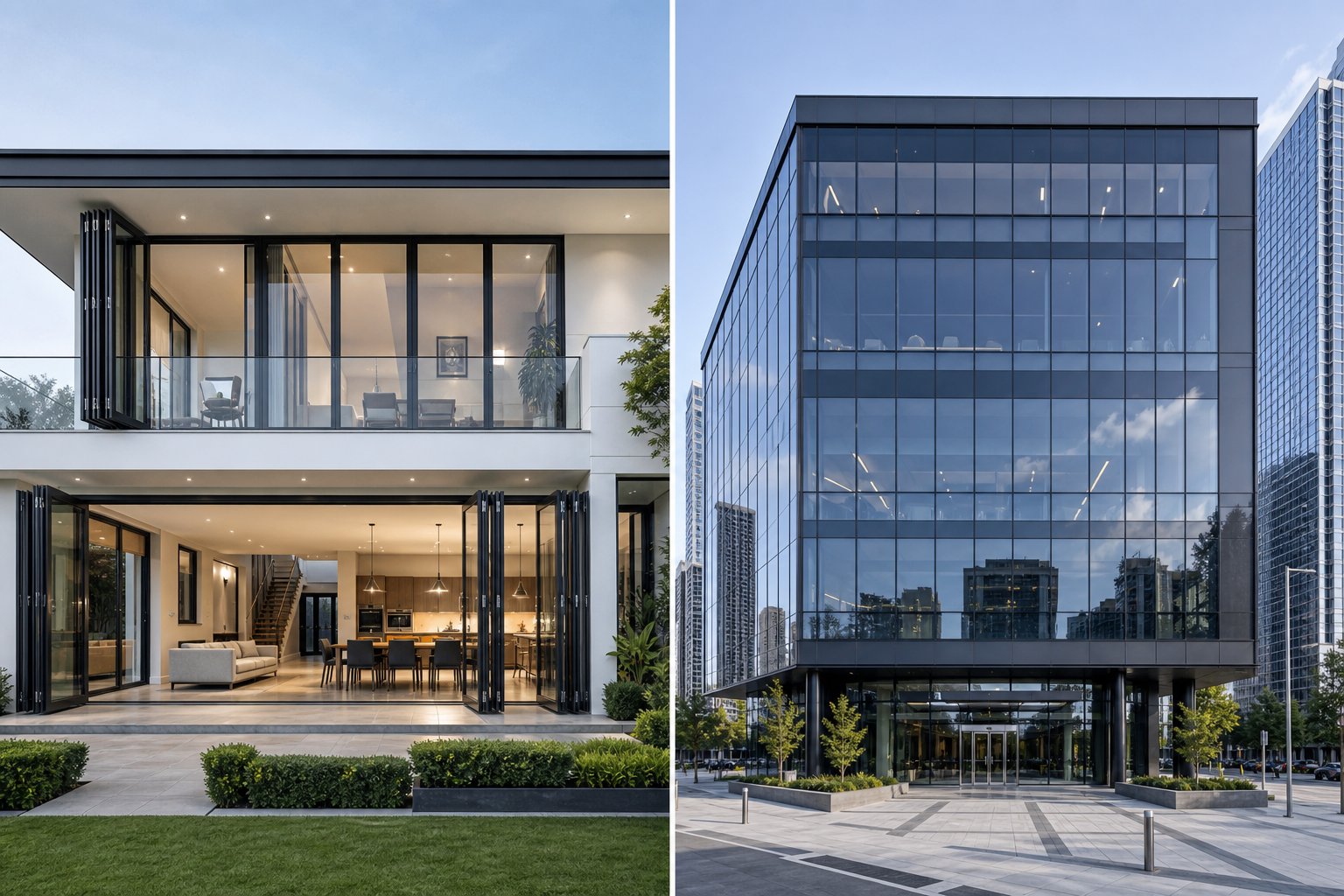
Climate dictates the finish and glazing, but the building type determines the structural demands placed on the frame itself. A single-storey home in suburban Adelaide and a 15-storey hotel tower in Surfers Paradise might both use aluminium glass windows and doors, yet the engineering behind each system is fundamentally different. Confusing the two categories leads to either over-spending on residential projects or, far worse, under-specifying on commercial ones where failure carries safety and compliance consequences.
Commercial Applications and Specifications
Commercial aluminum windows exist in a different performance universe to their residential counterparts. The higher you build, the harder the wind pushes. A window on the 12th floor of a Brisbane office tower faces wind pressures that would never occur at ground level in a suburban home. Commercial systems respond with thicker aluminium profiles — typically 100-150 mm deep versus 45-70 mm for residential — reinforced with steel where necessary to resist deflection under sustained load.
Acoustic performance adds another layer of complexity. Hotels near airports, hospitals beside arterial roads, and offices in CBD locations all require sound transmission class (STC) ratings that standard residential glazing cannot achieve. Commercial aluminium windows often carry laminated glass units 10-12 mm thick or asymmetric double-glazed configurations specifically tuned to dampen traffic and aircraft noise.
Compliance standards are stricter too. Commercial projects must demonstrate tested performance against AS 2047 at higher classification levels, with documented evidence of wind load resistance, water penetration limits, and air infiltration rates. Fire safety ratings, accessibility requirements under the Disability Discrimination Act, and NCC Section C fire compartmentation rules all impose constraints that residential builds rarely encounter.
Hardware tells a similar story. A sliding door in a hotel lobby might cycle 200,000 times over its service life — ten times the use a residential door sees. Heavy-duty rollers, commercial-grade multi-point locks, and panic hardware for emergency egress are standard in commercial aluminum windows and doors but unnecessary in a family home.
Residential Design Trends Driving Aluminium Adoption
Residential aluminum windows were once considered cold and industrial. That perception has reversed completely. The architectural trend toward open-plan living, indoor-outdoor flow, and floor-to-ceiling glazing has made aluminium the natural choice for homes that prioritise light and connection to landscape. Slim 45-55 mm sightlines disappear visually, letting the glass — and the view beyond it — dominate the wall.
Metal windows residential projects now specify routinely include bi-fold systems spanning 6-7 metres, corner-opening configurations with no vertical post, and fixed panels exceeding 3 metres in height. Timber and vinyl frames simply cannot achieve these spans without bulky mullions that interrupt the glass plane. Aluminium's strength-to-weight ratio makes these designs structurally viable without visual compromise.
Budget priorities differ sharply from commercial work. Homeowners weigh aesthetics and energy efficiency heavily, often choosing thermally broken frames with premium powder coat finishes over the raw structural performance that commercial specifiers demand. Residential projects also tend toward more operable panels — casement windows for cross-ventilation, bi-fold doors for entertaining — while commercial facades lean heavily on fixed glazing with minimal operable sections.
The table below maps the key differences across both sectors:
| Criteria | Residential | Commercial |
|---|---|---|
| Typical frame profiles | 45-70 mm depth, standard aluminium alloy | 100-150 mm depth, reinforced profiles for high wind loads |
| Glass specifications | Double-glazed IGU, 20-24 mm units typical, Low-E standard | Double or triple-glazed, 24-40 mm units, laminated for acoustic and safety, asymmetric configurations common |
| Hardware | Residential-grade, moderate cycle life (20,000-50,000 cycles) | Commercial-grade, high cycle life (100,000-200,000+ cycles), panic hardware, automated operators |
| Compliance standards | AS 2047 residential classification, NCC Section J energy, BAL rating where applicable | AS 2047 commercial classification, NCC Sections C, D, J, DDA compliance, fire compartmentation, acoustic certification |
| Budget considerations | $800-$2,500 per opening (supply and install), cost-sensitive, value-driven decisions | $2,000-$8,000+ per opening depending on size and specification, lifecycle cost prioritised over upfront price |
Many large developments blend both approaches. A mixed-use project might specify commercial-grade curtain wall systems for the retail podium and lobby, then transition to residential aluminium windows & doors for the apartment levels above. This hybrid strategy balances performance where it matters most with cost efficiency where residential loads allow lighter systems.
Suppliers who serve both markets under one product ecosystem simplify this process considerably. MEICHEN's aluminium window, door, and facade systems, for example, span residential windows and doors through to curtain walls, louvres, and balustrades — giving architects and builders a single source for specifying aluminum doors and windows across an entire mixed-use project without juggling multiple suppliers and incompatible profile systems.
Whether you are fitting out a family home or coordinating glazing across a 200-unit development, the specification process follows the same logic: define the performance requirements first, then select the system that meets them without over-engineering or under-delivering. The difference lies in where the performance bar sits — and how much documentation you need to prove you have cleared it.
How to Choose the Right Aluminium Window and Door Supplier
Specifications only matter if the supplier behind them can actually deliver. You can nail the thermal break width, glass configuration, and powder coat colour on paper, but a poor-quality aluminium window supplier turns those specs into delays, warranty disputes, and products that fall short of tested performance claims. The supplier decision shapes every stage of the project lifecycle — from initial quoting through to warranty support decades later.
What to Look for in an Aluminium Window and Door Supplier
Searching for aluminium windows near me or aluminum door suppliers returns dozens of results, and the differences between them are not always obvious from a website alone. These evaluation criteria separate reliable aluminium window suppliers from those likely to cause problems mid-project:
- Product range breadth — Can the supplier provide windows, doors, louvres, and facade systems from a single profile ecosystem? Sourcing from multiple manufacturers creates compatibility headaches at junctions and transitions.
- Thermal break availability — Does the range include thermally broken options across all product types, or only on select lines? A supplier limited to non-thermally-broken profiles restricts your ability to meet NCC energy requirements.
- Finish warranty — Look for minimum 10-year powder coat warranties backed by the coating manufacturer, not just the fabricator. Marine-grade finishes for coastal projects should carry specific salt-spray test documentation.
- Compliance certifications — Products should be tested and certified to AS 2047 and AS 1288 with documented evidence. Ask for WERS ratings on specific profiles rather than accepting generic performance claims.
- Project support and lead times — Reliable aluminum window manufacturers provide clear production timelines, shop drawing sign-off processes, and dedicated project coordination for larger builds. Vague delivery estimates signal capacity issues.
- Installation guidance or services — Whether the supplier installs directly or supports third-party installers with technical documentation, proper installation is critical. A well-made window installed poorly still leaks.
Builders and architects managing whole-building specifications benefit most from suppliers offering a complete facade ecosystem. MEICHEN's product range, for instance, covers aluminium windows, doors, curtain wall systems, louvres, and balustrades under one system — simplifying procurement and eliminating the coordination risk that comes with juggling separate aluminum window suppliers for different building elements.
From Specification to Installation
The procurement lifecycle for aluminium glass windows and doors follows a predictable sequence, and understanding it upfront prevents costly surprises:
Selection — Define performance requirements (U-value, SHGC, acoustic rating, wind load classification) before choosing products. Climate zone, building type, and NCC compliance drive these numbers.
Purchase — Confirm pricing covers supply, delivery, and any project management support. Ask whether quotes include hardware, flyscreens, and reveals, or whether these attract additional charges. Get lead times in writing — custom powder coat colours and non-standard sizes typically add 2-4 weeks beyond standard production schedules.
Installation — Proper flashing, sealing, and alignment determine long-term weather performance. Even the best aluminium system fails if installed with incorrect clearances or inadequate drainage provisions. Ensure your installer follows the manufacturer's documented fixing details.
Maintenance — Aluminium frames need very little: a wash with mild soapy water every few months, hardware lubrication annually, and drainage slot clearance checks. Coastal properties should be rinsed with fresh water more frequently to remove salt deposits.
Replacement timeline — Quality thermally broken aluminium systems last 40-60 years. Hardware components (rollers, locks, seals) may need replacement at 15-20 years, but the frames and glass units themselves should outlast most other building materials around them.
Choosing the right aluminium door suppliers and window partners early in the design phase — rather than scrambling during construction — gives you access to technical input that can improve specifications, avoid costly variations, and keep your project timeline intact.
Frequently Asked Questions About Aluminium Glass Windows and Doors
1. Are aluminium windows and doors energy efficient?
Modern aluminium windows and doors with thermally broken frames achieve U-values between 0.8 and 2.0 W/(m²K), representing a 70-85% improvement over non-thermally-broken aluminium. The polyamide thermal barrier inside the frame interrupts heat conduction, while paired double or triple glazing with Low-E coatings and argon gas fills handles the remaining 70-80% of the window area. When correctly specified for your climate zone, thermally broken aluminium systems meet or exceed NCC Section J energy requirements and perform comparably to timber and fiberglass frames.
2. How long do aluminium glass windows and doors last?
Quality thermally broken aluminium frames typically last 40 to 60 years with minimal maintenance — significantly longer than vinyl (20-25 years) and comparable to well-maintained timber. The frames themselves resist corrosion, warping, and UV degradation. Hardware components such as rollers, locks, and seals may need replacement at the 15-20 year mark, but the aluminium structure and sealed glass units outlast most surrounding building materials. Powder-coated finishes hold their colour for decades without repainting.
3. What is the difference between thermally broken and non-thermally broken aluminium frames?
Non-thermally broken aluminium frames use a continuous metal profile, allowing heat to transfer rapidly through the frame — producing poor U-values of 4.0-6.0 W/(m²K). Thermally broken frames split the profile into two separate aluminium sections connected by a polyamide (nylon) strip that has roughly 800 times less thermal conductivity than aluminium. This barrier prevents the frame from acting as a thermal bridge, keeps interior surfaces closer to room temperature, reduces condensation risk, and brings energy performance in line with timber and fiberglass alternatives.
4. Can aluminium windows and doors be used in coastal areas?
Aluminium is well suited to coastal environments when specified correctly. Homes within five kilometres of the coastline need marine-grade powder coating at 60-70 microns minimum thickness, stainless steel or marine-grade hardware, and a regular fresh-water wash-down schedule to remove salt deposits. Anodised finishes also perform exceptionally well in salt-air conditions. Without these specifications, standard zinc-plated fittings and thinner coatings can pit and fail within a few years of salt exposure. Suppliers like MEICHEN offer systems rated for Australian coastal conditions across their full product range at meichenwindows.com.au/products/.
5. How do I choose between aluminium, vinyl, and timber window frames?
The choice depends on your priorities across five factors: budget, maintenance tolerance, design ambition, lifespan expectations, and environmental values. Vinyl wins on upfront affordability but lasts only 20-25 years and cannot be repainted. Timber offers natural warmth and customisation but demands recoating every 3-5 years and is vulnerable to rot and termites. Aluminium costs more initially than vinyl but delivers 40-60 years of near-zero maintenance, the slimmest sightlines for maximum glass area, infinite recyclability, and unlimited colour options through powder coating. When spread over its full lifespan, aluminium's per-year cost often matches or undercuts alternatives.