

What Window Manufacturing Means and How the Supply Chain Works
What is window manufacturing? Window manufacturing is the process of turning frame profiles, glass, spacers, sealants and hardware into finished, tested window units. It runs from profile extrusion or milling and glass processing through insulated glass unit (IGU) assembly, frame and sash fabrication, hardware fitting and quality control, ending with packing and distribution.
What Window Manufacturing Covers
A finished window looks like a single product. In reality it brings together several components, each made by a different process, and they all have to meet tight tolerances. The supply chain usually breaks down into these stages:
- Profile extrusion or milling: aluminium or uPVC is pushed through a shaped die, or timber is machined to profile.
- Glass processing: sheets are cut, edged, toughened (tempered) or laminated, and coated.
- IGU assembly: panes are joined around a spacer, sealed and often gas-filled to make double glazing.
- Frame and sash fabrication: profiles are cut, machined and joined at the corners.
- Hardware fitting: locks, hinges, rollers, stays and weather seals go on.
- Quality control: dimensions, operation and seals are checked before dispatch.
- Distribution: units are packed and delivered to the builder or installer.
How Window Manufacturing Companies Divide the Work
Few window manufacturing companies handle every stage themselves. An integrated manufacturer runs its own extrusion press, glass line and assembly floor, so it can trace a fault back to the raw material. A fabricator buys extruded profiles from a system supplier and sealed glass units from a glass processor, then does the cutting, assembly, glazing and testing in-house. A reseller buys finished windows and controls none of the production.
Any of these models can turn out a good window. They differ in who controls quality at each step and in how long an order takes, because every outsourced component brings its own supplier lead time and inspection routine. This guide comes back to both points in later sections.
Why the Process Matters More Than the Brand Name
If you search for window manufacturers, you mostly get ranked lists of brand names. Those lists rarely explain why one window stays sealed for decades while another fogs up or leaks within a few years. In windows manufacturing, the answer usually comes down to factory details: how the corners are joined, how the glass unit is sealed, where the drainage slots are cut, and whether an independent laboratory tested the finished product. This guide follows that process from raw profile to delivered unit, so you can judge the result yourself.
The process starts with the frame. The material it's made from limits what the factory can do at every later stage.
Frame Materials and How Each One Is Made
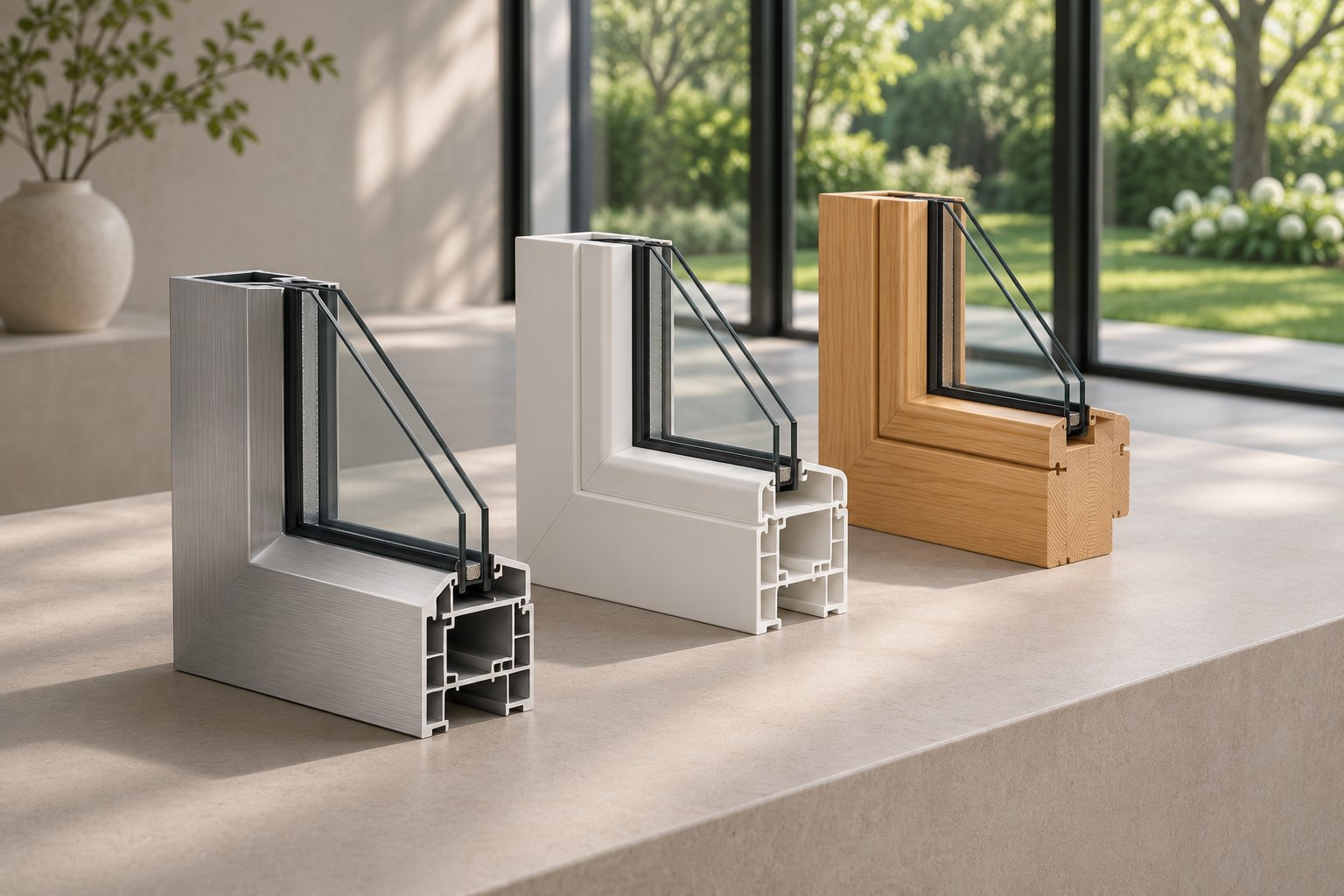
Two windows can share the same glass and still perform very differently because their frames were made differently. Each frame material has its own production method. That method limits how strong the frame can be, how much heat passes through it, and how well its corners hold together after years of sun and rain.
Vinyl and uPVC Extrusion and Fusion Welding
uPVC, called vinyl in North America, starts as a PVC compound, usually blended with UV stabilisers. The compound is heated and pushed through a die that forms a hollow profile with several internal chambers. The profile is then cooled and cut to length. Larger or heavier sashes also get steel or aluminium reinforcement slid inside the chambers.
Most uPVC windows manufacturers join the corners by fusion welding. The two mitred ends are pressed against a hot plate until they soften. They are then pushed together so the plastic melts into one piece, and a cleaning machine trims off the excess bead. One Canadian producer reports platen temperatures of 230 to 260°C.
The quality of a weld depends on tight process control. A study in the journal Materials found that welds made under optimised conditions came close to the strength of the uncut profile. Milling just 1.5 mm too deep around reinforcement inserts measurably weakened the corner. So when you compare products marketed as the best vinyl windows, ask how the corners are welded and checked. The brand name on the compound tells you far less.
Aluminium Extrusion and Thermal Breaks
Aluminium frames begin as heated billets forced through a steel die. Aluminium conducts heat readily, so higher-performance profiles include a thermal break, an insulating barrier that separates the inner and outer metal. Thermal barrier supplier Azon describes the two main methods:
- Polyamide struts: pre-extruded strips of glass-fibre reinforced polyamide (PA 6.6) are crimped into knurled channels on the two aluminium halves. The mechanical lock is only secure if the extrusion tolerances are tight.
- Pour and debridge: a liquid two-part polyurethane is poured into a channel in the profile and cures in place. The metal bridge beneath it is then cut away, so no metal path runs from inside to outside.
Azon ranks polyurethane foam as the barrier with the lowest conductivity, followed by solid polyurethane and then glass-filled polyamide. Aluminium can't be fusion welded like uPVC. Its corners are joined mechanically with corner cleats that are crimped, screwed or pinned, usually with sealant applied to the joint. Aluminium is the most common frame material in Australia, and thermally broken systems are a common way to lift its WERS results. Anodised or powder-coated finishes help protect frames from salt air near the coast.
Fibreglass Pultrusion
Fibreglass frames are made by pultrusion. A pulling machine draws continuous glass-fibre strands through resin, forms them to shape, and pulls them through a heated die where the resin cures, as this pultrusion overview explains. The fibres stay continuous and straight along the profile, which gives the profile high strength along its length. Fibreglass windows are much less common in Australia than aluminium or uPVC, so check local supply and lead times early.
Wood, Clad Wood and Composite Frames
Timber frames are milled from seasoned timber, treated against rot and insects, and then finished. Many are clad with aluminium on the outside to reduce repainting. Composite frames combine materials such as wood fibre and polymer resin, so their properties depend on the blend. On bushfire-prone sites, the timber species and frame construction must also suit the site's BAL rating under AS 3959.
| Frame material | Durability | Thermal performance | Maintenance | Relative cost |
|---|---|---|---|---|
| uPVC | Moderate to high (depends on UV stabilisation and weld quality) | High | Low | Moderate |
| Aluminium, no thermal break | High | Low | Low | Low to moderate |
| Thermally broken aluminium | High | Moderate to high | Low | Moderate to high |
| Fibreglass | High | High | Low | High |
| Timber | Moderate (depends on species and finish) | High | High | Moderate to high |
| Aluminium-clad timber | High | High | Moderate | High |
| Composite | Varies by formulation | Moderate to high | Low to moderate | Moderate to high |
These ratings describe general tendencies. They don't predict how any one product will perform. Material marketing often goes further than the evidence. Marvin, for example, says its fibreglass outlasts vinyl, aluminium and composites, but it doesn't publish comparative data to back the claim. Window frame manufacturers working in every material make similar statements. Tested ratings for the complete window give you a fairer comparison, and later sections explain how to read them.
Even a well-made frame is only a narrow band around the edge of the window. Most of the window's area is glass, and the sealed unit inside the sash has a large effect on heat flow, noise and condensation.
Inside the Insulated Glass Unit
When a double-glazed window fogs up between the panes, the frame is rarely the cause. The sealed glass unit has failed. Shoppers looking for high quality windows tend to compare frames, yet the insulated glass unit (IGU) makes up most of the window's area. An IGU is two or more panes held apart by a spacer, sealed around the edges and usually filled with gas. Glass processors and window fabricators build them in a fixed order, and each step affects how long the unit lasts.
Glass Cutting, Toughening and Laminating
Float glass is cut to size first. The edges are then seamed or ground to remove the tiny chips that can start cracks. All cutting and drilling has to happen before toughening (tempering). Toughened glass holds built-in stress, and cutting it afterwards shatters the whole pane into small fragments.
Laminated glass bonds two panes together with a plastic interlayer, commonly PVB. If the glass breaks, the interlayer holds the pieces in place. It also reduces noise and resists impact. In Australia, AS 1288 sets out where safety glass is required, such as in doors, side panels and glazing close to the floor.
Low-E Coatings and What They Do
A low-emissivity (low-E) coating is a microscopically thin, transparent layer of metal or metal oxide. It lets most visible light through and reflects long-wave radiant heat. UK rooflight maker Glazing Vision describes the two production methods:
- Hard coat (pyrolytic): tin oxide is applied to the hot glass while it is still on the float line, where it fuses with the surface. The coating is durable.
- Soft coat (sputtered): thin silver layers are deposited onto cut glass in a vacuum chamber. Soft coat has a lower emissivity and insulates better. It is also delicate, so it must face the sealed cavity.
Glass surfaces are numbered from the outside in, so a double-glazed unit has surfaces 1 to 4. A coating on surface 3 is slightly better at keeping heat indoors, which suits cold climates. Solar-control coatings designed to keep summer heat out usually go on surface 2, a common choice in hot Australian climates. Before assembly, the factory strips soft coat from the glass edges (edge deletion) so the sealants bond to bare glass.
Spacers, Warm-Edge Systems and Sealants
The spacer sets the gap between the panes. It is filled with desiccant, which absorbs any moisture sealed in during assembly or that seeps in later. Traditional aluminium spacers are rigid and cheap. Aluminium also carries heat across the edge of the unit, which makes the glass edge the coldest part of the window, so condensation forms there first. Warm-edge spacers reduce that heat path:
- Stainless steel: thin walls carry much less heat than aluminium, and the spacer stays rigid.
- Structural foam: a flexible closed-cell foam with the desiccant built in.
- Thermoplastic spacer (TPS): a machine lays it as one continuous bead, so the frame has no corner joints.
- Hybrid: a plastic body backed by a thin metal layer that blocks vapour.
Most IGUs use a dual seal. The primary seal is polyisobutylene (PIB), placed between the spacer and the glass to block water vapour and fill gas. PIB is mechanically weak, so a secondary seal of silicone, polysulphide or polyurethane goes around the outer edge to hold the unit together. Researchers writing in the journal Materials point out that silicone lets water vapour through fairly easily. The unit's gas and moisture tightness therefore depends almost entirely on the PIB layer.
Why Argon or Krypton Goes Between the Panes
Argon conducts heat less than air, so filling the cavity with it slows heat flow across the gap. It is also inexpensive, which makes it the most common fill gas. Krypton insulates better but costs more. It works best in narrow gaps, so manufacturers use it in triple glazing and slimline units where the cavities are thin.
Glazing the IGU Into the Sash
The finished unit sits in the sash on setting blocks, which are rigid packers placed near the bottom corners. The blocks carry the unit's weight so it doesn't bear down on the edge seal, and they keep the sash square. Glazing tape or wet sealant seals the glass to the frame. Glazing beads then clip or screw in to hold the unit in place. The glazing pocket also needs to drain, because water left sitting against the edge seal shortens its life.
The full build sequence runs like this:
- Cut and edge the glass, then toughen or laminate it if required.
- Remove soft-coat low-E from the edges, then wash and dry the panes.
- Build the spacer frame, fill it with desiccant and apply PIB to both faces, or lay a TPS bead directly on the glass.
- Press the panes onto the spacer and fill the cavity with argon or krypton.
- Apply the secondary seal around the perimeter and let it cure.
- Inspect the seal and check the gas fill.
- Set the unit on blocks in the sash, seal it and fit the glazing beads.
An IGU's rating describes how it performed on the day it was tested. Seal quality and gas retention decide whether it still performs that way ten years later.
Field evidence supports this. The same Materials study surveyed 4,500 curtain-wall units and found sealing defects in more than 30% of them after about 10 years in service. Most defects involved PIB pulled into the cavity. Damage was worst on facades that received the most sun, which is relevant under Australia's strong UV and summer heat. The researchers recommended frequent peel testing of the bond between the silicone and PIB during production. The best quality windows tend to come from plants that check seal adhesion on the line as the units are made.
The glass unit is only one station on the line. Before it reaches the sash, the frame has already been cut, drilled, joined and fitted with hardware, and each of those steps affects the finished window's ratings.
From Profile to Finished Window on the Factory Floor
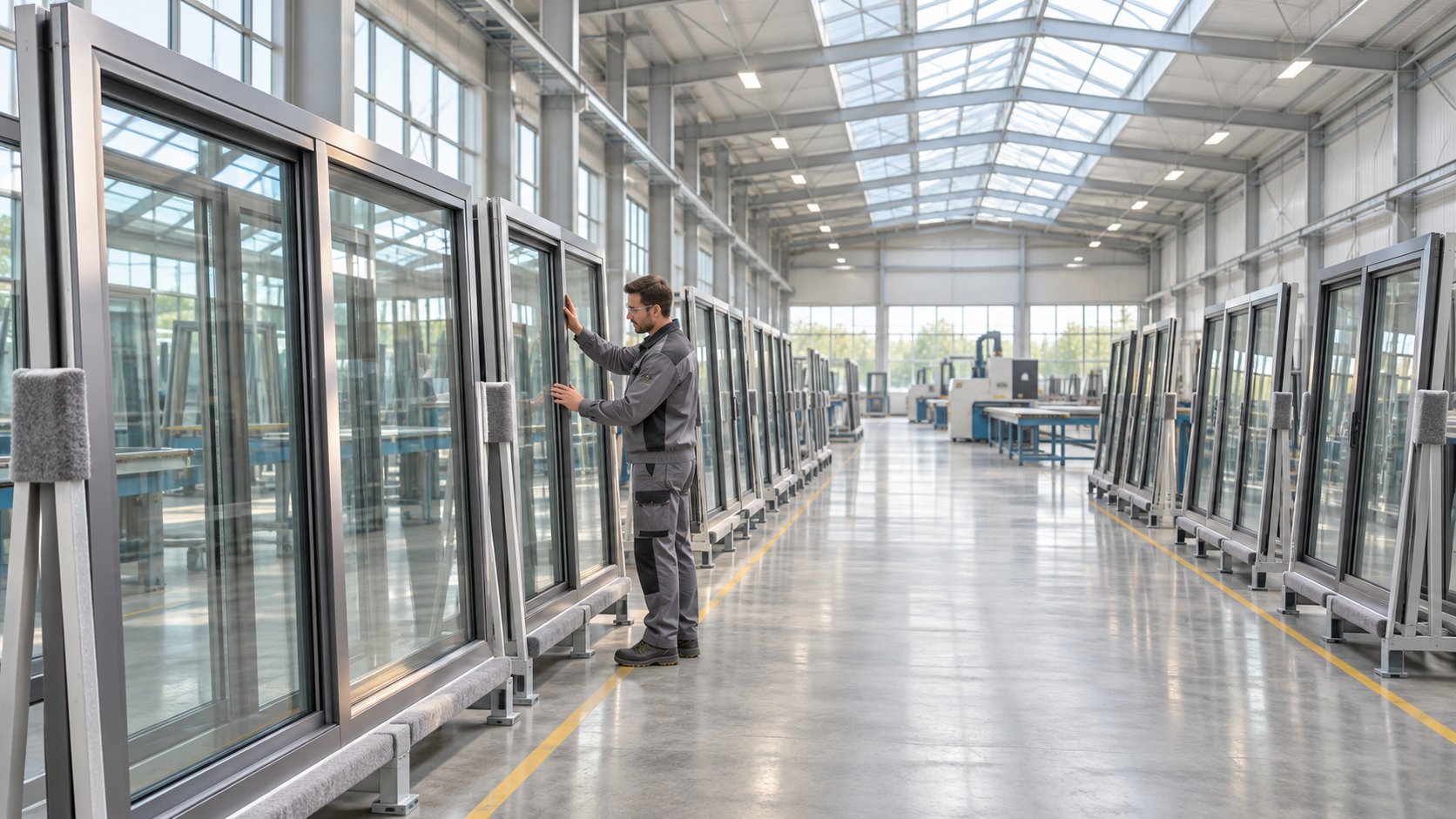
A sliding window that whistles in a southerly or drips onto the sill during a storm usually left the factory with the fault already built in. Any window manufacturing company, large or small, runs its line in roughly this order:
- Enter the order from drawings or window schedules.
- Optimise the cut list.
- Cut the profiles to length.
- Machine drainage slots and hardware preps.
- Insert reinforcement where the design calls for it.
- Weld or crimp the corners.
- Clean the corners.
- Fit weatherstripping and hardware.
- Glaze the insulated glass unit into the sash.
- Fit flyscreens.
- Inspect the finished unit.
- Wrap and pack it for delivery.
From Order Drawings to Cut Lists
Every job starts with the architect's drawings or the builder's window schedule. Each opening becomes a list of profile lengths, glass sizes, seals and hardware. Optimising software then arranges those cuts across stock lengths of profile to reduce offcuts. A wrong dimension entered at this stage carries through every later step, because the saws cut exactly what the program tells them to.
Cutting, Machining and Corner Joining
Profiles are cut, usually mitred at 45 degrees for welded or cleated corners, then machined for drainage slots, lock and hinge pockets, and fixing holes. UK machinery supplier Haffner lists inaccurate cutting and inconsistent drainage slotting or hinge prep among the most common fabrication mistakes, and links them to poor sealing, water getting in and sashes that don't operate properly. A fenestration engineer at Warren Forensics adds that badly machined weep slots leave weep covers fitting loosely, and installers rarely check them. When water sits against the glass seal, the unit can fog.
For uPVC, the corners are fusion welded. The machine settings make a measurable difference. A 2025 Materials study on reinforced uPVC profiles, with the composite insert milled to 1 mm, found that a welding head feed rate of 0.25 mm/s produced the strongest, most even welds. The average failure load at that rate was 3,637 N, compared with 3,157 N at 0.19 mm/s and 3,033 N at 0.31 mm/s. Aluminium corners are crimped or screwed onto cleats and sealed instead. In both materials, corner cleaning removes excess material so the seals sit flat.
Hardware, Glazing and Final Assembly
Weatherstrip is pressed into its grooves. If it is stretched or cut short at a corner, it leaves a gap. Hardware is screwed into the machined preps, and the reinforcement gives the screws something solid to hold. The glass unit goes in on setting blocks, flyscreens are fitted, and an inspector checks squareness, operation and the seals. Protective film and corner guards then protect powder-coated or anodised finishes on the way to site.
How Each Factory Step Shows Up on the Spec Sheet
In Australia, AS 2047 rates windows for wind pressure, water penetration resistance and air infiltration, and WERS reports energy performance. Each of those results can be traced back to particular steps on the line:
| Factory step | What can go wrong | Rating or test affected |
|---|---|---|
| Order entry and cut list | Wrong size or profile selected | Fit in the opening, and every test that follows |
| Profile cutting | Lengths or angles out of tolerance | Air infiltration, squareness, operating force |
| Drainage slot machining | Slots missing, misplaced or rough | Water penetration resistance |
| Reinforcement and hardware preps | Reinforcement left out, preps misaligned | Wind pressure (structural) performance, sash operation |
| Corner welding or crimping | Weak welds, unsealed cleats | Structural strength, water penetration resistance |
| Weatherstrip fitting | Stretched, short or poorly seated seals | Air infiltration |
| IGU and spacer choice, glazing | Aluminium spacer, weak edge seal, blocked glazing drainage | U-value and SHGC on the WERS rating, condensation risk, IGU life |
| Inspection and packing | Damage missed, frame racked in transit | Installed performance on site |
Custom window makers who build to order follow the same steps, but the sizes, reinforcement and machining programs change from one unit to the next. That gives more room for error than a run of identical windows. If you're ordering an oversized or unusual unit, ask the window makers whether their test reports cover that size and configuration.
Linking each step to a rating only helps if someone measures the result. Some of that checking happens on the factory floor, and some happens in an independent laboratory with no stake in the sale.
Factory Quality Control and Third-Party Window Testing
Anyone can print a number on a spec sheet. The number only means something if you know who produced it, what sample they tested and which test method they used. Well-run plants check their own work every shift. They also send sample windows to an independent laboratory that has no interest in whether the product passes.
In-Factory Quality Checks
Production checks are there to catch faults before a window leaves the plant. A typical line includes:
- Corner strength tests: sample welded corners are loaded in a press until they break, to confirm the welder settings still produce full-strength joints.
- Squareness and dimension checks: frames are measured across both diagonals, because a frame that is out of square makes the sash bind and lets air through.
- Sash operation checks: each sash is opened, closed and locked to check how much force it takes and whether the seals make even contact.
- IGU seal inspection: edge seals are checked for gaps, and some sample units are peel-tested.
- Gas-fill verification: a non-invasive analyser measures the argon or krypton concentration through the glass.
Ask whether these results are logged against batch or order numbers. If they are, a fault found on site can be traced back to the shift and machine that produced it.
Air, Water and Structural Testing in the Laboratory
Laboratory tests use full-size windows sealed into a pressure chamber. In Australia, AS 2047 sets the performance requirements that windows must meet under the NCC. Imported products often come with North American reports based on ASTM methods instead. Building envelope engineers at UL stress that results only count when an accredited, independent laboratory produces them. In Australia, that means a NATA-accredited lab. UL also points out that laboratory tests cover the window on its own and not the joint between the window and the wall. Installation quality still matters for that reason.
| Test | What it measures | Australian reference | North American method |
|---|---|---|---|
| Air infiltration | How much air passes through the closed, locked window at a set pressure difference | AS 2047 | ASTM E283 |
| Water penetration resistance | Whether water sprayed onto the window gets inside while air pressure is applied | AS 2047 | ASTM E331 (uniform pressure), ASTM E547 (cyclic pressure) |
| Structural performance | How far the frame and glass deflect under wind load, and whether they survive a higher overload | AS 2047 | ASTM E330 |
| Forced-entry resistance | Whether the window resists prying and lock manipulation | Not a core AS 2047 rating, so ask for separate security test evidence | ASTM F588 |
Performance Class and Grade Under the North American Fenestration Standard
Windows tested in North America carry ratings under AAMA/WDMA/CSA 101/I.S.2/A440, known as NAFS. NAFS sorts products into four performance classes:
- R: residential
- LC: light commercial
- CW: commercial window
- AW: architectural window, for high-rise buildings and heavy use
The performance grade is a number tied to the design pressure (DP) the product passed. The structural test is run at a higher pressure than DP to build in a safety margin. The water test is run at a fraction of DP. Each class above R requires a higher minimum grade and a larger test sample. For that reason, commercial window manufacturers usually test to CW or AW, because large units on tall buildings face stronger wind loads and harder use. DP is quoted in pounds per square foot, and AS 2047 ratings are in pascals (1 psf is about 48 Pa). A NAFS report also doesn't replace AS 2047 compliance, so confirm what the building certifier will accept.
Third-Party Certification Programs
A single test proves that one sample passed. Certification checks that ongoing production still matches that sample, using independent labs and regular plant inspections. AAMA runs a program of this kind, and so does the WDMA Hallmark program. Hallmark is ANSI-accredited, covers air, water, structural and impact performance, and lists certified products in a public online directory. Its inspectors can audit for IGCC, which certifies insulated glass units, during the same visit. For Australian projects, the equivalent evidence is an AS 2047 label on each window, test reports from a NATA-accredited lab, IGUs tested to AS/NZS 4666, and a WERS rating for energy performance.
Compare that evidence with marketing copy. Vinyl Kraft describes its windows as "rigorously manufactured and tested," and Superior Window Manufacturing calls its products "high-performance." Neither phrase names a standard, a rating, a class or a laboratory. When a supplier claims to sell the best rated windows or top rated windows and doors, ask for a test report and a certification listing you can check yourself.
These tests show whether a window stays dry and holds together in a storm. Heat loss, solar gain and cyclone debris resistance are rated under separate schemes, and each one has its own label.
Energy and Impact Window Ratings Explained
A rating on a window label comes from a test or computer simulation of that product, checked by someone other than the seller. In Australia, two ratings carry the compliance weight. WERS covers energy performance, and AS 2047 covers structural and weather performance. Imported windows, especially from North America, often come with American labels as well. You can use those labels to read the paperwork, but they don't replace Australian compliance.
Australian Ratings: WERS, AS 2047 and AS 1288
The Window Energy Rating Scheme (WERS) is run by the Australian Fenestration Rating Council. It rates the frame and glass together as one window. Each rated product gets a whole-window U-value (Uw) in W/m²K, where lower means less heat loss. It also gets a solar heat gain coefficient (SHGCw) on a scale of 0 to 1, and star ratings for heating and cooling. NatHERS assessments and NCC energy calculations use the Uw and SHGCw values. When you compare replacement window ratings for an Australian home, put these numbers side by side.
AS 2047 rates wind pressure, water penetration and air infiltration, and each compliant window carries a label showing its ratings. AS 1288 sets the glass type and thickness needed to handle wind loads and to meet human impact safety requirements.
Reading the NFRC Label on Imported Windows
North American windows carry a label from the National Fenestration Rating Council (NFRC). The label can show five ratings:
- U-factor: heat loss through the whole window.
- SHGC: solar heat gain, on the same 0 to 1 scale that WERS uses.
- Visible transmittance (VT): the share of daylight that gets through.
- Air leakage: optional on the label.
- Condensation resistance: optional, scored from 0 to 100. A higher score means less condensation.
NFRC-accredited laboratories produce the ratings through simulation and testing, and independent inspection agencies oversee the work. ENERGY STAR points out that NFRC sets no minimum performance levels and doesn't sort windows into good and bad. NFRC U-factors are in imperial units. To compare one with a WERS Uw, multiply it by about 5.68.
How ENERGY STAR Certification Works by Climate Zone
ENERGY STAR is a US government efficiency program, and it decides whether a window qualifies using only its NFRC U-factor and SHGC. It splits the US into Northern, North-Central, South-Central and Southern zones, each with its own limits. The current specification is Version 7.0, in force since October 2023. In the Northern zone, the glass must have at least a minimum SHGC so that winter sun can warm the house. In the two southern zones, SHGC has an upper limit so the glass keeps solar heat out. ENERGY STAR has no standing in Australia. Even so, the zone a product is certified for shows which climate its glass was designed for.
Impact Approvals for Hurricane and Cyclone Regions
In Florida, a window must have a product approval before it can be used in construction. The Florida Building Commission issues Florida Product Approvals. Miami-Dade County issues a Notice of Acceptance (NOA) for products used in its High-Velocity Hurricane Zone. Outside that zone, impact products are usually tested to ASTM E1886, the test method, and ASTM E1996, which sets the missile sizes and wind zones. You can look up both kinds of approval online by number.
The Australian equivalent is cyclonic wind regions C and D under AS/NZS 1170.2. These regions cover coastal northern Queensland, the Top End and northern WA. Windows there need an AS 2047 rating for the site's cyclonic wind class. Where the building design requires openings to resist windborne debris, AS/NZS 1170.2 sets the impact criteria. A Florida approval shows that a product passed a similar type of test. It doesn't replace Australian evidence, including for top rated residential windows.
| Rating | What it measures | Who issues it | When it matters most |
|---|---|---|---|
| WERS rating | Uw, SHGCw, heating and cooling stars | Australian Fenestration Rating Council | NCC and NatHERS energy compliance in every Australian climate |
| AS 2047 label | Wind pressure, water penetration, air infiltration | Manufacturer, backed by NATA-accredited test reports | Every Australian window, especially on exposed and cyclonic sites |
| AS 1288 glass selection | Glass type and thickness for wind load and human impact | Manufacturer or glazier, working to the Standards Australia standard | Doors, low-level glazing and large panes |
| Debris impact (AS/NZS 1170.2) | Resistance to windborne debris | Accredited test laboratory | Regions C and D, where the design calls for it |
| NFRC label | U-factor, SHGC, VT, optional air leakage and condensation resistance | NFRC-accredited labs with independent inspection agencies | Reading data for imported North American windows |
| ENERGY STAR | Whether U-factor and SHGC meet the limits for a US climate zone | US Environmental Protection Agency | Showing which climate an imported product was designed for |
| Florida Product Approval or Miami-Dade NOA | Wind, water and impact performance for use in Florida | Florida Building Commission or Miami-Dade County | Evidence of impact testing on imported products |
A label tells you what a window does. It can't tell you which of those numbers matters most for your house. A low SHGC keeps a Townsville bedroom cool in summer, but the same glass could block the winter sun that warms a Hobart living room.

Matching Window Ratings to Your Climate
Which glass makes the best windows for home use? It depends on where the home is. A window that keeps a Darwin apartment cool can leave a Canberra house cold and damp in July. No single list of the best residential windows works across a country that runs from tropical to alpine, because the rating that matters most changes with the site.
Heating-Dominated Climates
In Canberra, Hobart, Melbourne and the alpine regions, most household energy goes into heating. A low Uw comes first, because it slows the heat escaping through the frame and glass. Low air infiltration under AS 2047 matters almost as much, since cold draughts cancel out good glazing. Condensation is the third concern. Bare aluminium frames and aluminium spacers run cold on winter mornings, and water forms on them first. Thermally broken frames and warm-edge spacers keep those surfaces warmer. Window style also affects air leakage. US energy retailer Reliant notes that casement and awning windows generally seal tighter than sliders.
Cooling-Dominated and Coastal Climates
In Darwin, Cairns and Townsville, keeping solar heat out matters more than holding warmth in, so a low SHGCw comes first. In cyclonic wind regions C and D, the window's AS 2047 rating must match the site's cyclonic wind class, and debris impact resistance applies where the building design calls for it. Close to the coast, frame finishes and hardware also have to stand up to salt air.
Mixed Climates and the Adelaide Example
Sydney, Adelaide and Perth have hot summers and cool winters, so their windows need to handle both. Here is how the lookup works for an Adelaide project:
- Find the site on the NCC climate zone map. Adelaide sits in climate zone 5, warm temperate.
- Find out what window performance the project needs. The figures come from the NatHERS assessment or the NCC energy efficiency provisions for zone 5, and the project's energy assessor can confirm them.
- Compare the WERS Uw and SHGCw of each quoted window against those targets.
- Check each elevation separately, because one house can need different glass on different sides.
That last step catches many people out, because most online advice is written for the northern hemisphere. In southern Australia the winter sun comes from the north. North-facing windows shaded by eaves can use a higher SHGCw to let in winter warmth, while west-facing glass needs a low SHGCw to block the hot afternoon sun.
Using the NCC Climate Zone Map
The Australian Building Codes Board publishes the NCC's eight climate zones, from zone 1 (high humidity summer, warm winter) to zone 8 (alpine). Always confirm the zone on the official map. Zone boundaries don't always match the nearest city: coastal Sydney is zone 5, while western Sydney is zone 6.
Paperwork for imported North American windows may refer to the US Department of Energy's IECC climate zone map or to an ENERGY STAR zone. A product certified for IECC zone 4A and the ENERGY STAR North-Central zone was designed for a mixed, humid climate with cold winters. That tells you what climate the product was designed for. It doesn't show that the product complies with the NCC.
| Climate type | Example NCC zones and places | Priority ratings | Reason |
|---|---|---|---|
| Heating-dominated | Zones 6 to 8: Melbourne, Canberra, Hobart, alpine areas | Low Uw, low air infiltration, condensation control | Heat loss and draughts drive energy use, and cold frames collect condensation |
| Mixed | Zone 5: Adelaide, Perth, coastal Sydney | Balanced Uw and SHGCw, set separately for each orientation | Heating and cooling both count over a full year |
| Cooling-dominated | Zones 1 and 2: Darwin, Cairns, Townsville, Brisbane | Low SHGCw, then Uw | Solar heat gain drives most of the air-conditioning load |
| Cyclonic coastal | Wind regions C and D: coastal north Queensland, the Top End, northern WA | AS 2047 cyclonic rating, debris impact where required, low SHGCw, corrosion-resistant finishes | Wind load, flying debris and salt air decide whether the window survives |
With a target Uw and SHGCw for your zone, you have specific numbers to ask suppliers for. You still need to check that the figures in a brochure apply to the exact window in your quote.
How to Verify Manufacturer Claims and Identify Who Made a Window
Window brochures use the same few words again and again: "energy efficient", "tested" and "built to last". Each of those words should point to a number, a standard or a listing that someone outside the company can check. If you can't find one behind it, you have no way of verifying the claim.
How to Check a Manufacturer's Quality Claims
Match each claim to the evidence behind it. For windows made in Australia, that evidence is mostly WERS and AS 2047 paperwork. Imported North American products should also have the US listings covered in earlier sections.
| Common claim | Evidence to ask for | Where to verify |
|---|---|---|
| Energy efficient | WERS Uw and SHGCw for the exact frame and glass combination in your quote | WERS product listings. For imported units, the NFRC Certified Products Directory |
| Tested or weatherproof | AS 2047 ratings backed by a NATA-accredited lab report. For imports, the NAFS standard, class and grade (for example, CW with its grade number) | AS 2047 label on the frame, the lab report, and the AAMA or WDMA Hallmark certification directory |
| Cyclone or impact rated | AS 2047 cyclonic rating and a debris impact test report. For imports, a Florida Product Approval (FL) number or a Miami-Dade NOA number | The test report, or the Florida and Miami-Dade online approval searches |
| Lasts longer | Written warranty terms for the frame, IGU seal, hardware and finish, plus test data such as IGU testing to AS/NZS 4666 | The warranty document and test certificates |
Read import approvals carefully. A Miami-Dade NOA is not automatically equivalent to a Florida Product Approval, so check which one the document actually is. Read the warranty closely too. Find out what voids it, whether it passes to a new owner, and who honours it if the fabricator closes.
How to Identify Who Made an Existing Window
Suppose a double-glazed unit in a 15-year-old house has fogged up and you want to find the original maker. If you're wondering how to find the window manufacturer, check these places:
- Frame and sash labels: Australian windows usually carry an AS 2047 label on the frame or sash, often near the head or in the sliding track. It typically names the manufacturer and the window series. North American windows may have a small AAMA certification sticker, about 13 mm by 90 mm, that shows a manufacturer code and the window series.
- Spacer bar: look at the spacer between the panes. It may be printed or stamped with a company name or a date code.
- Etched glass mark: safety glass sold in Australia is permanently marked in one corner under AS/NZS 2208 with the glass maker's name or trademark and its grade.
- Hardware stamps: check handles, locks and rollers for a brand name.
Each of these marks can point to a different company. The glass processor that made the IGU, the supplier of the locks and the window fabricator are often separate businesses, and many window makers fit the same hardware. Parts may also have been replaced since the window was installed. Some windows carry no marks at all, which usually means a small local fabricator made them. Tracking down the maker is still worth the effort, because the warranty may still apply even if you weren't the original buyer.
Judging the Best Window Brands by Criteria, Not Rankings
Searches for the best window brands or the worst window brands return plenty of lists. Few of them explain what was tested, by whom, or how the scores were weighted. Without a published method, nobody can check or repeat a ranking. One brand can also sell several product series with very different ratings. Compare the specific products you've been quoted on these points instead:
- WERS Uw and SHGCw against the targets for your climate zone
- AS 2047 ratings that match the site's wind classification
- Warranty length and what it covers
- Local service: who replaces a failed seal or roller, how quickly, and whether parts are stocked
A claim that comes without a rating number, a test standard or a directory listing is marketing.
All of these checks measure a window against the rules that apply today. Those rules keep getting stricter, and factories are changing the way windows are built to keep up.
Production Trends Reshaping the Window Manufacturing Industry
Changes in energy rules, design tastes and material supply eventually reach the factory floor. Each one changes what goes into a window, how heavy it is and how long it takes to build. The useful way to read trends in the window manufacturing industry is to ask what each one changes on the line.
Energy Codes Reshaping IGU and Frame Design
In Australia, the NCC 2022 energy provisions raised the minimum for new homes to 7 NatHERS stars in most states and territories. That puts more pressure on window Uw and SHGCw values. Overseas codes are moving the same way. US energy codes are revised every three to four years, and Builder magazine notes that each revision tends to tighten U-factor and SHGC limits.
Factories respond with triple glazing, warm-edge spacers, wider thermal breaks and multi-chamber profiles. Each of these upgrades adds weight or bulk. A third pane makes the sash heavier, so hinges, rollers and stays need higher load ratings, and the frame may need more reinforcement. Some profile suppliers now use fibreglass-composite reinforcement in place of steel. The aim is to keep the frame stiff without creating a cold path through the metal. That change is covered in the 2026 Industry Pulse report from Window + Door magazine. The same report finds that demand for large panes with slim sightlines is pushing fabricators toward tighter tolerances and updated tooling.
What Smart Windows Add to the Build
Switchable or electrochromic glass, built-in sensors and motorised operators all make the window an electrical product. Each unit needs a wiring path from the glass or motor through the frame and into the wall, and that path must not break the weather seals or the thermal break. Assembly gains extra steps for connectors and controllers. Every unit also needs electrical and function checks on top of the usual air and water tests. On site, connecting a smart window to mains power is a job for a licensed electrician.
Sustainability and Material Choices
More profile makers now put their own scrap and fabricators' offcuts back into production. Some products list their recycled PVC or aluminium content, and timber should come with FSC or PEFC chain-of-custody certification. The strongest evidence is an Environmental Product Declaration (EPD). An EPD is a third-party verified document based on a lifecycle assessment. It reports measures such as carbon emissions, water use and energy consumption, and is developed under ISO 14025. Many EPDs only run from raw material extraction to the factory gate, and many cover only some product lines. Ask which product series and which lifecycle stages a declaration includes.
Supply Chain Pressure on Lead Times and Cost
Window and door manufacturers rely on four main inputs: glass, PVC resin, aluminium and hardware. When any one of them runs short, lead times stretch and prices change. In the US Industry Pulse survey, respondents named aluminium, hardware and glass as the hardest materials to get, and three-quarters expected material costs to rise again in 2026. That is US data, and Australian conditions differ. Locally, the same four inputs still set the pace, and imported glass or hardware adds shipping time. New construction window manufacturers schedule production around building programs, so one late component can hold up a whole house.
- Tighter energy codes: more triple glazing, warm-edge spacers, wider thermal breaks and multi-chamber profiles, which bring heavier sashes, stronger hardware and more reinforcement.
- Larger, slimmer units: tighter tolerances, new tooling and different reinforcement methods.
- Smart windows: wiring paths through the frame, extra assembly steps and electrical testing.
- Sustainability: recycled content, certified timber and EPDs, with more material tracking and paperwork for each product line.
- Supply chain pressure: longer, less predictable lead times and price changes, so orders need to be placed earlier.
A delayed delivery hits whoever placed the order. That could be the builder, a dealer or the factory itself, and which one it is decides who carries the risk and who answers for the warranty.
Manufacturer, Dealer or Installer and How to Source Windows for a Project
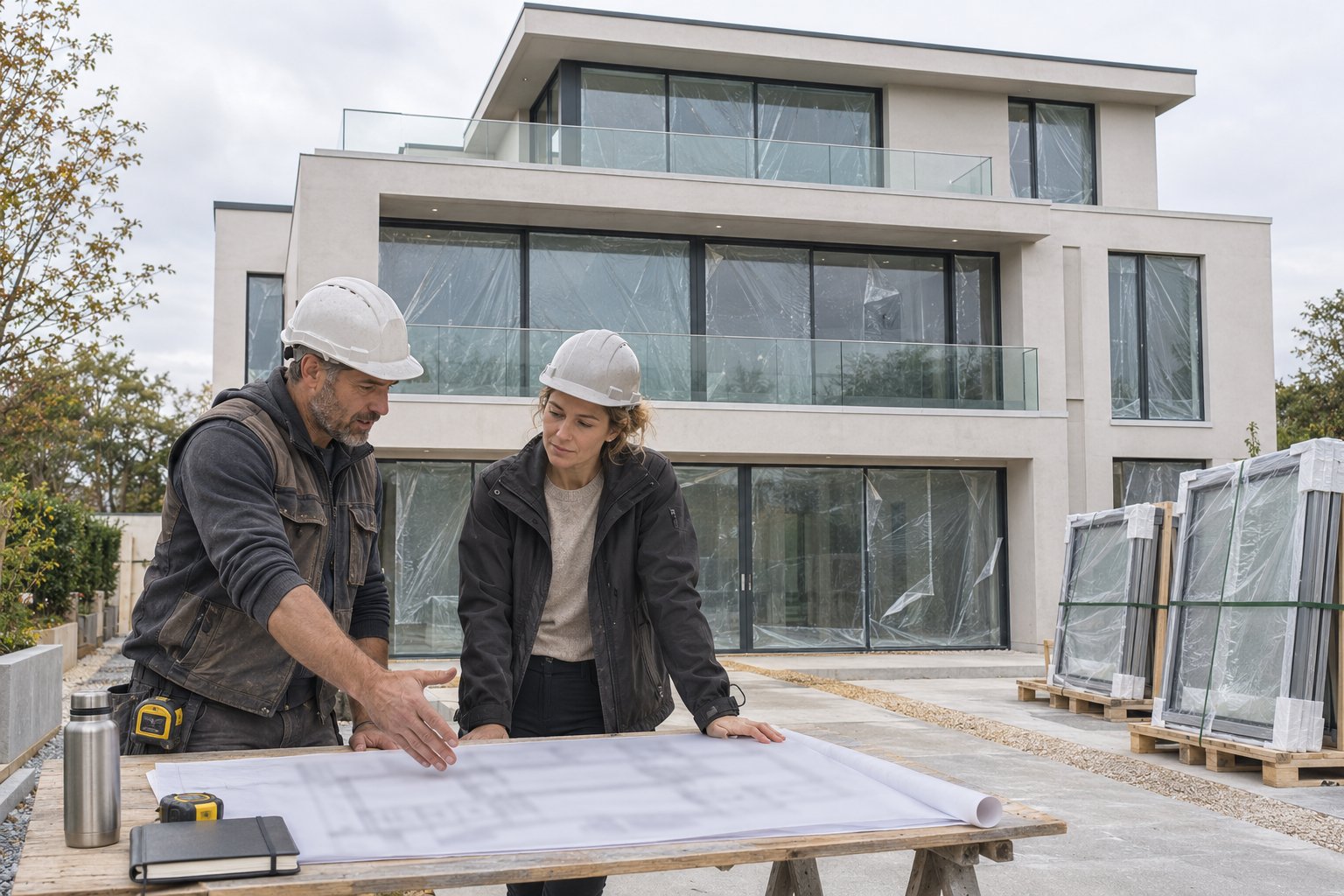
A glass unit fogs up five years after handover. Someone has to fix it, and who that is depends on who made the window, who sold it and who fitted it. These are often three different businesses, and each one carries a different part of the risk.
Manufacturer, Dealer and Installer Roles
The manufacturer designs and builds the window. The dealer sells it and coordinates the order. The installer fits it into the wall. US window company Newman Windows warns that a lifetime guarantee may cover only some parts or exclude labour. It also says warranty claims get harder if the dealer closes or loses its account with the manufacturer.
| Role | What it does | Who owns the warranty | Measurement and installation |
|---|---|---|---|
| Manufacturer | Fabricates, tests, labels and dispatches the windows | Product warranty on the frame, IGU seal, hardware and finish, under its written terms | Usually neither, unless contracted separately |
| Dealer or reseller | Quotes, places orders and acts as the buyer's contact | Passes on the manufacturer's warranty and may add its own service terms | Often measures, and may arrange installation through subcontractors |
| Installer | Removes old units, then fits, flashes and seals the new ones | Workmanship warranty on the installation | Both, including the joint between window and wall |
Can You Buy Windows Direct From the Manufacturer
Often, yes, especially if you're a builder, developer or project team ordering from drawings. Some factories also sell to homeowners. US manufacturer ViewLux notes two benefits of buying direct: you avoid the dealer's markup, and one business answers for any errors. It also points out that buying direct doesn't make the product any better. With no dealer involved, the buyer takes on site measurement, logistics and compliance. In Australia, that means you arrange the installation, any council or certifier requirements, and engineering sign-off, unless you contract someone else to handle them.
What Local Manufacturing Changes for Quality Control and Lead Time
People who search for window suppliers near me usually want shorter freight times, a factory they can visit and faster warranty call-outs. Local window manufacturers can offer those things. Superior Window Manufacturing and Vinyl Kraft both promote their in-house production. A factory being close by doesn't prove anything about quality, though. Wherever the windows are made, ask for AS 2047 labels backed by NATA-accredited test reports, WERS listings for the series you've been quoted, and a written lead time that starts from approval of the shop drawings. Imported units may perform well too, but shipping and customs add weeks. The best window suppliers for your project are the ones that can show this evidence and commit to dates in writing.
Specifying and Sourcing New Units for Your Project
Accurate quotes need complete information. Before you approach suppliers, prepare:
- Drawings and window schedules: a window schedule listing each opening's type, size, glazing, hardware and finish.
- Opening sizes and conditions: structural openings, wall type (brick veneer, weatherboard or rendered), and the condition of any existing frames on replacement jobs.
- Required ratings: WERS Uw and SHGCw targets for your NCC climate zone, the AS 2047 wind classification, BAL or cyclonic requirements, and AS 1288 glass selection.
- Glazing and hardware selections: IGU makeup, spacer type, locks, rollers and flyscreens.
- Supply scope: supply only or supply and install, plus reveals, flashings and accessories.
- Delivery logistics: site access, unloading, staging, and inspecting each unit against the shop drawings on arrival.
- Responsibilities: who handles site measurement, removal and installation, named in writing.
MEICHEN's drawing-based window and door supply services show one way a supply process can be organised around project drawings and schedules for builders, developers, architects and property teams. The service covers drawing review, system recommendations, glazing and hardware coordination, material calculation, fabrication and quality checks for residential and commercial projects. Site measurement, removal, installation and engineering approvals are not automatically included and must be agreed in the proposal, and replacement projects and Brisbane inquiries need the location, opening conditions, supply scope and delivery arrangements confirmed first.
Whichever supplier you choose, approve the shop drawings in writing before production begins. Changes made after approval usually cost extra and push the lead time back to the start.
Window Manufacturing FAQs
1. What are the main stages of window manufacturing?
Window manufacturing follows a set order. First, frame profiles are extruded or milled. Glass is cut, edged and toughened or laminated, and then the panes are sealed around a spacer to form the insulated glass unit. Next, the profiles are cut, machined for drainage and hardware, and joined at the corners. Seals, hardware and glass go in after that. Each unit is then inspected and wrapped for delivery. Not every business does all of this in one factory. Some run their own extrusion and glass lines, while others buy profiles and sealed glass units and only do the fabrication. Ask a supplier which stages it controls itself, because each outsourced part brings its own lead time and its own quality checks.
2. Why does double glazing fog up between the panes?
Fogging inside a double-glazed unit means moisture has got past the edge seal. The desiccant in the spacer can only absorb a limited amount. Once the primary polyisobutylene seal fails, humid air keeps getting in and the fill gas leaks out. Common causes are poorly applied sealant at the factory, water sitting in a glazing pocket that doesn't drain, and years of heat and UV on sunny elevations, which is a real risk in much of Australia. The usual fix is to replace the sealed glass unit, not the whole window. Check whether the seal warranty still applies. When you order new windows, ask whether the glass units are tested to AS/NZS 4666 and whether the factory checks seal adhesion during production.
3. Which window ratings matter in Australia?
Two ratings matter most. WERS reports the whole-window Uw (heat loss) and SHGCw (solar heat gain), and these values feed into NatHERS and NCC energy compliance. AS 2047 covers wind pressure, water penetration and air infiltration, and every compliant window should carry an AS 2047 label. The glass must also meet AS 1288. On bushfire-prone sites, the frames and glazing need to suit the site's BAL rating under AS 3959, and homes in cyclonic regions C and D need ratings for the site's wind class. Imported windows may come with NFRC, ENERGY STAR or Florida approvals. Those show how the product performed in overseas tests, but your certifier will still expect Australian evidence. The right priority depends on your NCC climate zone: a low Uw for cold southern areas and a low SHGCw for the tropical north.
4. How do I find out who made my existing windows?
Start with the frame. Australian windows usually have an AS 2047 label near the top of the frame or inside the sliding track, and it names the fabricator and the window series. If there's no label, look at the spacer bar between the panes for a printed name or date code. Check one corner of the glass for the permanent safety glass mark, and look for brand stamps on the locks, handles and rollers. These marks may point to different companies. The glass processor, the hardware supplier and the window fabricator are often separate businesses, and parts may have been replaced over the years. Windows with no marks at all were often built by a small local fabricator. Finding the maker is worth the effort, because some warranties pass to later owners.
5. Can I buy windows direct from a manufacturer in Australia?
Usually, yes. This is most common for builders, developers, architects and property teams ordering from drawings, and some factories also sell to homeowners. Buying direct can cut out the dealer's margin and gives you one contact for product faults. It also hands you the work a dealer would do: site measurement, delivery handling, installation, certifier requirements and engineering sign-off, unless you contract someone else for them. You'll get an accurate quote if you supply a complete window schedule with sizes, required ratings, glazing and hardware. As one example, MEICHEN's drawing-based supply services cover drawing review, system recommendations, glazing and hardware coordination, fabrication and quality checks. Measurement, removal, installation and approvals have to be agreed separately in the proposal. For Brisbane or replacement jobs, confirm the location, opening conditions, supply scope and delivery arrangements before you commit.