
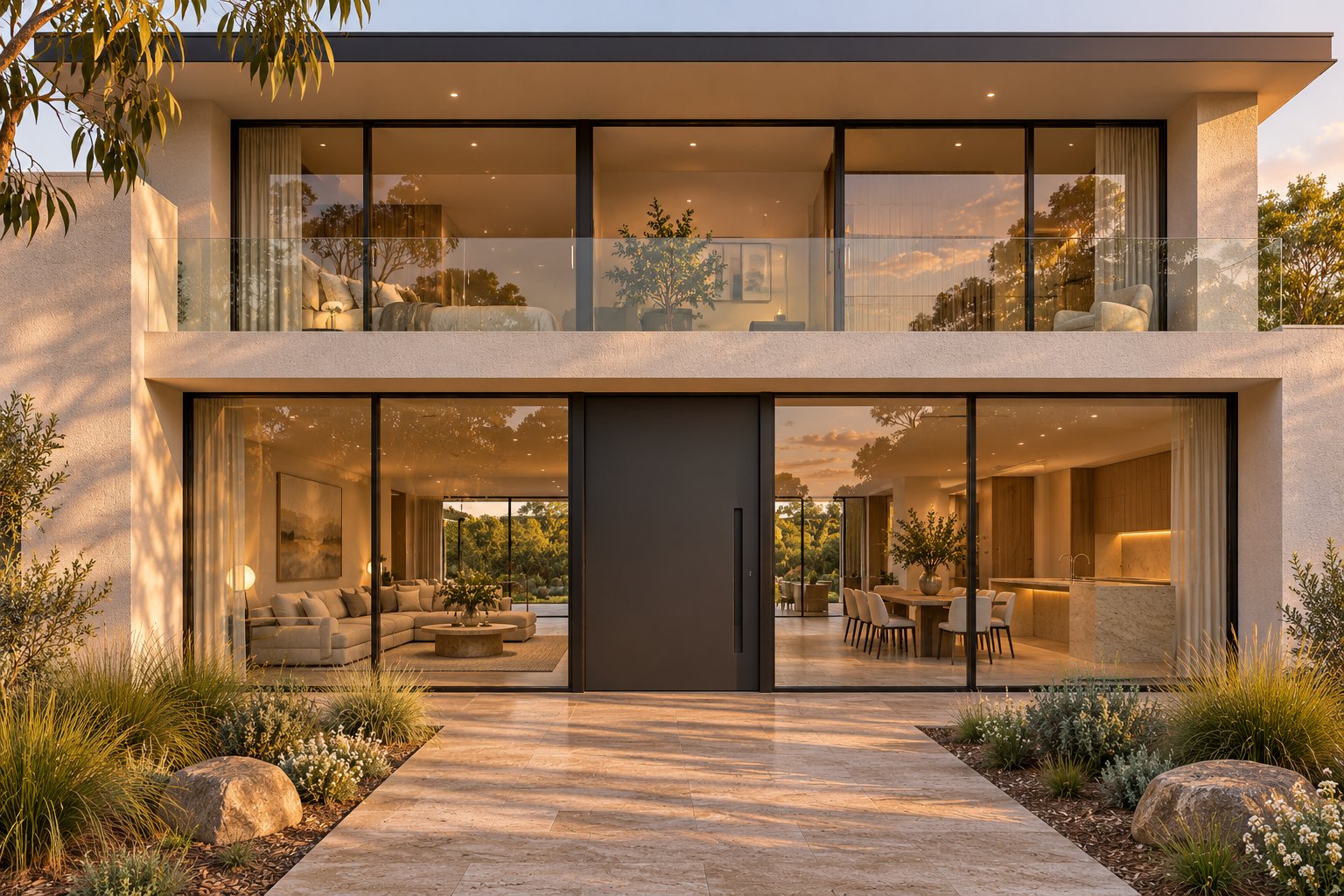
What Solid Aluminium Exterior Doors Actually Are
Search for an aluminium front door and you will see glass sliders, security screens and timber doors with a metal skin, all sold under much the same label. Only some of them are solid aluminium. The difference changes the door's weight, strength, insulation and price, so it helps to know what you are looking at before you compare quotes.
Defining Solid Aluminium in the Door Industry
A solid aluminium exterior door is an entry door whose panel is built from aluminium sheet or plate. The aluminium either runs through the full profile or forms both faces over an insulating core. The aluminium is the door's structure. It is not a frame around glass or a weather skin over another material.
That definition rules out three products often sold under similar names. Aluminium-framed glazed doors have aluminium frames, but the panels are glass. Aluminium storm and screen doors are lightweight secondary doors fitted outside the main door. Aluminium-clad doors use aluminium door cladding to protect a timber or fibreglass core. One overseas manufacturer describes its clad range as a timber and insulation sandwich finished with aluminium sheet on the outside face. An aluminium box bar door belongs to another group again. It is made from hollow rectangular sections, much like the extrusions used for interior aluminium doors and shopfronts.
So "solid" describes what the panel is made of. Most people searching the term want a metal entry door that will not rot, swell or warp, and that does not have the glass-heavy look of a slider.
Who Needs a Solid Aluminium Exterior Door
- Homeowners who are replacing a weathered timber entry door, often in coastal suburbs where salt air wears down wood and steel, and who want a low-maintenance door for front entries.
- Architects who specify flush, minimalist entries for contemporary new builds and need to confirm the door's thermal performance against the NCC energy efficiency provisions.
- Builders and contractors who compare aluminium with steel, fibreglass and timber on cost, lead time and how easily each door installs into brick veneer or lightweight framed walls.
How This Guide Is Structured
The guide begins with how these doors are built, layer by layer, and then separates solid, hollow and clad construction. Next come comparisons with other door materials, security performance and climate suitability, including aluminium's habit of conducting heat. The final sections cover where aluminium is the wrong choice, how its cost compares with other front door prices, and how to check quality before you buy. You can skip to the section that matters most for your project. If you are starting from scratch, read the construction details first, because every later section depends on knowing what sits inside the panel.
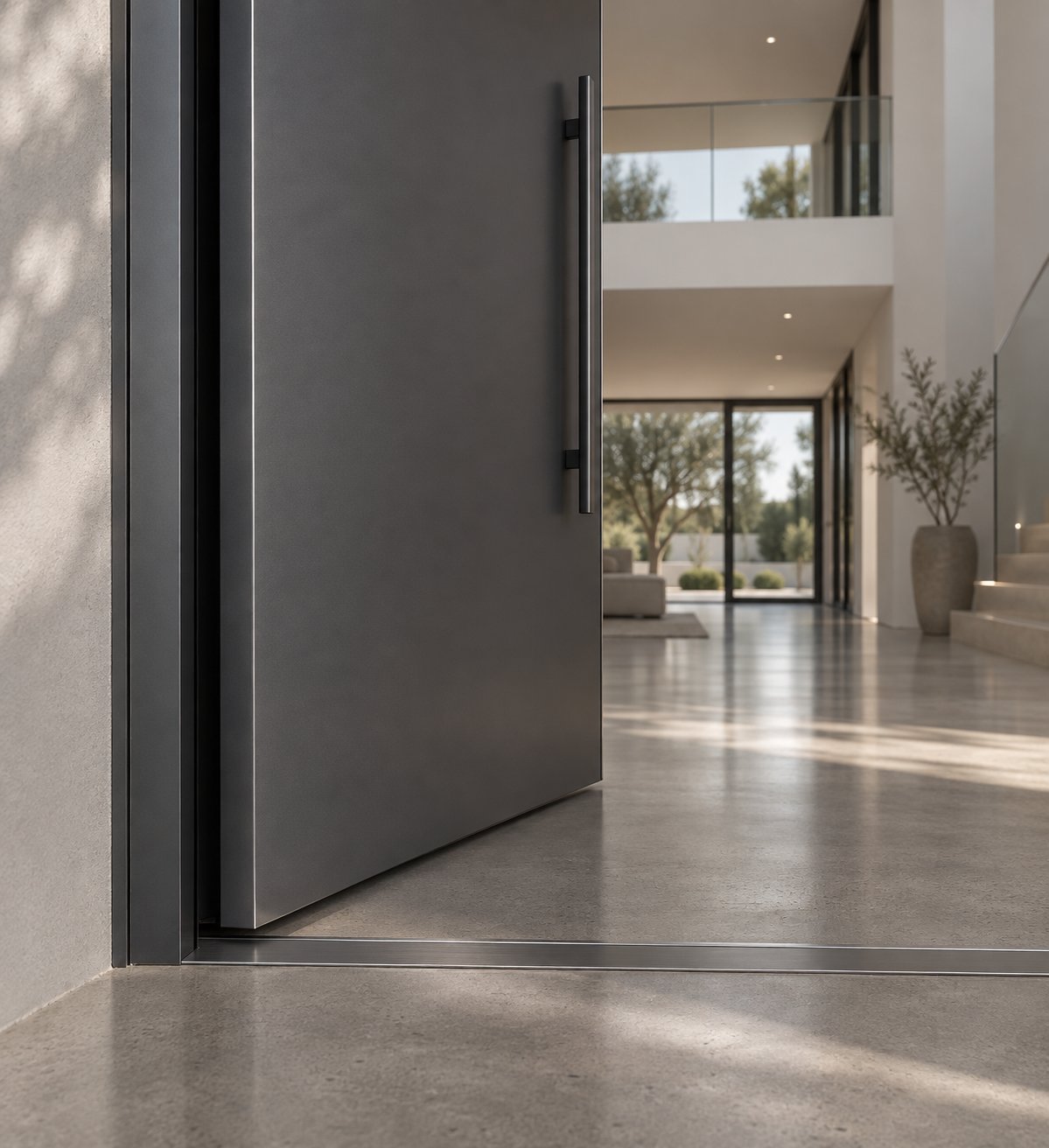
Anatomy of a Solid Aluminium Door From Frame to Threshold
Most product pages show the outside face of the door and a colour chart. The parts that decide how the door performs sit behind that face. Here they are in order, from the street side to the hallway.
Panel Construction and Core Options
The exterior face sheet takes the sun, rain and knocks, so its thickness and finish matter most. A matching interior face sheet closes the panel on the inside. The core sits between the two sheets and comes in three main forms:
- Foam-injected core: Polyurethane foam is injected between the sheets and bonds to them as it sets. Of the three cores, it usually insulates best and keeps the weight moderate, which is why many affordable front doors use it. The panel stays rigid only while that bond holds.
- Aluminium honeycomb core: A grid of hexagonal cells spreads loads across the panel and resists warping. One US core maker says the cells are more than 90% empty space, which makes honeycomb over 90% less dense than plywood or fibreboard of the same thickness and strength. How well it insulates depends on the face sheets and any fill, so ask the supplier for thermal data.
- Solid aluminium plate: The panel is metal all the way through. It is the most rigid and heaviest option and the poorest insulator, because aluminium conducts heat easily. It suits high-security and commercial openings better than most homes.
Residential panels usually measure about 44 mm to 57 mm (1.75 to 2.25 inches) thick. A thicker panel leaves more room for insulation and for multi-point lock bodies.
Frame, Jamb, and Threshold Assembly
The frame is an extruded aluminium profile made of a head, two side jambs and a sill. Installers fix it into the rough opening with screws or brackets and use packers to keep it square and plumb. They then seal the gap between the frame and the wall. If the frame is out of square, even good seals will leak.
The adjustable threshold can be raised or lowered until it meets the door's bottom seal, which keeps out draughts and wind-driven rain. Under the threshold, a sill pan (also called a sill tray) catches any water that gets past and drains it outside, away from the floor and wall framing. A sill pan is easy to leave out, so check that quotes for cheap exterior doors include one.
Weatherstripping and Thermal Break Layers
Weatherstripping fits into channels in the frame or along the door edge. Aluminium doors typically use one or more of these seal types:
- Compression seals: bulb or tubular profiles that squash flat when the door closes.
- Magnetic seals: strips that pull the seal tight against the door. Aluminium is not magnetic, so these work only on doors designed with a compatible steel insert.
- Fin-type seals: pile or rubber strips with a flexible fin that wipes against the moving panel. They are common on sliding alu doors.
A seal should touch the door along its full length without you having to slam the door. As one door hardware guide notes, no weatherstrip will fix a loose hinge or a distorted frame.
The thermal break is a strip of polyamide or polyurethane that separates the outer aluminium from the inner aluminium, so heat has no continuous metal path through the door. It matters most in cooler climates, and the climate section later in this guide covers it in detail.
Use this checklist when you read a specification sheet:
- Exterior face sheet and finish
- Core type: foam, honeycomb or solid plate
- Interior face sheet
- Frame, head and jambs
- Weatherstripping channels and seal type
- Adjustable threshold
- Sill pan or sill tray
- Thermal break
Steel and fibreglass entry exterior doors have most of these parts too. What makes a door solid aluminium is the panel, and product listings are often vague about the panel.
Solid Panel vs Hollow Core vs Aluminium-Clad Construction
Put three doors side by side in a showroom, all finished in the same matt black powder coat, and they can look identical. Open and close each one and you notice the difference straight away. One feels heavy and shuts with a dull, solid sound. Another feels light and rattles slightly. The third feels like timber. Choosing aluminium for door construction tells you little until you know which of these three methods the manufacturer used.
What Makes a Door Truly Solid Aluminium
The panel decides the category. The frame does not. A solid-panel aluminium door is either aluminium through its full profile or has substantial aluminium face sheets bonded over an insulated core, as described in the previous section. The metal carries the load and takes the knocks.
An aluminium glass door is a different product. Its aluminium rails and stiles hold the glass and give the hinges, closers and locks something to mount to, as one commercial entrance specialist explains. Glass makes up most of the door. This matters when you read listings, because a product titled "aluminium front door" could be a glazed hinged door, a clad timber door or a true solid panel.
Hollow-Core and Extruded Aluminium Doors
Hollow doors are built from extruded aluminium sections with air or light infill inside. They are light, inexpensive to make and easy to hang. That suits interior partitions, commercial screen doors and lightweight patio screens. As a main entry door, a hollow door falls short. The thin extrusion walls dent more easily, can flex when someone levers at the lock side, and insulate poorly unless the profile includes a thermal break. Many hollow sections also leave little room for a multi-point lock body.
Aluminium-Clad Doors and Why They Differ
Cladding covers the outside face of a timber, fibreglass or steel door with aluminium sheet or trim. The cladding shields the core from rain and UV, but the door underneath is still timber, fibreglass or steel.
Pros
- Usually lighter than a solid-plate panel
- Keeps a timber look and feel on the inside
- Low-maintenance exterior face
Cons
- Aluminium and the core expand and contract at different rates, so the bond can loosen and delaminate over decades
- Water that gets past failed seals can sit against the core where nobody sees it
- Performance depends on the core, so you need to check the specifications for both the cladding and the core
| Criteria | Solid-panel aluminium | Hollow-core extruded aluminium | Aluminium-clad |
|---|---|---|---|
| Weight | Moderate to heavy (solid plate is heaviest) | Light | Light to moderate, depending on core |
| Strength and dent resistance | High | Low to moderate | Moderate, depending on core |
| Insulation | Good with a foam core and thermal break; poor as solid plate | Poor without a thermal break | Good with a timber or foam core |
| Maintenance | Very low | Low | Low outside; a timber interior still needs refinishing |
| Price positioning | Premium | Budget to mid-range | Mid-range to premium |
| Typical use | Main entries, coastal homes, contemporary builds | Interior partitions, screens, commercial framing | Entries that need weather protection with a traditional interior look |
Construction type tells you what you are buying. It does not tell you whether aluminium is the right material for your entry. A genuine solid-panel aluminium door still has to compete with steel, fibreglass and timber, and each of those materials beats it on at least one count.
How Solid Aluminium Stacks Up Against Steel, Fibreglass and Timber
No door material wins on every count. Steel costs less, fibreglass insulates better and timber looks warmer. Solid aluminium resists corrosion, stays rigid and has a clean modern look. Those strengths count for more on some homes than on others. The comparisons below apply the same criteria to each material, so you can weigh them against your own house door, climate and budget.
Solid Aluminium vs Steel Exterior Doors
Steel is usually the cheapest of the main options. Consumer Reports calls steel doors the most budget-friendly way to get security and insulation. Steel is also the harder metal, so a steel skin resists denting better than an aluminium sheet of the same thickness. Budget steel doors use thin skins, though, and those dents are hard to repair. Once a dent or scratch breaks the paint, the exposed steel can rust. Salt air in beachside suburbs from the Gold Coast to Perth speeds this up, and one coastal door retailer describes steel as "less forgiving in high-moisture conditions."
Aluminium is lighter and does not rust. It forms a thin protective oxide layer, and a quality powder coat or anodised finish adds more protection. Both metals make strong entry doors when they are paired with a good lock and a well-anchored frame.
Solid Aluminium vs Fibreglass Exterior Doors
Fibreglass is the material to beat on insulation. Boise Cascade rates its energy efficiency as excellent, ahead of both steel and timber. Embossed fibreglass skins can also copy timber grain closely. Fibreglass doors are usually lighter than solid aluminium panels and sit in the mid-range on price. Their weak point is impact. Consumer Reports notes that fibreglass can crack under a hard blow, especially in extreme cold.
Aluminium is more rigid. Under a hard impact it dents instead of cracking, and it suits flush, minimalist designs that fibreglass rarely imitates well. To get close to fibreglass on insulation, an aluminium door needs a foam core and a thermal break, so check the specification for both.
Solid Aluminium vs Timber and Clad Timber Exterior Doors
Timber suits Federation homes, Queenslanders and other character houses better than metal does. It can be stained, painted or detailed with intricate panels, and you can sand out scratches. It is also usually the most expensive material and the one that needs the most upkeep. Timber needs regular painting or varnishing, and without that it can swell, warp or crack in humid or sunny conditions. Solid timber panels are heavy as well, which puts extra load on the hinges.
Clad timber doors put aluminium on the weather side and keep timber on the inside. As the previous section explained, the joint between the two materials is where delamination can start. Some builders combine materials differently, fitting exterior aluminium door frames around a timber or fibreglass panel. Compared with any of these, a solid aluminium door needs little more than a wash and a check of the seals now and then.
| Criteria | Solid aluminium | Steel | Fibreglass | Timber | Clad timber |
|---|---|---|---|---|---|
| Durability and dent resistance | Rigid; dents under hard impact but does not crack | Strong; thin skins dent and are hard to repair | Good dent resistance; can crack under heavy impact | Resists dents; scratches sand out | Good on the outside; the core is still timber |
| Weight | Moderate to heavy (solid plate is heaviest) | Moderate to heavy | Light to moderate | Heavy | Moderate to heavy |
| Thermal efficiency | Good with a foam core and thermal break; poor without | Good with an insulated core | Excellent | Good | Good |
| Maintenance | Very low | Low to moderate; touch up scratches to stop rust | Low | High; regular paint or varnish | Low outside; the timber interior needs refinishing |
| Weather and coastal resistance | Excellent; will not rust or rot, but finish quality matters | Fair; rusts where the coating is damaged | Very good; resists warping, rot and rust | Poor to fair; swells and warps with moisture and sun | Good, with risk at failed seals and delamination points |
| Aesthetic range | Modern and flush; wide powder-coat colour range | Moderate; mostly painted finishes | Wide; smooth or timber-grain, paint or stain | Widest; species, stains, custom panels | Modern or traditional outside, timber inside |
| Security contribution of the panel | Strong | Strong | Good | Good when solid | Depends on the core |
| Cost positioning | Premium | Budget | Mid-range (premium for high-end ranges) | Premium, often the highest | Premium |
| Best fit | Coastal and contemporary homes | Tight budgets, sheltered sites | Most climates where a timber look is wanted with low upkeep | Character homes with owners willing to maintain them | Weather protection outside, timber feel inside |
Treat the table as a starting point, because individual products vary. A thin-skin steel door and a heavy-gauge one perform very differently, and the same is true of aluminium doors. Ask aluminium door manufacturers for the panel thickness, core type and thermal data instead of relying on the material name. The table also covers solid panels only. Aluminium framed doors with large areas of glass perform differently on both insulation and security.
Security is the row to read most carefully. In Consumer Reports' battering-ram tests, fibreglass, steel and timber front entrance doors all failed in the same place: the jamb split near the lock's strike plate. A solid aluminium panel is therefore only as secure as the frame, lock and fixings that hold it in the wall.
Security Performance and Break-In Resistance Explained
Burglars rarely try to break through the door panel. They kick near the lock or lever at the gap between the door and the jamb, then wait for something to give. The panel material matters, but it is only one of the parts under attack.
How Solid Aluminium Resists Forced Entry
A solid aluminium panel handles that kind of attack well. Nobody can kick through it the way they can with a hollow-core door. A heavy blow will dent it, but it won't crack the way fibreglass can. It also keeps its shape under a pry bar better than timber, which can split along the grain. A thick panel leaves room inside the door edge for a multi-point lock body, and many hollow sections don't.
The panel is rarely what fails, though. In many break-ins the frame gives way first and splits or bends around the strike plate, as Shield Security Doors points out. Hinges, locks and strike plates are the usual weak points. The Prepared suggests replacing the short screws that hold these parts with screws about 75 mm long, so they reach through the jamb into the wall framing. When you compare quotes, judge the aluminium door and frame as one system. A strong panel in a flimsy frame with a single deadbolt can still be forced open.
Lock Grades and Security Hardware to Look For
With a single deadbolt, the whole force of a kick lands on one bolt and one strike plate. A multi-point lock throws bolts into the frame at several points at once, which spreads the load. If one bolt fails, the others still hold the door shut. Three-point and five-point systems are the most common.
Australian mechanical locksets are tested to AS 4145.2. Many imported locks and smart locks quote US ratings instead, and those ratings are often misread. ANSI Grades 1 to 3 are commercial grades. Residential locks certified by the Builders Hardware Manufacturers Association (BHMA) get letter grades for security, durability and finish, where A is best and C is lowest. An ANSI Grade 1 deadbolt must survive 250,000 open and close cycles and 10 hammer blows of about 100 joules each, PCWorld reports. Look for the word "certified". A lock that only "meets standards" has been tested by its own maker. You can check certification claims in the BHMA Certified Products Directory.
Check the hardware separately from the door. Locks made for patio aluminium doors or aluminium internal doors are often lighter-duty and are not meant for a main entry.
- Multi-point lock compatibility: the panel and frame are made to take a three-point or five-point lock, and keeps for the bolts are fitted into the frame.
- Hinge reinforcement: heavy-duty hinges with long fixings, plus security pins or hinge bolts so the door can't be lifted out of the frame. These matter most on outward-opening doors, where the hinge pins face the street.
- Strike plate quality: a long, heavy-gauge strike fixed with long screws, instead of a small plate held by short ones.
- Frame anchoring method: how the frame is fixed into brick veneer, double brick or timber framing, and how far apart the fixings are.
- Glazing: on an aluminium door with window panels or a sidelite, laminated safety glass, which stays in place when it breaks.
Every item on this list relies on the door staying straight in its frame, with the bolts lining up with their keeps year after year. How well an aluminium door does that depends a lot on the climate it lives in.
Climate Suitability and Thermal Break Technology Demystified
A timber door that closes easily in a dry Brisbane winter can stick by February, once the summer humidity has swollen the wood. Aluminium does not absorb moisture, so humidity does not change its size, and the gaps around the door stay even. That stability makes solid aluminium a strong choice in some climates. In others, it only performs well if the door has one specific feature.
Where Solid Aluminium Excels: Coastal, Humid and Hot Climates
Aluminium does not rot, rust or swell, and termites leave it alone. Those properties suit beachfront homes on the Gold Coast or the Perth coast, humid tropical towns such as Cairns and Darwin, and inland areas where strong UV dries out timber finishes and fades cheaper fibreglass skins.
The finish still matters. Salt air attacks a coating where it is thinnest or broken, such as cut edges, screw holes and panel joints, and glare off the water adds to the UV load, as one facade finishes specialist explains. The two common finishes behave differently:
- Powder coat: a sealed layer over the metal, available in a wide colour range. You can touch up chips, though the colour rarely matches perfectly.
- Anodising: turns the metal surface into aluminium oxide, so it cannot peel. The oxide is porous, though, and if it is poorly sealed, salt can pit the metal underneath. Damage cannot be repaired on site.
For a coastal home, ask whether the powder coat complies with AS 3715 or the anodising with AS 1231. Also check how close to breaking surf the finish warranty applies. Most coastal warranties require regular washing to remove salt build-up.
Cold Climate Considerations and Thermal Bridges
Aluminium's main weakness is that it carries heat very easily. Figures from the American Wood Council put its thermal conductivity at roughly 1,500 to 2,000 times that of structural softwood. A door with unbroken metal from the outside face to the inside face acts as a thermal bridge. In a Canberra or Hobart winter, heat escapes through it, and the inside face can get cold enough for condensation to form. Over time, water running down to the threshold can damage flooring and encourage mould. In summer the heat flows the other way, so a dark door in full western sun warms the hallway behind it.
How Thermal Breaks Work and Why They Matter
A thermal break is a strip of insulating material, usually glass-reinforced polyamide, set into the aluminium profile so the outer and inner metal never touch. Heat has to pass through the insulator instead of running straight through the metal. That keeps the inside face closer to room temperature and much less likely to collect condensation.
Published test data shows the size of the gain. In US figures from a metal window maker, a double-glazed steel casement window had a U-value of about 2.6 W/m²K without a thermal break and about 1.9 W/m²K with one. Its condensation resistance rating more than doubled. A lower U-value means less heat loss. These numbers come from a window, not a solid door, so ask the supplier for a tested U-value for the complete door, or a WERS rating if the door is glazed.
In cooler climates such as Melbourne, the ACT and Tasmania, check that both the frame and the panel are thermally broken. The same applies to glazed openings, including exterior aluminium French doors and an aluminium patio door, where the frame surrounds a large area of glass. An aluminium-clad door gets around the problem because its timber core already slows heat flow, but it brings the bonding risks covered earlier. Many listings for aluminium exterior doors never say whether the profile is thermally broken. If the supplier confirms it is not, a home in a cold climate may be better served by another material.
When Solid Aluminium Is Not the Best Fit
Many product pages describe aluminium as the right choice for every home. In the situations below, a different material will usually do the job better, or do it for less money.
Budget-Constrained Projects Where Steel Wins
Solid aluminium sits in the premium price tier. If your budget is tight and the house is well away from salt air, an insulated steel door gives you a strong panel and reasonable durability for less. Steel is most at risk where its coating gets damaged on a coastal or very humid site. On a sheltered inland block in western Sydney or Toowoomba, that risk is low. The money you save can go into a better lock and longer frame fixings, which do more for security than the panel material.
Traditional Homes Where Timber or Fibreglass Fits Better
A flush aluminium panel looks modern. On a Federation brick home, a Victorian terrace, a Californian bungalow or a Queenslander, it can look out of place. One joinery maker says a good entry door "repeats what your house is already saying." On these facades, a timber door or a fibreglass door with a timber-grain finish usually suits the house better. If your home sits under a heritage overlay, check with your council before you order, because changes to the street-facing facade may need approval.
Extreme Cold Without Thermal Breaks
NCC climate zones 7 and 8 include Canberra, Hobart and the alpine areas. In these zones, an aluminium door without a thermal break loses more heat and collects more condensation than an insulated fibreglass or steel door. You cannot add a thermal break after the door is made. It has to be built into the extrusion during manufacture, so the only fix is a new frame. The same applies to aluminium doors and frames around large glazed openings. If a listing doesn't mention a thermal break, assume the door doesn't have one and compare other materials.
Aluminium can still work elsewhere on the same project. A Queenslander might get a timber front door and an aluminium glass door opening onto the back deck. A shop might use commercial aluminium entrance doors at the street and steel at the loading dock. Choose each door to suit the climate, the style of the building, your budget and how the door will be used. If solid aluminium does suit your entry, the next thing to work out is whether its higher price pays off over the life of the door.
Solid Aluminium Door Costs, Maintenance and Long-Term Value
Two quotes for what looks like the same black aluminium entry door can be thousands of dollars apart, and often both are fair. The difference comes from parts you can't see in a product photo. Over the following decades, it also comes from what the door costs to keep.
What Drives the Price of a Solid Aluminium Exterior Door
Solid aluminium sits in the premium tier with high-end fibreglass and custom timber. It generally costs more than steel. One overseas manufacturer's cost breakdown puts installed aluminium entry doors at three price levels:
- About US$800 to US$1,500 for a basic door without a thermal break, roughly AUD $1,200 to $2,300.
- US$1,500 to US$4,000 for a thermally broken door with a multi-point lock, roughly $2,300 to $6,200.
- US$4,000 to US$10,000 or more for oversized pivot doors, roughly $6,200 to $15,500 or more.
Use these figures only as a rough guide. They come from the US market and include glazed doors as well as solid-panel doors. Supply-and-install prices in Australia are usually higher because local labour, freight and compliance cost more. The same source names the factors that move a door from one price level to the next:
- Panel and profile: A flat panel costs the least to make. Machined reveals or inlays add 15 to 30%. Heavier profiles with 2.0 mm walls add 10 to 20% compared with standard 1.4 to 1.8 mm walls. Honeycomb and solid-plate cores cost more than foam.
- Thermal break: A thermally broken profile costs 40 to 60% more than one without a break. In cooler climate zones, you need it anyway.
- Finish: Standard powder coat is usually included in the price. Custom colours, timber-look finishes, PVDF coatings and anodising all cost extra.
- Hardware: A multi-point lock costs more than a basic latch. A smart lock adds more again.
- Size: A custom size adds 20 to 40% to the price of the nearest standard size.
- Configuration: Double doors, sidelites, transoms and a matching screen door with aluminium frame each add materials, hardware and installation time.
Installation can change the total as much as the door does. Fixing into double brick or concrete, or altering the opening, adds labour. For that reason, ask for a quote based on a site visit instead of one given over the phone.
Long-Term Maintenance and Care Requirements
Exterior aluminium doors never need sanding or refinishing on a schedule, but they still need some care. One manufacturer's maintenance guide suggests a simple routine:
- Every three months: Wash the panel and frame with a soft cloth, mild soap and water. Clear the weep holes at the base of the aluminium entry door frame so water can drain. Near the coast, wash more often to remove salt.
- Every six months: Lubricate the hinges and lock with a silicone-based product. Avoid oil, because it attracts dirt. Check the weatherstripping and threshold seals, and replace any that are cracked, hard or loose.
- Once a year: Tighten the screws on the handles and hinges, taking care not to strip the threads. Test the lock from both sides. Touch up chips in the finish, particularly at edges where bare metal shows.
Never use steel wool, abrasive pads or acidic cleaners on aluminium door frames and panels, because they strip the coating. Don't aim a pressure washer at the seals, either. The water can be forced past them into the frame.
Expected Lifespan and Total Cost of Ownership
Few suppliers publish lifespan figures for solid aluminium panels, so related figures are the best guide. One US door supplier estimates that fibreglass doors last 25 to 30 years and aluminium clad doors last more than 30. A solid aluminium panel doesn't rot or rust. In practice, the finish, seals and hardware wear out first, and you can replace all three without replacing the door.
Timber is where the long-term savings show most clearly. The same supplier says many timber door makers recommend a new topcoat every 6 to 12 months in humid conditions. Over 30 years, that comes to dozens of recoats, plus any repairs once rot sets in. An aluminium door with a good finish needs little more than cleaning, so on exposed coastal sites the higher purchase price can pay itself back.
| Material | Routine care | Periodic checks | Bigger jobs |
|---|---|---|---|
| Solid aluminium | Wash every three months, more often near the coast | Lubricate hardware and inspect seals every six months | Touch up chips; no scheduled refinishing |
| Steel | Wash regularly | Inspect the coating for scratches and check the seals | Touch up damage quickly to stop rust; repaint when the finish wears |
| Timber | Wash regularly | Check for swelling, cracks and soft spots | Recoat every 6 to 12 months on exposed, humid sites; sand and refinish when the finish fails |
| Fibreglass | Occasional cleaning | Check the hardware | Repaint or restain timber-look skins when they fade |
These lifespans assume the door matches its listing. A weak thermal break, thin face sheets or a finish without a proper warranty can cut decades off a door's life, and the price alone won't show any of them.

How to Evaluate Door Quality and Explore Aluminium Door Options
A product page can show an attractive door and still leave out everything that decides whether the door lasts. The checks below help you compare quotes on what the doors are actually made of. They work the same way whether you are replacing one front door or scheduling twenty for a townhouse development.
Specifications and Questions That Reveal Quality
Ask for these details in writing before you compare prices:
- Panel thickness and core type: the overall panel thickness in millimetres, the face sheet thickness, and whether the core is foam, honeycomb or solid plate.
- Thermal break: whether both the frame and the panel are thermally broken, what the break is made of, and a tested U-value for the complete door.
- Lock compatibility: which multi-point lock the door is built to take, and whether that lock is tested to AS 4145.2 or certified by BHMA.
- Finish warranty: how many years it runs, whether it covers coastal sites, and whether the powder coat or anodising complies with AS 3715 or AS 1231.
- Air and water infiltration ratings: test results showing how much air and water get past the door when it is closed.
- Structural load testing: the wind pressure the door and frame are rated for. This matters most on exposed sites and in the cyclone regions of northern Queensland, WA and the NT.
Glazed doors usually come with much of this information already documented. AS 2047 covers windows and external glazed doors. A compliant product carries a performance label, normally on the inside of the frame or head, that shows its wind and water ratings in pascals. DLG Aluminium and Glazing also recommends asking for a certificate of compliance. It notes that members of the Australian Glass & Window Association have their products tested in NATA-accredited labs. A solid-panel door with no glass may not be covered by AS 2047 at all, so ask the supplier which tests the door has passed and request copies of the reports.
Red Flags to Watch for When Comparing Products
Be cautious when a listing describes the door only as "premium aluminium construction" and gives no thicknesses, core type or test data. Other warning signs are a missing specification sheet, no finish warranty, and stock photos with no cross-section view. Suppliers who have tested a product can usually send the paperwork the same day.
Check the product labels carefully too. Some listings describe an aluminium door with glass panels, or a timber door with aluminium cladding, as "solid aluminium". Both are legitimate products. As the earlier sections showed, though, each differs from a solid panel in weight, insulation and security. If a description is unclear, ask for a cross-section diagram or a material data sheet. A drawing of the panel edge shows whether the door is solid plate, a foam core between two aluminium sheets, or timber under a metal skin.
Exploring Glazed Aluminium Door Systems as an Alternative
Some projects need glass more than a solid panel. Patio access, wide bi-fold openings and shopfront entrances call for natural light and slim frames, and solid aluminium entry doors can't provide either.
If your project is one of these, MEICHEN's aluminium door collection includes sliding, stacking, hinged, bi-fold and commercial glazed systems. Each comes in thermally broken or non-thermally broken versions. The range is made up of custom aluminium doors, with panel layouts, glass, powder-coat frame colours, hardware and threshold details specified for each project. Glass options include laminated, Low-E and double glazing. These are aluminium-framed glazed doors, not solid aluminium panel doors. If your project needs a solid panel, confirm availability and specifications directly with each supplier you contact, including MEICHEN. In cooler climate zones, choose one of the thermally broken systems.
The checklist above applies to glazed systems as well. MEICHEN's own page says performance values vary by system and should be confirmed against datasheets and test reports. Whether you choose glass or a solid panel, get those documents for the aluminium door and frame together before you pay a deposit.
Common Questions About Solid Aluminium Exterior Doors
1. Are solid aluminium exterior doors worth the higher price?
The answer depends mostly on where the door will go. Solid aluminium is a premium material. It costs more than steel and sits in the same tier as high-end fibreglass and custom timber. US manufacturer figures convert to about AUD $1,200 to $2,300 installed for a basic door without a thermal break. A thermally broken door with a multi-point lock comes to about $2,300 to $6,200, and an oversized pivot design to about $6,200 to $15,500 or more. Australian supply-and-install quotes usually come in higher because local labour, freight and compliance cost more. The higher price is recovered through lower upkeep. On an exposed, humid site, a timber door can need a new topcoat every 6 to 12 months. An aluminium door with a good finish mostly needs washing, seal checks and the occasional touch-up. On coastal or sun-exposed entries, those savings build up over decades. On a sheltered inland block with a tight budget, an insulated steel door with better locks and longer frame fixings is often the better use of the money.
2. Do solid aluminium doors need a thermal break in Australia?
They do in the cooler parts of the country. Aluminium conducts heat roughly 1,500 to 2,000 times faster than structural softwood. A door with unbroken metal from the outside face to the inside face loses warmth in winter, and condensation can form on its inside face in Canberra, Hobart, Melbourne and the alpine regions. NCC climate zones 7 and 8 are the most demanding. A thermal break is a strip of insulating material, usually glass-reinforced polyamide, set inside the profile to keep the outer and inner aluminium apart. It has to go in during manufacture and cannot be added later. Check that both the panel and the frame are thermally broken. Ask for a tested U-value for the complete door, or a WERS rating if the door includes glass. If a listing doesn't mention a thermal break, assume the door doesn't have one. In tropical areas such as Cairns and Darwin, a thermal break matters less for winter heat loss. It still reduces the heat that a dark door in strong sun passes into the house.
3. How secure is a solid aluminium front door?
A solid aluminium panel holds up well against attack. It can't be kicked through, it dents instead of cracking, and it keeps its shape under a pry bar better than timber does. In most forced entries, though, the frame around the strike plate gives way first, so treat the door, frame and hardware as one system. Look for a three-point or five-point lock, which spreads the force of a kick across several bolts. The lock should be tested to AS 4145.2 or carry genuine BHMA certification. A lock that only claims to meet a standard has been tested by its own maker. Ask for a long, heavy-gauge strike plate, and screws about 75 mm long that reach through the jamb into the wall framing. Fit hinge bolts or security pins, especially on outward-opening doors. Use laminated glass in any sidelite or vision panel. Finally, check that the frame fixings suit your wall type, whether brick veneer, double brick or timber frame.
4. How do I look after a solid aluminium door near the coast?
Coastal care starts with the finish. Ask whether the powder coat complies with AS 3715 or the anodising with AS 1231. Also check how close to breaking surf the warranty still applies and what washing the warranty requires. After installation, follow a simple routine. Wash the panel and frame with mild soap, water and a soft cloth every three months, and more often if you live close to the surf. Clear the weep holes at the base of the frame so water can drain. Every six months, lubricate the hinges and lock with a silicone-based product rather than oil, which attracts grit. At the same time, check that the seals are still soft and sit flush against the door. Once a year, tighten the handle and hinge screws and touch up chips, particularly at edges where bare metal shows. Never use steel wool, abrasive pads or acidic cleaners, and keep pressure washers away from the seals. Chips in powder coat can be touched up, but anodising damaged on site cannot be repaired.
5. What is the difference between a solid aluminium door and a glazed aluminium door?
The difference is the panel. A solid aluminium door has a panel of aluminium plate, or two aluminium face sheets over a foam or honeycomb core. Residential panels are typically about 44 to 57 mm thick. A glazed aluminium door has an aluminium frame holding glass. A clad door is timber or fibreglass with an aluminium skin on the outside, and a box bar door is built from hollow sections. Listings often mix these up, so ask for a cross-section drawing or a material data sheet before you compare prices. For patio access, wide bi-fold openings and shopfronts, a glazed system usually suits better because it lets in light and keeps the frames slim. MEICHEN's aluminium door range covers sliding, stacking, hinged, bi-fold and commercial glazed systems. Panel layouts, glazing, frame colours, hardware and threshold details are specified for each project. These are aluminium-framed glazed doors, not solid-panel doors. If you need a solid panel, confirm availability and specifications directly with the supplier.