

What Exterior Aluminium Doors Are and How They Are Built
What is an exterior aluminium door? An exterior aluminium door is an outside door whose frame, and often the stiles and rails of its moving panels, is made from extruded aluminium. Most are paired with glass infill, keeping frames slim while letting light into entries, patios and shopfronts.
Ask for a quote on exterior aluminium doors and you'll probably get a spec sheet full of alloy codes, profile depths and glazing notes. Little of it makes sense until you know how the door is put together.
How Aluminium Door Frames Are Made
Every aluminium door frame starts life as an extrusion. Logs of aluminium are heated to roughly 480°C so the metal becomes malleable, cut into shorter billets, then forced through a shaped die by a hydraulic ram. Window + Door magazine likens it to a Play-Doh press on an industrial scale. What comes out is a long profile, usually hollow and divided into several internal chambers.
Those chambers matter. They add stiffness without much extra weight, form channels for seals and glazing beads, and give screws solid material to grip when hinges, locks and rollers are fitted. Wall thickness plays a similar role, since thin walls can flex and let hardware work loose over time. Corners count too. Frames joined with mechanical cleats, crimping or reinforcing brackets better resist racking, the slow drift out of square that wide, heavy glass panels can cause. Wall thickness is rarely printed in brochures, so ask the manufacturer for it in writing.
What 6063-T5 Means on a Spec Sheet
The "6063" is the alloy, an aluminium-magnesium-silicon blend widely used for architectural extrusions because it flows cleanly through dies and takes anodising and powder coating well. The "T5" is the temper. It means the profile was cooled straight from the extrusion process and then artificially aged to reach its final strength. It's a common pairing for windows and doors, while projects needing more strength may call for a different temper, such as T6, which adds an extra heat-treatment step.
Glazed Aluminium Doors Versus Solid Aluminium Panels
This is where plenty of buyers get tripped up. Most products sold as an aluminium door are really aluminium-framed glass doors. The frame is metal, but most of what you see is glass, and an aluminium frame alone doesn't make it a solid aluminium door. Clad doors sit in another category altogether.
- Aluminium-framed glass: extruded frames and panels holding single or double glazing, the most common type for patios and modern entries.
- Solid or insulated-panel aluminium: aluminium skins over an insulated core instead of glass, chosen where privacy or security comes first.
- Aluminium-clad: a thin aluminium skin protecting a timber or composite core, giving a timber look inside and a low-maintenance finish outside.
Knowing which type sits on your quote makes comparisons fairer. It also hints at why aluminium behaves so differently from steel, timber and fibreglass, mostly for the better, though not in every respect.
Aluminium Versus Steel, Fibreglass and Timber Doors
Every door material is a compromise. Brochures rarely admit it, but knowing exactly where aluminium shines and where it struggles is the quickest way to tell whether a quote offers real value or just clever marketing.
Where Aluminium Outperforms Other Door Materials
Aluminium's headline strength is its strength-to-weight ratio. A light frame can still carry big, heavy panes, which is why aluminium doors deliver the slim sightlines and wide openings that suit open-plan, double-storey homes. Steel can match that strength, but it's heavier and needs protection from rust. Aluminium forms its own protective oxide layer, so it won't rust the way untreated steel does.
Stability is another win. Timber swells and shrinks as humidity changes, which is why a timber exterior door can start sticking after a muggy Brisbane summer. Aluminium doesn't absorb moisture, and a factory powder coat or anodised finish usually needs little more than a wash with mild soapy water. No sanding, no resealing, no repainting every few years.
The Real Drawbacks of Aluminium Exterior Doors
Heat is the big one. Aluminium conducts heat around 1,000 times faster than timber, so a frame without a thermal break becomes a direct bridge between outside and in. On a frosty Canberra morning, that frame feels cold to the touch, bleeds warmth from the room and collects condensation that can drip onto sills and floors. In a hot summer, the same path runs in reverse.
There are smaller catches too:
- Dents: a hard knock from a trolley or ladder can leave a mark that's tricky to repair invisibly.
- Finish quality: coating thickness and pre-treatment vary widely between suppliers, and a cheap finish fades faster under harsh Australian UV.
- Salt air: aluminium resists rust, yet salt can still attack thin or poorly applied coatings on homes near the coast.
Aluminium Compared With Steel, Fibreglass, Timber and Aluminium Clad
| Material | Durability | Thermal Performance | Maintenance | Large Glass Flexibility | Relative Cost |
|---|---|---|---|---|---|
| Aluminium | High; won't rust or warp, but can dent | Poor without a thermal break, good with one | Low | Excellent; slim frames carry big panels | Moderate |
| Steel | Very high strength; rust risk if coating is damaged | Moderate; frame conducts heat | Low to moderate | Good, but frames are heavy | Lower for basic panels, higher for slim glazed designs |
| Fibreglass | High; resists rot and dents | Inherently insulating | Low | Limited; mostly panel doors with smaller glass inserts | Moderate |
| Timber | Moderate; can swell, warp or rot if neglected | Good natural insulator | High; regular sealing or painting | Moderate; needs thicker sections for wide panels | Moderate to higher |
| Aluminium-clad | High; timber core shielded from weather | Good; timber core insulates | Low outside, some care inside | Good, though frames are bulkier than aluminium | Higher |
Aluminium-clad doors suit buyers who want warm timber inside and weather protection outside. Pure aluminium wins on slimness and simplicity, while fibreglass and timber hold the edge on natural insulation.
Key takeaway: Aluminium excels where large glass, slim frames and low maintenance matter most. Its comfort and energy performance, though, hinge on one detail many quotes gloss over: whether the frame is thermally broken.
Aluminium Door Styles and Which Projects Each Suits
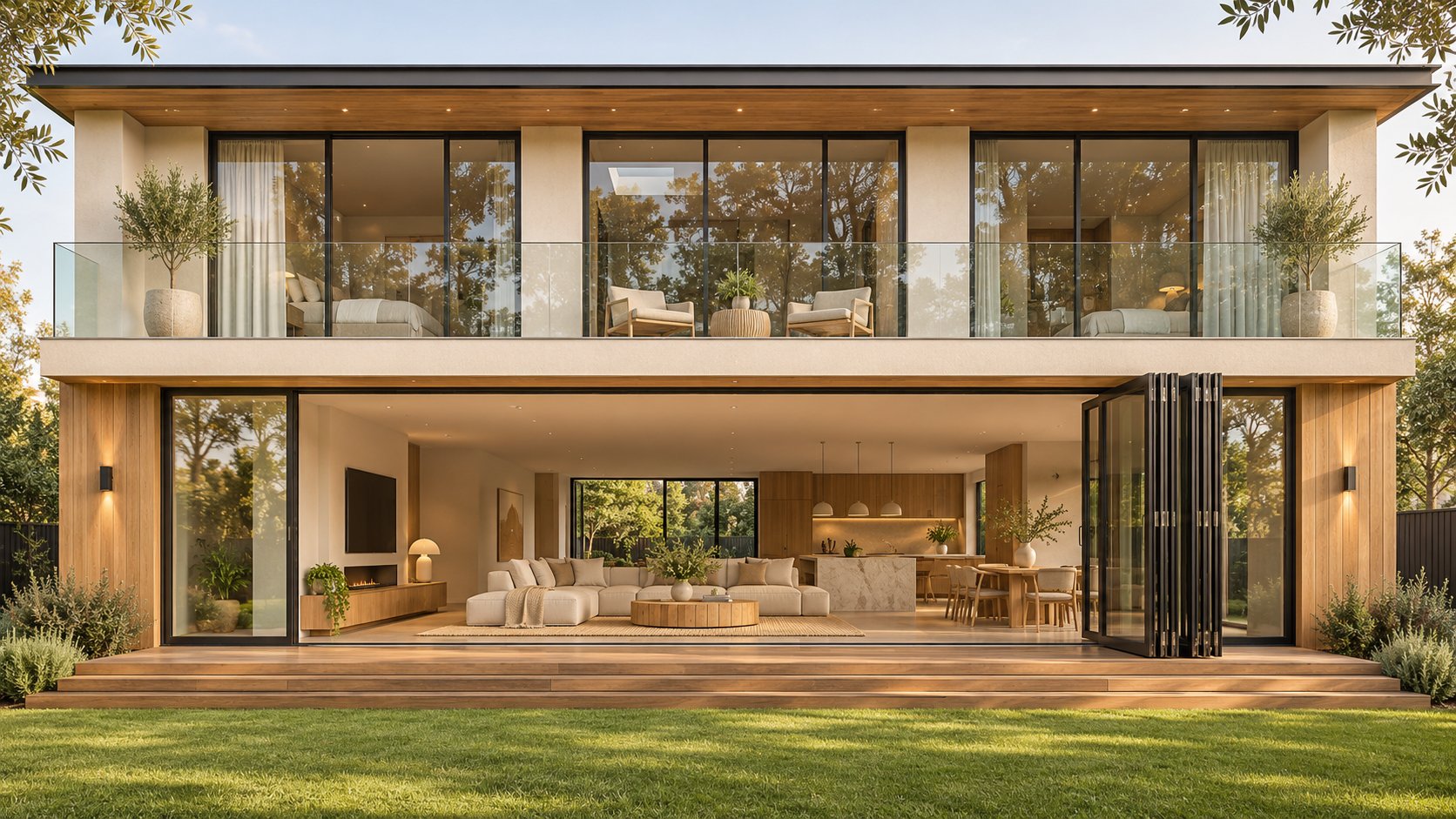
Picture two neighbouring homes, each with the same wide opening onto the backyard. One gets a sliding door, the other a bifold. Both look great on handover day, yet they'll open, seal and age in completely different ways. Choosing a style is really about how the opening needs to work, not just how it photographs.
Hinged, French and Pivot Aluminium Doors
Hinged doors are the familiar choice. A single hinged panel suits most front entries and side doors, while a double set covers wider openings. The bigger decision is swing direction. An in-swing door opens into the house, keeping the porch clear and leaving room for a security screen door outside, which usually swings out. An out-swing door frees up interior floor space, and wind pressure pushes the panel tighter against its frame, which is why out-swing doors are often favoured where wind-driven rain is a concern. The catch? An out-swing door shouldn't open over a step, so it needs a proper landing outside.
Exterior aluminium French doors are a matched pair of hinged, mostly glazed panels that open from the centre. They give a patio or courtyard a classic look without the stacked panels of a folding system. Pivot doors take a different approach. Rather than hanging on side hinges, the panel rotates on a vertical axis using pivot hardware at the top and bottom, with the floor carrying much of the load. That's what makes an oversized, statement-making aluminium front door possible, though the pivot rating and floor preparation need careful specifying.
Sliding, Stacking and Bifold Patio Systems
Most aluminium patio doors fall into three camps, and Perth fabricator Action Glass sums up the mechanical differences neatly:
- Sliding: two panels on two tracks, with one panel gliding behind a fixed one.
- Stacking: extra panels and tracks let two or three sliders collect behind a single fixed panel, so more of the opening clears.
- Bifold: panels hinged to each other run on one track and concertina against the reveal, opening almost the entire wall.
Bifolds come with trade-offs. Panels are usually kept between about 600 and 1,000 mm wide, each folded panel can sit 100 to 150 mm deep, and the system hangs from a head track, so the lintel above must stay level. Sliders and stackers carry their weight on the sill instead. A bifold also has more meeting stiles, meaning more junctions to seal against wind-driven rain, something tested under AS 2047.
One more thing to check. Standard sliding isn't the same as lift-and-slide. With lift-and-slide hardware, turning the handle raises the panel off its seals so it glides freely, then lowers it again to press the seals closed, creating a weather-tight seal. Quotes sometimes use "sliding" loosely, so confirm which mechanism you're actually being offered.
Sidelights, Transoms and Storefront Configurations
A brighter entry doesn't always need a wider door. Sidelights are fixed glass panels beside the door, and a transom is a fixed panel above it. Together they wash a dark hallway with daylight. If a solid panel still feels too closed off, an aluminium door with window inserts or full-height glazing can help, with obscure or laminated glass keeping the entry private and secure.
Shopfronts follow different rules. Narrow-stile storefront doors maximise glass and visibility, while wider-stile designs leave more room for heavy-duty locks and closers. Both get a closer look in the commercial section further on.
| Configuration | How It Operates | Typical Opening Width | Best-Suited Projects | Key Consideration |
|---|---|---|---|---|
| Single hinged | One panel swings in or out on side hinges | Narrow | Front entries, side and laundry doors | Match swing to landing, steps and any security screen door |
| Double / French | Two hinged panels open from the centre | Medium | Patios, courtyards, period-style homes | Needs clear swing space inside or out |
| Pivot | Panel rotates on top and bottom pivots | Medium to wide (one large panel) | Statement entries on contemporary homes | Pivot load rating, floor preparation and sealing detail |
| Sliding | Panel slides past a fixed panel on parallel tracks | Medium | Patios, balconies, tight spaces | Only part of the opening clears; keep tracks clean |
| Stacking | Several panels slide and stack behind one fixed panel | Wide | Alfresco areas, wide rear openings | Confirm standard sliding versus lift-and-slide |
| Bifold | Hinged panels fold and slide along a single track | Wide | Entertaining spaces where the whole wall should open | Stack depth, head support and more seal junctions |
| Entry with sidelights / transom | Hinged door with fixed glass beside or above | Medium overall | Front entries needing more daylight | Privacy glass and safety glazing to AS 1288 |
Every option in this table can be built with basic glass in a plain frame or with high-performance glazing in a thermally broken one. The style decides how a door opens. The frame and glass decide how the room behind it feels in the depths of July and the peak of January.
Thermal Breaks and Energy Ratings Made Simple
Touch the frame of an older aluminium sliding door on a Canberra winter morning and you'll feel the problem straight away. The glass is fogged, the frame is icy, and a small puddle is forming on the sill. Whether a new door repeats that experience comes down to two things: what's hidden inside the frame, and what the energy label actually says.
What a Thermal Break Is and Why It Matters
A thermal break is a strip of low-conductivity material that separates the inside and outside halves of an aluminium profile, so heat can't travel straight through the metal. There are two main methods. Polyamide struts, usually glass-fibre-reinforced nylon, are crimped into knurled grooves in the aluminium. In the pour-and-debridge method, liquid polyurethane is poured into a channel and cured, then the metal bridge beneath it is cut away so no aluminium touches across the gap. Both are proven technologies, and thermal barrier specialist Azon notes that polyurethane foam has the lowest conductivity, followed by solid polyurethane, then glass-filled polyamide.
In everyday terms, a thermally broken frame gives you:
- Interior frame surfaces that stay closer to room temperature
- Less condensation, and less mould risk around sills and reveals
- Less heat escaping in winter and less creeping in during summer
Watch the wording, though. Labels such as "thermally improved" can describe anything from a full break to a thin insert in one part of the frame. Ask exactly what the barrier is made of and whether it runs through both the frame and the moving panels.
How to Read a WERS Label
In Australia, the Window Energy Rating Scheme (WERS) is the standard way to compare aluminium frame doors on energy performance. Ratings follow Australian Fenestration Rating Council procedures, which are closely aligned with the US NFRC methods many overseas guides mention. Here's how to work through a label:
- Confirm the product. Make sure the rating matches the exact frame, glass and configuration on your quote, not the best performer in the range.
- Read the Uw-value. This is the whole-unit rate of heat transfer. Lower means better insulation.
- Check the SHGCw. The solar heat gain coefficient runs from 0 to 1 and shows how much solar heat gets through. Lower suits sun-baked rooms, while higher can help where winter sun is welcome. The right figure depends on climate and orientation.
- Look at visible transmittance (Tvw). Higher means more daylight. One window rating guide notes that values below about 0.50 noticeably dim a room.
- Review air infiltration where listed. Lower means fewer draughts, though poor installation can still undo a good result.
- Compare the heating and cooling stars. They summarise the numbers above for quick side-by-side checks.
NatHERS, BASIX and the National Construction Code
Ratings only mean something against the rules where you build. Under the NCC, glazed doors are generally treated as part of a home's glazing, so a large aluminium glass door counts toward the same energy calculations as your windows. Many new homes and major renovations are assessed through NatHERS, while NSW uses its own BASIX tool. Confirm current requirements for your climate zone with your energy assessor, builder or local council before locking in a product.
Glass does much of the heavy lifting in those calculations. Well-specified aluminium doors with glass typically combine double-glazed insulated units, low-E coatings that reflect heat, and sometimes argon gas between the panes. Upgrading the glass can shift a whole-door rating dramatically, but the frame still sets the ceiling. And which numbers deserve priority changes with location, because a door that excels in Hobart can be the wrong pick for Darwin.
Tip: Ask for the WERS rating of the whole door assembly, frame and glass together, not a glass-only figure. Impressive glass specs can make an unbroken frame look far better on paper than it performs.

Choosing Aluminium Exterior Doors for Your Climate
Australia packs alpine frosts, tropical build-ups and salt-sprayed coastlines into one continent, so there's no single best door. The aluminium exterior doors that keep a Ballarat family room cosy could turn a west-facing Perth living area into an oven, or start corroding within a few years on a Port Macquarie beachfront. Start with where you live, then let that shape the frame, glass and hardware.
Cold and Southern Climates
In Canberra, Hobart, the Victorian highlands and alpine NSW, heat loss is the main enemy. Prioritise a thermally broken frame and sash, double glazing with a low-E coating, and a Uw-value comfortably inside what your energy assessment requires. Weatherstripping matters just as much, because a good thermal rating does nothing to stop draughts slipping past worn seals. Even a well-insulated frame can't fully prevent condensation, since that also depends on indoor humidity. Keep kitchens, bathrooms and laundries near glass doors well ventilated.
Hot and Sunny Climates
From Darwin to western Sydney and inland Queensland, keeping heat out matters more than keeping it in, so SHGC becomes the headline number. Solar-control or spectrally selective glass can reject much of the sun's heat while still admitting plenty of daylight. Lighter or heat-reflective frame colours absorb less heat than dark charcoal or black. Shading is often the best-value upgrade of all. Deep eaves, pergolas and external blinds stop the sun before it ever reaches the glass. Pay special attention to west-facing openings, where a wide sliding door copping full afternoon sun can add a serious cooling load, even with good glazing.
Coastal and Salt Air Environments
Aluminium won't rust, but salt is relentless. Chlorides from sea spray attack thin or damaged coatings, and trouble often starts where mixed metals meet, such as steel screws in aluminium fittings. Hardware maker Titon also points out that prevailing winds and local microclimates can push salt exposure well inland. For an aluminium outside door anywhere near the coast:
- Choose a high-performance powder coat or anodised finish suited to marine exposure, and get the warranty terms in writing.
- Specify 316 stainless steel or other marine-grade hardware and fixings.
- Rinse frames, tracks and hardware with fresh water regularly. Many coastal finish warranties depend on a washing routine, so check the conditions.
Cyclone and High-Wind Regions
Northern Queensland, the Top End and WA's Pilbara coast fall within cyclonic wind regions, where doors may need tested resistance to high wind pressure and windborne debris to comply with the NCC. Marketing labels like "all weather doors" don't settle that question. Documented test results do, and the next section explains how to read them.
| Climate | Primary Risk | Frame Priority | Glass Priority | Finish and Hardware Priority |
|---|---|---|---|---|
| Cold (Canberra, Hobart, alpine areas) | Heat loss, condensation, draughts | Thermally broken frame and panels | Double glazing, low-E coating, low Uw-value | Quality weatherseals, locks that compress seals firmly |
| Hot and sunny (Darwin, Perth, inland QLD) | Solar heat gain, glare, UV fading | Lighter colours; thermal break still helps | Low SHGC, solar-control or spectrally selective glass | UV-stable finish, external shading |
| Coastal and salt air | Corrosion of finishes and hardware | Well-sealed joints, isolated dissimilar metals | Matched to the local energy needs | Marine-grade finish, 316 stainless hardware, regular rinsing |
| Cyclonic and high wind (northern QLD, NT, Pilbara) | Wind pressure, debris impact, water ingress | Structural rating for the wind region, secure anchoring | Laminated or debris-tested glazing where required | Heavy-duty locks and fixings as part of a tested assembly |
Climate tells you what to prioritise. In cyclone country, though, toughness can't be taken on trust, because a door is only as strong as the test it actually passed.
Impact Ratings and Security for Aluminium Doors
"Cyclone rated" sounds reassuring on a quote. Before you rely on it, you need three answers. What test did the door pass, at what size, and installed how? Without them, the phrase is just a sales line. Aluminium impact doors earn the name through specific laboratory tests, and once you know what those tests involve, it gets much harder for anyone to oversell you.
What Impact and Cyclone Tests Actually Check
Imported doors often arrive with American test codes on the spec sheet, usually ASTM E1886 and ASTM E1996. The two work as a pair. E1886 is the test method. A missile is fired at the door, then air pressure is cycled back and forth thousands of times to mimic a storm's push and pull. E1996 is the specification. It sets which missile level and wind zone a product must pass. One impact glazing guide explains that the large-missile levels use a length of timber, with Level D the most demanding. The wind zones run from 1 to 4.
Australia uses its own framework. AS/NZS 1170.2 defines wind regions and the debris impact loads buildings must allow for. Laboratories such as the Cyclone Testing Station at James Cook University in Townsville put products through debris impacts and repeated pressure cycles. The idea is the same as the US tests. The door has to survive the hit and then keep holding while the wind pressure reverses again and again. An overseas certificate suggests a tough product, but it doesn't prove compliance here on its own. Your certifier will expect evidence against Australian standards.
Cyclonic Regions, AS 2047 and NCC Compliance
Northern Queensland, the Top End and WA's Pilbara coast sit within cyclonic Regions C and D. Houses there receive site wind classifications from C1 to C4 under AS 4055, while non-cyclonic sites are rated N1 to N6. Every external glazed door should carry an AS 2047 rating, which covers serviceability and ultimate wind pressure plus water penetration resistance. In cyclonic regions, the NCC may also require debris and cyclic testing, depending on the building and how its openings are protected.
High wind isn't only a tropical issue. Exposed hilltop and beachfront sites further south can carry demanding classifications too. Ask your building certifier or council to confirm what applies to your site before you order.
How to Verify an Impact Rating Yourself
- Ask for the paperwork. Request the test report or certificate for the exact product, ideally from a NATA-accredited laboratory, or its CodeMark certificate number if it has one.
- Check it at the source. Look up CodeMark certificates on the ABCB's online register. For test reports, confirm who issued them and that they're current.
- Match the details. The configuration, panel sizes, glass makeup and fixing method must match what was tested. A bigger panel or different anchoring can void the rating, and inspectors check fixings on site.
- Confirm the wind classification. The tested pressures must meet or exceed what your site requires.
- Keep copies. File everything for your certifier, your insurer and any future sale.
If a seller can't produce test evidence, treat "cyclone rated" as marketing, not a specification.
Security Features Beyond Impact Glass
Impact resistance and burglary resistance overlap, but they aren't the same thing. A handful of features do most of the work:
- Multi-point locks: these engage bolts or hooks at several points along the frame instead of one at the handle. That spreads force more evenly, makes prying far harder and pulls the door tighter against its seals, as one manufacturer's guide to multi-point locking explains.
- Reinforced strike areas: a lock is only as strong as the frame it engages, so look for reinforced keeps and solid fixing into the surrounding structure.
- Laminated glass: its plastic interlayer holds broken fragments in place, so even a cracked pane resists entry. It also counts as Grade A safety glass under AS 1288.
- Security screen doors: an aluminium security door fitted outside the main door adds a lockable barrier while still letting the breeze through. Products sold as security doors should comply with AS 5039. Overseas, an aluminium storm door plays a similar add-on role, though Australians more often choose a screen door.
How much of this you need depends on who walks through the door. A family front entry and a busy shopfront face very different traffic, wear and code demands, and that gap shapes everything from the hinges to the door handles.
Residential Aluminium Entry Doors Versus Commercial Storefronts
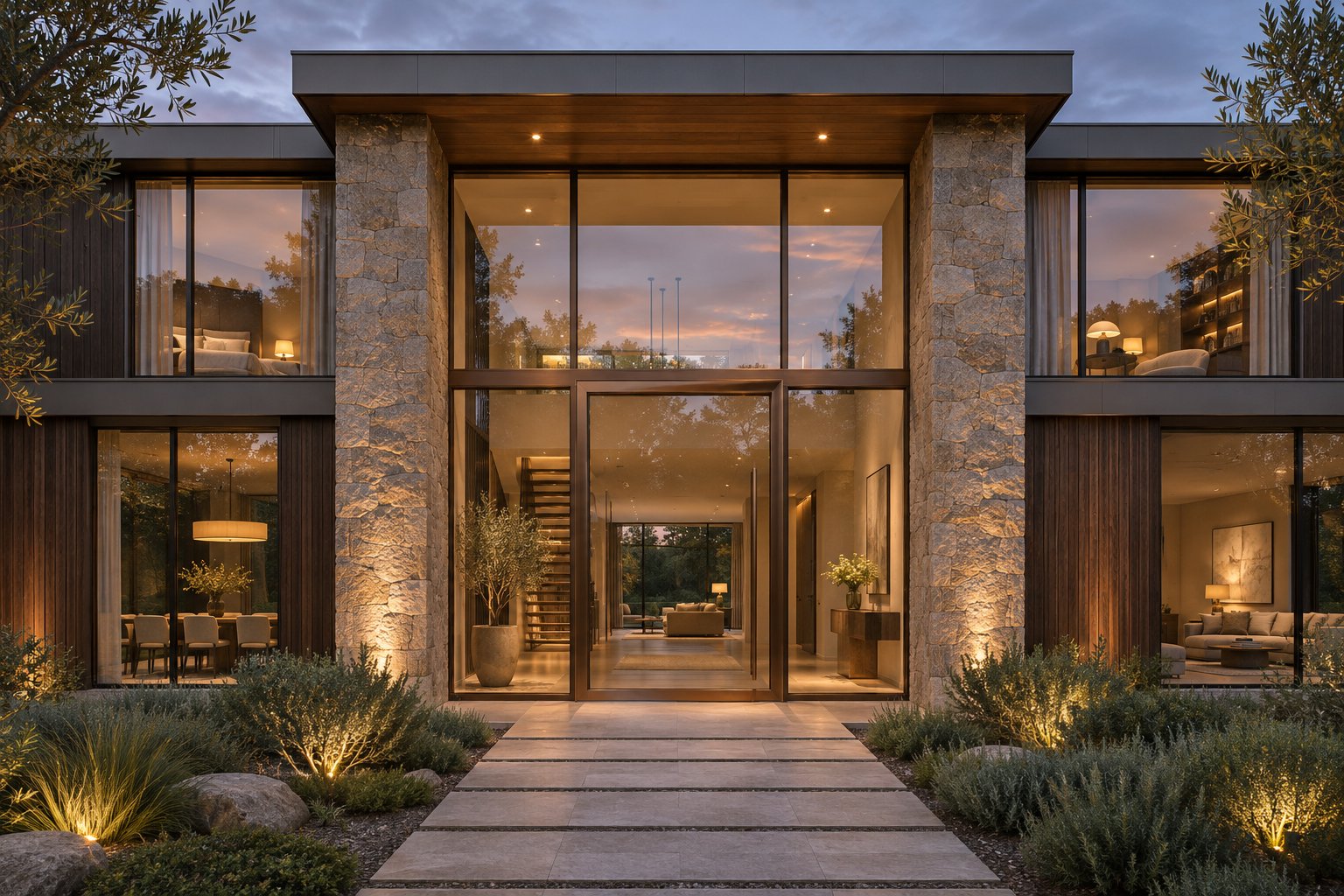
A family front door might open a dozen times a day. A cafe entrance on a busy Melbourne shopping strip can swing hundreds of times before lunch, often nudged open with a hip, a pram or a loaded trolley. Same material, very different job. Knowing which category a quote really belongs to saves you from paying for toughness you don't need, or skimping where you can't afford to.
Residential Aluminium Entry and Patio Doors
At home, aluminium mostly shows up as glazed front entries, sliding or stacking patio doors, and wide bifolds that open living areas to the alfresco. The aluminium entry doors residential builders install today lean towards slim frames, full-height glass and dark or textured powder coats that suit contemporary facades. Priorities are clear: good looks, energy performance that satisfies your NatHERS or BASIX assessment, and solid security hardware such as multi-point locks. Traffic is light, so standard residential hinges, rollers and handles usually last for years with basic care.
Commercial Storefront and Entrance Doors
Commercial aluminium exterior doors are built for punishment. When comparing aluminium entrance doors, commercial specifiers usually start with the stile, the vertical frame member on each side of the glass. Manufacturers typically offer narrow, medium and wide stile doors as standard, each with a curated range of hinges, closers, locks and exit devices.
- Narrow stile: the most glass and the lightest look, suited to offices and boutiques with moderate traffic.
- Medium stile: a middle ground, with more room for sturdier locks and fixings.
- Wide stile: the heaviest option, built for schools, shopping centres and transport hubs.
Hardware does the heavy lifting. Continuous hinges spread the door's weight along its full height, while pivots carry it at the top and bottom. Closers control closing speed so the door latches every time. Panic bars and other exit devices let occupants push out without a key, which ties directly into NCC egress requirements. Just as important, quality commercial hardware is designed to be replaced. When a closer wears out after years of heavy use, you swap the closer, not the whole door. Oversized entrances also weigh more and generally need heavy-duty hardware to match.
Accessibility Requirements for Entrance Doors
Ever wondered why so many shopfront doors have a deep bottom rail? Accessibility is a big part of it. The US ADA Standards require the push side of many swinging doors to be smooth to a height of at least 254 mm (10 in), because wheelchair footrests and walking frames are often used to push doors open. Many commercial systems sold internationally are designed around that detail. In Australia, access to public buildings is governed by the Disability (Access to Premises - Buildings) Standards 2010, the NCC and AS 1428.1, which cover clear opening widths, circulation space, hardware type and height, thresholds and level changes at doorways, and the force needed to operate doors.
Opening force is a balancing act on exterior doors. A closer strong enough to latch firmly against wind and air pressure can be hard for some people to push. Even the US rules set no maximum opening force for exterior hinged doors for that reason, pointing to power-assisted or automatic operation as the better fix. Requirements also shift between code editions, so confirm the details with an access consultant, your building certifier or local council rather than relying on summaries, including this one.
| Factor | Residential | Commercial |
|---|---|---|
| Typical door types | Glazed hinged entries, French doors, sliding, stacking and bifold patio doors | Narrow, medium and wide stile swing doors, storefront pairs, automatic sliders |
| Hardware | Butt hinges, rollers, multi-point locks, lever handles | Continuous hinges or pivots, closers, panic bars, access control, replaceable heavy-duty components |
| Traffic level | Low to moderate | High to very high |
| Code drivers | NCC housing provisions, AS 2047, AS 1288, energy ratings, BAL in bushfire-prone areas | NCC Volume One egress and Section J energy rules, AS 1428.1 access, AS 2047, AS 1288 |
| Finish priorities | Colour, texture and curb appeal, plus coastal durability | Hard-wearing finishes such as anodising, consistency across large facades, easy upkeep |
Whichever side of the line your project sits on, two doors that look identical in a showroom can differ hugely in coating quality, profile walls and hardware grade. Those differences rarely make it into a glossy brochure. They do appear on a spec sheet, though, if you know which lines to read.
Decoding Spec Sheets and What Drives Aluminium Door Prices
Two quotes for what looks like the same glazed front door can be thousands of dollars apart. Sometimes one supplier is simply charging more. More often, the gap hides in the fine print: a different coating, a thinner profile, or a frame with no thermal break. Once you can read that fine print, front door prices start making a lot more sense.
Finishes Explained From Anodised to Kynar
The finish is a door's first defence against sun, salt and scuffs, and quality varies more than most buyers expect. Three families dominate:
- Anodising: an electrochemical process that thickens aluminium's natural oxide layer, giving a crisp metallic look. The colour sits within the oxide, so it won't peel or flake. Coatings maker PPG notes the trade-offs: a limited palette of mostly metallics and earth tones, and an oxide layer that can crack under impact or bending.
- Powder coating: dry powder sprayed on and baked into a tough film, available in a wide range of colours and textures. It's the most common finish on Australian homes, but pre-treatment and film thickness make a big difference, so ask whether it's applied to AS 3715.
- PVDF and fluoropolymer coatings: often sold under the Kynar 500 resin name, these premium systems resist UV, chalking and fading exceptionally well, which matters under harsh Australian sun. Fluoropolymer powders now offer similar durability with powder application.
Whichever you choose, get the finish specification and warranty in writing, including any washing conditions tied to coastal cover.
Spec Sheet Items to Request Before You Buy
Reputable aluminium door manufacturers can supply most of this without fuss. Vague answers tell you something too.
- Alloy and temper, such as 6063-T5 or T6.
- Frame depth and wall thickness of the main profiles.
- Thermal break type: polyamide strip, poured polyurethane, or none.
- WERS ratings for the whole unit, matched to your exact glass and configuration.
- AS 2047 results for air infiltration, water penetration and structural wind pressure.
- Cyclone or debris test evidence where your site requires it.
- Glass makeup: single or double glazed, laminated or toughened, low-E coating, gas fill.
- Finish type and warranty, including maintenance conditions.
- Hardware material and lock type, for example 316 stainless steel and multi-point locking.
- Threshold details, covering height, drainage and resistance to wind-driven rain.
What Drives the Price of an Aluminium Door
Exact figures shift between regions and suppliers, but the cost drivers are predictable:
- Opening size and panel count: more panels mean more extrusion, glass and hardware.
- Operation type: bifold and stacking systems generally cost more than a single hinged door, thanks to extra tracks, hinges and rollers.
- Thermal break: two-part profiles joined by an insulating strip take more material and fabrication.
- Glass specification: double glazing, low-E coatings and laminated glass each add cost, and glass often makes up a large share of the materials.
- Impact or cyclone rating: heavier sections, tested glazing and stronger fixings.
- Finish type: standard powder coat sits at the lower end, while anodising and fluoropolymer systems usually cost more.
- Custom colours and sizes: custom aluminium doors outside a standard range need bespoke fabrication, and special colours may involve separate coating runs.
- Hardware: multi-point locks, concealed pivots and lift-and-slide gear are premium components.
- Installation complexity: widening an opening may mean a new lintel plus making good brickwork, render or cladding.
The cheapest quote isn't always the cheapest door. In Canberra or Hobart, a frame without a thermal break can bleed heat every winter night, drip condensation onto timber floors and leave the nearby room too cold to enjoy. Those costs never appear on the quote, but they turn up on energy bills and repair invoices for years.
Tip: Compare quotes line by line against the checklist above. A lower price that skips the thermal break, the test reports or the finish warranty isn't a bargain. It's a different product.
Even a well-chosen door ages, though. Grit builds up in tracks, seals harden and coatings slowly weather, usually in ways that are cheap to fix if you catch them early.
Fixing Common Aluminium Door Problems
A sliding door that once moved with two fingers now needs a shoulder. A front door fogs up every winter morning. Aluminium door faults usually creep in slowly, and most have a clear cause. If you catch them early, the fix often costs less than a new set of handles.
Condensation and Draughts
Moisture on the inside of the frame usually means a frame without a thermal break is meeting humid indoor air. This is common near kitchens, bathrooms and laundries. Draughts point to worn or flattened weatherstripping. Fog between the panes is a different problem. It means the edge seal on the insulated glass unit has failed, so moisture gets in and the insulating gas leaks out. The Spruce notes that weatherstripping and glass seals are separate parts, so they need different fixes. Defogging services exist, but they don't replace the lost gas. Replacing the glass unit in the existing frame is usually the more reliable repair.
Sticking, Dragging and Hard-to-Lock Doors
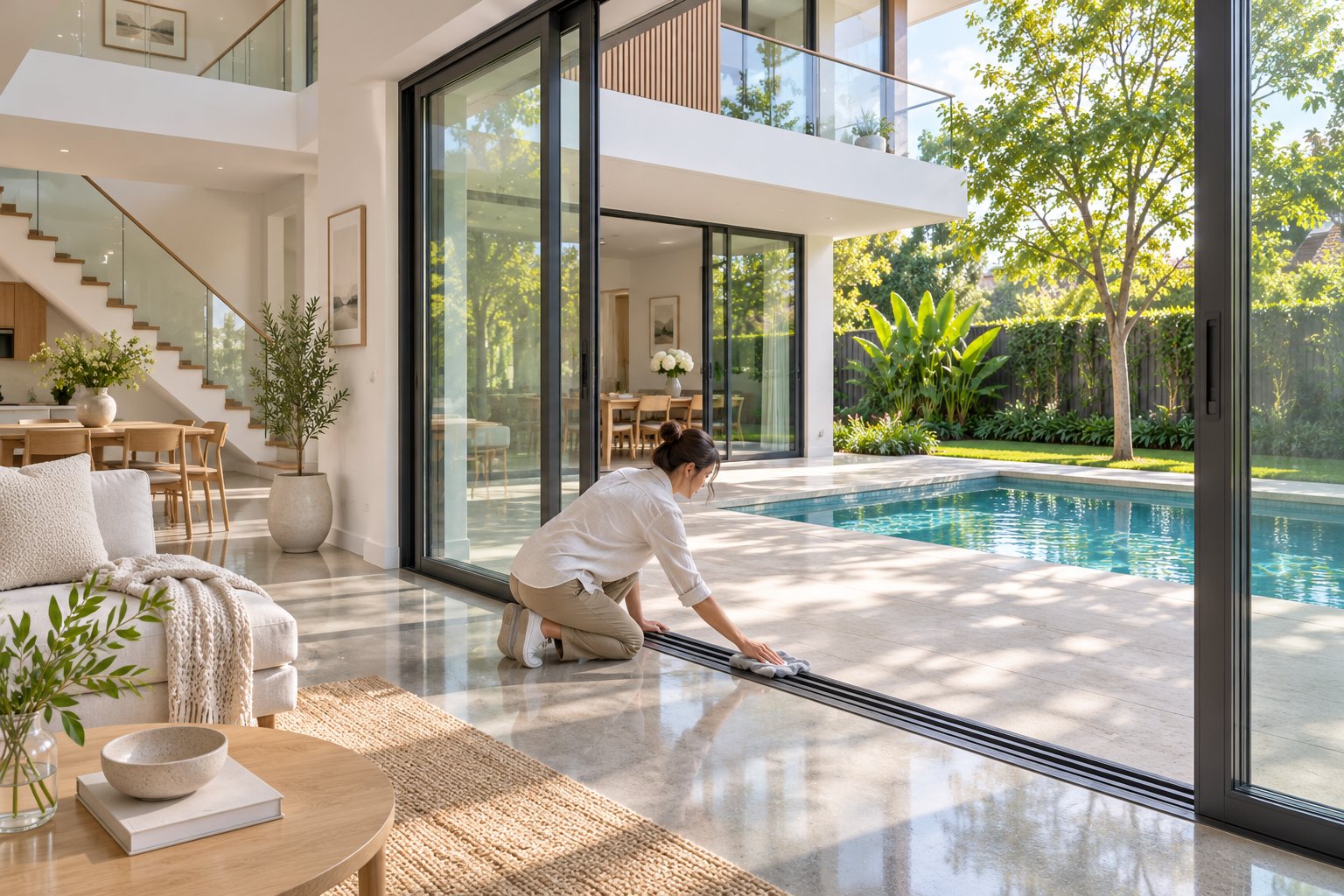
Grit in the track is the usual culprit, followed by worn rollers. Don't reach for WD-40. It's a solvent that leaves a sticky residue, and door repair specialists warn that the residue traps sand and hair, which wears rollers out faster. Instead:
- Vacuum the track.
- Scrub it with mild soapy water and dry it.
- Finish with a dry silicone spray.
If the door still won't lock, the rollers may have dropped. A loss of just 2 mm in height can stop the latch meeting the strike. Adjustment screws at the bottom of the panel, sometimes hidden behind plastic caps, raise it back into line. For a hinged door that drags or won't latch, look for settled hinges or a strike plate that has shifted.
Finish Wear and Corrosion on Older Doors
A chalky grey film on an old aluminium door is usually oxidation, and it is mostly cosmetic. The oxide layer actually protects the metal underneath. Frame restoration specialists remove light chalking with a dedicated aluminium cleaner and a non-scratch pad, then apply carnauba wax. Faded powder coat can often be refinished. Pitting near the coast is more serious, because salt left on the surface for years eats deeper into the metal.
Damaged aluminium door trim can usually be replaced on its own. Replacing the whole aluminium door and frame makes sense in three cases: the frame is bent, the seals have failed throughout, or the frame has no thermal break and you live in a cold climate. Faded colour alone isn't a reason to replace.
| Problem | Likely Cause | DIY Fix | When to Call a Professional |
|---|---|---|---|
| Condensation on frame | No thermal break, high indoor humidity | Improve ventilation, use exhaust fans | Persistent mould or water damage; consider a frame upgrade |
| Fog between panes | Failed glass unit edge seal | Check whether the warranty still applies | Glass unit replacement |
| Draughts | Worn weatherstripping | Replace seals with matching profiles | Gaps caused by a frame out of square |
| Heavy or grinding slider | Dirty track, failed rollers | Clean track, adjust roller screws | Roller replacement means lifting a heavy glass panel; gouged tracks may need a stainless repair cap |
| Door won't lock | Dropped rollers, settled hinges, shifted strike | Adjust rollers, tighten hinges, realign strike | Worn multi-point lock mechanism |
| Chalky or faded finish | Oxidation, UV exposure | Aluminium cleaner, then wax | Refinishing or recoating |
| Pitting near the coast | Salt sitting on the surface, damaged coating | Clean and rinse with fresh water | Deep pitting or corroded hardware |
A short routine prevents most of these problems:
- Tracks: vacuum and wipe them every few months, and more often on sandy or dusty sites.
- Hardware: lubricate rollers, hinges and locks with a dry lubricant rather than WD-40.
- Coastal rinsing: wash frames, tracks and hardware with fresh water regularly. Avoid pressure washers, which can damage glass seals.
- Weatherstrips: check them before winter and replace any that are cracked or flattened.
Sometimes the list of repairs outgrows the door itself. At that point the question changes from what to fix to what to specify next, and that decision is easier with a clear sequence to follow.
Putting It Together and Planning Your Aluminium Door Specification
By this point, a spec sheet should read less like code and more like a list of decisions. The order you make them in matters. Pick a finish before confirming your wind classification and you might end up re-quoting the whole job. Work from the site outwards instead, and each choice narrows the next one.
A Step-by-Step Decision Framework
- Identify climate and code requirements. Confirm your climate zone, wind classification, BAL rating if you're in a bushfire-prone area, and any NatHERS or BASIX targets with your builder, certifier or council.
- Define the use. A front entry, a patio opening and a commercial entrance face very different traffic, security and access demands.
- Choose the configuration. Pick hinged, pivot, sliding, stacking or bifold, based on the opening size and how you want it to work day to day.
- Select the frame and glass. Decide whether you need a thermally broken frame, then specify the full glass build-up, including safety glass to AS 1288.
- Pick the finish and hardware. Match coatings and fixings to sun and salt exposure, and locks to your security needs.
- Verify ratings and approvals. Ask for whole-unit WERS figures, AS 2047 results and any cyclone test evidence your site requires.
- Compare quotes like for like. Line each offer up against the spec sheet checklist from earlier, item by item.
That last step is where many budgets slip. One manufacturer's quoting guide suggests giving every opening a unit mark, sending each supplier the same schedule revision, and asking for any unresolved options to be priced separately. Otherwise, a lower total may simply reflect a simpler product or a narrower scope, such as missing flyscreens, trims or delivery.
Exploring Aluminium Door Systems for Your Project
Browsing real ranges of aluminium doors and frames helps turn the configurations in this guide into something tangible. MEICHEN's aluminium door collection is one example. It groups aluminium-framed glazed doors into sliding, stacking, hinged, bifold and commercial systems, with both thermal break and non-thermal break options listed. Panel layouts, glazing, frame colours, hardware and threshold details are worked out per project, and drawings or door schedules can be sent in for review.
Two cautions apply to any aluminium door supplier, this one included. If you need lift-and-slide hardware or solid aluminium panels instead of glass, raise it in your project inquiry rather than assuming it's standard. And treat listed performance values as a starting point. Check that the exact system's WERS ratings, AS 2047 results and any cyclone or bushfire compliance suit your site and local requirements before you sign anything.
Final takeaway: The best exterior aluminium door isn't the one with the boldest brochure. It's the one whose frame, glass and hardware are documented, tested and matched to your site. Verify first, then buy.
Frequently Asked Questions About Exterior Aluminium Doors
1. Are exterior aluminium doors a good choice for Australian homes?
For most Australian homes, yes, particularly where you want wide glass openings, slim frames and minimal upkeep. Aluminium does not rot, swell or rust, so it copes well with humid summers, harsh UV and coastal conditions, provided the finish suits the site. The main weakness is heat transfer. A standard frame lets warmth escape in winter and creep in during summer, so homes in cooler regions such as Canberra, Hobart or the Victorian highlands benefit most from thermally broken frames paired with double glazing. In hot northern climates, glass selection and shading usually matter more than the frame alone. Choose the frame, glass and finish to suit your local climate rather than buying on looks.
2. Do I really need a thermally broken aluminium door?
It depends on your climate, the size of the door and how much the room's comfort matters to you. A thermal break is an insulating barrier, usually polyamide or poured polyurethane, that separates the inside and outside halves of the frame. It keeps interior surfaces warmer, cuts condensation and reduces energy loss. In cold southern regions, or for large glazed doors opening onto living areas, it is usually worth the extra cost, because a cheaper unbroken frame can lead to years of higher heating bills, damp sills and cold spots. In mild coastal climates the payoff is smaller, though it still helps with summer heat gain. If a quote says thermally improved, ask exactly what the barrier is and whether it runs through both the frame and the moving panels.
3. How can I check whether an aluminium door is cyclone rated?
Do not rely on a sticker or a sales claim. Ask the supplier for the test report or certificate for the exact product, ideally from a NATA-accredited laboratory, or a CodeMark certificate number that you can look up on the ABCB register. Every external glazed door should also have AS 2047 results covering wind pressure and water penetration. Then confirm that the tested panel sizes, glass build-up and fixing method match your order, and that the tested pressures meet your site's wind classification. US codes such as ASTM E1886 or E1996 show the product is tough, but your certifier will still expect evidence against Australian requirements. Keep copies of the paperwork for your certifier, your insurer and any future sale.
4. How do I stop aluminium doors corroding near the coast?
Start at the specification stage. Choose a marine-suitable powder coat, anodised or fluoropolymer finish, and specify 316 stainless steel hardware and fixings so different metals do not react with each other. After installation, rinse frames, tracks and hardware with fresh water regularly to wash off salt before it can attack the coating. Use a soft cloth and mild detergent rather than a pressure washer, which can damage glass seals. Many coastal finish warranties only remain valid if you follow a set cleaning routine, so read those conditions before you buy. Remember that prevailing winds can carry salt several kilometres inland, so homes that are not on the beachfront may still need coastal-grade products.
5. What should I ask an aluminium door supplier before placing an order?
Request a full spec sheet. It should cover the alloy and temper, profile wall thickness, thermal break type, whole-unit WERS ratings, AS 2047 results, the glass build-up, finish type and warranty terms, hardware material, lock type and threshold details. Send every supplier the same door schedule so the quotes can be compared fairly, and ask for any missing items such as flyscreens, trims or delivery to be priced separately. Ranges such as MEICHEN's aluminium door collection, which covers sliding, stacking, hinged, bifold and commercial glazed systems with project-specific layouts, glazing, colours and hardware, help you see how each configuration translates into a real product. With any supplier, confirm special needs such as lift-and-slide hardware or solid aluminium panels through a project inquiry rather than assuming they are standard. Also check that the ratings and approvals meet your local code requirements.