

What Is a Crank Window and What Is It Called
You turn a small handle near the sill, and the glass swings smoothly out into the breeze. If that sounds like a window in your home, you already know crank windows, even if you have never been quite sure of their proper name.
What Is a Crank Window in Plain Terms
A crank window is a hinged window you open and close by turning a small handle. The handle drives a gear-driven operator that pushes the sash outward and pulls it back against the frame, where the lock presses it tight against the weatherstripping for a firm seal.
That clamped-shut closing action is a big part of the appeal. A sliding sash needs a little room to move in its track, while a locked crank sash is pressed shut against the frame. It is also why the small gearbox under the handle matters so much when something goes wrong.
What Are Crank Out Windows Called
Most of the time, the formal name is a casement window: the side-hinged style that swings open like a door. Industry guides group casements with awning and hopper windows as the windows that crank on a hinge rather than slide or stay fixed.
You may also see people searching for a 'crankcase window'. It is an easy slip, but a crankcase is actually an engine component. When you are shopping or hunting for parts, the terms that will get you useful results are casement, awning or crank-out window.
- Casement: hinged at the side, swings out like a door
- Awning: hinged at the top, opens outward from the bottom
- Hopper: hinged at the bottom, tilts open from the top
- Crank-out: informal name for an outward-opening casement or awning
- Roll-out: an older everyday term, usually describing a side- or top-hinged sash
- Winding window: a common Australian phrase, named after the winder handle, with the hinge position depending on the style
Why Crank Windows Is an Umbrella Term
Think of 'crank window' as a family name rather than a single product. Casements, awnings and hoppers share the same basic idea, a handle turning a geared operator, yet each hinge position changes how the sash moves, how much clearance it needs and which replacement parts fit. A side-hinged kitchen casement and a top-hinged bathroom awning may look like cousins, but their operators are rarely interchangeable.
That is exactly why this guide starts with names and works forward. From here, we cover how the mechanism works, the different types, honest pros and cons, and where these windows suit an Australian home. Then the practical side takes over: diagnosing problems by symptom, fixing them in order from cheapest to most involved, identifying the right part, and knowing when full replacement makes more sense.
A spinning handle or a sash that refuses to close is almost never a mystery once you can picture what sits between your fingers and the glass. So the logical place to look next is inside that compact gearbox.
How the Crank Mechanism Actually Works
Every crank window hides a short chain of parts between your hand and the glass. Each part passes motion to the next one. When a single link wears out, the whole window feels it, which is why a little mechanical knowledge saves a lot of guesswork later.
Inside the Operator of a Crank Window
Picture yourself opening a kitchen casement over the sink. Here is what happens with each turn:
- You turn the crank handle, which may be a fixed handle or a folding one that tucks flat.
- The handle grips a splined stud, a short shaft with fine ridges that lock the two together.
- The stud spins a worm gear inside the operator gearbox, and the worm meshes with gear teeth on the arm assembly.
- Those gear teeth rotate the operator arm.
- The end of the arm, often a roller or shoe that travels inside a track on the sash, pushes the sash outward.
- Hinges or friction stays guide the sash along a controlled arc.
- Cranking in reverse draws the sash back, and the lock pulls it tight against the weatherstripping.
| Component | What It Does | Common Wear Sign |
|---|---|---|
| Crank handle | Gives you grip and leverage | Wobbles or spins loose (see spinning-handle checks in the diagnosis section) |
| Splined stud | Transfers your turn into the gearbox | Rounded ridges, handle slips under load |
| Operator gearbox | Converts rotation into arm movement | Grinding, stiffness, or a handle that turns while the sash stays put |
| Operator arm(s) | Push and pull the sash | Arm detached from its track or visibly bent |
| Hinges or friction stays | Guide and support the sash | Sagging, dragging, or a sash that won't sit square |
| Locks or multipoint locking | Clamp the sash closed | Rattles, or a lock that is hard to engage |
| Weatherstripping | Seals the closed sash | Drafts, visible gaps, flattened seals |
Each wear sign above has a matching quick test in the diagnosis section further on.
Single Arm, Dual Arm and Split Arm Operators
Not every operator moves the sash the same way. You don't need to remove anything to tell them apart. Simply crank the window and watch how the arms move.
- Single arm: one arm pushes from one point, with its end running in a sash track. Simple and very common.
- Dual arm: two paired arms share the work, spreading force across more of the sash.
- Split arm: the arm is hinged in the middle and folds like an elbow, letting it follow a different path as the sash swings.
You may also come across dyad or hybrid operators, which combine elements of these styles.
Crank Handles and High Window Opening Mechanisms
Windows with crank handles near the sill are easy to reach in most rooms. Folding handles are handy where blinds or shutters sit close to the glass. High windows are a different story, such as clerestory sashes in a double-storey void. These usually rely on an extension pole that engages the operator, or on another high window opening mechanism such as a remote winder or motorised operator.
The gearbox stays much the same from window to window. What changes is where the hinge sits, and that single detail reshapes how each crank style opens.

Types of Crank Windows and How Each Opens
Walk around a typical Australian home and you might spot three or four crank styles without noticing. There is the tall sash beside the kitchen bench, the slim pane high on the bathroom wall, and the pair framing a view in the living room. They all share the same basic gearbox. Each one hinges somewhere different, though, and that one detail changes how it behaves.
Casement Windows That Swing Out From the Side
The casement is the best known of the types of crank windows. It is hinged along one vertical edge and swings outward like a door. Because the whole sash clears the opening, it can catch a passing breeze and steer it indoors. Casements also suit tall, narrow openings, such as the gap between kitchen cabinets.
The catch is on the outside of the wall. An open casement projects into the space beyond, so it needs clear room on that side.
Awning Windows That Crank Open From the Bottom
Move the hinge to the top edge and you have an awning window. These are the windows that crank open from the bottom. The sash angles outward and forms a small canopy, which is why an awning can usually stay open in light rain. They sit well high on a wall, so they are a favourite in bathrooms and laundries and above benches. Many Australian awning windows use a chain winder rather than an arm-style operator, so check which hardware you have before ordering any parts.
Hopper, Double Casement and Inward Opening Variants
A hopper is basically an awning turned upside down. It is hinged at the bottom and tilts open from the top, usually inward, although outward-opening versions exist. An inward hopper needs no clearance outside, so it can work in tight spots such as lower-level rooms or walls beside narrow side paths.
Double casements put two sashes in one frame. Some pairs close against a central mullion. French-style pairs close against each other with no centre stile, which leaves a wide, clear opening. Depending on the system, these pairs may use crank operators or push-out hardware.
Casement windows that open inward are the least common crank variant. They avoid clearance problems outside, but the open sash then competes with blinds, curtains and furniture, and the screen has to go on the exterior.
| Type | Hinge Position | Opening Direction | Typical Placement | Key Consideration |
|---|---|---|---|---|
| Casement | Side | Outward, like a door | Kitchens, living areas, tall narrow openings | Needs clear space outside the wall |
| Awning | Top | Outward from the bottom | Bathrooms, laundries, above benches | Open sash can be a hazard at head height beside paths |
| Hopper | Bottom | Usually inward from the top, sometimes outward | Lower-level rooms, bathrooms, beside narrow paths | Inward sash takes up room space |
| Double casement | Side, one hinge per sash | Outward as a pair | Living areas and view openings | Confirm whether a central mullion is included |
| Inward-opening casement | Side | Into the room | Spots with tight exterior clearance | Room needed for blinds, curtains and furniture |
Editorial note: Double casement describes the sash arrangement, meaning two opening sashes. Double glazing describes the glass assembly, meaning two panes with a sealed gap between them. These are separate choices, so a double casement window can be single or double glazed.
Each hinge position solves one problem and creates another. An outward sash gains airflow but needs clearance outside. An inward sash saves outdoor space but uses up room space. Those trade-offs decide whether a crank style is right for a particular wall.
Benefits and Honest Drawbacks of Crank Open Windows
A sash that swings fully clear of its frame is brilliant on a still summer evening. It is a nuisance if it opens straight into a narrow side path. Most brochures only tell you the first half of that story, so here is the whole picture.
Benefits of Crank Open Windows
The biggest strengths come from two things: the way the sash moves and the way it closes.
Pros
- Ventilation: The whole sash opens, not just half the frame. Angled into the wind, it works like a wind scoop, so it can catch breezes running along the wall as well as those hitting it head-on.
- Seal: When you crank the sash shut and lock it, it presses against the weatherstripping around the frame. This compression seal holds up better than the brush seals in a sliding track, which wear with use. Thermal performance still depends on the frame and glazing, so check the WERS rating for the specific system.
- Security: Hook-style or multipoint locks clamp the sash in place. The operator sits on the room side, so there is no latch for anyone to pry at from outside.
- Views: No meeting rail cuts across the glass. A closed casement looks almost like a fixed pane.
- Ease of operation: A few turns of a handle is far easier than pushing a sash open across a deep kitchen bench or over the sink.
Limitations to Weigh Before Choosing
Windows that open out need space around them, and their hardware needs some attention.
Cons
- Clearance: The open sash projects past the outside wall. It can block walkways, decks and balconies, or run into a pergola post.
- Screens: Flyscreens have to sit on the interior, which affects both cleaning and appearance.
- Wind exposure: An open sash catches gusts. Leaving it wide open through a southerly change or a summer storm strains the arms and hinges.
- Moving parts: The operator, hinges and seals need occasional cleaning, lubrication and adjustment.
- Size: A very wide single sash puts heavy leverage on its hinges, so practical dimensions depend on the selected system. Wide openings are often better served by a pair or a combination unit.
How Crank Windows With Screens Work
The sash swings outward, so the flyscreen fits inside the frame on the room side. The winder handle sits below the screen line, which means you can open and close the window without touching the mesh. Some systems use retractable or roll-up screens instead of fixed panels.
The trade-off shows up on cleaning day. You usually have to remove or retract the screen first. Then clean only what you can reach while keeping both feet on the floor. Safe-cleaning guidance warns against leaning through the opening, especially upstairs. The mesh also stays in your line of sight and slightly softens the view. Keep in mind that a flyscreen keeps insects out but will not stop a child from falling through.
Crank windows with screens suit households that want strong airflow, a tight seal and easy reach, as long as the wall outside has room for the sash to swing.
That last condition is often what decides it. A style that shines above a kitchen sink can be awkward beside a busy side path, so the room matters as much as the window.
Where Crank Windows Work Best in a Home
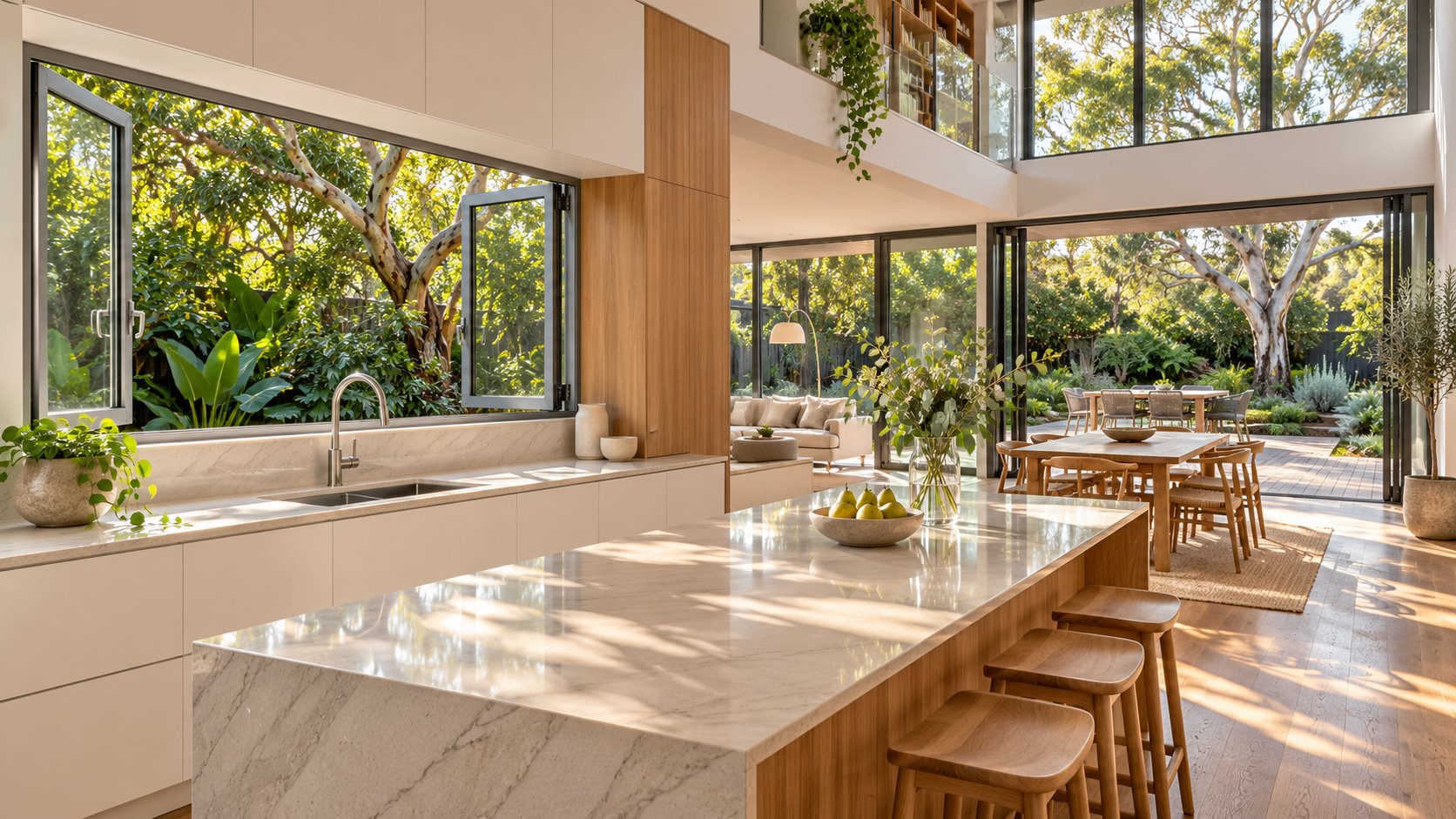
Picture the same window in two places. Over the kitchen sink, it is a pleasure to use. Beside a narrow side path, it is a sharp corner waiting for whoever wheels the bins out after dark. With crank type windows, where you put the window matters as much as which one you choose.
Best Rooms for Crank Windows in a House
Windows with cranks earn their place wherever reaching is awkward or airflow really counts. Here is how they suit each room.
| Room | Why a Crank Style Window Suits It | What to Check |
|---|---|---|
| Kitchen | A few turns opens the sash across a deep bench or sink, and full ventilation clears cooking smells quickly | Handle clearance from taps and splashbacks, and clear space outside |
| Bathroom | Strong airflow helps manage moisture, and the glass can be obscure or frosted for privacy | Privacy glazing type, and whether a top-hinged awning suits the wall height better |
| Bedroom | Wide opening for breezes, with locks that clamp the sash firmly shut | Fall-prevention rules on upper floors and any emergency-opening needs |
| Living areas | Clear glass for views and a full opening for cross-breezes | Pairing with fixed panes, and how the interior screen looks |
| Upper floors | Easy to operate from inside without leaning out | Safe cleaning access to the outer glass, and opening restrictors |
Bedrooms need extra care. Under the NCC fall-prevention provisions, a bedroom window where the floor is 2 m or more above the ground below, and the opening sits less than 1700 mm above the floor, needs protection. That usually means a restrictor limiting the opening to 125 mm, or a screen that resists a 250 N outward force. Restrictors reduce airflow, so confirm with your certifier how they work alongside ventilation and any emergency-opening requirements.
Where Open Out Windows Can Cause Problems
A window that swings out needs free space beyond the wall. Think twice about placing one:
- Beside narrow side paths, driveways or walkways
- Over decks, balconies or alfresco areas where people sit or walk
- Next to pergola posts, downpipes, fences or garden beds
In those spots, a sliding window, an inward hopper or fixed glass is often the better choice.
Frame Materials and Specification Considerations
- Aluminium: Slim frames, a wide range of finishes and low upkeep. On the downside, aluminium conducts heat readily, so thermally broken frames and double glazing make a real difference, and coastal homes need suitable finishes plus regular rinsing. If you are comparing options, MEICHEN's aluminium casement and window systems let Australian homeowners and specifiers weigh side-hinged, crank-operated casements against sliding, awning and fixed styles. Custom sizing, opening layouts, glazing, hardware and finishes such as Black Mall can be coordinated across a project. Paired, French-style, oversized or steel-look configurations need individual confirmation, and a black finish alone does not create a steel-look profile.
- Timber: Warm and naturally insulating, but it needs regular sanding and painting. Swelling can also make the crank stiff to turn.
- uPVC: YourHome ranks uPVC among the most thermally efficient frames. The trade-off is bulkier profiles and usually fewer colour choices.
- Composite: Blends materials, such as a timber interior with an aluminium exterior. Options vary widely between makers.
Whatever the frame, hardware, glazing and performance depend on the specific system. Check its WERS rating, and in bushfire-prone areas confirm the BAL compliance before ordering. Even a well-specified window still relies on a small gearbox and a few hinges, and those are the parts that eventually start to complain.
Diagnosing Common Crank Window Problems by Symptom
A crank open window rarely fails without warning. First it gets stiff. Then it grinds, or a draft creeps in. Then one morning the handle just spins. Each of those symptoms points to a specific part, and reading them correctly is the cheapest step in learning how to fix crank out windows. It stops you from buying a whole new operator when only the handle has worn out.
Why a Crank Handle Spins Without Opening the Window
When the handle turns but the sash stays put, something in the chain between your hand and the glass has let go. The usual suspects are a loose set screw, worn splines on the handle or stud, stripped operator gears, or an arm that has come away from the sash. Truth-branded operators are fitted to a great many casement windows, so plenty of people start with a search for truth window crank repair. Whatever the brand, the checks are the same:
- Find the set screw at the base of the handle and tighten it. If the handle now grips and the sash moves, the problem is solved.
- If not, loosen the screw and pull the handle off.
- Look inside the handle. Sharp, even ridges are fine. Smooth or rounded ridges mean the handle itself is worn.
- Inspect the splines on the stud in the same way.
- Grip the stud with pliers and turn it gently. If the sash moves, the gear is engaging and the handle is your culprit. If the stud turns freely, or clicks and grinds, the gear teeth have probably stripped.
- Before blaming the gear, check that the arm is still attached to the sash track. A detached arm can feel exactly like a stripped gear.
Stiff Cranking and a Sash That Won't Close
Stiffness is usually a cleaning problem before it is a hardware problem. Grit, leaf litter and dried lubricant build up in the hinge tracks. In coastal suburbs, salt air can also corrode the operator. To pinpoint the cause, unclip the arm and swing the sash by hand. If the sash moves easily, the operator is binding. If it still drags, look at the hinges and tracks.
A sash that stops short of the frame tends to have a bent or misaligned hinge, loose hinge screws, a detached arm, or weatherstripping that has slipped and bunched up in a corner. A bent hinge rail or loose screws can shift the closing path by a few millimetres and leave gaps at opposite corners.
Weatherstripping, Hinge and Arm Problems
A sagging sash that scrapes the sill in the same spot points to worn hinges or friction stays. Drafts and rattles usually come from flattened weatherstripping or a lock keeper that has drifted out of position. For a quick check, close and lock the window on a banknote. If the note slides out easily, the seal isn't being compressed.
| Symptom | Likely Cause | Quick Test | Escalation Step |
|---|---|---|---|
| Handle spins, sash still | Loose set screw, worn splines or stripped gear | Turn the stud with pliers | Tighten the screw, replace the handle, or replace the operator |
| Stiff or grinding crank | Dirt, dried lubricant or corrosion | Unclip the arm and move the sash by hand | Clean and lubricate, then consider a new operator |
| Sash won't close fully | Bent hinge, detached arm or displaced seal | Check the corner gaps and the arm connection | Adjust or replace the hinges, or reseat the seal |
| Sash sags or drags | Worn hinges or friction stays | Look for scrape marks on the sill | Tighten the hinge screws or replace the stays |
| Drafts or rattles | Compressed seal or misaligned lock keeper | Banknote test around the sash | Adjust the keeper or replace the weatherstripping |
| Arm off the sash track | Broken clip or worn shoe | Inspect the arm end and the track | Reattach it, or replace the clip or arm |
Look down that last column and a pattern appears. Most fixes start with a screwdriver, a cloth or a small clip, and only a few end with a new gearbox. The order you try them in is what keeps the cost down.
Repair or Replace With an Escalating Fix Sequence
A handle that spins or a sash that grinds makes it tempting to order a new operator straight away. Hold off. Most crank window faults clear up at one of the cheapest steps, and each step you try narrows down what is actually wrong.
The core rule: diagnose first, buy last. Spend money only after the free and cheap fixes below it have failed.
The Clean, Lubricate, Adjust Sequence
Work up this ladder in order, and stop as soon as the window behaves.
- Clean the track, hinges and operator area. Trigger: stiffness or grinding. Tools: soft brush, vacuum nozzle and a damp cloth. Difficulty: easy. Skip harsh abrasive cleaners, which Andersen's care guide warns can damage hardware. Move on if the crank still binds once the grit is gone.
- Lubricate. Trigger: the hardware is clean but still stiff. Tools: dry silicone spray, or whatever product the hardware maker specifies. Difficulty: easy. Oil-based and liquid spray lubricants are generally not recommended. Move on if the operator still grinds.
- Adjust or tighten. Trigger: sagging, rattles, or a sash that closes out of square. Tools: screwdrivers. Difficulty: easy to moderate. Wind slowly loosens hinge screws, so tighten them, reseat the arm clips and reposition the lock keepers. Move on if drafts persist.
- Replace the weatherstripping. Trigger: the banknote test fails, or the seals are flattened or torn. Tools: scraper and a matching seal profile. Difficulty: moderate. Move on if the sash still won't pull in tight against the new seal.
- Replace only the handle. Trigger: worn splines inside the handle while the stud still drives the gear. Tools: screwdriver. Difficulty: easy.
- Replace the full operator. Trigger: stripped gears, a cracked housing or heavy corrosion. Tools: screwdrivers and the correct matching operator. Difficulty: moderate.
- Replace the sash or the whole window. Trigger: damage to the frame, sash or glazing, or hardware that is no longer made. Difficulty: a professional job.
Prevention keeps you on the lower rungs. Andersen suggests a full clean-and-check at least once a year, and every three months in coastal areas. That shorter interval suits homes exposed to salt spray, from the Gold Coast to Perth's beachside suburbs.
How to Replace a Window Crank Handle
If the stud passed the pliers test, a new handle is often all you need. Most handles are held on by a set screw, although some are a press-fit type that pulls straight off.
- Loosen the set screw at the base of the handle. If there isn't one, ease a press-fit handle off with a flat screwdriver at the base.
- Pull the handle off the stud.
- Match the spline pattern, the stud style (some studs have a groove made for press-fit handles) and the handle type. Taking the old handle to your supplier is the easiest way to do this.
- Push the new handle fully onto the stud, tighten the screw, and run the sash through a full open-and-close cycle.
A window folding crank handle tucks flat when you aren't using it. That makes it a good choice where blinds, shutters or a cellular shade sit close to the sill, because a fixed handle can catch the bottom rail. Choose one made for your window brand and operator model. Keep in mind it only clears the handle itself, so the locks and screen still need room.
When to Stop Repairing and Replace
Repairs stop paying off once the fault moves beyond the hardware. Lubricant can't fix a rotted timber sash, a warped frame, fogged double glazing or an operator that has been discontinued. If new parts keep failing, the sash itself has probably moved out of square.
Short of that point, step six is usually where the money goes. Learning how to replace a window crank is the easy part. When you replace casement window crank hardware, the hard part is matching the new operator to the old one, because many gearboxes look almost identical and differ only in details you have to know to check.
Identifying the Correct Replacement Crank Mechanism
Two operators can sit side by side on a hardware counter and look like twins. One fits your window. The other stops the sash short of the frame or leaves the screw holes sitting just off the old ones. Most guides on how to replace a window crank mechanism rush past this stage. Yet when you replace a casement window crank mechanism, getting the right part comes down to a few minutes with a torch, a tape measure and your phone camera.
Reading Manufacturer Markings on the Operator
Start with the operator body. Look for a logo, brand name or model code on the housing. If the top is blank, take the cover off and check the underside of the arms, where makers often stamp a number. Hinge tracks sometimes carry markings too. A small etched logo in one corner of the glass can also reveal who made the window, even if the hardware came from another supplier.
Names such as Truth, Andersen, Pella and Marvin narrow the search quickly, because many replacement operators are designed to match one maker's part from a particular run of years. Plenty of operators carry no markings at all, though. A blank housing is normal, not a dead end.
Counting Splines, Handing and Arm Length
Work through this checklist with the old operator in your hand, or photographed beside a tape measure:
- Splines: Count the ridges on the stud and measure its diameter. Common sizes are roughly 7.9 mm (5/16 in), 8.7 mm (11/32 in) and 9.5 mm (3/8 in). Truth operators commonly use 11/32 in, while older Andersen-style units often use 3/8 in.
- Handing: Stand inside, look out, and note which side the sash hinges on. Then check the supplier's own convention, because sellers describe handing differently. Some view the window from inside and others from outside.
- Arm length: With the window closed, measure from the pivot centre of the operator to the centre of the arm end. For split arms, also measure to the joint, and from the joint to the pin.
- Arm style: Crank the window and watch. Is it a single arm, a paired dual arm, or an arm hinged in the middle?
- Linkage and arm end: Note whether the arm is straight or curved, and whether it ends in a clip, a stud post or a roller.
- Mounting: Check whether the screws go through the face, the rear or the surface of the housing, then measure the hole spacing. Holes that don't line up mean drilling new ones in the sill.
- Handle: Measure the handle length and note whether it is a fixed, folding or tee style.
If the markings are unclear, photograph the operator from above, below and side-on with the tape in shot. Then take the old part to a window hardware supplier. Matching it in person beats guessing from online images.
How to Replace a Truth Casement Window Operator
These steps follow the widely used Truth EntryGard dual-arm layout, and they suit most surface-mounted operators.
- Remove the flyscreen, the handle and the operator cover. On timber windows, score the paint line and lift off the sash stop if it covers the operator.
- Open the sash part way.
- Release the retainer clip with a flat screwdriver and lift the link arm off its stud bracket.
- Press down on the roller arm to free it from the guide channel track.
- Unscrew the operator and lift it out. Clean the track while you can reach it easily.
- Feed the new arm into the track and seat the operator. Start every screw by hand before tightening any of them.
- Reattach the link arm and clip, then refit the cover and handle. Crank the sash through a full cycle and check that it closes evenly.
A new operator can only work as well as the sash and frame it pushes against. If the arm moves perfectly but the timber is soft, the frame has twisted or the glass has fogged, no gearbox will fix it. At that point, the window itself becomes the part that needs replacing.

Replacing Crank Out Windows When Repairs Are Not Enough
Sometimes the gearbox is perfectly healthy and the trouble is everything around it. When the frame, sash or glass gives out, the final rung of the ladder is replacing the whole window, and careful planning matters more here than at any earlier step.
Signs It Is Time for Crank Out Window Replacement
Crank out window replacement is worth considering when you find a rotted or warped frame, a cracked or twisted sash, or fogging between the panes of double glazing, which means the glazing seal has failed. Obsolete hardware with no compatible operator is another clear signal. A planned renovation is too, especially if you want a different size, style or finish.
How to Replace Crank Out Windows Step by Step
- Measure the opening. Measure the width at the top, middle and bottom, and the height at both sides and the centre. MI Windows recommends working from the smallest figures, and in Australia you record them in millimetres.
- Choose insert or full-frame. An insert sits inside the existing frame. It is quicker and less disruptive, but it only suits a frame that is square and sound, and it slightly reduces the glass area. A full-frame replacement strips back to the rough opening. That lets the installer fix hidden water damage and change the size or style.
- Pick the opening type and handing. Decide between casement, awning, sliding or fixed. Hinge the sash so it catches the prevailing breeze, or so it sits neatly near a room corner.
- Select the glazing. Weigh up double glazing, low-E coatings and obscure glass for bathrooms. Safety glass requirements fall under AS 1288.
- Plan professional installation and flashing. Brick veneer, weatherboard and rendered walls each need correct flashing and sill detailing. Ask for the AS 2047 performance label, and leave upper-storey work to professionals.
That is the short answer to how to replace a crank window well. The real work happens in the specification.
Specifying Replacement Crank Windows With Confidence
If you are weighing options, you can compare aluminium casement window systems in MEICHEN's collection. It is built for Australian homeowners, architects, builders and procurement teams, and it sets side-hinged, crank-operated casements beside sliding, awning and fixed alternatives. Custom sizing, opening layouts, glazing, hardware and finishes such as Black Mall can be coordinated. Replacement, paired, French-style, oversized, steel-look and industrial configurations need project-specific confirmation, so don't assume any of them is standard.
Whichever supplier you use, take this checklist with you:
- Opening type: casement, awning, hopper or fixed combination
- Handing: hinge side, confirmed using the supplier's own viewing convention
- Sash arrangement: single, paired or French-style. Double casement describes the sash layout and is a separate choice from double glazing.
- Glazing: pane build-up, coatings, safety glass and WERS performance for the exact system
- Hardware: operator type, fixed or folding handle, locks and restrictors
- Finish: colour and coastal suitability. Black does not equal steel-look, because profile geometry decides that.
Key takeaway: Fix the cheapest failed part first. When the frame, sash or glass is the real problem, confirm the configuration, glazing and performance in writing before you order a new crank window.
Crank Windows: Frequently Asked Questions
1. What are crank windows called?
Crank windows is an everyday umbrella name, not one specific product. A side-hinged crank window is a casement, a top-hinged one is an awning, and a bottom-hinged one is a hopper. Many Australians also call them winder or winding windows after the handle. If you search for parts using 'crankcase window', you will mostly get engine results. Searching for casement, awning or crank-out window, plus the hardware brand if you can find one, gets you to the right supplier much faster.
2. Why does my window crank turn but the window won't open?
A handle that turns while the sash stays still means one link between your hand and the glass has stopped transferring motion. Work from the cheapest cause to the most expensive. First, tighten the set screw at the base of the handle. If that doesn't help, remove the handle and look for rounded ridges inside it or on the stud. Then turn the bare stud with pliers. If the sash moves, you only need a new handle. If the stud spins freely or clicks, the operator gears have likely stripped. Before ordering anything, check that the arm hasn't simply popped off its sash track, because that feels almost identical to a stripped gear.
3. Can I replace just the crank handle instead of the whole operator?
Yes, when the stud still drives the gear and the wear is limited to the handle. A replacement handle is usually the cheapest hardware fix and needs only a screwdriver. Match three things: the spline count and stud diameter, the stud style (some have a groove for press-fit handles), and the handle type, whether fixed, folding or tee. A folding handle is worth considering where blinds or shutters sit close to the sill. Taking the old handle to a window hardware supplier is the most reliable way to get an exact match.
4. How do I find the right replacement crank operator for my casement window?
Start by looking for a brand name or code on the operator housing, under the cover, on the hinge tracks or etched in a corner of the glass. Next, record the spline size, the handing (the hinge side, confirmed using your supplier's viewing convention), the arm length from the pivot centre, the arm style (single, dual or split arm), the shape of the arm end, and the spacing of the mounting holes. Plenty of operators carry no markings, so a set of clear photos taken with a tape measure in shot, plus the old part itself, will usually let a supplier match it accurately.
5. When should crank out windows be replaced rather than repaired?
Replace the window when the fault sits in the frame, sash or glass rather than the hardware. Typical signs include rotted or warped timber, a twisted sash that won't sit square even with new parts, fogging between double-glazed panes, or an operator that is no longer made. For Australian homes, resources such as MEICHEN's aluminium window collection let you compare side-hinged, crank-operated casements with sliding, awning and fixed systems, with custom sizing, glazing, hardware and finishes like Black Mall. Paired, French-style, oversized and steel-look configurations need project-specific confirmation. Also remember that double casement refers to two sashes, while double glazing refers to the glass, so specify each separately along with WERS performance and any BAL requirements.