
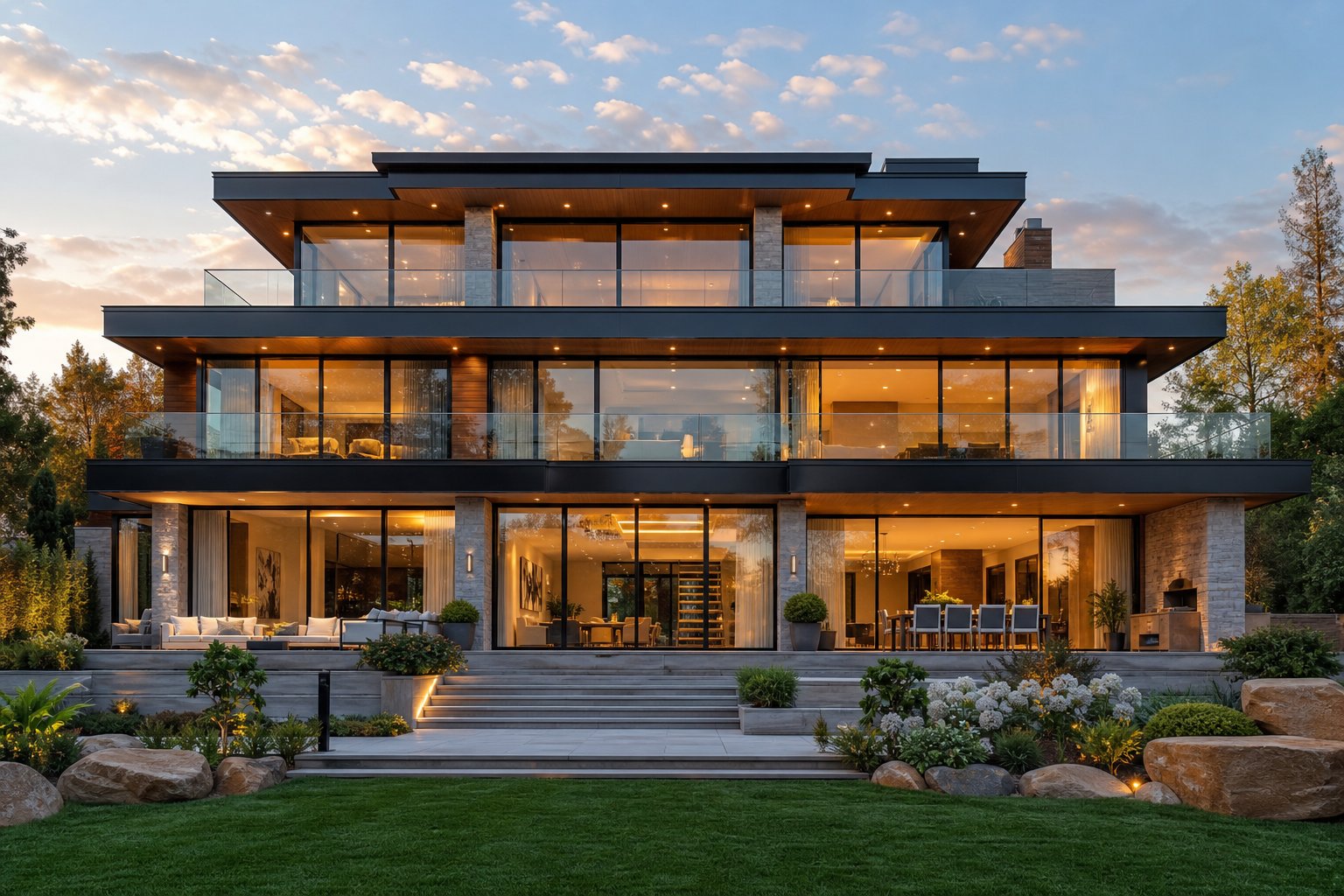
What Black Aluminium Frame Windows Are and Why They Matter
Black aluminium frame windows are window systems built from extruded aluminium profiles finished in black through powder coating, anodising, or electrophoretic deposition, then glazed with single or double-pane insulated glass units. They sit at the intersection of two distinct choices: aluminium as a structural material and black as a colour finish. Each decision carries its own implications for durability, thermal performance, and long-term appearance.
What Are Black Aluminium Frame Windows
The aluminium extrusion process produces profiles that are inherently slim yet structurally rigid. That slenderness translates directly into more visible glass area per opening compared to timber or vinyl alternatives, which require thicker frames to achieve equivalent strength. A black aluminum window with a narrow sightline of 45-55 mm can deliver noticeably more daylight and unobstructed views than a vinyl frame measuring 70-90 mm across the same opening.
This combination of structural strength and minimal visual bulk is what makes aluminium frame windows the preferred choice for large-format glazing, corner windows, and floor-to-ceiling configurations. The black finish is then applied as a separate manufacturing step, meaning the colour and the material are independent variables you can evaluate on their own merits.
Why Black Frames Dominate Modern Architecture
Black aluminium windows create bold contrast against light-coloured renders and cladding, sharpening architectural lines the way a picture frame defines a canvas. Against darker facades, they recede and let the glass become the focal point. That versatility explains why the trend spans minimalist new builds, industrial warehouse conversions, and heritage renovations seeking a contemporary edge without losing character.
The aesthetic works because black functions as a neutral anchor. It pairs with exposed concrete, warm timber, steel detailing, and coastal whites equally well. Designers and homeowners searching for black aluminum frame windows are often drawn to that industrial-modern character, but the reality is these frames adapt to far more contexts than a single style label suggests.
Choosing black aluminium involves two independent decisions — the material for structural performance and the colour for design impact — and understanding both is essential before specifying.
Getting those two decisions right means understanding how the finish is actually applied to the aluminium substrate, how different methods age over time, and what that means for your specific climate and project.
How the Black Finish Is Achieved on Aluminium Frames
The black colour on an aluminium window frame doesn't come from the metal itself. Raw aluminium is silver-grey, so achieving a deep, consistent black requires a dedicated finishing process applied after the profiles are extruded and fabricated. Three primary methods dominate the architectural window industry, and each produces a noticeably different result in terms of appearance, longevity, and repairability.
Powder Coating for Black Aluminium Frames
Powder coating is the most widely used finish for residential and commercial aluminium windows in Australia. The process works by spraying electrostatically charged dry powder particles onto the aluminium surface, then curing the coated profile in an oven at around 180-200°C. The heat melts the powder into a continuous film that bonds mechanically and chemically to the substrate.
Coating thickness typically ranges from 60 to 120 microns for architectural applications. Thicker coatings generally offer better UV resistance and longer colour retention, but quality depends heavily on pre-treatment. A black aluminium frame finished by a Qualicoat-certified applicator undergoes rigorous chemical pre-treatment, controlled application, and standardised testing that budget operations skip entirely.
Powder coating offers the widest range of black shades available to specifiers: matte, satin, semi-gloss, full gloss, and textured finishes. That flexibility makes it the default choice for most projects. Warranties from quality manufacturers typically span 15 to 25 years for colour stability and film integrity, though cheaper coaters may offer as little as 5 to 10 years.
Anodising and Electrophoresis Methods
Anodising takes a fundamentally different approach. Rather than applying a coating on top of the aluminium, the process submerges the profile in an acidic electrolyte bath and passes an electrical current through it. This converts the outer surface of the aluminium into a hard aluminium oxide layer that becomes part of the metal itself. For anodised aluminium windows, the result is a distinctive metallic-black appearance with a depth and lustre that painted finishes cannot replicate.
The oxide layer is extremely hard and scratch-resistant, and it won't peel or flake because it isn't a separate film. However, anodised aluminium frame windows come with trade-offs: colour options are limited to a narrow range of metallic tones, and repairs are difficult because the finish can't simply be touched up with paint. If a section is damaged, the entire piece may need replacement.
Electrophoretic deposition (e-coating) sits between these two methods. The aluminium is immersed in a water-based paint bath, and an electric field draws coating particles onto the surface to form a dense, uniform film — even in recesses and complex shapes that powder struggles to reach. After deposition, the profile is baked to cross-link the polymer into a durable protective layer. E-coating delivers corrosion resistance superior to standard powder coating, making it particularly relevant for coastal Australian environments where salt air accelerates degradation.
How Finish Method Affects Long-Term Durability
Here's what most installers won't discuss: a budget powder coat and a premium architectural-grade finish look identical on day one. The divergence happens over five to ten years of Australian sun exposure. Cheap coatings chalk, fade unevenly, and lose gloss. Quality coatings certified to standards like Qualicoat Class 2 or Class 3 maintain their appearance through decades of UV bombardment.
Anodised finishes resist chalking and fading better than most powder coats, but scratches show as bright aluminium lines against the dark oxide — visible and difficult to disguise. Powder coat scratches can be touched up with colour-matched repair pens or localised recoating. E-coated profiles rarely need touch-ups due to their superior adhesion and chemical resistance, though the finish is thinner than powder coating and relies on that uniformity for protection.
The table below breaks down how each method performs across the criteria that matter most when specifying an aluminium frame black finish for a long-term project.
| Criteria | Powder Coating | Anodising | Electrophoresis (E-Coating) |
|---|---|---|---|
| Appearance | Wide range — matte, satin, gloss, textured | Metallic-black with natural depth | Smooth, uniform, moderate gloss options |
| Durability | 15-25 year warranty (quality tier) | 20-30+ years; integral to metal | 15-25 years; excellent chemical resistance |
| Scratch Resistance | Moderate — surface film can chip | High — hard oxide layer | Moderate to high — thin but tough film |
| UV Stability | Good to excellent (varies by quality) | Excellent — no organic pigments to fade | Good — acrylic resins offer weather resistance |
| Cost Tier | Low to mid | Mid to high | Mid to high |
| Touch-Up Ease | Easy — repair pens and localised recoat | Difficult — cannot be recoated | Difficult — requires controlled reapplication |
For most Australian residential projects, architectural-grade powder coating strikes the best balance of cost, appearance options, and repairability. Anodised aluminium windows suit homeowners who prioritise longevity and accept the limited colour palette. E-coating tends to appear in commercial or high-exposure applications where corrosion resistance outweighs all other factors.
The finish you select also interacts with your home's architectural style and surrounding environment — factors that shape whether a matte black, satin sheen, or metallic tone will complement or clash with your design intent.
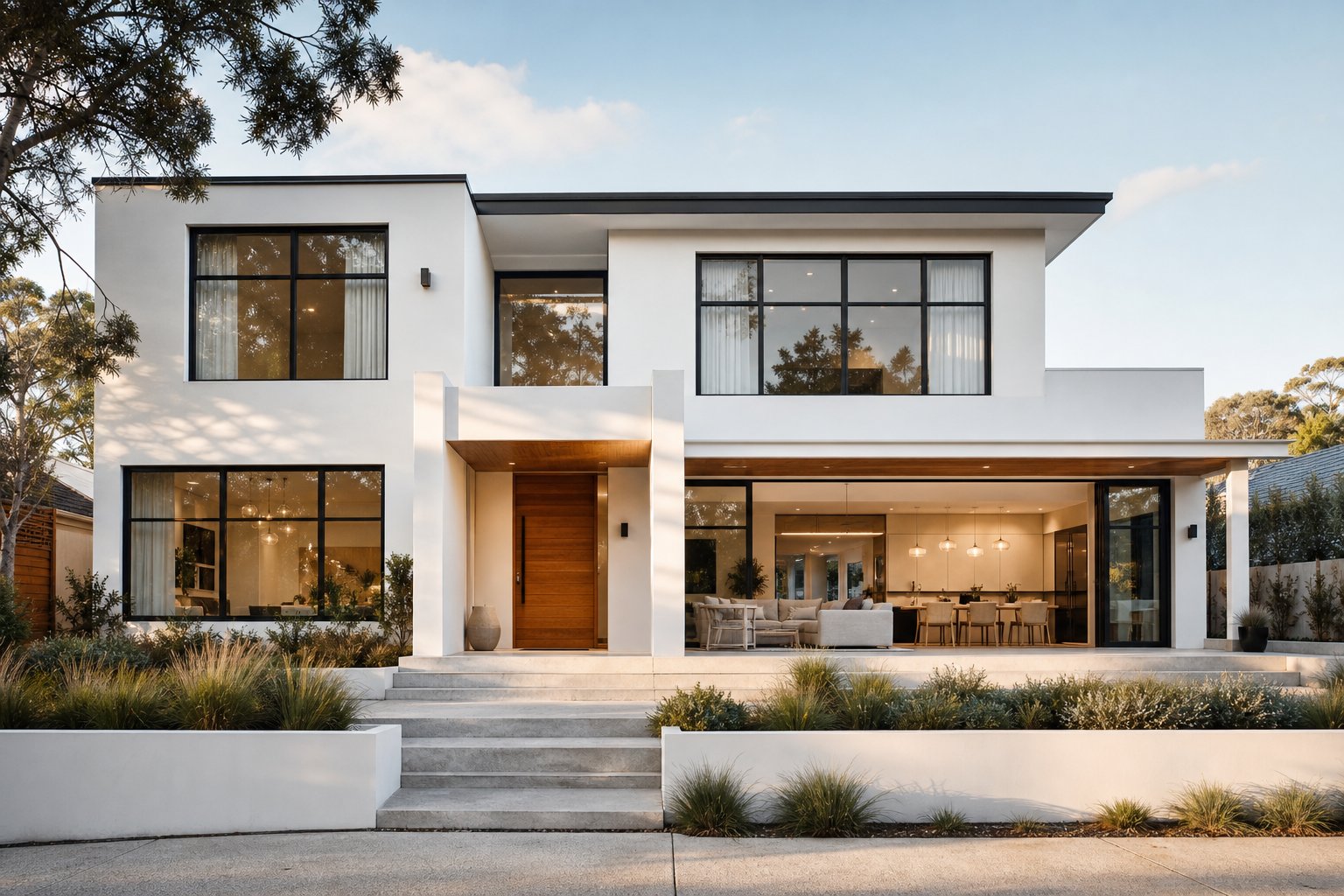
Which Home Styles Pair Best With Black Aluminium Frames
A matte black finish on a slim aluminium profile looks striking in a product brochure, but the real question is whether it will look right on your home. Architectural style dictates proportions, materiality, and visual rhythm — and black frames interact differently with each of those variables. Getting the pairing wrong can make a facade feel disjointed rather than refined.
Modern and Industrial Aesthetics
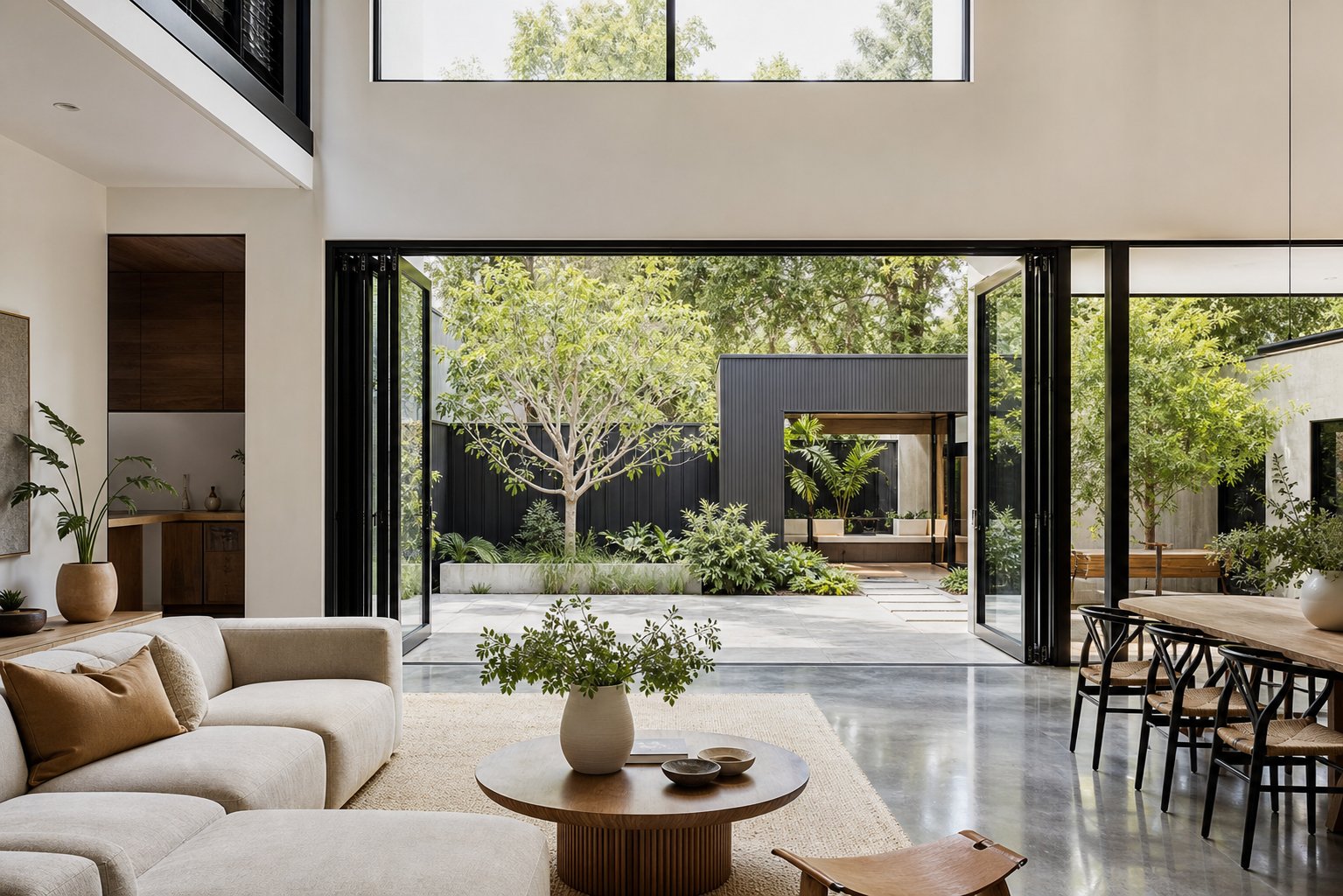
Contemporary and industrial-style homes are where black aluminium feels most at home. Flat rooflines, open-plan living areas, and large-format openings all benefit from thin frame windows that maximise glass and minimise visual interruption. The dark colour anchors expansive glazed walls without competing with the architecture, letting the building's geometry speak for itself.
Inside these homes, black framed exterior windows create a deliberate dialogue with exposed concrete, raw steel beams, and natural timber ceilings. The frames read as structural elements rather than decorative additions. Floor-to-ceiling aluminium sliding windows in matte black can dissolve the boundary between indoor and outdoor living — particularly effective in Australian climates where covered terraces and pool areas extend the living space year-round.
For industrial loft conversions and warehouse-style builds, the slim sightlines of aluminium replicate the proportions of original steel-framed factory glazing at a fraction of the cost and maintenance burden. Black metal windows exterior applications in these settings look authentic because the material genuinely belongs to the architectural language.
Farmhouse and Transitional Style Pairings
The modern farmhouse movement has embraced black aluminium with surprising enthusiasm. Where traditional farmhouses relied on chunky painted timber mullions for contrast against white weatherboard, contemporary interpretations achieve the same high-contrast aesthetic with cleaner lines and less bulk. Aluminium sliding windows in black replace heavy timber sliders, while aluminum double hung windows offer a familiar operating style wrapped in a sharper visual package.
Transitional homes — those blending traditional forms with contemporary detailing — benefit from the restraint that aluminium profiles bring. An aluminum single hung window with a black finish reads as modern without feeling alien against a pitched roof or rendered brick facade. The key is matching the window configuration to the home's proportions: double-hung and aluminium sash windows suit vertically proportioned openings, while wide sliders complement the horizontal emphasis of single-storey wings.
Heritage and Period Home Considerations
Heritage contexts demand more careful thought. Black aluminium can work beautifully in Art Deco homes, where the original steel-framed windows had similarly slim profiles and dark finishes. Purpose-designed heritage aluminium systems with stepped profiles and deeper shadow lines replicate the proportions of period metalwork while delivering modern thermal performance and weather sealing.
Warehouse conversions are another natural fit. Horizontal glazing bars and robust frame profiles in black powder coat reference the building's industrial origins without requiring the ongoing maintenance that original steel demands. However, homes in heritage overlay zones or conservation areas may face council restrictions on material changes. Always check local planning requirements before specifying — some councils require like-for-like replacement or specific colour approvals regardless of how sympathetic the design appears.
The following styles pair particularly well with black aluminium frames:
- Modern minimalist
- Industrial loft
- Coastal contemporary
- Modern farmhouse
- Transitional
- Mid-century modern
- Warehouse conversion
Style compatibility matters, but it only tells half the story. The material you choose for those black frames — aluminium, vinyl, steel, or fiberglass — determines whether the profiles can actually achieve the proportions your design requires, and at what cost.
Black Aluminium Frames Compared to Alternative Materials
Profile slimness, thermal behaviour, maintenance demands, and budget all shift dramatically depending on which material sits behind that black finish. Aluminium isn't the only option — vinyl, steel, and fibreglass all come in black — but each carries trade-offs that directly affect what your windows can achieve structurally and visually. Here's how they stack up.
Black Aluminium vs Black Vinyl Frames
Vinyl (uPVC) is the budget-friendly alternative. Its multi-chamber construction provides natural insulation without thermal breaks, and it resists rot and corrosion. For straightforward openings in mild climates, black vinyl frames deliver reasonable performance at a lower price point.
The catch is bulk. Vinyl lacks the tensile strength of aluminium, so profiles need to be thicker — typically 70-90 mm compared to aluminium's 45-55 mm — to support the same glass weight. That extra width eats into your glass area and produces chunkier sightlines that undermine the crisp, minimal aesthetic most people want from black metal frame windows. In large openings or corner configurations, vinyl simply can't span the distances aluminium handles comfortably.
Durability diverges over time, too. Black vinyl finishes are integral to the material rather than applied, which sounds like an advantage until you consider that dark-coloured vinyl absorbs more heat and is more susceptible to warping and fading than lighter shades. A quality powder-coated aluminium frame resists UV degradation far more reliably over a 20-year span, particularly under Australian sun exposure.
Black Aluminium vs Black Steel and Fibreglass
Steel delivers the thinnest profiles of any metal window frame material — sometimes as narrow as 25-35 mm — and the highest structural strength. For heritage restorations and ultra-minimalist designs, nothing else replicates those razor-thin sightlines. But steel costs significantly more, requires ongoing corrosion protection (especially in coastal zones), and weighs considerably more than aluminium, complicating installation and hardware selection.
Fibreglass bridges several gaps. It offers thermal performance comparable to vinyl, dimensional stability that matches glass expansion rates, and profiles slimmer than vinyl though still wider than aluminium. The material can be painted, won't rot, and handles extreme temperatures without warping. Its limitations are availability and cost — fewer Australian suppliers stock fibreglass systems, and pricing sits at the premium end alongside timber-clad options.
Aluminium windows occupy the most versatile middle ground for residential and commercial projects. They deliver slim profiles, excellent corrosion resistance, decades of low-maintenance service, and the widest range of configurations — from sliding and awning to casement and fixed-lite systems. When specified with thermally broken profiles, aluminium closes the insulation gap that historically favoured vinyl and fibreglass.
Choosing the Right Material for Your Project
The table below compares all four materials across the criteria that matter most when specifying metal framed windows in black. Aluminium leads the comparison as the most broadly applicable option for Australian conditions.
| Criteria | Aluminium | Vinyl (uPVC) | Steel | Fibreglass |
|---|---|---|---|---|
| Profile Thickness | 45-55 mm (slim) | 70-90 mm (bulky) | 25-35 mm (ultra-slim) | 55-70 mm (moderate) |
| Thermal Performance | Good with thermal break (U-value 0.8-2.0) | Good inherently (U-value 0.7-1.5) | Moderate with thermal break (U-value 1.5-2.5) | Excellent (U-value 0.7-1.4) |
| Weight | Light | Light | Heavy | Moderate |
| Maintenance | Minimal — occasional cleaning | Minimal — occasional cleaning | Moderate — corrosion monitoring | Minimal — occasional cleaning |
| Lifespan | 40-60 years | 20-40 years | 50+ years | 40+ years |
| Cost Range (AUD, supply) | Mid-range | Budget to mid | Premium to high-end | Premium |
| Style Versatility | Very high — all window types | Moderate — limited by profile bulk | Moderate — mostly fixed and casement | Moderate — limited supplier range |
Aluminium's configurability is a genuine differentiator. Australian suppliers like MEICHEN offer custom aluminium window systems across sliding, awning, casement, and fixed configurations — all available with thermally broken profiles and a full palette of black finishes. That breadth means a single supplier can cover every opening type on a project, simplifying procurement and ensuring consistent aesthetics from facade to facade.
For most Australian homes, aluminium windows deliver the best balance of slim sightlines, durability, thermal compliance, and design flexibility. Vinyl makes sense where budget is the overriding constraint and openings are modest. Steel belongs in bespoke architectural statements where cost is secondary. Fibreglass suits extreme climates if you can source it locally.
Material choice sets the structural boundaries of your project. But even within aluminium, performance varies enormously depending on one factor most buyers overlook: whether the frame includes a thermal break — and how that break performs in your specific climate zone.
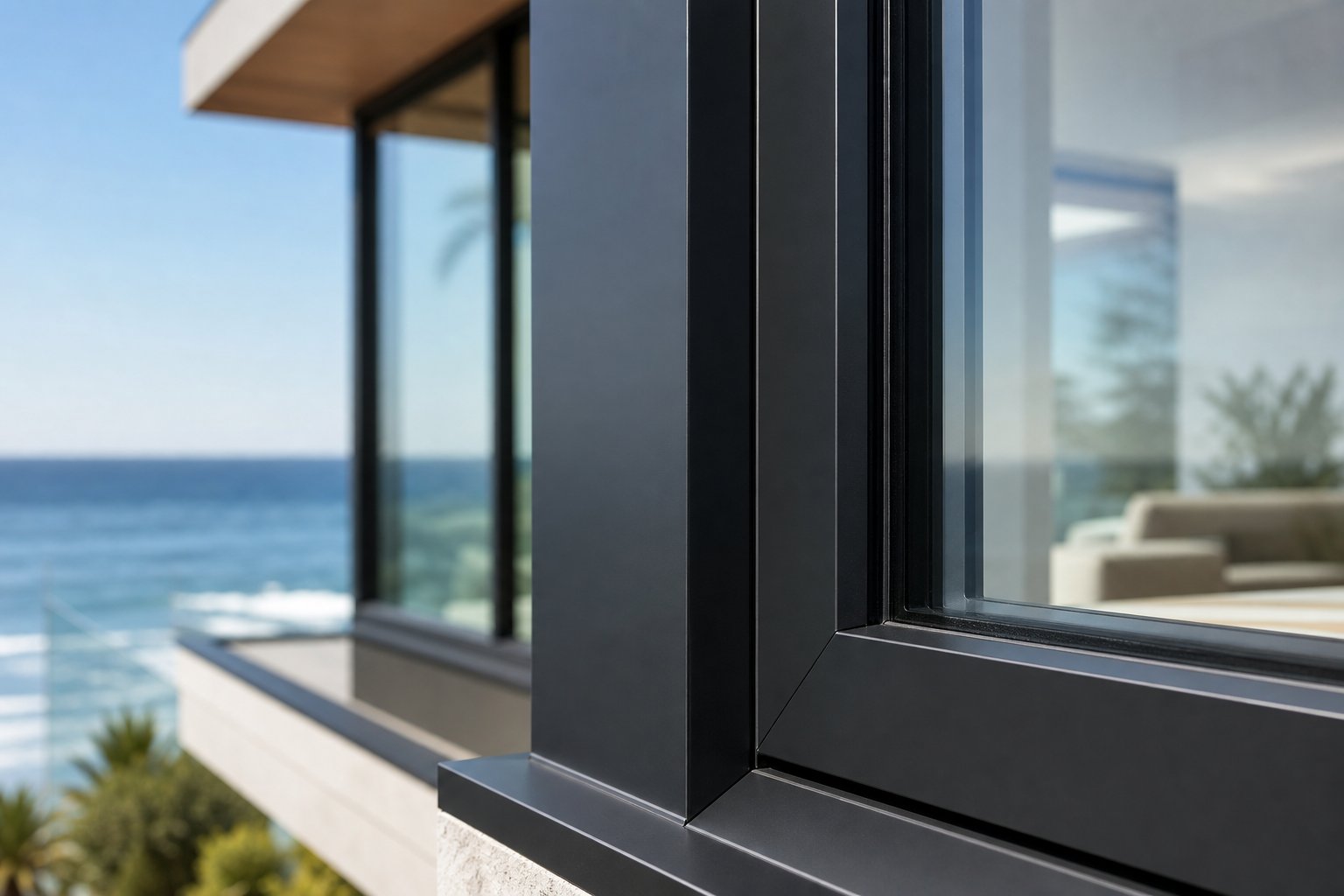
Climate Performance and Thermal Break Technology
Aluminium is strong, lightweight, and corrosion-resistant — but it conducts heat roughly 1,000 times more readily than the polyamide insulators used to counteract that property. That conductivity is the single biggest performance variable in aluminium window frames, and it's the one most buyers fail to investigate before signing a quote.
Thermal Bridging Explained for Aluminium Frames
A thermal bridge forms whenever a conductive material creates an uninterrupted path between the warm side and the cold side of a building envelope. In a standard aluminium frame without intervention, heat travels straight through the window frame metal from your air-conditioned interior to the outside air — or vice versa in winter. The result is energy loss, uncomfortable cold or hot spots near windows, and condensation forming on interior frame surfaces when humidity is high.
Thermally broken profiles solve this by physically splitting the aluminium extrusion into two separate sections — interior and exterior — connected only by a continuous strip of polyamide (glass-fibre-reinforced nylon) or polyurethane. That insulating barrier reduces frame conductance by up to 60%, bringing aluminium's thermal performance in line with inherently insulating materials like vinyl. Premium systems use thermal breaks ranging from 20 mm to 35 mm in width, creating substantial insulation zones within the profile.
Non-thermally-broken aluminium — the type found in old aluminum windows from the 1970s through 1990s and budget imports today — remains suitable for mild climates with minimal heating or cooling demand. But anywhere energy codes are enforced or comfort expectations are high, it falls short. Single pane aluminum windows without thermal breaks represent the worst-case scenario for energy performance: maximum conductance through both the frame and the glazing.
Climate Suitability for Black Aluminium Windows
Black aluminium frame windows perform differently depending on where in Australia you install them. The colour itself introduces a variable most people overlook: black surfaces absorb significantly more solar radiation than lighter colours, raising frame surface temperatures on sun-exposed facades. In practice, quality aluminium handles this thermal expansion without distortion, but it does mean the frame radiates more heat toward the glass edge — another reason thermal breaks matter in hot climates.
Here's how suitability breaks down by environment:
- Coastal zones (Sydney, Gold Coast, Perth coast): Aluminium resists salt-air corrosion far better than steel or timber. Specify marine-grade powder coating or e-coating for properties within 500 metres of the waterfront. Aluminum frame glass assemblies with quality seals prevent salt ingress into the glazing cavity.
- Hot inland climates (western Sydney, central Queensland): Thermal breaks are essential to prevent heat conducting inward through sun-baked frames. Pair with low-E glass and consider satin or matte black finishes that absorb marginally less radiation than gloss.
- Cold climates (Canberra, Hobart, alpine regions): Thermally broken profiles become non-negotiable. Without them, interior frame surfaces drop below dew point in winter, causing persistent condensation and potential mould growth around the frame perimeter.
- Humid tropical zones (Cairns, Darwin): Aluminium's immunity to rot gives it a decisive advantage over timber. Ensure drainage channels in the frame are unobstructed and specify hardware rated for high-humidity environments.
- Bushfire-prone areas: Aluminium is non-combustible and meets BAL (Bushfire Attack Level) requirements more readily than vinyl or timber frames. Check that glazing and seals also comply with AS 3959.
Energy Ratings and Building Code Compliance
Australia's National Construction Code now mandates 7-star energy ratings for new homes, and windows account for up to 40% of a home's total energy loss or gain. Two metrics determine whether your aluminium window frames will comply:
U-value measures how much heat passes through the entire window assembly (frame plus glass) per square metre. Lower numbers mean better insulation. Non-thermally-broken aluminium typically delivers U-values of 5.0-7.0 W/m²K — well outside compliance for most climate zones. Thermally broken systems drop that to 1.5-2.5 W/m²K, and premium configurations with double glazing and low-E coatings can achieve below 1.5 W/m²K.
SHGC (Solar Heat Gain Coefficient) measures how much solar energy passes through the window. In cooling-dominated climates like northern Australia, a lower SHGC reduces air-conditioning load. In heating-dominated climates like Victoria and Tasmania, a higher SHGC lets beneficial winter sun in. The frame material doesn't directly control SHGC — that's primarily a glass selection decision — but the aluminum frame glass interface and thermal break design influence edge-of-glass temperatures and overall system performance.
The Window Energy Rating Scheme (WERS) rates windows on a 10-star scale for both heating and cooling performance, giving Australian buyers a standardised way to compare products. When evaluating black aluminium frame windows, always ask for the WERS rating of the complete assembly — not just the glass or the frame in isolation. A window that meets compliance in Melbourne's climate zone may fall short in Brisbane's, and vice versa.
Thermal performance determines whether your windows pass inspection and deliver comfort. But it also feeds directly into cost — because thermally broken profiles, quality glazing, and certified finishes all carry price premiums that buyers need to budget for realistically.
Cost Factors and Budget Planning for Black Aluminium Windows
Thermally broken profiles, quality glazing, and certified finishes all cost more than their basic counterparts — but how much more, and where should you allocate your budget? Pricing for black aluminium frame windows varies so widely that a single number is meaningless without context. The real question isn't just how much do black windows cost, but what's driving the price on your specific quote.
What Drives the Cost of Black Aluminium Windows
Six primary factors determine black window prices for any given project:
- Window size and configuration: A fixed-lite picture window is the simplest and cheapest to manufacture. Operable windows — casement, awning, sliding, double-hung — require complex hardware, balancing systems, and weather seals that add 20-35% over a fixed unit of the same dimensions.
- Glass specification: Double glazing with a low-E coating is standard for most Australian residential projects. Stepping up to triple glazing adds 25-40% to the glass component cost. Laminated or acoustic glass carries further premiums.
- Thermal break inclusion: Industry data suggests thermally broken frames run 15-50% higher than non-broken equivalents, depending on whether you're specifying a basic polyamide strip or an advanced multi-chamber barrier.
- Hardware quality: Budget friction stays versus premium German-engineered systems (Roto, Siegenia) create a meaningful cost gap, particularly on tilt-and-turn or large sliding configurations.
- Finish quality tier: The black colour itself adds minimal cost — typically 5-10% over standard silver or white in powder coating. However, specifying an anodised black or marine-grade finish for coastal properties carries a more noticeable premium.
- Installation complexity: Labour accounts for roughly 30-40% of total project expenditure. Full-frame tear-outs, difficult access, brick or rendered walls, and high-level openings requiring scaffolding all push installation costs upward.
Budget Expectations Across Project Types
In the Australian market, black aluminium sits in the mid-range between budget vinyl and premium steel or timber-clad options. Indicative supply-and-install pricing for thermally broken black aluminium windows in standard residential sizes typically falls between $800 and $2,500 AUD per opening, with the wide spread reflecting the variables listed above. Non-thermally-broken units for garages, sheds, or tropical climates where insulation demands are lower start from around $500-$900 AUD installed.
Project economics shift depending on scale. A homeowner replacing a single window during a renovation faces higher per-unit costs because mobilisation, scaffolding, and finishing work get absorbed by one opening. A new build specifying 20 or more units benefits from volume pricing, streamlined installation sequences, and reduced per-window labour — often bringing the effective cost down 15-25% compared to one-off aluminum window replacement projects.
Black window frames cost roughly the same as any other colour in the same quality tier. The colour decision is essentially free within powder coating; it's the underlying specification — thermal break, glass, hardware — that moves the needle. Buyers searching for cheap black windows should understand that meaningful savings come from specification choices, not from finding a supplier willing to cut corners on the finish.
Getting Value Without Overpaying
Affordable black windows don't require sacrificing performance. They require strategic prioritisation. The following cost-saving approaches maintain quality where it matters most while trimming expenditure where the impact is minimal:
- Prioritise thermal breaks and glass performance over window style. A fixed window with excellent glazing outperforms an expensive operable unit with basic glass. Use fixed lites where ventilation isn't needed and save operable hardware for key openings.
- Standardise sizes where possible. Custom dimensions incur tooling and fabrication premiums. Working with your architect to align openings with standard profile sizes can reduce material costs without compromising design intent.
- Compare like-for-like specifications. Get at least three itemised quotes that break out frame system, glass unit, hardware, finish standard, and installation scope separately. The cheapest headline number often hides thinner profiles, inferior powder coating, or excluded items.
- Ask about finish warranty duration and exclusions. A 25-year finish warranty from a Qualicoat-certified applicator protects your investment far better than a 10-year warranty from an uncertified coater — and the upfront cost difference is often modest.
- Consider black frame replacement windows strategically. If your existing frames are structurally sound, insert replacements (fitting new sashes into existing sub-frames) halve the labour cost compared to full-frame tear-outs. Not every aluminum replacement windows project requires starting from scratch.
- Bundle your order. Specifying all windows from a single supplier for a whole-house project unlocks volume discounts and ensures consistent colour matching across every opening.
The cheapest quote rarely represents the best value over a 20-year ownership period. A slightly higher upfront spend on certified finishes, quality hardware, and proper thermal breaks pays dividends through lower energy bills, fewer maintenance interventions, and warranty coverage that actually holds up when you need it.
Budget clarity helps you spend wisely — but even well-funded projects go wrong when buyers fall for common misconceptions about how these windows perform and what specifications actually matter.
Common Mistakes When Choosing Black Aluminium Windows
Spending wisely is one thing. Spending based on false assumptions is another entirely. The most expensive mistakes in window procurement rarely come from choosing the wrong colour or style — they come from misunderstanding what's behind the glass. Here are the errors that catch buyers out repeatedly, and how to sidestep each one.
Assuming All Black Finishes Are Equal
Two black aluminium framed windows can look identical in a showroom and diverge dramatically after five years on a sun-drenched facade. The difference lies in finish certification, not appearance. A budget powder coat applied without proper pre-treatment begins chalking — developing a whitish haze on the surface — once UV radiation breaks down the binder in the coating. Qualicoat's classification system quantifies this: Class 1 coatings suit standard installations, while Class 2 and Class 3 formulations use more robust materials engineered for decades of exposure on prestigious buildings.
The pre-treatment step matters just as much as the powder itself. Without thorough chemical preparation of the aluminium substrate, the coating loses adhesion over time — even if the powder quality is high. Certified applicators undergo independent inspections to verify their pre-treatment processes meet specification. Budget operators skip this entirely, and you won't notice until the finish starts lifting years later. When comparing quotes for residential aluminium windows, always ask which coating standard applies and whether the applicator holds third-party certification.
Overlooking Thermal Break Requirements
Buyers fixate on colour, profile style, and price — then discover at inspection that their frames don't meet the National Construction Code's energy requirements. In climate zones where NCC mandates minimum thermal performance (which now covers most of Australia under the 7-star standard), non-thermally-broken aluminum framed windows simply won't pass certification. The result is costly retrofitting or outright replacement before you can obtain an occupancy certificate.
Condensation is the early warning sign. If moisture forms on the interior face of your aluminium frames during cool mornings, the frame is conducting exterior cold directly inward. Beyond the aesthetic nuisance of water dripping onto sills, persistent condensation promotes mould growth in surrounding plaster and timber reveals. For anyone upgrading old aluminum window frames from the 1980s or 1990s — the era of single-glazed, non-broken aluminium — the thermal break is the single most important specification upgrade, more impactful than the glass or the colour.
Ignoring Warranty Terms and Conditions
A 15-year finish warranty sounds reassuring until you read the exclusions. Industry analysis of warranty documents reveals that many standard warranties exclude coastal salt damage unless marine-grade finishes were specified, void coverage if maintenance schedules aren't followed, and limit claims to the original purchaser only. Properties within 500 metres of the waterfront face the highest risk of discovering their warranty doesn't cover the exact conditions their windows endure daily.
Maintenance-related voiding catches homeowners off guard most often. Many warranties require annual cleaning with pH-neutral solutions and prohibit abrasive or chemical cleaners. Failing to clean framed windows as specified — or allowing glass-cleaning residue to sit on powder-coated surfaces — can technically void your coverage. The best aluminium windows in the world won't protect your investment if the warranty lapses because you didn't read the maintenance clause.
Before signing any contract, request the full warranty document — not a summary — and check these specifics:
- All black finishes are the same — they aren't; certification tier determines longevity
- Black frames always get hotter and cause problems — quality aluminium handles thermal expansion without distortion
- Aluminium windows are always cold — thermally broken profiles eliminate this issue entirely
- Cheaper is always worse value — a well-specified mid-range product often outperforms a poorly specified premium one
- Expensive always means better — price doesn't guarantee correct specification for your climate or location
Each of these misconceptions leads buyers toward decisions based on incomplete information. The antidote is straightforward: ask precise questions, demand documentation, and verify that what you're paying for matches what your project actually requires. Knowing which questions to ask — and what answers to expect — separates informed buyers from those who learn expensive lessons after installation.
How to Specify and Source Black Aluminium Frame Windows
Asking the right questions before you sign a contract is worth more than any amount of research after installation. The specification and procurement process separates buyers who get exactly what they need from those who discover gaps months later — when condensation appears, finishes degrade, or a warranty claim gets rejected on a technicality. Whether you're a homeowner managing a renovation, a builder coordinating a multi-dwelling project, or an architect specifying for a client, the process below gives you a structured framework for getting it right.
Questions to Ask Your Window Supplier
Most aluminium window suppliers will walk you through their product range and quote a price. Fewer will volunteer the technical detail that determines whether those windows perform as expected over 20 years. These questions force that detail to the surface:
- What powder coating standard do you use, and is your applicator independently certified? Look for Qualicoat Class 2 or higher for residential applications. If the supplier can't name their coating standard, treat that as a red flag.
- Is the profile thermally broken, and what is the thermal break width? A 20 mm polyamide break is the minimum for most Australian climate zones. Premium systems use 24-35 mm breaks for superior insulation.
- What is the finish warranty period, and what specifically voids it? Get the full warranty document — not a brochure summary. Check coastal exclusions, maintenance requirements, and transferability if you sell the property.
- Can you provide test certificates for thermal and acoustic performance? Reputable aluminium window manufacturers hold AS 2047 compliance certificates and can supply U-value and SHGC data for the complete window assembly, not just the glass.
- What lead time should I expect for custom sizes and black finishes? Standard sizes in common colours may ship in 2-4 weeks. Custom configurations and specific black shades (matte, satin, textured) can extend to 6-10 weeks depending on the manufacturer's schedule.
- Do you offer project-specific engineering for large openings or structural glazing? Oversized sliding doors, corner windows, and stacking systems require engineering calculations for wind load and deflection. Not every aluminium window supplier has this capability in-house.
- What hardware brand and grade is included in the quoted price? Budget hardware is the most common area where suppliers cut costs invisibly. Ask for the brand name and confirm it's rated for the window size and operating frequency your project demands.
A supplier who answers these questions confidently and provides documentation without hesitation is demonstrating the transparency that industry experts identify as the clearest marker of reliability. One who deflects or generalises is telling you something equally important.
Specification Checklist for Builders and Architects
Verbal agreements and vague line items on quotes lead to disputes during construction. A written specification locks in exactly what you're purchasing and gives you recourse if what arrives on site doesn't match. The table below provides a template you can adapt for any project involving aluminium doors and windows — residential or commercial.
| Specification Item | Minimum Requirement | Notes |
|---|---|---|
| Profile system and series | Named system (e.g., specific manufacturer series) | Avoid generic "aluminium frame" descriptions — demand the exact product line |
| Thermal break | Polyamide strip, minimum 20 mm width | Confirm break is continuous, not intermittent; verify NCC compliance for your climate zone |
| Glass specification | Double-glazed IGU, Low-E coating, argon fill | Specify glass thickness, spacer type, and SHGC target based on orientation |
| Hardware grade | Named brand, rated for window size and cycle count | Confirm corrosion rating for coastal or high-humidity locations |
| Finish standard | Qualicoat Class 2 minimum; marine grade if within 500 m of coast | Specify exact black shade (matte, satin, gloss) and confirm colour code |
| Finish warranty | Minimum 15 years for colour stability and film integrity | Request full warranty document including exclusions and maintenance obligations |
| Compliance certificates | AS 2047, AS 1288, WERS rating for complete assembly | Certificates must cover the specific configuration ordered, not a generic product family |
| Installation methodology | Full-frame or insert; flashing and sealing method specified | Confirm who is responsible for waterproofing integration with the building envelope |
| Acoustic performance | Rw rating appropriate for site noise exposure | Relevant for properties near roads, flight paths, or commercial zones |
This checklist works equally well for aluminium windows and doors specified together on a project. Consistency across window and door systems — same profile series, same finish batch, same hardware family — ensures uniform appearance and simplifies future maintenance or part replacement.
Finding the Right Supplier for Your Project
Not every aluminium window manufacturer operates at the same level. Some specialise in volume production of standard sizes. Others focus on custom architectural work with project-specific engineering support. Matching your project's complexity to a supplier's actual capability prevents the frustration of discovering mid-build that your supplier can't deliver what was quoted.
Five characteristics distinguish quality aluminium window suppliers from order-takers:
- Range of window types: A supplier offering sliding, awning, casement, fixed, and double-hung configurations from a single profile system gives you design flexibility without introducing inconsistencies across your facade.
- Custom sizing capability: Standard sizes suit some projects, but Australian homes — particularly renovations of older brick veneer or weatherboard properties — frequently need non-standard dimensions. Confirm the supplier manufactures to order rather than stocking only fixed sizes.
- Thermal break options: The best aluminium doors and windows suppliers offer both standard and thermally broken variants, allowing you to specify performance levels appropriate to each elevation and climate zone rather than paying for thermal breaks where they aren't needed.
- Project support for builders and architects: Technical drawings, wind-load calculations, compliance documentation, and installation guidance should come as part of the service — not as an afterthought or an additional charge.
- Transparent warranty terms: As discussed earlier, warranty clarity is non-negotiable. Suppliers confident in their product publish full warranty conditions openly and explain exclusions upfront.
For Australian residential and commercial builds, MEICHEN's aluminium windows range demonstrates what a full-service supplier looks like in practice — covering sliding, awning, casement, fixed, and double-hung types with custom sizing, thermally broken profiles, and project support for builders and architects. Their aluminium windows page is a practical starting point for readers ready to explore specific configurations and get project-specific guidance on aluminium windows and doors for their build.
Regardless of which supplier you engage, the procurement process should follow a consistent sequence: define your specification using the checklist above, request itemised quotes from at least three aluminium window suppliers, verify compliance documentation before committing, and confirm lead times against your construction programme. Rushing this process — or skipping the specification step entirely — is how projects end up with windows that look right on delivery day but underperform for the next two decades.
The difference between a good outcome and a costly mistake rarely comes down to the product itself. It comes down to whether the buyer knew what to ask for, put it in writing, and verified that what arrived matched what was specified. That discipline applies whether you're ordering three aluminum doors and windows for a granny flat or sixty units for a multi-storey development.
Frequently Asked Questions About Black Aluminium Frame Windows
1. Do black aluminium window frames get hotter than lighter colours?
Black surfaces absorb more solar radiation than lighter colours, which raises the frame's surface temperature on sun-exposed facades. However, quality aluminium profiles are engineered to handle thermal expansion without warping or distortion. The real concern isn't the frame itself overheating — it's the additional heat conducted inward through the frame toward the glass edge. This is why thermally broken profiles become especially important for black aluminium windows in hot Australian climates. A polyamide thermal break separates the exterior and interior aluminium sections, preventing that absorbed heat from transferring into your living space. Pairing a matte or satin black finish with a thermally broken profile and low-E glass effectively neutralises any comfort penalty from the darker colour.
2. How long does the black finish last on aluminium windows?
Longevity depends entirely on the finishing method and quality tier. Architectural-grade powder coating certified to Qualicoat Class 2 or Class 3 standards typically carries a 15 to 25 year warranty for colour stability and film integrity, with real-world performance often exceeding that in non-coastal environments. Anodised black finishes can last 20 to 30 years or more because the colour is integral to the metal's oxide layer rather than a separate film. Budget powder coatings without proper pre-treatment or certification may begin chalking and fading within 5 to 10 years under Australian UV exposure. For coastal properties within 500 metres of the waterfront, marine-grade finishes or electrophoretic coatings offer superior corrosion resistance and extended service life.
3. Are black aluminium windows more expensive than white or silver?
Within powder coating, the colour itself adds minimal cost — typically only 5 to 10 percent over standard white or silver finishes. The black colour is essentially a free choice when you're already specifying powder-coated aluminium. What actually drives price differences is the underlying specification: whether the frame includes a thermal break, the glass type (double or triple glazed, low-E coatings), hardware quality, and installation complexity. Anodised black finishes do carry a more noticeable premium over standard powder coating due to the specialised electrochemical process involved. So while searching for the cheapest black option, buyers should focus on specification choices rather than colour — that's where meaningful cost variation occurs.
4. Do black aluminium windows cause condensation problems?
Condensation on aluminium window frames is a thermal break issue, not a colour issue. When a non-thermally-broken aluminium frame conducts cold exterior temperatures directly to the interior surface, that surface drops below the dew point and moisture forms. This happens regardless of whether the frame is black, white, or silver. Thermally broken profiles solve the problem by inserting a polyamide or polyurethane insulating strip between the interior and exterior aluminium sections, keeping the indoor surface warm enough to prevent condensation. In Australian climate zones where the National Construction Code mandates minimum thermal performance — which now covers most of the country under 7-star energy ratings — thermally broken frames are effectively required. If you're upgrading older single-glazed aluminium windows, specifying a thermal break is the single most impactful upgrade for eliminating condensation.
5. What window styles work best with black aluminium frames?
Black aluminium frames suit a surprisingly broad range of architectural styles beyond the obvious modern and industrial aesthetics. Contemporary minimalist homes benefit from slim black profiles that maximise glass area across floor-to-ceiling configurations. Modern farmhouse designs use black aluminium sliding and double-hung windows to achieve high-contrast aesthetics with cleaner lines than traditional timber. Transitional homes blend traditional forms with contemporary detailing through black casement and awning windows. Heritage contexts like Art Deco homes and warehouse conversions work well with slim-profile black aluminium that replicates original steel-frame proportions. Coastal contemporary homes pair black frames with light renders and natural timber. Australian suppliers like MEICHEN offer the full range of window types — sliding, awning, casement, fixed, and double-hung — in black finishes, allowing consistent aesthetics across any architectural style.