
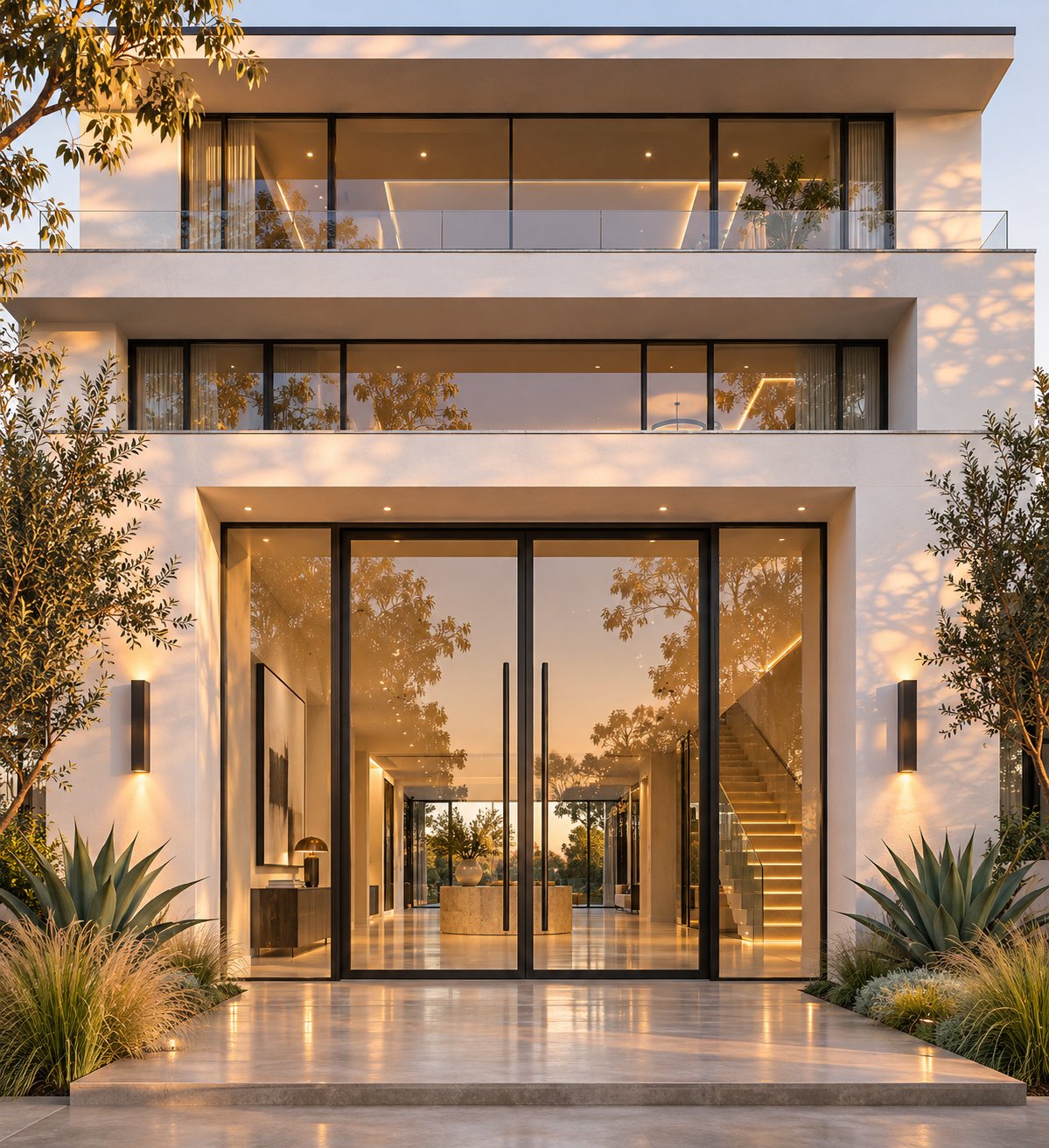
What Is an Aluminium Front Door and Why It Matters
An aluminium front door is a residential or commercial entry door constructed from extruded aluminium profiles, typically paired with glass panels, insulated cores, or decorative elements to serve as the primary exterior door of a building. Unlike lightweight screen or storm doors, a modern aluminium front door is engineered for security, thermal performance, and long-term durability — making it a genuine alternative to timber, steel, and fibreglass options.
What Makes an Aluminium Front Door Different
The core of every aluminium entry door frame starts with extrusion — a manufacturing process that forces aluminium alloy through a shaped die to create precise, hollow profiles. These profiles form the structural skeleton of the door, and their geometry can be tailored for strength, slim sightlines, or accommodating large glass panels.
Several key features distinguish a quality aluminium front exterior door from other materials:
- Thermal breaks: A reinforced polyamide or polyurethane strip inserted between the inner and outer aluminium profiles, interrupting heat transfer through the frame.
- Glazing options: Single, double, or triple-glazed insulated glass units (IGUs) with Low-E coatings and argon gas fills.
- Finish treatments: Powder coating in virtually any RAL colour, or anodising for a natural metallic appearance — both providing excellent UV and corrosion resistance.
A common misconception is that aluminium door frames belong only on storm doors or screen doors. That assumption stems from older, non-thermally-broken aluminium products that were thinner and less insulated. Today's thermally broken aluminium entry systems are a different category entirely — purpose-built as the main door for front entrances on everything from coastal homes to multi-storey apartment buildings. The distinction between a secondary storm door and a primary aluminium entry door is significant, and understanding it helps homeowners avoid comparing products that serve fundamentally different roles.
Why Homeowners and Architects Are Choosing Aluminium
Across Australia, architects and homeowners are increasingly specifying aluminium for front entry doors. The reasons are practical rather than purely aesthetic. Aluminium's strength-to-weight ratio allows manufacturers to create slimmer frame profiles without sacrificing structural integrity — which means more visible glass area and cleaner architectural lines. Corrosion resistance makes it particularly well-suited to coastal and humid Australian climates, where timber can swell, warp, or attract mould, and steel can rust without rigorous maintenance.
Unlike wood or fibreglass, aluminium front doors resist warping, rotting, and cracking while supporting larger glass panels for maximum natural light.
Design flexibility is another driver. A single aluminium door system can be powder-coated in matte black, white, bronze, or a custom colour to suit any facade — from a contemporary double-storey build to a renovated brick veneer home. The Spanish-speaking community may recognise this material under the term puerta de aluminio, reflecting its global popularity in residential construction.
This article breaks down everything you need to know before choosing an aluminium front door: how it stacks up against competing materials, the styles and configurations available, energy performance and thermal break technology, security features, climate suitability across Australian regions, realistic cost factors, a step-by-step selection guide, and essential terminology every buyer should understand.
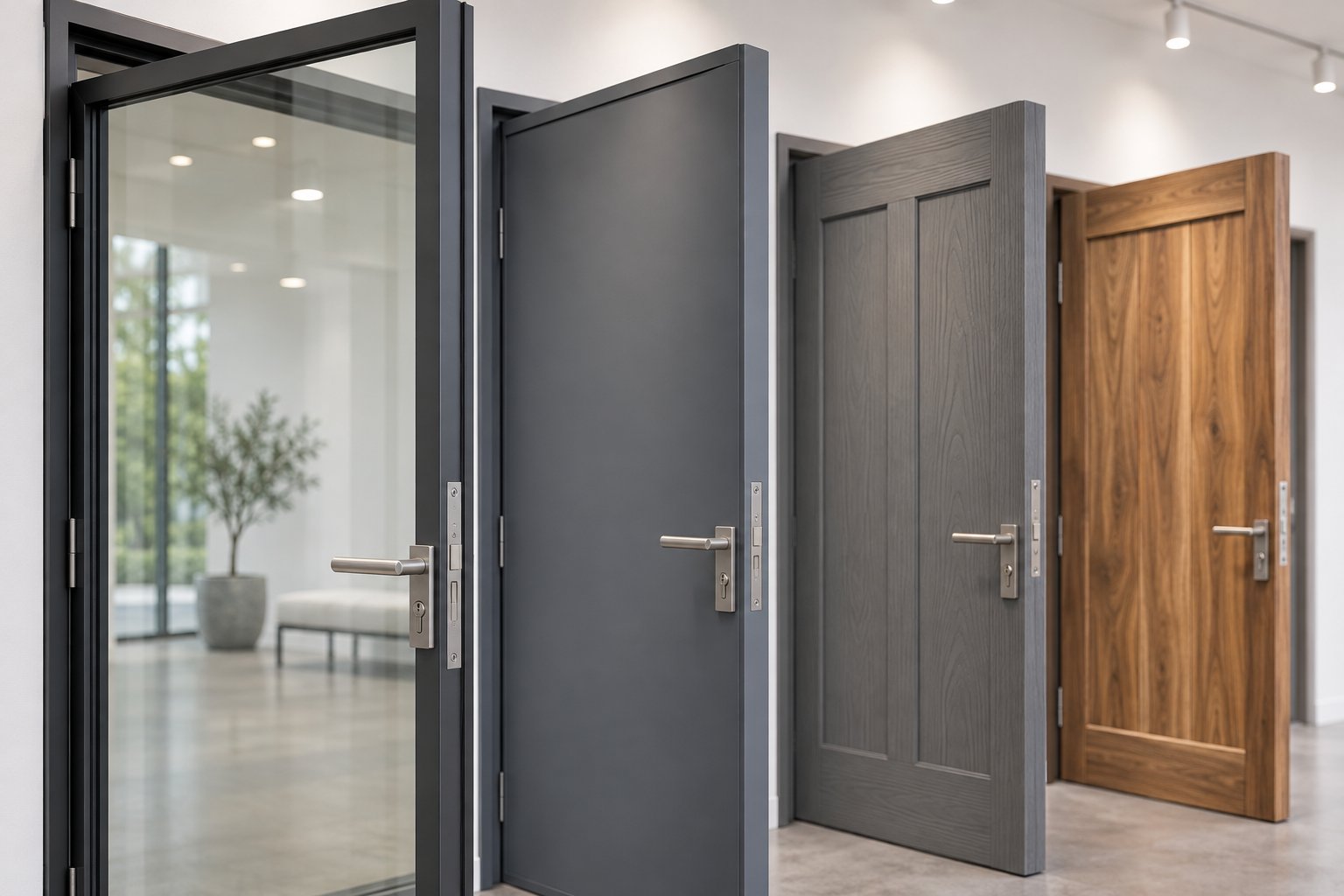
How Aluminium Compares to Steel, Fibreglass, and Wood
Knowing what an aluminium front door is only gets you halfway. The real decision starts when you hold it up against the other materials competing for the same spot in your entryway. Steel, fibreglass, and timber each bring something legitimate to the table — and aluminium isn't automatically the right pick for every home. An honest side-by-side comparison is the fastest way to figure out which material actually fits your situation.
Aluminium Against Steel, Fibreglass, and Wood
The table below compares the four most common front door materials across the criteria that matter most during selection. Rather than quoting specific dollar figures — which shift with supplier, configuration, and region — it uses qualitative descriptors so you can focus on relative positioning. For precise R-values or weight data, always request the manufacturer's product data sheet for the exact door configuration you're considering.
| Criteria | Aluminium | Steel | Fibreglass | Timber |
|---|---|---|---|---|
| Durability | High — resists corrosion, warping, and cracking | High — very rigid, but vulnerable to rust if coating is damaged | High — strong impact and dent resistance | Moderate — susceptible to swelling, rot, and insect damage without regular maintenance |
| Weight | Low to moderate — excellent strength-to-weight ratio | Heavy — noticeably heavier than other options | Low to moderate | Moderate to heavy, depending on species |
| Thermal Performance | Good with thermally broken profiles; bare aluminium is highly conductive | Good when paired with an insulated core | Good — insulated cores are standard | Naturally insulating; performance varies by species and construction |
| Maintenance Requirements | Low — periodic cleaning; powder coat protects the finish | Moderate — protective coatings need periodic inspection and touch-ups | Low — occasional cleaning; may need paint touch-ups over time | High — regular sealing, staining, or painting required |
| Corrosion Resistance | Excellent — natural oxide layer plus finish treatment | Low to moderate — steel rusts without intact protective coatings | High — does not corrode | Low — vulnerable to moisture damage and mould |
| Design Flexibility | Very high — slim profiles, custom sizes, large glass areas, pivot formats, broad colour range | Moderate — better suited to solid, rigid designs | Moderate — available in painted or wood-grain finishes | High for traditional detailing; natural grain is unmatched |
| Estimated Lifespan | 30+ years with proper finish care | 20–30 years, depending on environment and maintenance | 25–30+ years | 20–40+ years with diligent upkeep |
| Relative Cost Range | Medium to High | Low to Medium | Medium to High | Medium to Very High (species-dependent) |
A few things jump out. Aluminium and fibreglass both score well on corrosion resistance and low maintenance, yet fibreglass holds an edge in raw dent resistance — a practical consideration for busy households with children or pets. Steel delivers unmatched rigidity at a lower price point but demands more attention in coastal or humid climates where protective coatings can break down. Timber remains the gold standard for natural warmth and traditional craftsmanship, though its maintenance cycle is significantly higher than any of the manufactured alternatives.
Where aluminium genuinely separates itself is in design flexibility. The extrusion process produces slimmer frame profiles than steel or fibreglass can typically achieve, which is precisely why an aluminium door with glass — especially large-format or floor-to-ceiling panels — delivers more visible glazing area and cleaner sightlines. That characteristic makes it the go-to material when architects want the entryway to feel open and light-filled rather than framed by bulky profiles.
When Aluminium Is the Stronger Choice
Material comparisons only become useful when you overlay them onto real-world conditions. Aluminium doesn't need to win every category — it just needs to win the ones that matter for your specific project. Here are the scenarios where it consistently outperforms:
- Coastal and salt-air environments: Aluminium's natural oxide layer and powder-coated finishes resist salt spray corrosion far better than steel, making it a reliable option for beachside homes along the Australian coastline.
- Modern and contemporary architecture: Slim profiles and custom RAL colour options let aluminium complement flat-roof, minimalist, and glass-heavy facade designs that fibreglass or timber cannot easily match.
- Large glazed entryways: The strength-to-weight ratio supports bigger glass panels without excessive frame bulk — ideal for homeowners wanting maximum natural light at their front entrance.
- Commercial and multi-unit applications: Low maintenance, consistent finish quality across multiple units, and long-term durability make aluminium the practical choice for apartment buildings, hotels, and office entries.
- Aluminium casement door and hinged configurations: The material's lightweight strength suits a range of operating styles, from standard hinged entries to casement-style doors and pivot systems.
That said, honesty matters. Aluminium isn't the ideal material in every situation, and pretending otherwise would be a disservice.
- Extreme cold without thermal breaks: A non-thermally-broken aluminium frame in a cold climate will conduct heat rapidly, undermining energy efficiency. Always specify thermally broken profiles for cooler regions.
- Heritage restoration: If your home is in a heritage overlay zone and council requires authentic timber doors, aluminium — however well finished — won't satisfy those guidelines.
- Ultra-tight budgets: Entry-level steel doors remain the most affordable option. If budget is the overriding constraint, aluminium's premium may be hard to justify.
- Dent-prone environments: Fibreglass absorbs impact better than aluminium. In households where the front door takes regular physical abuse, fibreglass may be more forgiving over time.
It's also worth clarifying a point of confusion that comes up frequently: an aluminium storm door is not the same product as an aluminium front entry door. Storm doors are secondary doors installed in front of an existing entry door for added weather protection. When people browse listings for doors — aluminium doors of all types — they sometimes conflate the two categories. A primary aluminium entry door is engineered as a standalone exterior door with its own thermal, security, and weatherproofing systems built in. If your goal is replacing your main front door, make sure you're comparing purpose-built entry systems, not storm door add-ons.
Choosing the right material is really about matching strengths to circumstances. With the material question settled, the next layer to explore is style — because aluminium's design flexibility opens up a surprisingly broad range of configurations, finishes, and glass options that directly shape how your entrance looks and functions.
Popular Aluminium Front Door Styles and Configurations
Aluminium's design range is one of its genuine competitive advantages — and it's the reason the same base material shows up on everything from a minimalist single-panel entry on a Sydney terrace to a towering double-door statement piece on a Perth coastal build. The style you choose shapes more than aesthetics; it determines clear passage width, how much natural light enters your hallway, and which hardware and weatherproofing options are available. Here's how the main configurations break down.
Single Door, Double Door, and French-Style Configurations
A single aluminium door is the most common layout for standard residential entries. It typically suits openings between 820 mm and 1,020 mm wide, providing a clear passage that comfortably handles everyday foot traffic, furniture moves, and accessibility requirements. Single-door systems are space-efficient, straightforward to install, and offer the widest range of panel designs — from full-glass to solid aluminium with decorative inserts.
Double-door configurations use two equal-width panels that open from the centre, creating an entrance width that can exceed 1,800 mm. This layout works particularly well on wide facades, double-storey homes, or properties where the entryway serves as a visual centrepiece. One panel often functions as the primary operating leaf while the second remains fixed with flush bolts, ready to open when a wider clearance is needed — for moving large furniture, for example, or welcoming guests through a grand opening.
French-style paired doors share the double-door footprint but lean into a more traditional, symmetrical aesthetic. Both panels are fully operational, swinging open in opposite directions on side hinges. They pair naturally with glass panels, flooding the entry with light from both leaves simultaneously. The trade-off is swing clearance — French-style doors need ample space on the opening side, so they're better suited to covered porches, wide verandahs, or recessed entries rather than tight front landings.
Beyond the door panel itself, sidelites and transoms are popular additions that extend the glazed area around the main door. Sidelites are narrow fixed glass panels flanking one or both sides of the door, while a transom sits above the door head. Together, they can transform a modest single-door entry into a light-filled architectural feature without increasing the operable door width. These elements are especially effective on aluminium systems because the slim frame profiles keep the glass-to-frame ratio high — you see more glass and less metal.
Modern, Contemporary, and Transitional Glass Designs
Glass selection is where personality enters the equation. The aluminium door frame is the structural backbone, but the glazing choice dictates the visual character of the entrance.
Full-glass panels are the defining feature of modern aluminium entries. Floor-to-ceiling clear glass behind slim aluminium profiles creates maximum transparency and an almost seamless connection between interior and exterior. This is the look that drives much of the material's popularity in contemporary Australian architecture — particularly on north-facing entries designed to capture winter sunlight.
Frosted, textured, and obscure glass options solve the privacy challenge without sacrificing light. Acid-etched frosted glass is a popular middle ground: it diffuses incoming light evenly while preventing direct sightlines into the home. Textured patterns like reeded or fluted glass add visual depth and have surged in popularity for transitional-style homes that blend modern structure with warmer interior finishes.
Divided-lite patterns bring a more traditional appeal. Thin glazing bars — either applied to the glass surface or set between the panes of an insulated glass unit — break a large panel into smaller rectangular or grid sections. This style helps an aluminium door sit comfortably on federation-era or Hamptons-inspired homes where a fully frameless look would feel out of place.
Beyond glazing, the structural format of the door itself opens up further design territory. Key style options include:
- Pivot doors: Rotate on a central or offset vertical axis rather than side hinges, creating a dramatic, oversized entry. They can accommodate significantly larger and heavier panels than standard hinged doors, though they require precise installation for correct alignment and may not seal as tightly as hinged alternatives.
- Flush-panel doors: A clean, flat-faced design with no raised mouldings — the hallmark of minimalist and contemporary entries.
- Arched-top doors: Curved upper profiles that suit Mediterranean, art deco, or period-inspired facades.
- Rectangular full-height profiles: Standard geometric formats that integrate seamlessly with modern flat-roofline homes and commercial frontages.
Finish colour ties the whole composition together. Powder coating is the dominant finishing method for aluminium fenestration, and its versatility is remarkable. Standard options like matte black, satin white, and bronze cover most residential projects, but custom RAL colours — including wood-grain sublimation finishes that mimic the look of natural timber — mean an aluminium door can complement virtually any home exterior. A powder-coated finish also delivers a 20–25 year service life under normal conditions, far outperforming liquid paint alternatives that typically need attention within 5–10 years. For Australian coastal homes, specifying a marine-grade powder coat with enhanced pretreatment provides extra salt-spray resistance.
Homeowners hunting for affordable front doors sometimes overlook aluminium because of its premium reputation, but single-door configurations in standard sizes with a basic powder coat and clear double glazing sit at a competitive price point — particularly when you factor in the low maintenance costs over the door's lifespan.
A few final configuration decisions deserve attention before you lock in a specification. Swing direction — inswing versus outswing — affects weatherproofing, security, and how the door interacts with your entry space. Threshold type matters for accessibility, water management, and draught sealing. And hardware selection — lever handles, deadbolts, and multi-point locking systems — varies significantly between manufacturers. These aren't details to sort out after the door arrives; they need to be confirmed at the quoting stage. The same applies to anyone considering a screen door in aluminium as a secondary addition: make sure the primary entry door's swing direction and frame dimensions are finalised first, so the screen door integrates properly.
Similarly, while an aluminium patio door system shares much of the same profile technology, its operational requirements — wider openings, sliding or bi-fold mechanisms, higher wind-load ratings — differ enough from a front entry that the two should be specified as separate products rather than assumed interchangeable.
Style and configuration shape the visual identity of your entrance, but they also determine how well the door performs once it's installed. The next critical performance layer sits inside the frame itself — and it's the one factor that historically gave aluminium a bad reputation among energy-conscious buyers.
Energy Efficiency and Thermal Break Technology in Aluminium Doors
Here's the uncomfortable truth aluminium's critics love to repeat: bare aluminium conducts heat roughly 1,000 times faster than timber and around 200 times faster than PVC. That raw conductivity is the reason older, non-thermally-broken aluminium doors earned a reputation as energy liabilities — they essentially acted as a bridge, shuttling heat straight through the frame between your living room and the outside air. For homeowners weighing up exterior front doors with glass, that statistic sounds like a deal-breaker.
It would be, if the technology had stayed frozen in the 1980s. It didn't.
How Thermal Break Technology Works
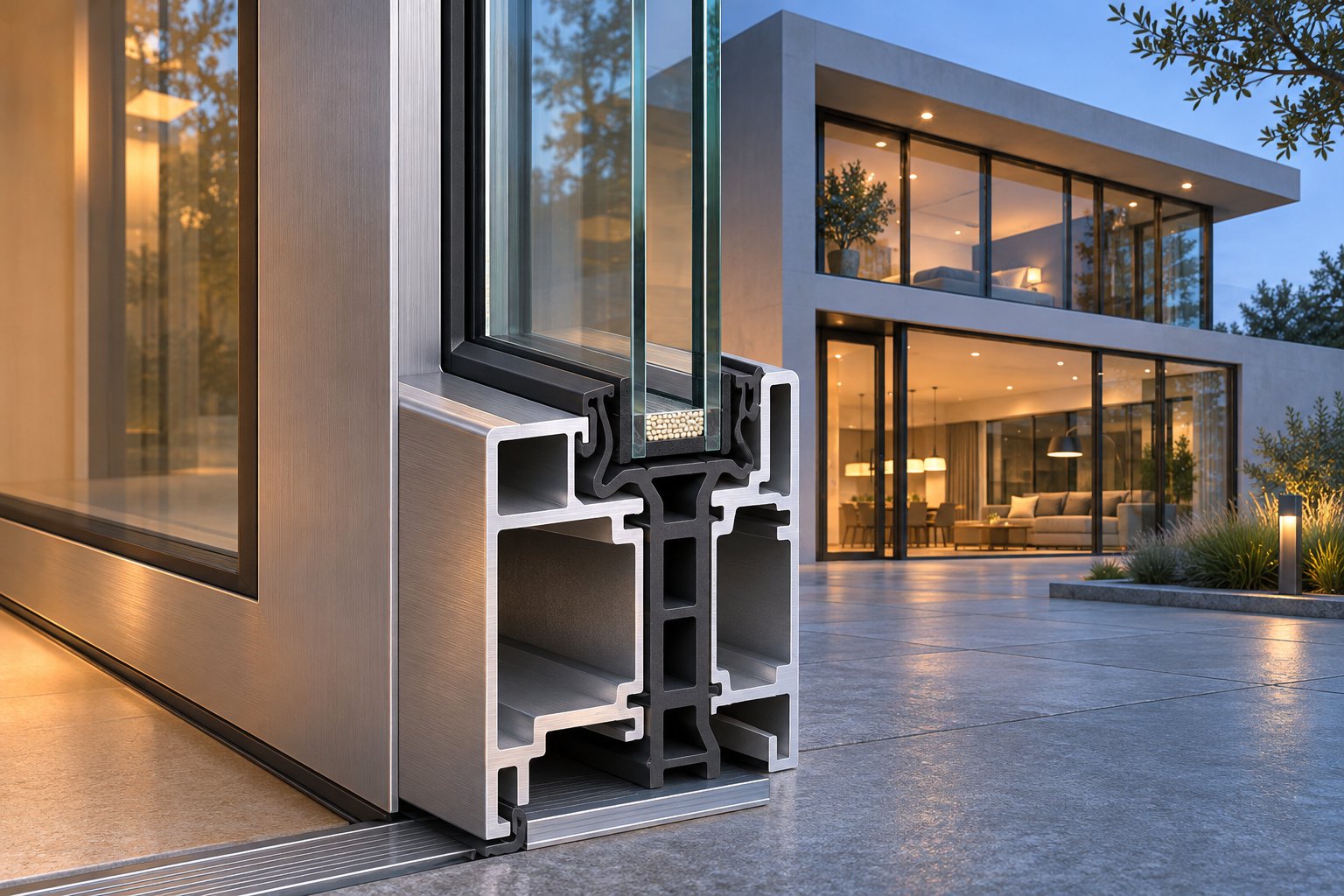
A thermal break is an insulating barrier — typically a reinforced polyamide (nylon) or polyurethane strip — inserted between the interior and exterior aluminium profiles during manufacturing. This strip physically interrupts the continuous metal pathway, so heat can no longer travel unimpeded through the frame. Think of it as cutting a metal bridge in half and replacing the missing section with a material that barely conducts heat at all. Polyamide thermal breaks have a thermal conductivity of approximately 0.3 W/mK, compared to aluminium's 237 W/mK — a difference of nearly 800 times.
The performance impact is dramatic. While traditional non-broken aluminium frames might produce U-values (the rate of heat transfer through a building element) of 4.0–6.0 W/(m²K), thermally broken aluminium systems routinely achieve U-values between 0.8 and 2.0 W/(m²K). That represents a 70–85% improvement in thermal efficiency — enough to bring aluminium doors into the same performance territory as timber and fibreglass alternatives.
Wider thermal break strips generally deliver better insulation, with advanced systems featuring breaks of 24 mm to 35 mm. But width alone doesn't tell the full story. Multi-chamber profile designs — where the extruded aluminium frame contains multiple sealed air pockets alongside the thermal break — add further insulation layers and improve acoustic performance as a bonus.
When evaluating any aluminium front door for energy efficiency, don't rely on general marketing claims. Ask the supplier for the tested U-value of the specific door configuration you're considering — including the frame, glazing, and hardware — because a U-value calculated for the glass alone will always look better than the whole-door figure.
Insulated Glass and Weatherproofing
A thermally broken frame is only half the equation. The glass panel — which often represents the largest surface area of an aluminium glass door — plays an equally critical role in overall energy performance.
Modern aluminium door systems accommodate insulated glass units (IGUs), which consist of two or three panes of glass separated by sealed air spaces. These IGUs can be specified with several energy-efficiency upgrades:
- Low-E coatings: A virtually invisible metallic coating applied to one or more glass surfaces that reflects radiant heat while still transmitting natural daylight. In cooler months, Low-E helps retain indoor warmth; during summer, solar-control Low-E variants reduce unwanted heat gain — a particularly relevant consideration across much of Australia.
- Argon gas fills: The sealed space between glass panes is filled with argon — an inert gas that insulates better than ordinary air — reducing convective heat transfer within the IGU.
- Double-glazed and triple-glazed options: Double glazing is the standard for most Australian residential applications, while triple glazing provides additional thermal and acoustic performance for projects in cooler climate zones or high-noise environments.
Beyond the glass itself, the door's weatherproofing system determines how much conditioned air escapes through gaps around the panel. Compression seals and multi-fin weatherstripping fitted along all four edges of the door leaf create an airtight barrier when the door is closed. Threshold design matters too — a thermally broken threshold with an integrated seal prevents both draughts and water ingress at the floor line, which is the most vulnerable point for air infiltration on any entry door.
A thermally broken aluminium front door with insulated glass can rival the energy performance of fibreglass and wood alternatives while maintaining slimmer sightlines.
To see what these specifications look like in a real product, MEICHEN's MC100 Hinged Door offers a practical reference point. It's a thermally broken aluminium glazed-door system with listed insulated-glass choices and powder-coated finishes — the kind of transparent specification sheet that lets homeowners compare thermal performance across configurations rather than relying on vague efficiency promises. If you're evaluating any aluminium door system, use the MC100's approach as a benchmark: look for clearly published glazing options, thermal break details, and whole-door performance data before committing.
Energy performance protects your comfort and your power bills, but a front door has a second non-negotiable job — keeping uninvited visitors on the other side. That's where the conversation shifts from thermal engineering to physical security, and aluminium has a structural story worth examining closely.
Security Features and Structural Durability of Aluminium Doors
Your house door does two things every single day: it welcomes you home, and it stands between your family and anyone who shouldn't be inside. Energy ratings and sleek finishes matter, but if the door can't resist a determined kick or a crowbar jammed into the frame, nothing else counts for much. Security is consistently one of the top concerns homeowners raise when shopping for entry exterior doors — and rightly so. Aluminium's structural properties give it a genuine head start, but the lock, the glass, and the frame construction all need to work as an integrated system for that advantage to translate into real-world protection.
Locking Mechanisms and Multi-Point Systems
Most people are familiar with a standard single-point deadbolt. You turn the key, a bolt slides into the strike plate on the aluminium door frame, and the door is locked at one spot — usually around handle height. It's simple, widely available, and better than nothing. But it concentrates all of its holding force at a single point on the frame, which means a well-placed kick or pry bar can generate enough leverage to defeat it.
Multi-point locking systems take an entirely different approach. When you lift the handle or turn the key, multiple bolts, hooks, or roller cams engage simultaneously at the top, middle, and bottom of the door — sometimes at even more positions along its full height. This distributes the locking force across the entire door edge rather than concentrating it at one vulnerable spot. The practical result is significant: forced entry becomes far more difficult because an intruder would need to overcome three, four, or five anchoring points at once instead of just one.
Beyond the raw security benefit, multi-point locks also pull the door panel tightly and evenly into its frame seals when engaged. That compression improves both the weatherproofing and acoustic performance of the door — a secondary advantage that often goes unmentioned but makes a noticeable difference in draughty hallways or homes near busy roads.
Lock quality itself varies enormously. The ANSI/BHMA grading system — widely referenced even outside the US market — assigns hardware a Grade 1, 2, or 3 rating based on laboratory testing for cycle endurance, strength, and security resistance. Grade 1 represents the highest performance tier, with locks tested to withstand one million operational cycles and more rigorous forced-entry simulations. While Australian building codes reference different standards (primarily AS 4145 for locksets), the ANSI/BHMA framework remains a useful international benchmark when comparing imported hardware. Whatever system your supplier uses, always confirm the lock grade in writing before placing an order — generic claims like "high security" mean nothing without a tested rating behind them.
Frame Strength and Glass Considerations
A lock is only as strong as the frame it bolts into. Aluminium's strength-to-weight ratio is one of its defining characteristics: the material delivers structural rigidity comparable to steel at roughly one-third the weight. For a front door, that means the frame resists bending, twisting, and prying forces effectively — even in slimmer profile dimensions that would compromise a timber or fibreglass equivalent.
How the frame corners are joined matters just as much as the material itself. Welded corners create a monolithic bond between horizontal and vertical members, producing the strongest possible joint. Mechanically joined corners — using crimped connections, brackets, or screws — are more common in standard residential systems and still perform well, but they can be the weak point under sustained force if poorly engineered. When evaluating front doors for sale, ask specifically whether the frame corners are welded or mechanically joined, and whether reinforcement plates are used at hinge and lock strike locations.
Glass presents a more nuanced security picture. Many aluminium entry doors feature large glass panels — it's one of the material's signature strengths — but not all glass offers the same level of protection. The three main categories buyers encounter are:
- Tempered glass: Heat-treated to be roughly four to five times stronger than standard annealed glass. When it breaks, it shatters into small, blunt fragments rather than dangerous shards, reducing injury risk. However, once broken, it offers no ongoing barrier — the opening is immediately accessible.
- Laminated glass: Two or more glass layers bonded with a tough polyvinyl butyral (PVB) or ethylene-vinyl acetate (EVA) interlayer. When impacted, the glass cracks but the fragments remain adhered to the interlayer, maintaining a physical barrier that is significantly harder to penetrate. This makes laminated glass the stronger choice for forced-entry resistance.
- Impact-rated glass: Engineered and independently tested to withstand high-velocity impacts — from wind-borne debris in cyclone zones, for example. In Australia, this is particularly relevant for homes in northern Queensland or coastal regions subject to cyclone-rated building requirements under the National Construction Code (NCC). Impact-rated glazing must comply with specific Australian Standards, including AS 1170.2 for wind loads and AS 1288 for glass selection and installation.
A critical distinction that trips up many buyers: standard insulated glass is not security glass. A double-glazed IGU designed for thermal performance may use ordinary annealed glass in both panes. It will insulate well but offer minimal resistance to a deliberate break-in attempt. If security is a priority — and for a front entry door, it should be — you need to specify either tempered or laminated glass (or both, as tempered laminated glass combines strength with post-break containment) and confirm that the chosen product carries the appropriate test certification.
Bringing all of these elements together, here is a checklist of security features every buyer should verify before committing to a specific door system:
- Multi-point locking system with a minimum of three engagement points along the door height
- Reinforced strike plates — preferably full-length steel plates rather than small, single-screw fittings
- Hinge security pins (also called dog bolts) that interlock with the frame when the door is closed, preventing removal even if hinge pins are extracted
- Laminated or tempered glass — or tempered laminated glass for maximum protection
- Applicable security ratings confirmed through the manufacturer's published test reports (in Australia, look for compliance with AS 5039 for security doors, or request documentation of the specific lock and hardware grades)
One final point bears repeating: fire, security, and cyclone-impact certifications must be confirmed through the manufacturer's published test reports, not assumed from general product descriptions or marketing brochures. A product page that says "secure" without citing a tested standard is making a claim, not providing evidence. Ask for documentation. Any reputable supplier — whether you're browsing options at a major retailer or working with a specialist fabricator — will be able to provide test certificates for the specific door configuration you're ordering.
Security protects what's inside your home. But the door itself needs to survive what's outside — salt air, UV radiation, cyclonic wind, and temperature swings that vary wildly across Australian climate zones. How aluminium holds up under those conditions depends on where you live and what you're building.
Which Climates and Home Styles Suit Aluminium Best
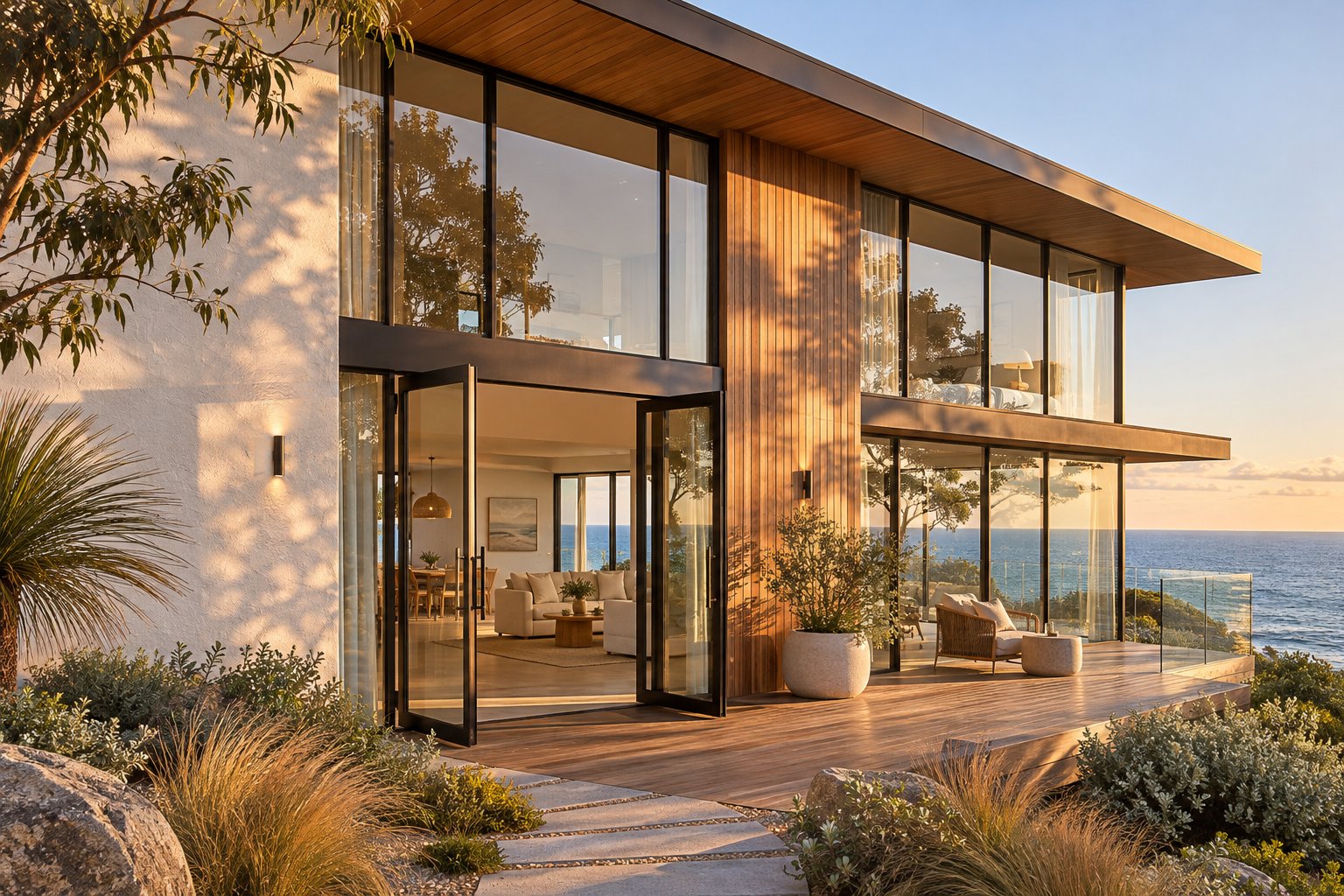
Australia throws just about every weather extreme at a front door. A beachside home in Noosa cops relentless salt-laden wind. A house in Alice Springs bakes through 45 °C summer days before plunging to single digits overnight. A property in Darwin endures months of tropical humidity and cyclone season. The material you bolt into your entrance needs to handle whichever cocktail your postcode serves up — and this is where aluminium's real-world advantages become sharply geographic rather than theoretical.
Coastal, Humid, and Salt-Air Environments
When aluminium is exposed to air, it forms a thin, self-healing oxide layer on its surface. That natural barrier resists corrosion without any human intervention — a characteristic that sets it apart from steel, which will begin to rust the moment its protective coating is scratched or worn. Add a quality powder-coated or anodised finish on top of that oxide layer, and you have a front door material engineered to withstand salt-spray conditions for decades rather than years.
This matters enormously along Australia's coastline — from the Gold Coast and Sunshine Coast in Queensland, through the NSW South Coast, down to the Mornington Peninsula in Victoria, and across to the beach suburbs of Perth. In these regions, salt-laden moisture attacks exterior aluminium door frames, hardware, and seals constantly. Steel front doors exterior to the building envelope can develop corrosion within a few years if their coating is compromised, even with diligent maintenance. Timber swells, warps, and invites mould when humidity sits above 60–70% for extended periods — a near-permanent state of affairs in tropical and subtropical coastal zones.
Aluminium framed doors sidestep both problems. Specifying a marine-grade powder coat (look for systems pretreated to meet the Qualicoat or equivalent standards and salt-spray tested beyond 1,000 hours) provides an additional safeguard for properties within a few hundred metres of the waterline. EPDM rubber seals further prevent salt spray from penetrating the frame's internal structure, and drainage channels within the door sill stop water pooling — a detail that matters in areas where driving rain coincides with high-salt wind events.
Maintenance in these environments is refreshingly simple: rinse the door and frame with fresh water every three to six months, check the seals annually, and apply a silicone-based lubricant to hinges and lock mechanisms. Compare that regime with the annual sanding, sealing, and repainting timber demands in the same conditions, and the lifetime cost advantage of aluminium becomes obvious.
Extreme Heat, Cold, and High-Wind Regions
Inland Australia presents a different set of challenges. Summer temperatures in parts of South Australia, Western Australia, and the Northern Territory regularly exceed 40 °C, and UV intensity ranks among the highest on the planet. Under these conditions, some materials deteriorate rapidly — vinyl can soften and distort, timber dries out and cracks, and paint finishes on steel doors fade and chalk. Aluminium holds its structural shape across a wide temperature range without the dramatic expansion and contraction that vinyl experiences. A fluorocarbon (PVDF) powder coat finish retains its colour integrity under extreme UV exposure for 20 years or more — a proven solution already widely specified in outback and arid-zone commercial projects.
Cold-climate performance is more nuanced. Thermally broken aluminium systems — as covered earlier in this article — mitigate the conductivity issue effectively, making them suitable for cooler regions like the Tasmanian highlands, the Victorian Alps, and elevated parts of the Southern Tablelands. Without a thermal break, however, an aluminium frame in near-freezing overnight temperatures will transfer cold directly into your hallway and may develop condensation on interior surfaces. The takeaway is straightforward: if your region experiences cold winters, a thermally broken system isn't optional — it's essential.
High-wind performance is where aluminium's structural strength-to-weight ratio delivers a less obvious advantage. The material's rigidity allows it to support larger glass panels — including exterior full glass doors that maximise natural light — without flexing under wind load. For properties in cyclone-prone areas of northern Queensland, the Northern Territory, and parts of Western Australia, this matters because the National Construction Code (NCC) imposes strict wind-load requirements tied to regional wind speed classifications. Aluminium systems can be engineered to meet these ratings, but buyers must verify that the specific door they order carries wind-load certification tested to AS 1170.2 and installed in accordance with AS 2047. A door marketed as "strong" without published test data is making an unverified claim — and in a cyclone zone, that's a risk no homeowner should accept.
Pulling all of this geographic and stylistic data together, here's a practical summary of where aluminium front doors consistently perform best:
Best Suited For
- Coastal homes and beachside properties — superior salt-spray resistance compared to steel or timber
- Modern and contemporary architecture — slim profiles and custom finishes complement flat roofs, clean facades, and glass-heavy designs
- Commercial entrances — low maintenance, consistent finish quality across multiple openings, and long service life
- Homes prioritising natural light — the strength-to-weight ratio supports larger glass areas than most competing materials
- Warm and temperate climates — excellent durability under UV, humidity, and heat without the swelling, cracking, or fading that affects timber and vinyl
- Projects requiring large glazed areas — including patio aluminium doors and entry systems with sidelites and transoms
Where Aluminium May Not Be the Best Fit
- Extreme cold without thermal breaks: Non-thermally-broken aluminium frames in alpine or frost-prone regions will underperform thermally and may cause condensation issues. Always specify thermally broken profiles in cooler climates.
- Heritage and character home restoration: If your property falls within a heritage overlay or council character zone that mandates authentic timber joinery, aluminium — regardless of how convincing its wood-grain sublimation finish — is unlikely to satisfy approval requirements.
- Ultra-budget projects: Entry-level steel doors remain more affordable at the point of purchase. If the upfront cost is the only deciding factor, aluminium's premium will be difficult to justify — though lower lifetime maintenance costs often close that gap over a decade or more.
Climate suitability answers the question of whether aluminium makes sense for your location. The question that almost always follows — and the one that receives the least transparent coverage across the industry — is how much a quality aluminium entry door actually costs, and what drives the price up or down.
Cost Factors and Realistic Pricing for an Aluminium Front Door
Pricing is where the aluminium front door conversation gets vague — fast. Most manufacturer websites bury their numbers behind "request a quote" buttons, and comparison articles tend to either dodge the topic entirely or throw out figures so broad they're useless. The reality is that aluminium entry door pricing depends on a stack of interdependent variables, and understanding which ones carry the most weight gives you far more negotiating power than a single dollar figure ever could.
What Drives Aluminium Front Door Pricing
Not all cost variables hit your budget equally. Some shift the total by thousands of dollars; others nudge it by a few hundred. Here's how they rank, from the factors with the greatest financial impact down to those that fine-tune the final figure:
- Size and configuration: A standard single-door entry and a double-door system with sidelites are fundamentally different products. Doubling the opening width doesn't just double the aluminium — it increases glass area, hardware requirements, structural support, and installation complexity. This is consistently the single biggest price driver.
- Glass specification: Clear float glass in a basic double-glazed IGU sits at one end of the spectrum. Laminated safety glass, Low-E coatings, argon gas fills, tinted panels, and triple-glazed units push the cost progressively higher. For modern glass front doors where glazing dominates the panel, the glass specification can account for a substantial portion of the total door cost.
- Thermal break technology: Thermally broken aluminium profiles command a meaningful premium over non-thermally-broken alternatives. The polyamide or polyurethane insulating strip, the more complex extrusion geometry, and the wider profile all add manufacturing cost. It's a premium worth paying in most Australian climate zones — but it is a premium nonetheless.
- Finish and colour: Standard powder-coated colours — typically whites, blacks, and a handful of popular tones — are priced into the base specification. Custom RAL colours, wood-grain sublimation finishes, and anodised treatments cost more because they require additional processing steps or smaller production runs.
- Hardware and locking system: A basic single-point deadbolt and lever handle sit at the entry level. Multi-point locking systems, Grade 1 hardware, smart-lock integration, and premium handle designs escalate both the parts cost and the installation time.
- Brand and warranty: Established brands with longer warranty terms, published test certifications, and dedicated after-sales support typically price their systems higher than budget-tier imports. That margin often reflects genuinely better engineering — but not always, so compare specifications rather than brand names alone.
Each of these variables interacts with the others. Choosing a larger configuration automatically increases the glass area, which amplifies the cost impact of upgrading from standard to Low-E glazing. Opting for a thermally broken frame on a double-door system multiplies the thermal break premium across a wider profile set. Understanding these compounding effects helps you make deliberate trade-offs instead of reacting to sticker shock after the quote arrives.
Budgeting Realistically for an Aluminium Entry Door
In terms of relative positioning, aluminium front doors generally sit between timber and high-end fibreglass options in the Australian market. Entry-level steel doors remain the most affordable material at the point of purchase, but aluminium's lower lifetime maintenance costs close that gap considerably over a ten-to-twenty-year ownership period. Thermally broken aluminium glass doors — particularly those with larger glazed panels and premium hardware — move into the upper end of the residential pricing spectrum, comparable to quality hardwood entries but with a fraction of the ongoing upkeep.
A critical budgeting mistake many homeowners make is treating the door unit price as the total project cost. Three distinct cost categories need their own line items:
- The door unit itself: Frame, panel, glazing, hardware, and finish — supplied as a complete system. This is the figure most quotes lead with, and it's only the starting point.
- Professional installation: Industry data suggests labour commonly accounts for roughly 30–35% of the total installed cost for exterior doors. In Australia, installation labour rates tend to run higher than overseas equivalents due to local trade costs, particularly in capital cities like Sydney and Melbourne. Always confirm whether the quote covers removal of the existing door, disposal, weatherproofing, threshold adjustments, and trim reinstatement — these are frequently priced as separate line items rather than bundled in.
- Structural modifications: If your new door doesn't match the existing rough opening — whether it's wider, taller, or a different configuration — framing work, lintel adjustments, and wall repairs add cost that can rival the door unit itself. Keeping the existing opening dimensions where possible is the simplest way to avoid this category entirely.
Beyond the direct project costs, administrative and regulatory requirements can add both dollars and weeks to the timeline. Council approval may be required for non-standard door sizes, new openings, or properties in heritage overlay zones. Development applications (DAs) carry their own lodgement fees and processing periods, which vary by local council. Compliance with the National Construction Code (NCC) — including energy efficiency provisions under NatHERS and, in relevant regions, wind-load or bushfire attack level (BAL) requirements — may dictate specific product certifications that limit your supplier options or push you toward a higher-specification (and higher-priced) system.
The most effective way to cut through pricing uncertainty is straightforward: obtain at least three itemised quotes from suppliers who can confirm product certifications relevant to your location. "Itemised" is the key word — a single lump-sum figure tells you almost nothing. You need the door unit, glass specification, hardware, finish, installation labour, disposal, and any ancillary work broken out on separate lines so you can compare like with like. Suppliers offering aluminium patio doors alongside entry systems will sometimes bundle pricing across multiple openings, which can soften per-unit costs but also obscure line-item details if you're not careful.
Ask each supplier to note the thermal break specification, the glass makeup (including whether Low-E and argon are included or optional extras), and the lock grade on the quote itself. If they can't — or won't — provide that level of detail, treat it as a signal about the transparency you can expect after you've handed over the deposit.
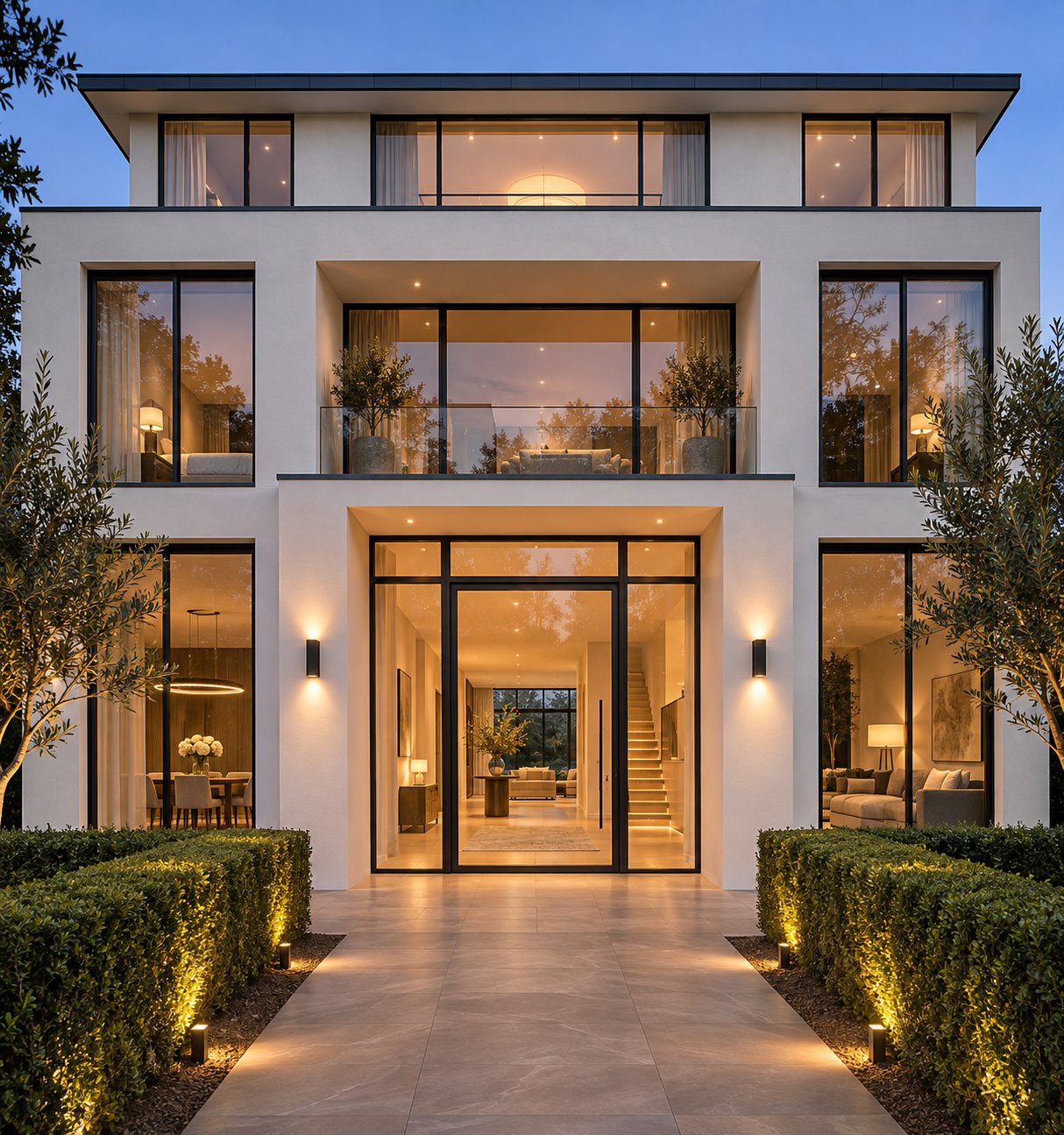
How to Select the Right Aluminium Front Door for Your Home
Armed with an understanding of materials, thermal performance, security, climate suitability, and cost drivers, the final challenge is pulling those threads into a single, logical buying process. Skipping steps — or tackling them in the wrong order — leads to mismatched specifications, surprise costs, and doors that look perfect on a product page but underperform once installed. A structured approach eliminates most of those pitfalls before they happen.
Step-by-Step Selection Checklist
This sequence moves from the decisions that constrain everything else down to the details that refine your final specification. Work through it in order, because each step narrows the field for the next.
- Measure the rough opening and confirm single versus double configuration. Record the width, height, and depth of the existing opening in millimetres. Decide whether a single-leaf entry, a double-door system, or a French-style paired layout suits your entrance proportions and daily use. If you're changing configuration — widening from single to double, for example — flag this early, because structural modifications to the lintel and framing will affect both budget and timeline.
- Define your style priorities. Settle on the glass area you want (full-panel, half-panel, or an aluminium door with window insert), your preferred finish colour, and the hardware aesthetic — lever handles, pull bars, or flush-mount fittings. These choices shape which product ranges are even worth quoting.
- Verify thermal break requirements based on your climate zone. In most Australian locations, thermally broken profiles are the sensible default. For homes in cooler regions — Tasmania, the Victorian highlands, elevated areas of the Southern Tablelands — they're non-negotiable. Reference your NatHERS climate zone to understand the energy performance your entry door needs to support.
- Confirm security requirements. Decide on the lock grade (multi-point locking is strongly recommended for any primary entry), and specify the glass type — laminated, tempered, or impact-rated — based on your security expectations and any regional requirements such as cyclone ratings in northern Queensland or the NT.
- Check local building codes, council requirements, and any body corporate rules. Development applications (DAs) may be needed for non-standard openings, heritage overlay zones, or bushfire attack level (BAL) rated properties. Body corporate or strata regulations in apartment buildings can restrict colours, materials, or door styles. Identify these constraints before you fall in love with a product that council or your owners' corporation won't approve.
- Request product certifications from your supplier. Ask for documented evidence of energy performance (WERS ratings or tested U-values), wind-load compliance (tested to AS 1170.2 and installed per AS 2047), and any security certifications relevant to your specification. A credible supplier will provide these without hesitation.
- Compare at least three itemised quotes with matching specifications. As covered in the pricing section, ensure each quote breaks out the door unit, aluminium door glass specification, hardware grade, finish, installation labour, and any ancillary work separately. Comparing lump-sum figures across different specifications is comparing apples with oranges — and it's the most common mistake homeowners make when evaluating door quotes.
Evaluating Aluminium Door Systems and Suppliers
The supplier you choose matters almost as much as the door itself. A beautifully engineered entry door with glass panels, thermally broken aluminium doors and frames, and a multi-point locking system can still disappoint if the company behind it can't deliver transparent specifications, reliable lead times, or after-sales support when a seal needs replacing in year five.
Look for these signals when assessing a supplier:
- Published configuration options: The product range should clearly show single-door, double-door, and French-style layouts with dimensions, not just a single glamour photo and a "contact us" button.
- Transparent glass and finish choices: You should be able to see the available IGU makeups (double-glazed, triple-glazed, Low-E, tinted, laminated) and the finish palette (standard powder-coat colours plus any custom RAL or anodised options) before requesting a quote.
- Hardware selection clarity: Handle styles, lock types, hinge specifications, and threshold options should be listed — not bundled into a generic "premium hardware" claim.
- Willingness to confirm certifications in writing: Any supplier who hesitates to provide documented test reports for energy, wind load, or security is a supplier worth questioning.
To illustrate what this level of transparency looks like in practice, MEICHEN's MC100 Hinged Door offers a useful benchmark. Its product page lists single-door and double-door configurations, specifies insulated-glass choices and powder-coated finish options, and details hardware selections — the kind of upfront information that lets you compare meaningfully before a sales conversation even begins. For homeowners considering an aluminium clad door system or a glass-forward entry design, this approach to product documentation is exactly what you should expect from any serious supplier.
That said, a product page — even a detailed one — has limits. French-style layouts, specific swing direction, clear passage dimensions, threshold profiles, locking system grades, and commercial access compliance all need to be confirmed against the exact configuration you're ordering. Fire, security, and cyclone-impact certifications are established through independent laboratory testing, not by a webpage. Always request the test documentation directly and verify it applies to the specific door size, glass makeup, and hardware combination in your quote.
One practical tip that saves time and frustration: create a single-page specification sheet listing your opening dimensions, preferred configuration, glass type, finish colour, lock requirements, and any applicable code or certification needs. Send the same document to every supplier you're quoting. This forces genuinely comparable responses and makes it immediately obvious which suppliers can meet your requirements and which are hedging with vague answers.
A structured selection process protects your investment. But even with the right door on order, you'll encounter industry terminology — on spec sheets, in supplier conversations, and across certification documents — that can trip you up if you're not familiar with it. A clear glossary of those terms turns confusion into confidence.
Essential Glossary of Aluminium Door Terms Every Buyer Needs
Spec sheets, supplier conversations, and certification documents are full of industry shorthand that can blur the line between informed decision and guesswork. Whether you're pricing a single aluminium glass door for a terrace renovation or specifying aluminium french doors exterior to a covered entertaining area, having a clear vocabulary makes the entire process faster and more transparent. Bookmark this glossary — it covers the terms you'll encounter most often when shopping for contemporary glass front doors and aluminium entry systems across Australia.
Materials and Construction Terms
| Term | Definition |
|---|---|
| Thermal Break | An insulating barrier — typically reinforced polyamide or polyurethane — placed between the interior and exterior aluminium profiles to interrupt heat transfer through the frame. Essential for energy-efficient door performance in most Australian climate zones. |
| Extrusion | The manufacturing process that forces heated aluminium alloy through a shaped steel die to produce precise, consistent profiles. These extruded shapes form the structural skeleton of aluminium doors and windows. |
| Powder Coating | A dry finishing process where electrostatically charged pigment particles are applied to the aluminium surface and then cured under heat to form a durable, UV-resistant film. Available in standard colours and custom RAL shades, including wood-grain sublimation finishes. |
| Anodising | An electrochemical process that thickens aluminium's natural oxide layer to create an extremely hard, corrosion-resistant surface with a metallic appearance. Unlike powder coating, the finish is integral to the metal rather than applied on top. |
| Polyamide Strip | A reinforced nylon (PA66) bar inserted into the thermal break cavity of an aluminium profile. It provides structural continuity between the inner and outer frame sections while dramatically reducing thermal conductivity. |
| Welded Corners | Frame joints where the horizontal and vertical aluminium members are fused together through welding, creating a monolithic bond. This produces the strongest corner connection available and is common in premium door systems. |
| Mechanical Joining | A frame corner assembly method using crimped connections, brackets, or screws instead of welding. It's widely used in standard residential aluminium clad doors and performs well under normal conditions, though it's generally less rigid than welded construction under sustained force. |
Glass and Performance Terms
| Term | Definition |
|---|---|
| IGU (Insulated Glass Unit) | A sealed assembly of two or three glass panes separated by spacer bars and air or gas-filled cavities. IGUs are the standard glazing format for thermally efficient aluminium entry doors. |
| Low-E Coating | A microscopically thin metallic coating applied to one or more glass surfaces within an IGU. It reflects radiant heat while transmitting visible light — helping retain warmth in winter and reduce solar heat gain in summer. |
| Argon Gas Fill | An inert gas injected into the sealed cavity between IGU panes. Argon insulates roughly 34% better than ordinary air, reducing convective heat transfer within the glass unit. |
| Tempered Glass | Glass that has been heat-treated to become approximately four to five times stronger than standard annealed glass. When broken, it shatters into small, blunt fragments rather than dangerous shards — a safety requirement under AS 1288 for certain door applications. |
| Laminated Glass | Two or more glass layers bonded with a tough interlayer (PVB or EVA). When impacted, the glass cracks but fragments remain adhered to the interlayer, maintaining a physical barrier. Preferred for security and cyclone-rated applications. |
| U-Value | A measure of the rate of heat transfer through a building element, expressed in W/(m²K). Lower U-values indicate better insulating performance. Always request the whole-door U-value — not just the centre-of-glass figure — when comparing products. |
| R-Value | A measure of thermal resistance — essentially the inverse of U-value. Higher R-values indicate greater resistance to heat flow. R-value is more commonly used for wall and roof insulation, while U-value is the standard metric for windows and doors. |
| Sidelite | A narrow, fixed glass panel installed alongside one or both sides of a door. Sidelites extend the glazed area of an entry without increasing the operable door width, adding both light and visual proportion. |
| Transom | A fixed glass panel or operable sash positioned above a door head. Transoms add height and light to an entrance and are commonly paired with sidelites in grander entry compositions. |
| Clear Passage Width | The unobstructed width available for walking through an open door, measured between the door face (at 90° open) and the opposite frame jamb. Australian accessibility standards typically require a minimum clear passage of 820 mm for residential entries. |
| Multi-Point Lock | A locking system where a single handle or key operation engages bolts, hooks, or rollers at multiple points along the door's height — typically at the top, centre, and bottom. This distributes locking force across the full frame, significantly improving forced-entry resistance. |
| Strike Plate | A metal plate or receiver fixed to the door frame jamb (or floor, in the case of shootbolts) that captures and holds the lock bolt or latch when the door is closed. Reinforced full-length strike plates offer substantially better security than small, single-screw fittings. |
| ANSI/BHMA Lock Grade | A hardware durability and security rating established through laboratory testing under ANSI/BHMA standards. Grade 1 is the highest tier (one million cycle endurance); Grade 3 is the minimum for residential use. While Australian standards (AS 4145) differ, the ANSI/BHMA framework remains a useful international benchmark for comparing imported hardware. |
Keep this glossary handy as you move through the quoting and specification process. Fluency in these terms doesn't just help you read a data sheet — it signals to suppliers that you know what to ask for, which invariably leads to sharper quotes, clearer answers, and a front door that performs exactly as promised.
Frequently Asked Questions About Aluminium Front Doors
1. Are aluminium front doors energy efficient?
Modern aluminium front doors with thermally broken profiles and insulated glass units can achieve U-values between 0.8 and 2.0 W/(m²K), representing a 70-85% thermal improvement over older non-broken aluminium frames. The thermal break — a reinforced polyamide or polyurethane strip between inner and outer profiles — interrupts heat conduction, while double or triple-glazed IGUs with Low-E coatings and argon gas fills further boost performance. Systems like MEICHEN's MC100 Hinged Door offer listed insulated-glass choices so buyers can compare thermal configurations directly. Always request the whole-door U-value rather than just the centre-of-glass figure when evaluating energy efficiency.
2. How do aluminium front doors compare to steel and fiberglass?
Aluminium outperforms steel in corrosion resistance, making it far more suitable for coastal and humid Australian climates where steel can rust once its protective coating is compromised. Compared to fibreglass, aluminium offers slimmer frame profiles that support larger glass panels and greater design flexibility through custom RAL powder-coated colours. However, fibreglass holds an edge in dent resistance, while steel remains more affordable at the entry level. Aluminium doors typically last 30-plus years with minimal maintenance — periodic cleaning and seal checks — whereas timber demands regular sanding, sealing, and repainting, and steel requires ongoing coating inspections.
3. How much does an aluminium front door cost in Australia?
Aluminium front door pricing in Australia sits between timber and high-end fibreglass options, with the final cost shaped by six main factors ranked by impact: door size and configuration (single vs double), glass specification (standard double-glazed vs laminated Low-E), thermal break inclusion, finish type (standard powder coat vs custom RAL), hardware and locking grade, and brand warranty tier. Budget separately for the door unit, professional installation (typically around 30-35% of total installed cost), and any structural modifications to the existing opening. Obtain at least three fully itemised quotes with matching specifications to compare meaningfully.
4. Are aluminium front doors secure enough for a primary entry?
Aluminium front doors deliver strong security when specified correctly. The material's high strength-to-weight ratio produces rigid frames that resist bending and prying, while multi-point locking systems engage bolts at the top, centre, and bottom of the door simultaneously — distributing force across the full height rather than relying on a single deadbolt. For glass panels, laminated glass maintains a physical barrier even after impact, unlike tempered glass which shatters completely. Buyers should verify multi-point locks, reinforced strike plates, hinge security pins, and laminated or tempered glass, and request documented test certifications rather than accepting generic security claims.
5. What aluminium front door styles are available for residential homes?
Aluminium entry doors come in single-leaf, double-door, and French-style paired configurations, each available with sidelites and transoms to extend the glazed area. Style options range from full-glass panels for maximum transparency, frosted or reeded glass for privacy, divided-lite patterns for traditional aesthetics, to flush-panel minimalist designs. Pivot doors suit oversized dramatic entries, while arched-top profiles complement Mediterranean or art deco facades. Powder-coated finishes — including matte black, satin white, bronze, and custom RAL colours with wood-grain sublimation — let aluminium complement virtually any Australian home exterior from contemporary builds to renovated brick veneer properties.