
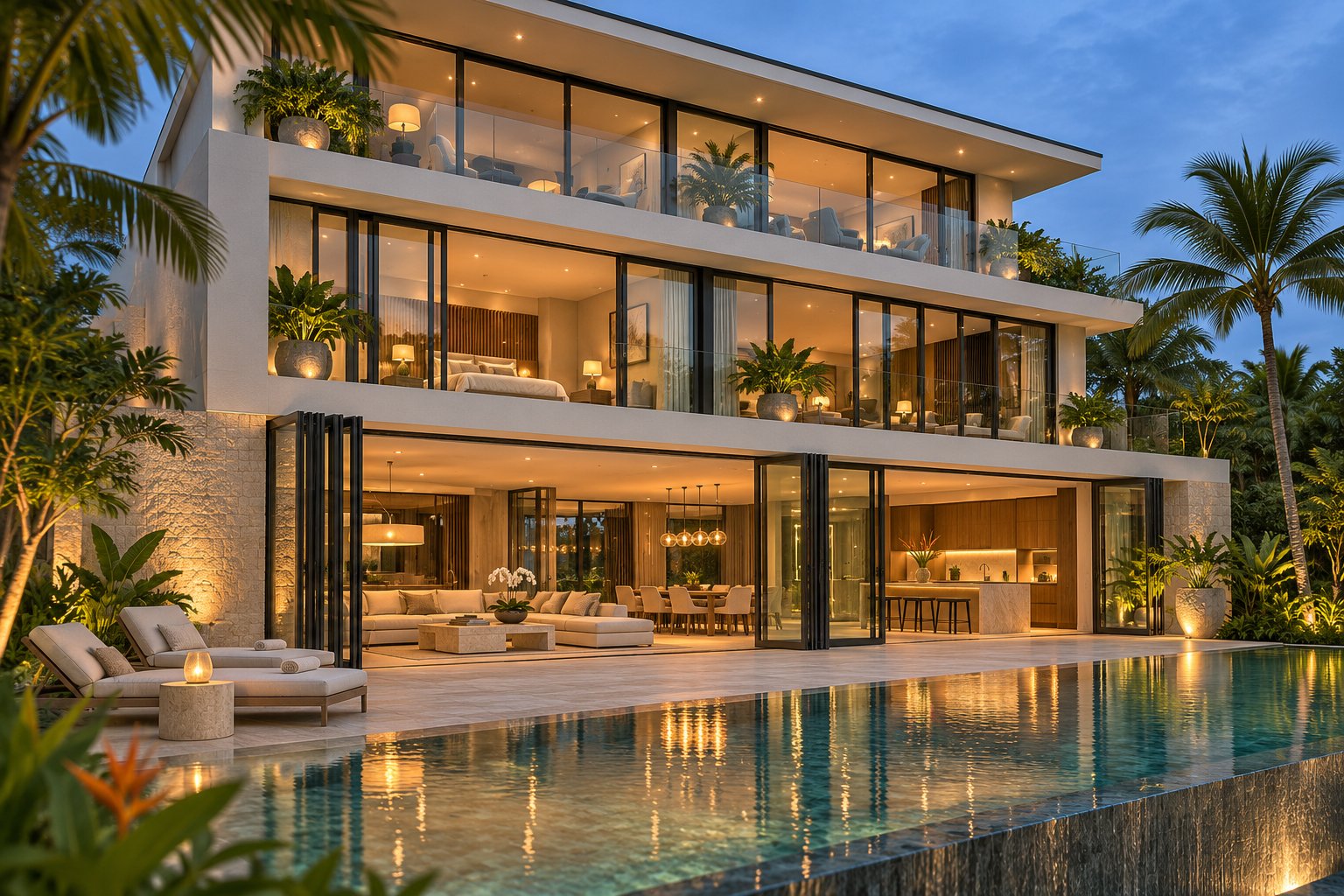
What Aluminium Doors Are and How They Are Built
An aluminium door is a door system built around extruded aluminium alloy frame profiles, typically glazed with single, double, or triple glass panels and sealed with weatherstripping, hardware, and drainage provisions. Unlike steel-framed doors that rely on heavier gauge material for rigidity, or timber doors that depend on solid mass for strength, aluminium doors achieve structural performance through the engineered geometry of their extruded profiles. That distinction matters more than most buyers realise, because it directly shapes what you can expect in terms of sightlines, glass area, durability, and long-term maintenance.
What Are Aluminium Doors and Why Do They Matter
Walk through any new housing estate in Sydney or Melbourne, step into a commercial fitout in Brisbane, or visit a coastal holiday home along the Great Ocean Road, and you will almost certainly pass through an aluminium-framed door. The material has become the default choice for a growing share of Australian residential and commercial projects, and for good reason.
Aluminium is roughly one-third the density of steel, which means lighter frames that place less stress on hinges, tracks, and structural openings. It resists corrosion naturally by forming a thin oxide layer on its surface, a property that gives alu doors a decisive edge in Australia's harsh coastal and high-UV environments. It is also one of the most recyclable building materials on the planet; scrap aluminium can be remelted and re-extruded repeatedly without losing its core properties.
For architects and builders, these characteristics translate into tangible design freedom. Slimmer frame profiles open up larger glass areas. Corrosion resistance reduces callback risk. Recyclability supports green building certifications and aligns with NCC sustainability objectives. Whether you are choosing a door for front entry, a wide sliding system for patio access, or aluminium storefront doors for a retail fitout, understanding how the material performs gives you a sharper eye when comparing quotes and product claims.
How Aluminium Door Frames Are Manufactured
Every aluminium door starts as a cylindrical billet of aluminium alloy. The alloy most commonly used in architectural door and window profiles is 6063-T5, an aluminium-magnesium-silicon blend specifically engineered for extrudability and surface finish quality. Its balanced composition allows manufacturers to push complex cross-sectional shapes through a steel die at high temperature, producing continuous lengths of frame profile with tight dimensional tolerances and smooth surfaces straight off the press.
Once extruded, the profiles move through a fabrication sequence that determines the final quality of the door:
- Cutting and machining — profiles are cut to length, drilled for hardware, and routed for drainage slots and weatherstrip channels.
- Corner joining — frame corners are crimped mechanically, screw-fixed, or welded depending on the system design and performance requirements.
- Surface finishing — the assembled or pre-cut profiles receive their protective and decorative coating. The three main options are anodising (an electrochemical oxide layer), powder coating (a thermally cured colour finish available across the full RAL palette), and PVDF fluorocarbon coating for premium weather resistance in harsh exposures.
- Glazing and sealing — glass units are inserted into the frame rebates, secured with aluminium or rubber glazing beads, and sealed with compression gaskets.
This process applies whether the end product is a front exterior door for a new build, a bathroom door aluminium profile for a compact ensuite, or a full-height commercial entrance system. The same extrusion and fabrication fundamentals underpin every type, which is why grasping these basics helps you judge build quality rather than relying solely on brochure claims.
Aluminium's strength-to-weight ratio allows door frames to use slimmer sightlines and support larger glass panels than most competing materials — delivering more natural light and unobstructed views without sacrificing structural integrity.
Even among affordable front doors at entry-level price points, the underlying extrusion and fabrication quality varies significantly between manufacturers. Aluminium door cladding details, corner joint methods, and gasket materials all influence how well a door performs over its lifespan. Knowing what to look for behind the finish puts you in a stronger position before you ever request a quote — and it sets the foundation for understanding the different door types, styles, and configurations available across the Australian market.
Every Type of Aluminium Door by Style and Application
The same extruded aluminium profiles can be fabricated into a surprising range of door configurations, each engineered for a different spatial problem. Picking the right type starts with understanding how each one operates and where it performs best.
Residential Aluminium Door Styles
Most Australian homes use one of four aluminium door styles, sometimes combining several across different openings within the same project.
Sliding doors remain the most popular choice for patio and outdoor living connections. A standard two-panel configuration places one fixed panel beside one operable panel, giving you roughly half the opening width for access. Multi-panel stacking systems push this further — three, four, or even six panels can slide and stack behind each other to clear a much larger portion of the opening. It is worth noting the mechanical difference between a standard sliding system and a lift-and-slide system. Standard sliders run directly along rollers on a track, while lift-and-slide doors use a handle-activated mechanism that raises the panel off its seals before gliding, offering superior weather tightness and smoother operation for heavier or wider panels. Not every supplier offers both mechanisms, so confirm exactly which system a quote covers before you commit.
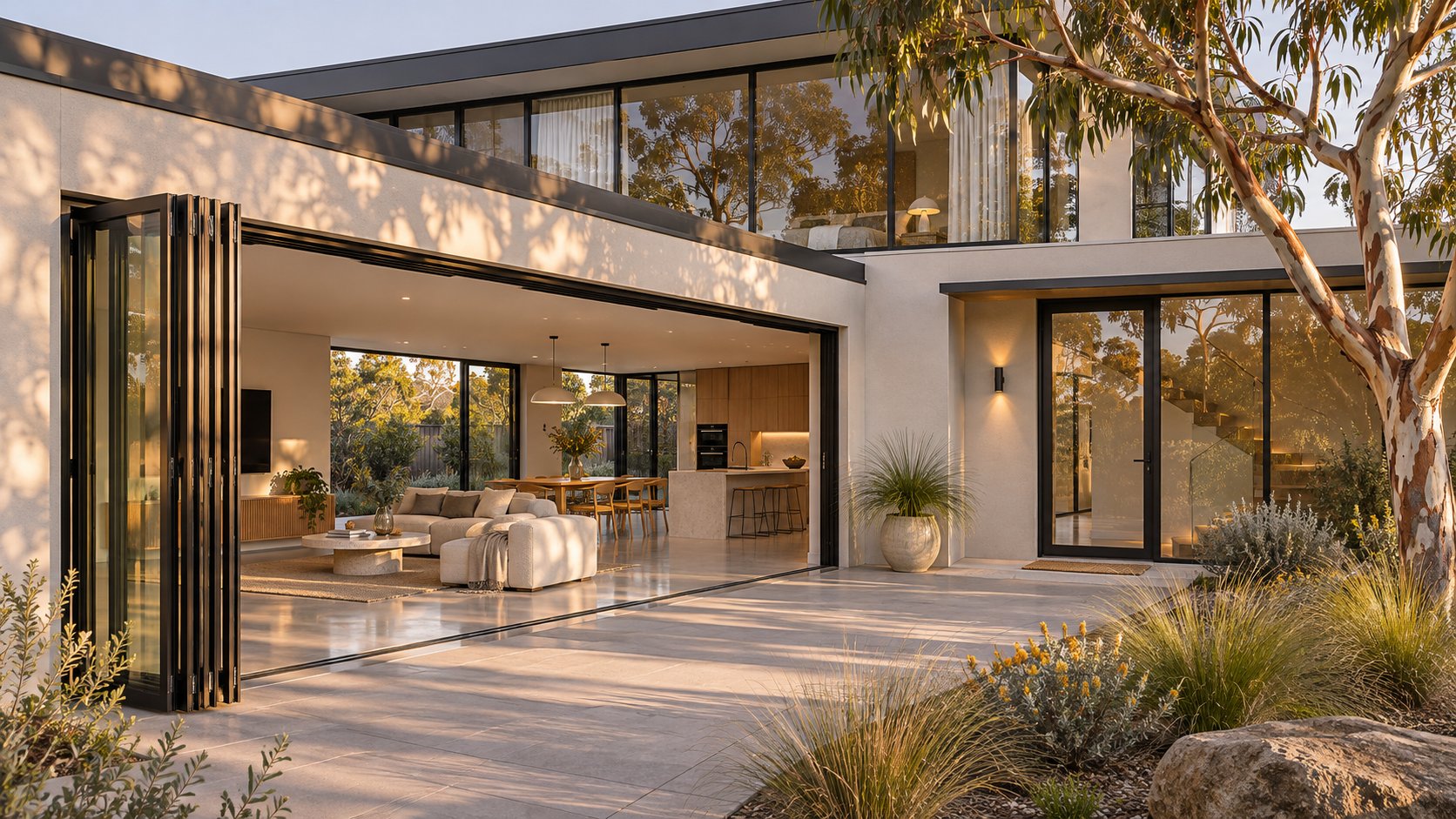
Bifold doors suit homeowners who want to dissolve an entire wall span. Multiple hinged panels fold in an accordion-style movement and stack to one side, clearing almost the full width of the opening. That dramatic indoor-outdoor flow makes bifolds a favourite for entertaining areas and alfresco kitchen extensions, though the stacked panels do occupy space at the jamb when open.
Hinged entry doors — single or double — serve as the traditional aluminium front door for street-facing entries. They swing inward or outward on butt or pivot hinges and accommodate a wide range of panel designs, sidelights, and transoms. An aluminium casement door follows a similar hinge-and-swing principle but is more commonly specified for side entries, laundries, or narrow utility openings where a compact single-leaf swing is practical.
French-style aluminium doors pair two hinged leaves that open from the centre, creating a symmetrical aesthetic often used between living rooms and courtyards. Aluminium framed doors in the French configuration offer slimmer profiles and better corrosion resistance than their traditional timber counterparts.
Commercial and Storefront Aluminium Doors
Commercial applications place heavier demands on frame depth, hardware durability, and code compliance. Storefront systems typically fall into two categories: narrow-stile doors with minimal frame width for a sleek retail appearance, and wide-stile doors with deeper sections that accommodate heavy-duty closers, panic hardware, and higher traffic loads. Both are commonly configured as aluminium glass door assemblies with full-height glazed panels for maximum product visibility and natural light.
Beyond storefronts, commercial projects may require fire-rated aluminium door assemblies tested to Australian Standards for fire resistance. These doors use intumescent seals and specially engineered frames to maintain compartmentation during a fire event. Hardware specifications, frame depth, closer requirements, and compliance with the NCC differ substantially from residential installations, so commercial buyers should always work with suppliers experienced in the relevant Australian Standards, including AS 1905 for fire-resistant doorsets.
The following list summarises each aluminium door type alongside its strongest use case:
- Standard sliding door — best for everyday patio access where a partial opening is sufficient and clean sightlines matter.
- Multi-panel stacking slider — ideal for wide openings where you want generous access without the folding stack of a bifold.
- Lift-and-slide door — suited to large, heavy panels and exposed locations requiring tighter weather sealing.
- Bifold door — the go-to for fully opening an entertaining area or merging indoor and outdoor living zones.
- Hinged entry door (single or double) — the classic choice for front entries, side access, and any opening that calls for a conventional swing.
- Aluminium casement door — practical for narrow utility or side-entry openings where space is limited.
- French-style door — preferred when a symmetrical, centre-opening appearance is a design priority.
- Narrow-stile storefront door — designed for retail and commercial entries where a slender frame and maximum glass area drive kerb appeal.
- Wide-stile storefront door — built for high-traffic commercial entries that require heavy-duty closers and panic hardware.
- Fire-rated aluminium door — required where NCC fire compartmentation and AS 1905 compliance must be met.
Each type uses aluminium for door frame construction, yet the profile geometry, hardware integration, and glazing methods vary widely between categories. A residential bifold and a commercial fire-rated door share almost nothing beyond their raw material. That gap between types is exactly why material comparisons — aluminium versus wood, steel, fibreglass, and vinyl — matter so much when narrowing down which product genuinely fits a project's performance and budget requirements.
Aluminium Doors vs Other Door Materials
Knowing which door types exist is only half the equation. The other half is deciding whether aluminium is actually the right material for your project — or whether timber, steel, fibreglass, or vinyl would serve you better. Surprisingly few guides lay these materials side by side with enough detail to make that call. The table below pulls together widely accepted characteristics so you can compare at a glance, followed by an honest breakdown of where aluminium frames genuinely excel and where they fall short.
How Aluminium Compares to Wood, Steel, Fibreglass, and Vinyl
Every material brings trade-offs. The comparison below reflects general industry consensus rather than any single manufacturer's claims. Bear in mind that real-world performance always depends on product construction, installation quality, and local conditions — so treat these as starting points, and confirm specifics with your supplier before specifying.
| Material | Durability | Maintenance Effort | Energy Efficiency | Approximate Lifespan | Weight | Design Flexibility | Recyclability |
|---|---|---|---|---|---|---|---|
| Aluminium | High — resists corrosion, rot, and insect damage; naturally forms a protective oxide layer | Low — periodic wipe-down and hardware lubrication; no painting required if powder coated or anodised | Moderate to high — requires thermally broken profiles to perform well; non-thermally-broken frames conduct significant heat | 30–45 years with minimal maintenance | Lightweight (roughly one-third the density of steel) | Very high — extruded profiles can achieve slim sightlines, large spans, custom colours, and complex configurations | Fully recyclable with no loss of material properties |
| Timber | Moderate — vulnerable to rot, warping, and termite attack if not properly sealed and maintained | High — regular sanding, sealing, or repainting required, especially on exterior faces exposed to weather | Naturally good — timber's low conductivity provides inherent insulation, though whole-door performance varies by construction | 20–40+ years depending on species, finish care, and exposure | Medium to heavy depending on species | High — can be shaped, carved, and stained; natural grain character unavailable in other materials | Biodegradable and recyclable, though finish chemicals may limit reuse |
| Steel | Very high — excellent impact and forced-entry resistance; superior rigidity in thin sections | Moderate — protective coatings must remain intact; scratches need prompt repair to prevent rust | Moderate — typically paired with insulated cores; frame conductivity still a factor without thermal breaks | 30–50+ years when coatings are maintained | Heavy — significantly denser than aluminium or fibreglass | Moderate — better suited to solid or flat-panel designs; less practical for slim-framed glazed assemblies | Highly recyclable through existing steel recovery streams |
| Fibreglass | High — resists rot, corrosion, and insect damage; does not warp easily | Low — minimal upkeep; painted finishes may need occasional touch-up over decades | Good — commonly paired with polyurethane insulated cores; low frame conductivity | 25–40 years depending on product quality and UV exposure | Light to medium | Moderate — available in wood-grain textures and painted finishes, but fewer profile geometries than aluminium | Limited — fibreglass composite recycling is less established than metal recycling |
| Vinyl (uPVC) | Moderate — resists moisture and insects but can become brittle under prolonged UV exposure, a real concern in Australia's climate | Low — virtually maintenance-free in protected locations | Good — multi-chamber profiles offer reasonable insulation at entry-level price points | 20–30 years; UV degradation shortens lifespan in harsh sun | Light | Low to moderate — limited colour options without laminate wraps; large spans can flex without internal reinforcement | Recyclable in dedicated PVC streams, though availability of recycling facilities varies |
A few points deserve emphasis. The lifespan figures above assume appropriate maintenance for each material. A neglected timber door can fail in under a decade; a well-maintained one can last generations. Similarly, exterior aluminium door frames with a quality powder coat and proper coastal-grade hardware will comfortably outlast the same profile left unfinished in a salt-air environment. Context always beats generalisations.
For homeowners hunting cheap exterior doors on a tight budget, vinyl often wins on upfront price — but that saving can evaporate if UV degradation forces a full replacement inside 20 years. Aluminium and steel tend to cost more initially, yet their longer service lives and lower ongoing upkeep shift the value equation when you think in terms of total cost of ownership rather than purchase price alone.
Strengths and Limitations of Aluminium Frames
Distilling the comparison into a focused pros-and-cons view helps clarify whether aluminium suits your particular house door project or entry exterior doors specification.
Pros
- Corrosion resistance — aluminium naturally oxidises to form a protective barrier, and anodising or powder coating amplifies that protection dramatically. Ideal for coastal Australian locations.
- Slim profiles, large spans — the material's strength-to-weight ratio lets manufacturers produce narrow frame sections that support expansive aluminium door glass panels, flooding interiors with natural light.
- Colour retention — factory-applied powder coat finishes resist fading and chalking far longer than field-applied paint on timber or steel, even under Australia's intense UV.
- Full recyclability — scrap aluminium can be remelted and re-extruded indefinitely without degrading, aligning with NCC sustainability goals and green building rating schemes.
- Design versatility — from a simple hinged entry to a multi-panel stacking slider, the same alloy platform supports virtually every configuration. Aluminium glass doors can be specified in residential, commercial, and architectural applications with equal confidence.
Cons
- High thermal conductivity without thermal breaks — bare aluminium conducts heat roughly 1,000 times faster than timber. Without an insulating polyamide or polyurethane barrier between the inner and outer frame sections, energy performance suffers badly. This is the single most important specification detail to verify.
- Typically higher cost than vinyl — quality thermally broken aluminium doors sit at a higher price point than uPVC alternatives, which can strain budgets on large-scale residential projects.
- Galvanic corrosion risk — when aluminium comes into direct contact with dissimilar metals such as copper or mild steel in the presence of moisture, galvanic corrosion can develop. Proper isolation with nylon bushings or compatible fixings eliminates this issue, but it needs to be specified deliberately.
- Dent susceptibility on thin sections — while far more rigid than vinyl, aluminium is softer than steel. Thin cladding panels can dent under sharp impact, a consideration for high-traffic or industrial settings.
This balanced picture matters because no single material dominates across every criterion. Aluminium doors earn their reputation on durability, design freedom, and lifecycle value — but that reputation holds up only when the frame includes a proper thermal break and a finish matched to the installation environment. Strip away the thermal break, and the energy performance argument collapses. Ignore the finish specification in a salt-spray zone, and the corrosion resistance advantage erodes with it.
That raises a practical question most buyers never think to ask: what exactly is a thermal break, how does it work inside an aluminium frame, and how do you read the performance ratings that prove it is doing its job?
Thermal Break Technology and Energy Performance Explained
The previous section flagged a critical detail: aluminium conducts heat roughly 1,000 times faster than polyamide plastic. Left unchecked, that conductivity turns a door frame into a thermal highway — shuttling warmth out of your home in winter and funnelling heat inside during summer. A thermal break is the engineering solution that stops this from happening, and it is the single most important specification separating a high-performance aluminium door and frame from a basic one.
How Thermal Break Technology Works in Aluminium Frames
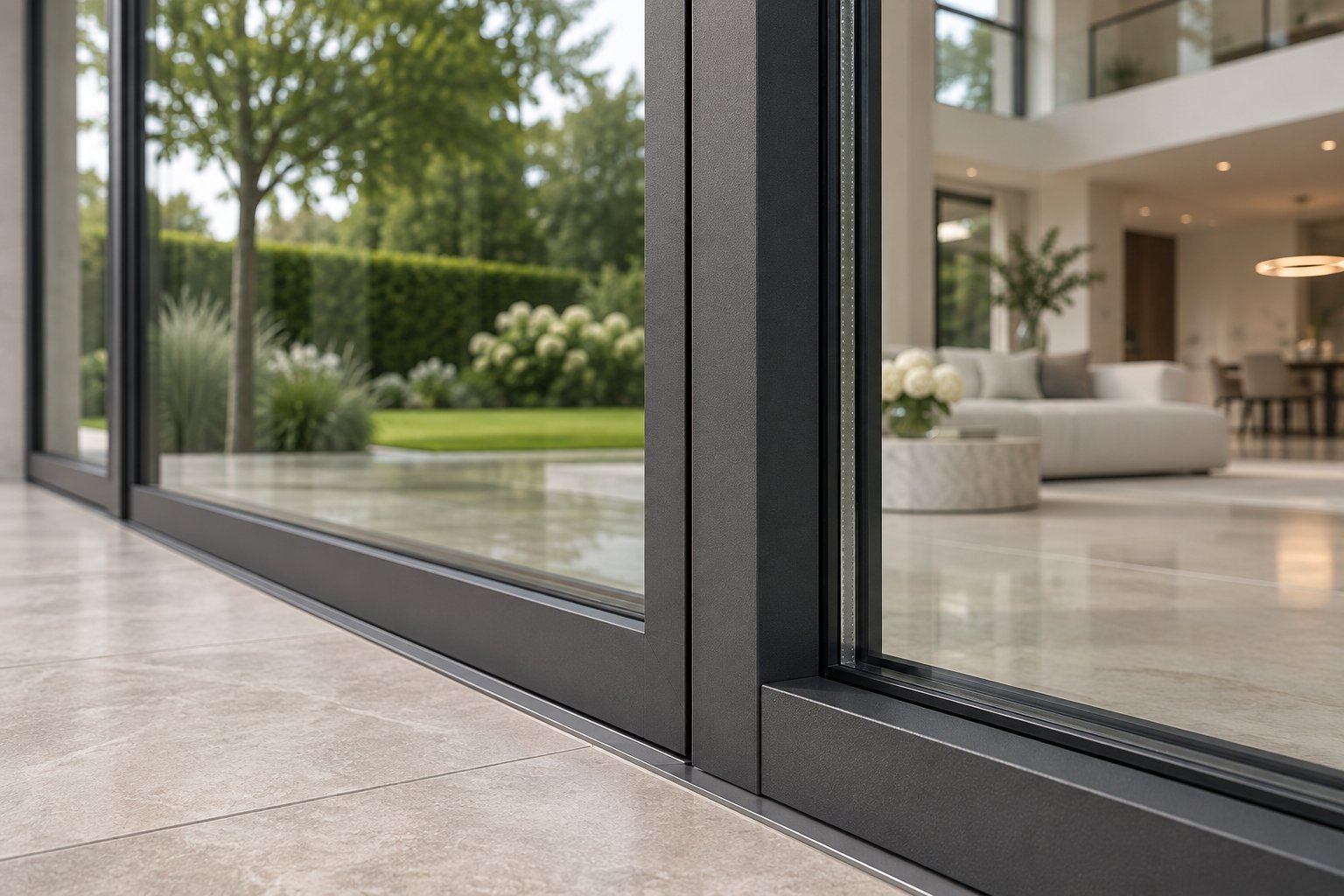
Picture an aluminium frame split into two distinct halves: an exterior profile facing the weather and an interior profile facing your living space. Between them, the manufacturer inserts a rigid strip of glass-fibre-reinforced polyamide — typically designated PA66 — or, in some systems, a polyurethane section. This strip is the thermal break. It bonds the two aluminium halves structurally while blocking the conductive path that would otherwise let heat race straight through the metal.
The effect is immediate and measurable. Without a break, the room-side surface of the frame drops close to the outdoor temperature on a cold night. Condensation forms, moisture runs down the profile, and over time mould can take hold around the frame. With the polyamide barrier in place, the interior surface stays warmer, condensation risk drops sharply, and the frame's energy rating improves dramatically.
This principle applies across every configuration — whether you are specifying an aluminium door with window sidelights for a front entry, aluminium french doors exterior opening onto a courtyard, or a glass door aluminium system for a commercial lobby. The thermal break sits inside the profile regardless of door style, doing the same job in each case.
One point worth stressing: not all thermal breaks are equal. The width, geometry, and material grade of the barrier influence how effectively it insulates. A wider polyamide section with optimised internal chambers will outperform a minimal strip in a budget profile. Asking your supplier about the thermal break depth and construction tells you more about real-world energy performance than almost any other single question.
Understanding U-Value, STC, and Air Infiltration Ratings
Three tested metrics give you an objective way to compare aluminium doors — or any fenestration product — on performance rather than marketing language.
U-value (also called U-factor) measures the rate of heat transfer through the complete door assembly, expressed in watts per square metre kelvin (W/m²K). A lower number means less heat escapes. According to published industry data, a non-thermally-broken double-glazed aluminium unit typically sits around 2.8–3.4 W/m²K, while a thermally broken double-glazed unit with Low-E glass can achieve 1.1–1.4 W/m²K — a reduction of roughly 60 per cent. Triple-glazed thermally broken systems push further still, reaching 0.7–1.0 W/m²K.
| Configuration | Typical U-Value (W/m²K) | Performance Level |
|---|---|---|
| Single glazed, no thermal break | 5.0–5.8 | Poor |
| Double glazed, non-thermally-broken frame | 2.8–3.4 | Moderate |
| Double glazed, thermally broken frame | 1.3–1.8 | Good |
| Double glazed, Low-E, thermally broken | 1.1–1.4 | Strong |
| Triple glazed, thermally broken | 0.7–1.0 | Highest |
In Australia, the WERS (Window Energy Rating Scheme) and NatHERS frameworks use these values — alongside Solar Heat Gain Coefficient (SHGC) — to rate how fenestration products contribute to a home's overall energy performance under the NCC. When browsing front doors for sale or comparing front doors exterior options, look for the whole-assembly U-value rather than a glass-only figure. The glass-only number always looks more impressive but ignores the frame, which is exactly where an unbroken aluminium profile bleeds the most energy.
Sound Transmission Class (STC) rates how effectively the door assembly blocks airborne sound. A higher STC number means better acoustic insulation. For context, commercial aluminium fenestration systems tested under laboratory conditions have achieved STC ratings in the mid-40s to 50, depending on glazing configuration and gasket design. Thicker glass, laminated interlayers, asymmetric pane thicknesses, and deeper air cavities all improve the score. If your project sits near a busy road or flight path, requesting tested STC data — not just a marketing estimate — is essential.
Air infiltration measures how much air leaks through the closed door assembly under a specified pressure difference. It is typically expressed as litres per second per square metre (L/s/m²) in Australian testing or cubic feet per minute per square foot in some international reports. Lower values mean a tighter seal. Excessive air leakage undermines both energy efficiency and acoustic performance, and it often signals poor weatherstripping compression or misaligned hardware rather than a fundamental frame deficiency.
These three ratings are tested values generated under controlled laboratory conditions to standards such as AS 2047 in Australia. They are not marketing claims, and they are not interchangeable — a strong U-value does not guarantee good acoustic insulation, and a tight air-infiltration result does not automatically mean low heat transfer. Each metric answers a different question about the door's real performance.
Thermally broken aluminium frames can approach the energy performance of timber and fibreglass frames while retaining aluminium's structural capacity, slim sightlines, and design versatility — making them a genuine all-rounder for Australian residential and commercial projects.
The practical takeaway is straightforward: always request product-specific data sheets with tested U-values, STC ratings, and air-infiltration figures from any supplier you are considering. If a supplier cannot or will not provide independently tested performance data for their aluminium door and frame systems, treat that as a red flag. Verified numbers are the only reliable way to confirm that the thermal break inside the profile is actually doing its job — and those numbers become especially critical once you start matching door specifications to the specific demands of your local climate.
Choosing Aluminium Door Features Based on Your Climate
Tested U-values and STC ratings tell you how a door performs under laboratory conditions — but the real test happens when that door faces the specific weather patterns outside your home. Australia's climate zones range from tropical humidity in Far North Queensland to alpine cold in the Snowy Mountains, with salt-laden coastal air battering properties along thousands of kilometres of coastline. An aluminium door that thrives in mild, temperate Melbourne may underperform badly on a beachfront block in Broome or a high-altitude site near Thredbo. Matching your specification to your local conditions is how you protect the investment long after the installer leaves.
Coastal and Humid Climate Considerations
Salt air is relentless. Airborne chloride concentrations within a few kilometres of the shoreline can accelerate corrosion by an order of magnitude compared to inland sites, and properties within 500 metres of breaking surf face the most aggressive exposure of all. For any exterior aluminium doors installed in these zones, surface treatment is not optional — it is a structural and warranty decision.
Marine-grade anodising (Class I, minimum 18 micrometre oxide depth) or a high-durability powder coat meeting AAMA 2605 standards provides the first line of defence. Some manufacturers layer both — applying a Class I anodise base beneath a 60-micrometre powder coat topcoat — for properties directly facing the ocean. Hardware matters equally: all exposed fixings should be 316-grade stainless steel, which contains molybdenum for significantly better chloride resistance than the more common 304 grade. Standard zinc-plated fasteners will corrode within months in Zone 1 coastal exposure.
Humid tropical regions across northern Queensland and the Northern Territory add cyclone risk to the equation. Here, an aluminium patio door or sliding system needs impact-rated glazing and frame assemblies tested to withstand wind-borne debris under cyclone conditions. Local council requirements will typically reference the NCC wind region classifications and may mandate specific design wind speeds. If you are specifying patio aluminium doors for a property north of the Tropic of Capricorn, confirm that the assembly has been tested and certified for the relevant wind region before signing off on any quote.
Cold Climate and Extreme Heat Requirements
In colder parts of Australia — the highlands of Victoria, Tasmania, and the ACT in winter — the priority shifts squarely to thermal performance. A non-thermally-broken aluminium frame in Canberra's subzero overnight lows will condensate heavily, potentially driving moisture damage around the frame over successive seasons. Thermally broken profiles with double or triple glazing are essential, not aspirational, for these locations.
Multi-point locking hardware plays a supporting role here. By pulling the door sash tightly against weatherstripping at multiple points along the frame, these locking systems compress seals evenly and significantly reduce air infiltration — keeping cold draughts out and conditioned air in. For homeowners fitting aluminium interior doors between heated zones and unheated spaces like garages or sunrooms, the same principle applies on a smaller scale.
At the other extreme, properties baking through Western Australian or outback Queensland summers face solar heat gain as the dominant challenge. Low-emissivity (Low-E) glass coatings reflect a significant portion of infrared radiation back outside before it enters the living space, reducing cooling loads. Aluminium's compatibility with reflective surface treatments and lighter powder-coat colours further limits heat absorption through the frame itself. If your build sits in NatHERS climate zones with high cooling demands, pairing Low-E glazing with a thermally broken frame delivers measurable energy savings that compound year after year.
Temperate and Mixed Climate Priorities
Sydney, Melbourne, Adelaide, Perth, and their surrounding regions enjoy relatively moderate conditions, which opens the widest range of suitable products. Thermally broken frames are still the smart specification — they improve WERS star ratings and help meet NCC Section J energy requirements — but the margin between a good and a great assembly may feel less dramatic than in extreme climates.
That does not mean temperate zones are free of site-specific hazards. Large portions of peri-urban Australia carry Bushfire Attack Level (BAL) ratings under AS 3959, which directly influence glazing type, frame construction, and seal requirements for every aluminium door on the property. A BAL-29 rated site in the Adelaide Hills or the Blue Mountains demands non-combustible frame materials, ember-resistant seals, and glazing tested to the relevant BAL classification. Similarly, wind load ratings vary by region and terrain exposure category — a seemingly sheltered suburban site on an elevated ridge may carry higher design wind speeds than expected.
The checklist below helps you prioritise the right features based on where you are building or renovating:
- Coastal (within 5 km of shoreline) — marine-grade anodising or AAMA 2605 powder coat; 316 stainless steel hardware; impact-rated glazing in cyclone regions; quarterly freshwater rinse maintenance schedule.
- Tropical and cyclone-prone — wind-rated assemblies certified for the relevant NCC wind region; laminated or impact-rated glass; corrosion-resistant hardware; enhanced drainage provisions for monsoonal rain.
- Cold and alpine — thermally broken frames with double or triple glazing; Low-E coatings; multi-point locking for air-tight seal compression; condensation resistance as a key selection metric.
- Hot and arid — thermally broken frames; Low-E glass with low Solar Heat Gain Coefficient (SHGC); lighter-coloured powder coat finishes to reduce frame heat absorption.
- Temperate and peri-urban — thermally broken frames to meet NCC energy targets; BAL-rated assemblies where bushfire risk applies; wind load ratings confirmed against AS/NZS 1170.2 for the specific site.
No single aluminium door configuration covers every Australian climate scenario. The features that matter most shift with geography, and so should your specification. Getting the climate match right protects performance and warranty coverage — but it also feeds directly into cost, because marine-grade finishes, triple glazing, and cyclone-rated hardware all carry price premiums that only make sense when the environment genuinely demands them.
Understanding Aluminium Door Costs and Budget Planning
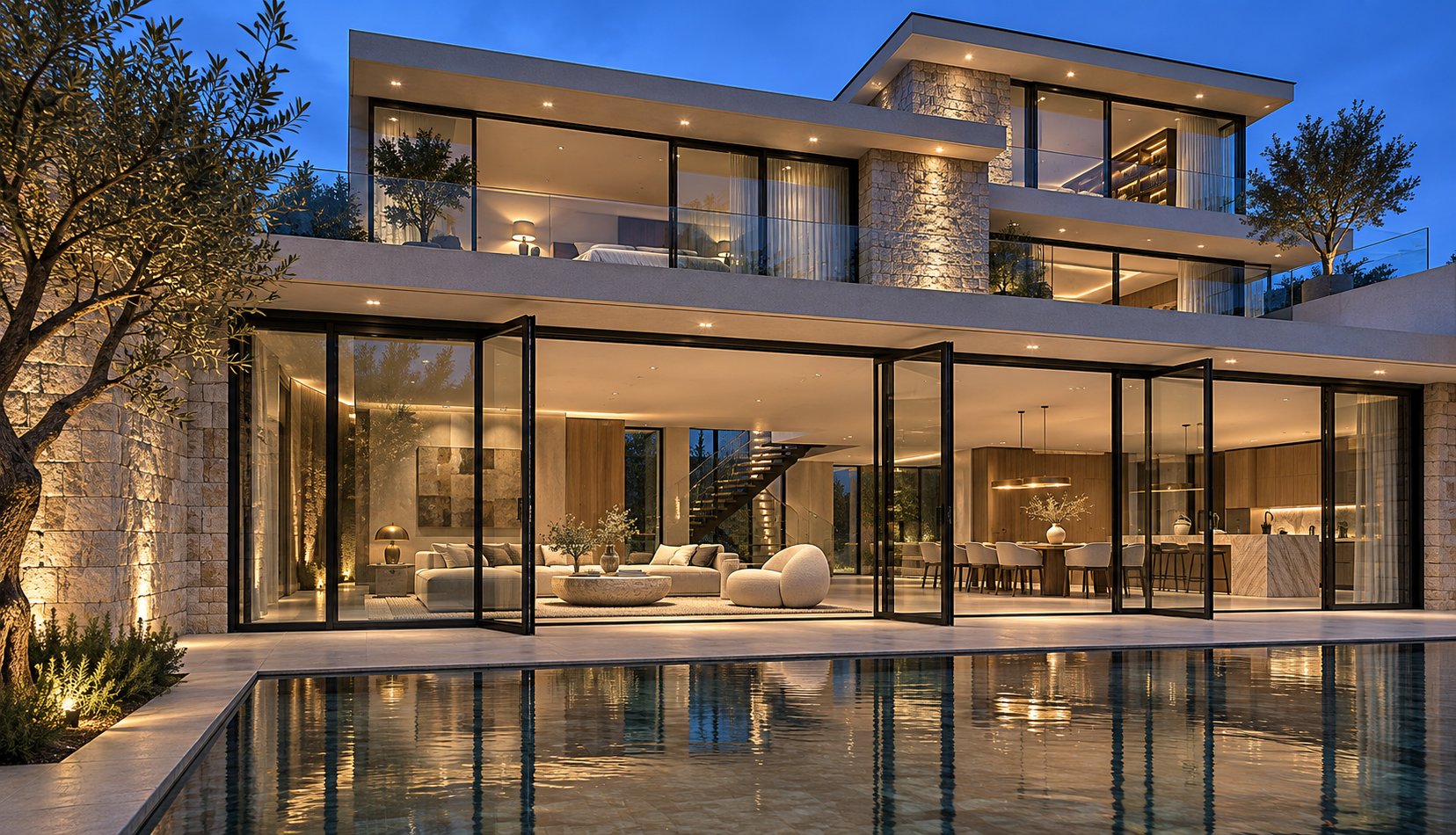
Climate-matched specifications protect performance — but they also shape what you pay. A standard thermally broken sliding door for a temperate Melbourne suburb and a cyclone-rated, marine-finished bifold for a beachfront property in Cairns sit in entirely different price brackets, even though both are aluminium. Rather than quoting fixed dollar figures that go stale the moment material costs shift, the more useful approach is understanding what drives the price so you can read any quote with clarity.
What Drives the Cost of Aluminium Doors
Every aluminium door quote reflects a stack of variables, and changing just one can move the total significantly. The major cost drivers break down as follows:
- Size and panel configuration — a single hinged entry is far less material-intensive than a four-panel stacking slider spanning 4,800 mm. More panels mean more extruded profile, more rollers or hinges, more glazing, and more fabrication time.
- Thermally broken vs non-thermally-broken frames — the polyamide-bridged profiles discussed earlier cost more to manufacture than a basic aluminium door and frame with no thermal barrier. That premium buys measurably better energy performance, but it does add to the bottom line.
- Glazing specification — single glazing is cheapest, double glazing with argon fill is the current baseline for most residential work, and triple glazing pushes the price higher again. Stepping up to Low-E coatings, laminated interlayers, or impact-rated glass for cyclone zones adds further cost at each tier.
- Hardware grade — basic rollers, handles, and a single-point lock differ enormously in cost from multi-point locking systems, 316 stainless steel hinges, and soft-close mechanisms. A commercial aluminium door in a high-traffic retail entry may need panic hardware and heavy-duty closers that alone rival the cost of basic residential hardware sets.
- Surface finish — stock powder-coat colours (typically blacks, whites, and greys) are the most economical. Custom RAL colours, dual-colour finishes (different colours inside and outside), and marine-grade anodising all carry surcharges — roughly 10–20 per cent more in many cases — and may extend lead times.
- Standard vs custom fabrication — off-the-shelf sizes suit new builds designed around common opening dimensions. Renovations, heritage conversions, and architecturally designed homes frequently require custom-fabricated aluminium doors and frames to fit non-standard openings precisely. That bespoke fabrication commands a premium, but it eliminates the compromises — packing strips, filler panels, or structural rework — that come with forcing a standard unit into a non-standard hole.
For aluminium commercial doors destined for storefronts, offices, or hospitality venues, additional factors enter the equation: deeper frame profiles, code-mandated fire or accessibility hardware, automatic closers or sensors, and compliance testing documentation. These requirements mean a commercial aluminium door project is rarely comparable to a residential one on a per-unit basis, even when the physical door dimensions look similar.
Budget Tiers and Total Cost of Ownership
While specific pricing varies by supplier, region, and project scope, aluminium doors generally fall into three recognisable tiers in the Australian market:
- Entry level — standard opening sizes, non-thermally-broken or basic thermally broken profiles, double glazing, stock powder-coat colour, and standard hardware. This tier suits straightforward replacements and budget-conscious new builds where energy ratings are not a primary driver.
- Mid-range — thermally broken frames, double glazing with Low-E coatings, upgraded multi-point locking hardware, and a broader colour selection. Most residential projects aiming for solid NatHERS compliance and long-term durability land here. An aluminium clad door system — where aluminium sheaths a timber or composite core — also sits in this band for homeowners who want the exterior resilience of metal with a different interior aesthetic.
- Premium — large-span bifold or multi-panel sliding configurations, triple glazing, custom or dual-colour finishes, marine-grade hardware, and project-specific engineering for cyclone, bushfire, or acoustic requirements. Architecturally designed homes and high-end commercial fitouts typically operate at this level.
Focusing exclusively on the purchase price misses the bigger picture. Aluminium's real value proposition sits in its total cost of ownership. Timber doors demand periodic sanding, sealing, and repainting — costs that compound over decades. Vinyl doors may need full replacement once UV degradation takes hold. A quality aluminium door, properly specified and finished, needs little more than routine cleaning and occasional hardware lubrication across a 30-to-45-year service life. When you spread the upfront cost across those decades and subtract the maintenance expenses you never incur, the lifetime cost per year often undercuts materials that looked cheaper on the original invoice.
Before you compare quotes from different suppliers, make sure each quote covers the same ground. The following checklist keeps comparisons honest:
- Frame construction — confirm whether the quoted profile is thermally broken or not, and ask about the thermal break depth and material.
- Glazing specification — verify the number of panes, gas fill type, coating (clear, Low-E, laminated), and spacer bar material.
- Hardware brand and grade — identify the lock type, handle set, hinge specification, and whether marine-grade options are included or optional.
- Finish warranty — check the duration and conditions of the powder-coat or anodising warranty, and whether coastal exposure voids or limits coverage.
- Installation scope — clarify whether the quote is supply-only or supply-and-install, and what the installation price includes (removal of existing door, structural trimming, flashing, internal and external finishing, waste disposal).
Pinning down these five details ensures you are comparing like with like. A quote that bundles thermally broken frames, Low-E double glazing, quality multi-point locks, a 15-year finish warranty, and full professional installation is a fundamentally different proposition from a supply-only price for a non-thermally-broken unit with basic hardware — even if the headline figure for the second option looks far more attractive on paper.
Cost clarity puts you in control of the budget, but it does not tell you how to protect the investment once the door is installed. The maintenance decisions you make — or neglect — over the following years determine whether that 30-to-45-year lifespan becomes a reality or just a number on a spec sheet.
Maintenance and Long-Term Care for Aluminium Doors
That 30-to-45-year lifespan is entirely achievable — but it does not happen on autopilot. Aluminium is the lowest-maintenance framing material on the market, yet "low maintenance" and "no maintenance" are not the same thing. A small investment of time each year keeps hardware operating smoothly, seals doing their job, and finishes looking sharp decade after decade. Ignore the basics, and even the best-specified door will underperform long before its time.
Routine Cleaning and Preventive Care
Start with the frames. A soft cloth, warm water, and a mild household soap are all you need to wipe down powder-coated or anodised aluminium profiles. That simple combination lifts salt residue, airborne grit, and general grime without risking the finish. Abrasive pads, steel wool, and acidic or solvent-based cleaners are off-limits — they scratch powder coating, strip anodising, and expose bare metal to the environment. For stubborn marks on an aluminium glass door frame or a screen door with aluminium mesh, a non-abrasive cleaner formulated for coated metals does the job safely.
Tracks deserve separate attention, especially on sliding and stacking systems. Dirt, sand, and leaf debris settle into the bottom rail and are the number-one cause of poor sliding performance. Vacuum the track channel, wipe it with a damp cloth, and clear weep holes — the small drainage slots at the base of the frame — with a fine brush or a short burst of compressed air. Blocked weep holes trap water inside the frame, and standing moisture eventually finds its way past seals.
Glass cleaning sounds straightforward, but one detail catches people out. If your glazing units use Low-E coatings on an interior surface, ammonia-based glass cleaners can degrade that coating over time. Stick to non-ammonia solutions or plain water with a microfibre cloth to keep Low-E performance intact.
How often should all this happen? A light frame and track clean every three months is a sensible baseline — quarterly aligns well with seasonal shifts. Properties near the coast or in dusty rural areas may benefit from monthly rinses to keep salt and particulate buildup in check.
Addressing Wear, Oxidation, and Hardware Issues
Aluminium does not rust in the way steel does, but it can oxidise. On untreated or damaged surfaces, oxidation appears as a white, powdery residue — a sign that the protective finish has been compromised and the bare alloy is reacting with moisture and air. Catching this early matters. Small scratches through the powder coat can be touched up with colour-matched paint before oxidation spreads, while more extensive damage may call for professional refinishing of the affected section.
Moving parts need periodic lubrication to stay smooth and reliable. Every six months, apply a silicone-based lubricant to rollers, hinges, and lock mechanisms — one light spray, then wipe away the excess. Never use petroleum-based oils or general-purpose lubricants on door tracks; they attract dirt and gum up rollers, creating the exact problem you are trying to prevent. This applies equally to a residential bifold, an aluminium storefront door in a commercial fitout, or an aluminium entry door frame carrying heavy daily traffic.
Weatherstripping is the unsung hero of any sealed door assembly. Run a finger along every gasket and compression seal at least once a year. Seals that feel cracked, hardened, or permanently compressed have lost their ability to block draughts and water. Replacing weatherstrips is a relatively inexpensive repair that restores both energy efficiency and acoustic performance — far cheaper than addressing the water damage or condensation issues that follow from worn seals left unattended.
Hardware screws on handles, hinges, and lock keeps gradually loosen through repeated use. An annual check with the correct driver — snugged firm, not overtightened to the point of stripping threads — keeps everything secure. Test locks from both inside and outside after lubricating, and address any stiffness before it worsens.
One of aluminium's underappreciated advantages is refurbishment potential. Ageing aluminium clad doors, residential entries, and commercial glazed systems can often be brought back to near-new condition rather than replaced outright. Repainting or re-powder-coating the frame, replacing failed double-glazed units, upgrading worn hardware, and fitting fresh weatherstripping can extend a door's service life by years at a fraction of the cost of a full replacement. Before writing off an older door, get a qualified technician's assessment — you may be surprised at what is salvageable.
| Task | Frequency |
|---|---|
| Wipe frames with mild soap and water | Every 3 months |
| Vacuum and clean tracks and drainage slots | Every 3 months |
| Clean glass with non-ammonia solution | Every 3 months |
| Freshwater rinse (coastal properties) | Monthly |
| Lubricate rollers, hinges, and locks (silicone-based) | Every 6 months |
| Inspect weatherstripping and gaskets for wear | Every 6 months |
| Check double-glazed units for seal failure (condensation between panes) | Every 6 months |
| Tighten handle, hinge, and lock screws | Annually |
| Test all locking mechanisms from both sides | Annually |
| Inspect powder coating or anodising for scratches or oxidation | Annually |
| Full professional inspection (hardware adjustment, seal assessment, alignment check) | Annually or as needed |
A few warning signs should prompt a call to your installer or a specialist technician rather than a DIY fix: a sliding door that drags or binds after cleaning the track, water leaking past the frame during rain, visible condensation trapped between the panes of a sealed glazing unit, or locking hardware that jams even after lubrication. Catching these issues early keeps a small repair from escalating into a costly replacement — and preserves the performance ratings you paid for when specifying the door in the first place.
Consistent, low-effort care is what separates a door that genuinely delivers on its three-to-four-decade promise from one that disappoints at the ten-year mark. Yet even the most diligent maintenance routine cannot change the fundamental properties of the material itself — and there are legitimate project scenarios where aluminium, despite all its strengths, simply is not the best fit.
When Aluminium Doors May Not Be the Best Choice
Aluminium earns its place across a vast range of Australian projects — but honesty demands acknowledging the situations where it does not. Every material has a sweet spot, and pushing aluminium into a role better suited to timber, steel, or fibreglass leads to compromises that no amount of maintenance discipline can fully overcome.
Scenarios Where Other Materials May Be a Better Fit
Heritage restorations and natural timber aesthetics. If your project involves a Federation cottage in inner Melbourne, a Queenslander renovation, or any listed heritage property where council approval hinges on preserving original character, solid timber doors are almost certainly the appropriate choice. No powder-coat finish or woodgrain laminate on aluminium door frames convincingly replicates the depth, grain variation, and tactile warmth of genuine hardwood — and heritage consultants will spot the difference immediately. In very cold climates like Tasmania's highlands, solid timber's naturally low conductivity also delivers respectable insulation without needing thermally broken engineering, which can matter if budget constraints rule out premium aluminium systems.
High-security and fire-rated applications. Steel dominates where brute strength is non-negotiable. For high-security commercial entries, warehouse access points, and fire-rated assemblies, steel's superior impact resistance and rigidity outperform aluminium significantly. Fire-rated steel doorsets are more widely available, often simpler to certify to Australian Standards, and more economical for large industrial openings where forced-entry resistance matters more than slim sightlines. Aluminium storefront doors serve retail and commercial glazed entries brilliantly, but they are not the material you reach for when blast resistance or maximum forced-entry protection sits at the top of the brief.
Budget-driven residential entries. Fibreglass entry doors offer a compelling alternative for homeowners who need a solid front entry at a lower upfront cost than thermally broken aluminium. Fibreglass slabs with polyurethane foam cores typically deliver R-values in the range of R-6 to R-8 — several times higher than a non-thermally-broken aluminium door with glass — without requiring the engineered thermal break that pushes aluminium prices upward. Advanced moulding techniques also let fibreglass convincingly mimic timber grain, giving you a traditional aesthetic with far less maintenance than real wood. Where the project calls for a standard-sized, well-insulated hinged entry rather than an expansive glazed opening, fibreglass frequently hits the value sweet spot.
Making an Honest Material Decision
It is tempting to declare a single "best" door material, but that framing is misleading. A four-panel aluminium stacking slider flooding a living room with harbour views is doing a job that fibreglass and steel simply cannot match. Equally, a heritage timber door anchoring a period façade is performing a role that aluminium aluminium-framed doors would compromise. The decision is project-specific, not material-hierarchical.
The best door material is the one that matches your specific performance requirements, budget constraints, and aesthetic goals — not the one with the best marketing. An honest assessment of what the opening actually needs to do will always lead to a better outcome than defaulting to any single material out of habit or brand loyalty.
Ask yourself three questions before committing: What must this door physically withstand (weather, traffic, security threats)? What energy and acoustic performance does my climate and site demand? And what visual language does the architecture call for? If the answers consistently point toward aluminium — corrosion resistance, slim profiles, large glass areas, long lifecycle — then specify with confidence. If they point elsewhere, follow the evidence rather than the marketing. That clarity carries directly into the final practical step: defining your specification in enough detail to get meaningful, comparable quotes from suppliers.
Planning Your Aluminium Door Project From Specification to Supplier
Knowing which material suits your project, which climate features to prioritise, and what drives the price puts you in a strong position — but only if you translate that knowledge into a clear specification before reaching out for quotes. Vague enquiries produce vague pricing, and vague pricing makes meaningful comparison impossible. The sharper your brief, the more useful every supplier response becomes.
Key Specifications to Define Before Contacting Suppliers
Think of your specification as the brief that every supplier reads from the same page. Missing even one detail — glazing type, hardware grade, finish — gives each company room to fill the gap with their own assumptions, and suddenly you are comparing apples with avocados. Before you send a single enquiry, pin down these essentials:
- Opening dimensions and configuration — measure the structural opening (width and height in millimetres), and decide on the door type: sliding, stacking, bifold, hinged, or a combination. For multi-panel systems, sketch the panel arrangement and identify which panels are operable and which are fixed.
- Performance ratings — based on your climate zone and site exposure, determine minimum requirements for thermal performance (U-value), acoustic insulation (STC), wind load rating (referencing AS/NZS 1170.2), and impact resistance if you are in a cyclone or BAL-rated area.
- Glazing specification — state the number of panes, gas fill preference, coating type (clear, Low-E, tinted, laminated), and any safety-glass requirements for specific openings. A request for "double glazing" alone is too vague to price accurately.
- Frame finish and colour — specify whether you want standard powder coat, a custom RAL colour, dual-colour (different inside and outside), or marine-grade anodising. Note that custom colours and dual finishes affect both cost and lead time.
- Hardware and locking preferences — identify the lock type (single-point, multi-point, keyed alike across multiple doors), handle style, hinge grade (standard or 316 stainless for coastal sites), and any accessibility requirements such as lever handles or low-threshold access.
- Code and compliance requirements — list applicable standards: NCC energy provisions, BAL rating if in a bushfire-prone area, AS 2047 compliance for weatherproofing, and any council DA conditions that influence door selection.
Having this information assembled before your first phone call or email means every quote you receive addresses the same scope. It also signals to suppliers that you are a serious, informed buyer — which tends to produce more detailed and competitive responses. Whether you are specifying aluminium entry doors for a new build or sourcing custom aluminium doors for a renovation with non-standard openings, the same discipline applies.
Evaluating Aluminium Door Suppliers and Collections
A well-prepared specification deserves a supplier capable of fulfilling it properly. Not every manufacturer or distributor carries the same breadth of systems, and not every sales team has the technical depth to discuss project-specific details. Here is what to look for when shortlisting:
- Range of door styles — a supplier offering sliding, stacking, hinged, bifold, and commercial glazed systems under one roof simplifies coordination. You avoid the headache of sourcing aluminium doors from multiple vendors with different profile systems, finishes, and warranty terms.
- Customisation capability — can they accommodate non-standard panel layouts, oversized configurations, and project-specific frame colours? Renovations and architecturally designed homes rarely fit neatly into catalogue sizes.
- Transparent glazing and hardware options — the supplier should clearly itemise what glass build-up, hardware brand, and locking specification are included in the quoted price. Bundled "standard inclusions" without detail make comparison unreliable, as industry guides on accurate quoting consistently emphasise.
- Willingness to discuss thresholds, installation interfaces, and site conditions — a good supplier asks about your floor finish, sill detail, and drainage connection rather than simply quoting a product in isolation.
- Commercial aluminium door frames and specialist systems — if your project includes both residential openings and commercial entries (common in mixed-use developments or home offices with public-facing access), check whether the supplier's range extends to commercial-grade profiles, fire-rated assemblies, and heavier-duty hardware.
As a practical example, MEICHEN's aluminium door collection demonstrates what a broad offering looks like in the Australian market — sliding, stacking, hinged, bifold, and commercial glazed systems available through a single supplier, with project-specific panel layouts, glazing, frame colours, hardware, and threshold details all open for coordination. Their verified range centres on aluminium-framed glazed doors; dedicated lift-and-slide mechanisms and solid aluminium exterior door panels were not confirmed on their reviewed product pages, so those requirements would need direct inquiry rather than assumption. That kind of honest scoping — knowing what a supplier covers and what falls outside their confirmed range — saves time and avoids costly mismatches during fabrication.
For projects involving interior aluminium doors between living zones, aluminium box bar door designs for contemporary room dividers, or large-span patio systems, the same evaluation criteria apply regardless of the supplier you choose. Breadth, transparency, and technical engagement matter far more than glossy imagery.
One final step before you sign off on any specification: request product data sheets with independently tested performance values — U-values, STC ratings, air infiltration figures, and wind load capacities tested to AS 2047 or equivalent standards. Comparing quotes line by line against the same tested benchmarks is the only reliable way to ensure the door you are paying for will actually perform the way the brochure promises. Marketing language fades; tested numbers hold up.
Frequently Asked Questions About Aluminium Doors
1. What is a thermal break in an aluminium door and why does it matter?
A thermal break is an insulating strip — typically glass-fibre-reinforced polyamide (PA66) or polyurethane — positioned between the interior and exterior sections of an aluminium frame. It interrupts the metal's natural heat conductivity, which is roughly 1,000 times higher than polyamide plastic. Without this barrier, heat transfers rapidly through the frame, causing energy loss in winter and heat gain in summer, along with condensation on the indoor surface during cold weather. Thermally broken double-glazed aluminium assemblies with Low-E glass can achieve U-values around 1.1–1.4 W/m²K, representing approximately a 60 per cent improvement over non-thermally-broken equivalents. When comparing quotes, always confirm whether the frame is thermally broken and ask about the break's depth and material grade, as these details directly affect real-world energy performance.
2. How long do aluminium doors last compared to other materials?
Aluminium doors generally deliver a service life of 30 to 45 years with minimal maintenance, provided the surface finish and hardware are appropriate for the installation environment. By comparison, timber doors can last 20 to 40-plus years but require regular sanding, sealing, and repainting to reach the upper end of that range. Vinyl (uPVC) doors typically last 20 to 30 years and are vulnerable to UV degradation — a significant concern in Australia's harsh sun. Steel doors match or exceed aluminium at 30 to 50-plus years but need prompt attention to any coating damage to prevent rust. Fibreglass sits around 25 to 40 years. Aluminium's advantage lies in its combination of longevity and low upkeep: no repainting, no rot risk, no termite vulnerability, and full recyclability at end of life.
3. What types of aluminium doors are available for residential and commercial projects?
Residential aluminium door styles include standard sliding doors (two-panel through to multi-panel stacking configurations), bifold doors that fold and stack to open an entire wall span, hinged entry doors in single or double configurations, casement doors for narrow utility openings, and French-style doors with twin centre-opening leaves. Commercial options encompass narrow-stile storefront doors designed for sleek retail entries, wide-stile doors built for heavy traffic with panic hardware and heavy-duty closers, and fire-rated aluminium assemblies tested to AS 1905. A supplier such as MEICHEN offers sliding, stacking, hinged, bifold, and commercial glazed systems through a single collection at meichenwindows.com.au/aluminium-doors/, though specialist mechanisms like lift-and-slide hardware would require direct confirmation before specifying.
4. How should I maintain aluminium doors to maximise their lifespan?
Routine care involves wiping frames with mild soap and warm water every three months, vacuuming and clearing tracks and drainage weep holes on the same schedule, and cleaning glass with a non-ammonia solution to protect any Low-E coatings. Every six months, apply a silicone-based lubricant to rollers, hinges, and lock mechanisms — never petroleum-based products, which attract grit and gum up moving parts. Inspect weatherstripping and gaskets for cracking or permanent compression at the same interval. Annually, tighten hardware screws, test all locks from both sides, and check the powder coating or anodising for scratches or white powdery oxidation. Coastal properties benefit from a monthly freshwater rinse to remove salt deposits. Ageing aluminium doors can often be refurbished — repainted, re-glazed, and fitted with fresh hardware — extending service life significantly at a fraction of full replacement cost.
5. What factors affect the cost of aluminium doors in Australia?
Key price variables include door size and panel configuration, thermally broken versus non-thermally-broken frame construction, glazing specification (single, double, or triple pane with optional Low-E or laminated layers), hardware grade (basic single-point locks versus multi-point 316 stainless steel systems), surface finish (stock powder-coat colours versus custom RAL, dual-colour, or marine-grade anodising), and whether the door is a standard catalogue size or custom-fabricated for non-standard openings. Commercial aluminium doors carry additional costs for deeper profiles, code-mandated hardware, and compliance documentation. To compare quotes accurately, ensure each supplier itemises the same five elements: frame construction details, glazing build-up, hardware brand and grade, finish warranty terms, and whether installation is included or supply-only.