

What Aluminium Window Hardware Does and Why It Matters
Strip away the handles, hinges, locks, and stays from an aluminium window, and what remains is a static rectangle of metal. It won't open for a breeze, seal against a storm, or stop an intruder. Aluminium window hardware is the collective term for every mechanical component that allows a window to function — to swing, slide, tilt, lock, and compress against weatherstripping. These are the parts that turn an inert frame into a working system.
Defining Aluminium Window Hardware
The category is broader than most people realise. It covers handles (from simple cockspur types to multi-point espagnolette handles), friction stays that control how far a casement opens, hinges that bear the weight of the sash, locking mechanisms that secure the frame at multiple points, restrictors that prevent dangerous over-opening, and sealing components like compression gaskets and adjustment cams. Each piece has a specific mechanical job, and they work as an integrated system rather than isolated parts.
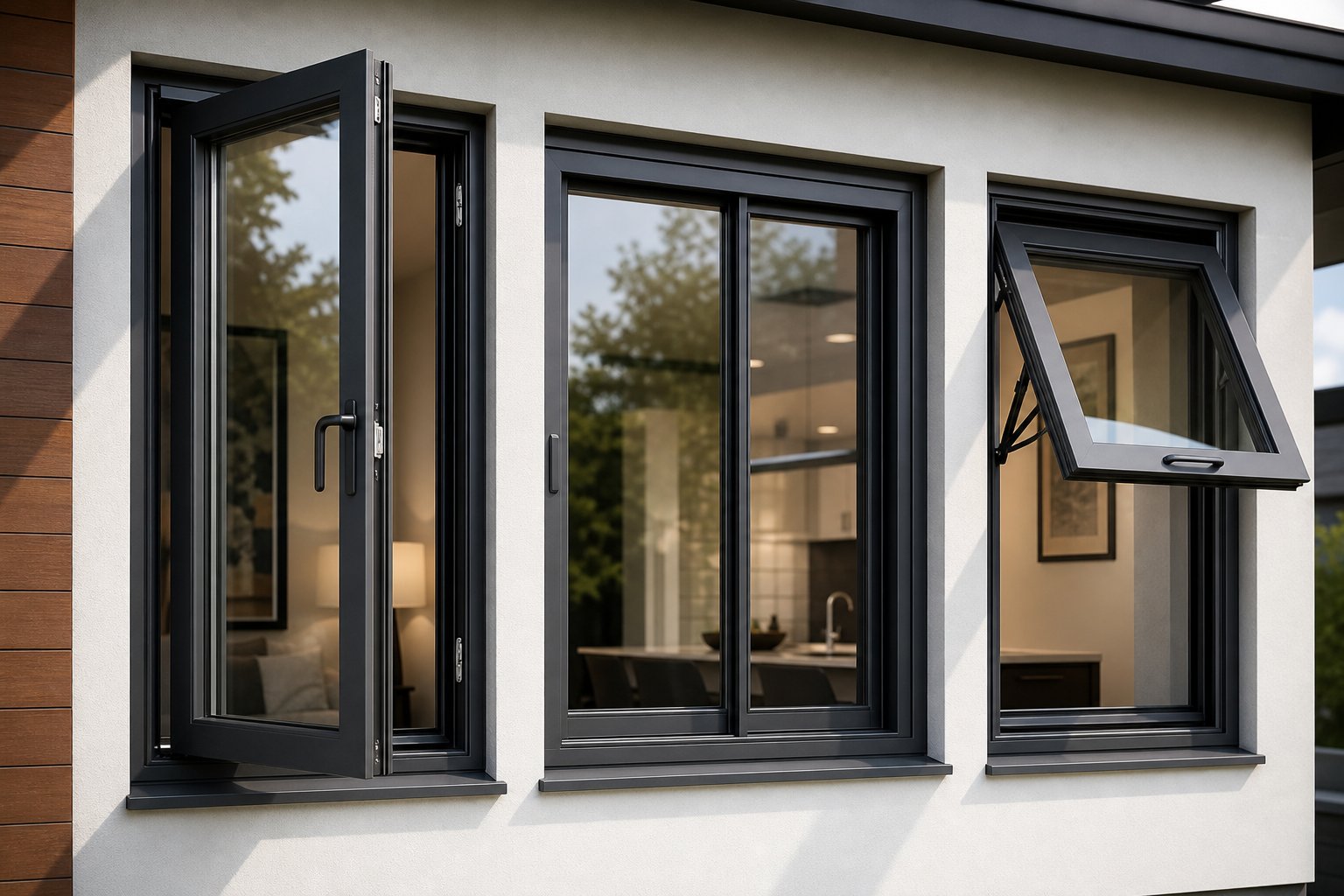
Think of it this way: the aluminium frame provides structure, the glass provides vision and insulation, but the hardware provides movement and control. A sliding window relies on roller carriages gliding along tracks. A casement window depends on friction stays holding the sash at any angle against wind load. A tilt-and-turn window uses a complex perimeter gear mechanism to switch between ventilation and full opening with a single handle rotation. Every window type demands its own hardware configuration.
Why Hardware Quality Determines Window Performance
Hardware quality matters because these components directly influence four critical outcomes: thermal performance, security, weatherproofing, and longevity. A multi-point locking system doesn't just resist forced entry — it compresses the sash evenly against the seal at multiple locations, reducing air infiltration and improving energy ratings. Friction stays don't just hold a window open — their tension determines whether the sash droops over time or maintains its position for years. Even something as simple as an adjustment cam affects how tightly the seal compresses when the window closes, which directly impacts draught resistance.
Hardware is the most mechanically stressed part of any window assembly. It absorbs repeated operating cycles, wind loads, thermal expansion, and physical force from daily use. It is consistently the first component to fail when poorly specified — and when it fails, the entire window underperforms regardless of how good the frame or glazing may be.
Industry testing reinforces this point. Standards like BS EN 1191 subject window hardware to between 5,000 and 20,000 repeated opening and closing cycles to verify durability, while separate tests measure resistance to racking, static torsion, and impact. Quality hardware passes these thresholds comfortably. Budget hardware begins degrading well before reaching them — leading to stiff operation, seal failure, and in extreme cases, detached sashes.
This article walks through every hardware category in detail, maps components to specific window types, explains the material science behind corrosion failures, covers finish selection for Australian coastal and inland environments, and provides practical maintenance guidance. Whether you're specifying hardware for a new build, troubleshooting a problem on an existing window, or simply trying to understand what all those metal parts actually do, the sections ahead have you covered.
Every Hardware Component Type Explained
Knowing that hardware matters is one thing. Identifying each piece by name, understanding its function, and recognising when it needs attention — that's where most homeowners and even some tradespeople get stuck. This section serves as a complete window hardware identification guide, covering every major component you'll find on modern aluminium window systems in Australia.
Handles, Stays, and Hinges
Handles are the most visible piece of hardware, and they come in several distinct types. A cockspur handle features a protruding spur that hooks into a catch on the frame — simple, but limited to a single locking point. An espagnolette handle (commonly called an "espag") operates a spindle that engages multiple locking points around the frame perimeter when rotated. This is the standard for modern aluminium casement windows because it combines operation and security in a single action. Inline handles sit flush with the sash profile and are typically used on sliding or tilt-and-turn windows where a protruding handle would interfere with movement.
Friction stays control how a casement or awning window opens and holds its position. A side-hung friction stay mounts along the top of a side-opening casement, while a top-hung friction stay supports awning windows that hinge at the top and push outward at the bottom. The internal friction mechanism allows the sash to hold at any angle without a separate prop or pin — a significant improvement over older stay-bar designs that only offered fixed positions.
Hinges bear the sash weight and define the pivot axis. Butt hinges are the traditional visible type, while flag hinges offer a compact mounting solution for lighter sashes. Concealed hinges hide entirely within the frame rebate when closed, delivering a clean sightline with no exposed metalwork. Quality hinges for aluminium windows use stainless steel pins and incorporate friction adjustment without metal-to-metal contact, which minimises wear over thousands of cycles.
Locking Mechanisms and Security Components
The aluminium window locking mechanism components work together as a coordinated system rather than individual parts. An espagnolette locking bar runs along the sash edge and is driven by the handle spindle. As the handle rotates, the bar moves locking cams into engagement with keep plates fixed to the frame.
Mushroom cams and roller cams are the two main engagement types. Mushroom cams have a T-shaped head that hooks behind the keep plate, providing anti-lift resistance — they physically prevent the sash from being levered away from the frame. Roller cams use a cylindrical roller that slides into the keep, offering smooth operation and adjustability but less resistance to forced separation.
Shoot bolts extend vertically from the top or bottom of the sash into the frame head or sill, adding locking points at locations the main espagnolette bar can't reach. Keep plates (also called strikers) are the fixed frame-side components that receive the cams or bolts. Window restrictors limit opening distance for child safety and fall prevention, typically capping the gap at 100 mm unless manually overridden.
Sealing and Adjustment Components
These are the least glamorous parts, but they directly determine whether your window keeps weather out and conditioned air in. Weatherpile (also called mohair or brush seal) fills gaps in sliding window tracks. Compression seals — usually EPDM rubber gaskets — press between the sash and frame when the window closes, creating an airtight barrier. Packers are shims used during installation to ensure the sash sits square within the frame, maintaining even seal compression on all sides.
Adjustment cams (sometimes called eccentric cams) allow fine-tuning of how tightly the sash pulls against the seal. Rotating the cam changes its effective diameter, increasing or decreasing compression. This is the mechanism that lets you tighten a window that's started to let draughts through without replacing any parts.
The table below brings all these components together as a quick-reference resource for identifying parts, understanding their role, and knowing when replacement is typically needed.
| Component Name | Function | Typical Window Types | Replacement Frequency |
|---|---|---|---|
| Espagnolette handle | Operates multi-point locking via spindle rotation | Casement, awning, tilt-and-turn | 10–15 years |
| Cockspur handle | Single-point latch engagement via spur hook | Older casement windows | 8–12 years |
| Friction stay (side-hung) | Controls opening arc and holds sash position | Side-opening casement | 8–12 years |
| Friction stay (top-hung) | Supports outward-opening sash from top hinge | Awning windows | 8–12 years |
| Concealed hinge | Bears sash weight while remaining hidden when closed | Casement, tilt-and-turn | 15–20 years |
| Espagnolette locking bar | Drives cams into keeps for multi-point locking | Casement, awning | 15–20 years |
| Mushroom cam | Provides anti-lift locking engagement with keep plate | Casement, awning, tilt-and-turn | 15–20 years |
| Shoot bolt | Extends into frame head or sill for vertical locking | Casement, French windows | 12–15 years |
| Window restrictor | Limits opening distance for safety compliance | All opening types | 10–15 years |
| Compression seal (EPDM) | Creates airtight and watertight barrier when closed | All types | 10–15 years |
| Weatherpile (brush seal) | Fills track gaps to reduce air and dust infiltration | Sliding windows and doors | 5–8 years |
| Adjustment cam | Fine-tunes sash-to-seal compression | Casement, awning, tilt-and-turn | Rarely replaced (adjusted only) |
Each of these components is engineered for a specific mechanical task, but none operates in isolation. The handle drives the locking bar, the locking bar moves the cams, the cams pull against the keeps, and the keeps compress the sash against the seal. A failure at any point in that chain compromises the entire system — which raises an important question about what those components are made from, and how the wrong material choice accelerates that failure.
Matching Hardware to Your Window Opening Type
Every window type moves differently, and that movement dictates exactly which hardware components are required. A casement swings outward on a side hinge. A slider rolls horizontally along a track. A tilt-and-turn pivots in two planes from a single handle. Each mechanism demands a specific combination of stays, locks, operators, and seals — get the combination wrong, and the window either won't function properly or won't last.
This section maps the casement window hardware requirements, sliding window mechanisms, tilt-and-turn systems, and bi-fold configurations so you can identify precisely what your windows need.
Casement and Awning Window Hardware
Casement windows are side-hung — they swing outward on a vertical axis, typically opening to 90 degrees. The primary hardware is a pair of side-hung friction stays mounted at the top and bottom of the sash. These control the opening arc while generating enough resistance to hold the sash at any angle against wind pressure. For proper support, the friction stay length should be roughly half to two-thirds of the window width.
An espagnolette handle drives the locking system. When you rotate the handle, it engages multiple cams around the sash perimeter, pulling the frame tight against the compression seal. Most modern casement configurations also include a window restrictor that caps the opening at 100 mm — a requirement for upper-storey windows under Australian safety standards — with a manual override for full opening when needed.
Awning windows flip the orientation. They're top-hung, hinging at the top edge and pushing outward at the bottom. The awning window friction stay hardware is similar in principle to casement stays but mounted horizontally rather than vertically, bearing the sash weight differently. Because awning windows typically open to a smaller angle (around 30 to 45 degrees), the friction stay stroke is shorter — roughly half the window width is sufficient.
For awning windows mounted high on a wall, a standard handle isn't practical. Chain winders or lever operators extend reach, allowing you to open and close the sash from below. Larger awning sashes may also need a telescopic stay working alongside the friction stays to manage the additional weight.
- Casement window minimum hardware: 2x side-hung friction stays, 1x espagnolette handle, espagnolette locking bar with mushroom or roller cams, keep plates, window restrictor, compression seal
- Awning window minimum hardware: 2x top-hung friction stays, 1x espagnolette handle or chain winder, locking bar with cams, keep plates, compression seal, telescopic stay (for larger sashes)
Sliding and Tilt-and-Turn Mechanisms
Sliding aluminium windows operate on a completely different principle. There are no hinges or stays — instead, the sash sits on roller carriages that glide along a track recessed into the sill. The quality of those rollers determines how smoothly the window operates over its lifetime. Tandem roller assemblies with sealed bearings handle heavier sashes without binding, while single rollers suit lighter panels.
Where the two sashes meet in the middle, interlocking meeting stile hardware creates a weathertight junction. The profiles overlap and compress a brush seal or fin seal between them, blocking air and water infiltration at the most vulnerable point. Locking is handled by crescent locks (a rotating cam that hooks over a keeper) or flush-mounted locks that sit within the stile profile for a cleaner appearance.
Tilt-and-turn windows demand the most complex hardware of any residential window type. A single handle controls a perimeter gear mechanism — an espagnolette rod running inside the sash, connected by corner drives that transfer motion around all four sides. Rotating the handle to 90 degrees releases the top of the sash to tilt inward for ventilation (typically 100 to 150 mm). Rotating to 180 degrees disengages all locking points, allowing the entire sash to swing inward on side hinges like a door.
The tilt-and-turn window hardware mechanism includes the espagnolette rod, corner drives at each sash corner, a tilt restrictor, side-mounted hinges for turn mode, and multi-point locks that compress the gasket evenly on all four sides when closed. This even perimeter compression is what gives tilt-and-turn windows their superior air-sealing performance compared to single-point or two-point locking systems.
Pivot windows — less common in residential applications — use a central pivot mechanism that allows the sash to rotate 180 degrees for cleaning. The hardware includes pivot pins, balance springs, and friction brakes to control rotation speed.
- Sliding window minimum hardware: 2x roller carriages (per sliding sash), track channel, interlocking meeting stile, crescent lock or flush lock, weatherpile or fin seal, sash guide
- Tilt-and-turn window minimum hardware: Espagnolette rod with corner drives, multi-point locking cams (4 to 8 points), tilt restrictor, side hinges, inline handle, perimeter compression gasket
Bi-Fold and Stacking Door Hardware
Bi-fold doors and stacking systems push the hardware demands further again. Multiple panels need to fold, slide, and stack neatly while supporting significant weight — a four-panel aluminium bi-fold can easily exceed 200 kg total.
The track system is the foundation. A top-hung configuration suspends panels from carrier rollers running along an overhead track, with a bottom guide channel keeping the panels aligned. Bottom-rolling systems reverse this, with the weight carried on rollers in the sill track and a top guide preventing sway. Top-hung systems generally offer smoother operation and a cleaner threshold, while bottom-rolling systems suit wider openings where overhead structural support is limited.
Each panel connects to its neighbour via pivot hinges that allow folding. D-handles or flush pulls provide grip for sliding the folded stack, and flush bolts secure the lead panel to the head and sill when the system is closed. The bi-fold door track and roller hardware must handle both the lateral sliding motion and the rotational folding motion simultaneously — a demanding combination that requires precision-machined components.
- Bi-fold door minimum hardware: Top or bottom track, carrier rollers (per panel), pivot hinges between panels, D-handle or flush pull, flush bolts (lead panel), drop bolt or shoot bolt, guide channel, weatherseal compression gasket
- Stacking door minimum hardware: Multi-channel track, tandem roller carriages (per panel), interlocking stile seals, flush lock per panel, anti-lift blocks, sill drainage system
Regardless of window type, every hardware configuration shares one vulnerability: the materials those components are made from. A perfectly specified mechanism will still fail prematurely if the metal reacts with the aluminium frame around it — a problem that has nothing to do with salt air and everything to do with electrochemistry.
Material Compatibility and Avoiding Galvanic Corrosion
Most people blame salt air when their window fittings corrode. Salt accelerates the process, certainly — but it isn't the root cause. The real culprit is an electrochemical reaction triggered the moment two dissimilar metals touch in the presence of moisture. Understanding this mechanism is the difference between specifying hardware that lasts decades and watching components deteriorate within a few seasons.
Understanding Galvanic Corrosion in Aluminium Frames
Galvanic corrosion works like a tiny battery. When two metals with different electrochemical potentials are in direct contact and an electrolyte (water, condensation, or salt spray) bridges between them, the less noble metal loses electrons and corrodes faster than it would on its own. The more noble metal is protected at the expense of its neighbour.
Aluminium sits toward the active (anodic) end of the galvanic series. Carbon steel sits higher, closer to the cathodic end. Fix a bare carbon steel hinge or locking bar directly to an aluminium frame, add moisture from rain, coastal fog, or even overnight condensation, and the aluminium around the fixing point becomes the sacrificial anode. It corrodes preferentially — white powdery deposits appear around screw holes, the frame pits at contact points, and eventually the fixing loses its grip entirely.
The severity depends on three factors: how far apart the metals sit on the galvanic series, the ratio of cathodic to anodic surface area, and how conductive the electrolyte is. A small steel screw in a large aluminium frame creates a concentrated attack zone around the screw hole. Coastal environments with chloride-laden moisture dramatically increase electrolyte conductivity, which is why galvanic corrosion on aluminium window hardware progresses fastest within a few kilometres of the shoreline — but it can occur anywhere moisture lingers.
Recommended Hardware Materials for Aluminium Windows
Preventing corrosion on aluminium window frames starts with choosing the best material for aluminium window fittings — metals and alloys that either sit close to aluminium on the galvanic series or resist corrosion so effectively that the electrochemical reaction barely registers.
Stainless steel remains the preferred choice for structural hardware components like hinges, stays, and locking bars. Grade 304 offers good general corrosion resistance and suits inland and sheltered environments where direct salt exposure is minimal. For coastal properties — particularly within 1 km of breaking surf — stainless steel grade 316 window hardware is the appropriate specification. The addition of molybdenum in 316 provides significantly greater resistance to chloride attack, making it the standard for marine-grade construction.
Zinc alloy (Zamak) is widely used for handles, cam housings, and non-structural components. It's cost-effective, casts into complex shapes easily, and sits close to aluminium on the galvanic series, which minimises electrochemical potential difference. The trade-off is lower mechanical strength compared to stainless steel, so it's best suited to components that don't bear heavy loads.
Engineered polymers — glass-reinforced nylon, acetal, and similar composites — eliminate galvanic risk entirely because they're non-metallic. They're commonly used for adjustment cams, roller housings, and internal mechanism components where corrosion resistance matters more than raw tensile strength.
Brass requires careful consideration. While it looks attractive and machines well, brass is susceptible to dezincification in certain water chemistries and aggressive environments. The zinc component leaches out, leaving a weak, porous copper structure. In tropical or coastal Australian conditions, brass hardware can fail unpredictably unless it's a dezincification-resistant (DR) grade — and even then, it's not the first choice for external fittings on aluminium frames.
| Material | Corrosion Resistance | Strength | Cost | Best Environment |
|---|---|---|---|---|
| Stainless steel 304 | Good — resists general atmospheric corrosion | High | Moderate | Inland, urban, sheltered coastal |
| Stainless steel 316 | Excellent — resists chloride and salt spray | High | Higher | Coastal, marine, tropical humid |
| Zinc alloy (Zamak) | Moderate — close galvanic compatibility with aluminium | Moderate | Low | All environments (non-structural roles) |
| Engineered polymer | Immune — no galvanic interaction | Low to moderate | Low | All environments (internal components) |
| Brass (standard) | Variable — risk of dezincification | Moderate | Moderate to high | Dry inland only (with caution) |
| Brass (DR grade) | Improved — resists dezincification | Moderate | High | Inland, light coastal (not immersion) |
Even with compatible materials, best practice includes an additional layer of protection: isolation gaskets and nylon washers placed between any metal hardware and the aluminium frame. These non-conductive barriers physically break the electrical circuit that galvanic corrosion requires. No electrical path means no electron transfer, regardless of moisture. It's a simple, inexpensive detail — a plastic washer or EPDM gasket under a screw head — but it's the single most effective measure for extending hardware life in aggressive environments. Reputable hardware manufacturers build these isolators into their designs as standard rather than leaving them as an aftermarket addition.
Material choice sets the foundation for hardware longevity, but it's only half the equation. The finish applied over that base material determines how well it resists UV, abrasion, and the specific atmospheric conditions of your site — a decision that varies significantly depending on whether your project faces the ocean, the bush, or a city streetscape.

Hardware Finishes for Coastal, Urban, and Harsh Environments
Choosing the right base material prevents galvanic corrosion — but that bare metal still needs a surface finish. And here's where many specifications go wrong: finish selection gets treated as a colour decision when it's actually a durability decision. The coating on your aluminium window hardware determines how well it resists UV degradation, salt spray, abrasion from daily use, and the specific atmospheric chemistry of your location. A finish that performs flawlessly in suburban Melbourne may deteriorate within two years on a beachfront property in Noosa.
Powder Coating vs Anodising for Hardware Finishes
Two dominant finish technologies compete for hardware applications, and each brings distinct advantages depending on the project context.
Powder coating is a dry finishing process where electrostatically charged pigment and resin particles are sprayed onto the metal surface, then cured under heat to form a continuous protective film. The result is a tough, uniform coating that offers the widest colour range of any hardware finish — virtually any RAL or custom colour is achievable. This makes it straightforward to match hardware to your window frame finish for visual cohesion. Powder coating also conceals minor surface imperfections in the base material, delivering a smooth, uniform appearance regardless of what's underneath.
The trade-off? Powder coat sits on top of the metal rather than integrating with it. Under sharp impact — a window stay striking a frame corner, or a handle catching against a hard surface — the coating can chip, exposing the base metal to moisture and initiating localised corrosion. High-quality powder coats resist this well, but no topcoat is immune to mechanical damage over a 15-year service life.
Anodising takes a fundamentally different approach. Rather than adding a layer on top, the electrochemical process converts the aluminium surface itself into a hard aluminium oxide layer. This oxide integrates with the metal at a molecular level — it can't peel, flake, or delaminate because it is the surface. Anodised finishes resist scratching far better than powder coat and provide excellent corrosion resistance without adding measurable thickness to the component.
The limitation is aesthetic flexibility. Anodising produces metallic tones — natural silver, bronze, black, and gold — but can't replicate the vibrant colours or matte/gloss textures that powder coating achieves. Any tooling marks or surface imperfections in the original component remain visible after anodising, since the process doesn't fill or mask them.
For aluminium window hardware specifically, the practical distinction often comes down to this: powder coating suits components where colour matching to the frame is a priority, while anodising suits components where scratch resistance and long-term surface integrity matter more than colour variety. Many quality hardware systems use both — anodised structural components (hinges, stays) paired with powder-coated handles and covers that match the frame colour.
Selecting Finishes by Environment
Your project's geographic and climatic context should drive the finish specification. A window facing the Coral Sea endures a completely different atmospheric assault than one overlooking a Canberra streetscape. The following breakdown matches aluminium window hardware finish options to the environments where they perform best.
- Marine and coastal (within 1 km of breaking surf): Grade 316 stainless steel with electropolished or passivated finish, or marine-grade powder coat tested to a minimum 1,000 hours neutral salt spray per ASTM B117 or ISO 9227 NSS. Standard powder coats and chrome finishes degrade rapidly in direct salt-laden air. Electropolishing smooths the stainless surface at a microscopic level, eliminating crevices where chlorides accumulate.
- Tropical and humid (northern QLD, NT, coastal NSW): Anodised finishes or high-build powder coat with UV stabilisers. Tropical environments combine intense UV radiation with persistent humidity — a combination that breaks down standard coatings through both photodegradation and moisture ingress. UV-stabilised powder coats incorporate additives that resist chalking and colour fade under prolonged solar exposure. Anodised finishes are inherently UV-stable because aluminium oxide doesn't degrade under ultraviolet light.
- Urban and industrial (capital cities, inland regional): Standard architectural-grade powder coat or satin chrome. These environments present lower corrosion risk but higher aesthetic expectations. Satin chrome offers a contemporary look with reasonable durability for sheltered applications. Standard powder coat in the 60 to 80 micron thickness range handles urban atmospheric pollutants without issue.
- Bushfire zones (BAL-12.5 through BAL-FZ): Non-combustible metal finishes only. CSIRO research confirms that all exposed window and door components in bushfire-prone areas must be made of non-combustible materials resistant to heat and corrosion. Plastic-coated or polymer-finished hardware is unsuitable — it melts under radiant heat exposure, potentially compromising window operation during an emergency. Stainless steel with anodised or ceramic-based coatings meets the non-combustibility requirement while maintaining corrosion resistance.
Reputable window hardware manufacturers validate their coastal environment window hardware finish specifications through accelerated salt spray testing. These tests — typically run to ASTM B117 or ISO 9227 standards — expose coated samples to a continuous 5% sodium chloride fog at 35°C for hundreds or thousands of hours, then assess for blistering, creep from scribe lines, and base metal corrosion. A result of 1,000 hours without failure is a common benchmark for the best window hardware finish for salt spray environments, though it's worth noting that salt spray hours don't translate directly to real-world years — they serve as a quality consistency check between production batches rather than a warranty predictor.
What these tests do confirm is relative performance. Hardware that survives 1,000 hours will outlast hardware that fails at 200 hours in the same real-world installation. When comparing products, ask for salt spray test data — manufacturers confident in their finishes will provide it readily.
Finish selection protects the hardware surface, but it doesn't change what the hardware is expected to resist mechanically. Security ratings, locking configurations, and the standards that govern them add another layer to the specification process — one where the number of engagement points and the type of cam used can mean the difference between a window that resists forced entry and one that doesn't.

Security Standards and Multi-Point Locking Explained
A window assembly is only as secure as its weakest component. You can specify the strongest aluminium frame on the market, pair it with laminated glass, and still end up with a vulnerable opening if the locking hardware is underspecified. That's because aluminium window security hardware standards test the complete unit — frame, glass, seals, and locks together — and the rating reflects whichever element fails first. In practice, that element is almost always the locking mechanism.
Security Standards and What They Mean
In Australia, AS 5039 governs security screens for windows and doors. It tests resistance to knife shear, impact, pull, and jemmy attack — simulating the tools and techniques opportunistic intruders actually use. While AS 5039 applies specifically to security screen assemblies rather than the primary window hardware itself, it establishes the performance philosophy that Australian building professionals expect: tested resistance to real-world forced entry methods, not theoretical load ratings.
For the primary window unit, AS 2047 sets the baseline performance requirements for windows and doors in Australia, covering structural adequacy, water resistance, and air infiltration. Security performance within this framework depends heavily on the locking hardware specified.
International benchmarks provide useful reference points. PAS 24 — the UK's Publicly Available Specification 24 — subjects complete window and door assemblies to physical attack simulations including levering with crowbars, drilling, heavy impact, and lock manipulation. Products must resist these attacks as a whole unit, not just at individual components. The Secured by Design accreditation goes further, requiring PAS 24 as a baseline plus enhanced hardware, laminated glass, and reinforced hinge systems. These standards confirm a principle that applies equally in Australia: genuine security requires independent testing under realistic attack conditions, not marketing claims.
Multi-Point Locking vs Single-Point Systems
The mechanical difference between single-point and multi-point locking is straightforward, but its security implications are dramatic.
A single-point lock — like a cockspur handle or a lone crescent lock — secures the sash at one location. This creates a lever arm: apply force at any point away from that single lock, and the sash flexes, gaps open, and the seal breaks. With enough force applied at the right angle, the sash separates from the frame entirely. The further from the lock you apply pressure, the less force you need. It's basic physics working against you.
A multi-point locking system eliminates this vulnerability by engaging the sash at three to five positions around the frame perimeter — typically top, bottom, and multiple points along the locking side. A single handle rotation drives an espagnolette bar that simultaneously projects all locking cams into their keep plates. There's no single leverage point an intruder can exploit because force applied anywhere along the sash is resisted by the nearest locking engagement. The load distributes across the entire perimeter rather than concentrating at one spot.
Within multi-point systems, the type of cam engagement matters significantly. This is where the mushroom cam vs roller cam window lock distinction becomes critical for security specification.
Roller cams use a cylindrical roller that slides into a V-shaped or flat keep plate. They pull the sash toward the frame through a wedging action, creating good seal compression. They're smooth to operate and easy to adjust. However, they resist separation primarily through friction — if enough outward force is applied, the roller can slide back out of the keep.
Mushroom cams feature a T-shaped or mushroom-shaped head that rotates behind a specially profiled keep plate. Once engaged, the cam is physically hooked behind the keep — it cannot be pulled straight out regardless of the force applied. The sash must be moved laterally (which the frame prevents) before it can separate. This mechanical interlock provides genuine anti-lift and anti-lever resistance that roller cams simply cannot match. It's why mushroom cam engagement is specified in security-rated window systems and required for certifications like PAS 24.
The number of locking points on a window directly correlates with both its security rating and its weatherseal compression consistency. Each additional engagement point reduces the unsupported span between locks — meaning less sash flex under wind load, more uniform gasket compression, fewer draughts, and greater resistance to forced entry. Security and thermal performance improve together, not at each other's expense.
For Australian residential projects, a minimum of three locking points is standard on casement windows up to 1200 mm in height. Taller sashes and doors typically require four or five points to maintain both security and even seal compression across the full frame height. Specifying mushroom cams at all engagement points — rather than mixing mushroom and roller types — delivers the highest resistance to forced separation while ensuring the gasket compresses uniformly when the handle is locked.
These standards and mechanisms apply universally to aluminium window systems, but they don't translate directly across frame materials. The physical profile geometry, fixing methods, and thermal behaviour of aluminium create hardware requirements that differ fundamentally from uPVC or timber — a distinction that catches many people off guard when they try to swap components between systems.
Why Aluminium Window Hardware Is Not Interchangeable with uPVC or Timber
A common assumption trips up homeowners and even some installers: if a handle or hinge fits one window, it should fit another. In reality, aluminium window hardware is not interchangeable between frame materials. The components are engineered for specific profile geometries, wall thicknesses, and fixing methods that differ fundamentally across aluminium, uPVC, and timber systems. Attempting to cross-match hardware between materials leads to poor fit, compromised security, and accelerated wear.
Why Aluminium Hardware Differs from uPVC and Timber
The distinction starts with how each frame material is constructed. Aluminium profiles are extruded with thin walls — typically 1.4 mm to 2.0 mm — and feature internal chambers that provide structural rigidity without bulk. Hardware fixes into these thin walls using machine screws that thread into pre-tapped holes or rivet nuts embedded in the profile. The fixing depth is shallow, the tolerances are tight, and the screw thread pitch is specific to metal engagement.
uPVC profiles take a completely different approach. They're wider, with thicker walls (around 2.5 mm to 3.0 mm of PVC) and rely on internal galvanised steel reinforcement for structural strength. Hardware screws must pass through the PVC outer wall and bite into that steel reinforcement to achieve adequate pull-out resistance. The screw types are longer, the pilot hole diameters differ, and the mounting geometry assumes a wider profile depth that simply doesn't exist in aluminium sections.
Timber frames represent the oldest fixing method: traditional woodscrews driven into solid material. There's no internal chamber, no reinforcement sleeve — just dense timber providing grip along the full screw length. Hardware designed for timber assumes a solid substrate that can accept a coarse-thread screw at virtually any point, with generous fixing depths of 25 mm or more. Try driving a timber-spec woodscrew into a 1.6 mm aluminium wall and you'll strip the hole immediately.
Beyond fixing methods, the profile dimensions themselves differ. Aluminium espagnolette handles have shorter spindles and narrower backplates than their uPVC equivalents because the sash profile is slimmer. Friction stays designed for aluminium use narrower mounting tracks than those built for the chunkier uPVC rebate. Even the hinge stack height — the distance from the frame face to the pivot centre — varies between materials, meaning a uPVC hinge mounted on an aluminium frame would position the sash incorrectly relative to the seal.
- Aluminium: Thin-walled extrusion (1.4–2.0 mm), internal chambers, machine screws or rivet nuts, narrow profile depth (typically 44–72 mm for residential), tight spindle lengths
- uPVC: Thick PVC walls (2.5–3.0 mm) with internal steel reinforcement, self-tapping screws into steel, wider profile depth (typically 60–85 mm), longer spindle lengths
- Timber: Solid substrate, traditional woodscrews with coarse thread, variable profile depth (typically 55–90 mm), generous fixing depth tolerance
Replacement Considerations for Older Aluminium Windows
Finding replacement hardware for old aluminium windows introduces a second layer of complexity. Older systems — particularly those installed in Australian homes during the 1970s through 1990s — used profile dimensions and hardware mounting standards that differ from current ranges. Manufacturers have updated, merged, or discontinued product lines over the decades, and the hardware that originally shipped with a 1985-era sliding window may no longer exist in any catalogue.
The challenge is dimensional. Older aluminium profiles often used non-standard mortise cutouts for handles, different hinge screw spacings, and proprietary roller carriage widths that don't align with modern replacements. A friction stay from a current product range might have the correct length but the wrong mounting hole pattern — off by just 3 or 4 mm, which is enough to prevent installation without drilling new holes into the frame.
When sourcing discontinued aluminium window parts, precise measurement is essential. Record the existing mortise length and width, the spindle height from the sash edge, the distance between fixing centres on hinges and stays, and the roller carriage width for sliding windows. Armed with these dimensions, specialist hardware suppliers can sometimes cross-reference compatible components from current ranges — but success isn't guaranteed, especially for systems that used proprietary fittings exclusive to a single manufacturer.
There's a practical threshold where sourcing obsolete parts stops making sense. If multiple hardware components have failed simultaneously — seized handles, worn stays, and degraded locking mechanisms all at once — the cost of finding and fitting individual replacements can approach or exceed the cost of a complete window upgrade. Modern aluminium window systems offer integrated hardware that's tested as a complete assembly, with readily available spare parts and documented maintenance procedures. When the frame itself shows signs of seal failure, thermal bridging, or structural fatigue alongside hardware deterioration, replacement delivers better long-term value than piecemeal repair.
The decision often comes down to frame condition. If the aluminium profiles remain structurally sound with intact powder coating and functional drainage, targeted hardware replacement makes economic sense. If the frame shows pitting corrosion, failed corner joints, or single-glazed construction that no longer meets energy performance expectations, the hardware failure is simply the most visible symptom of a system that's reached end of life.
Whether you're maintaining existing hardware or specifying new components, the practical reality is the same: these mechanical parts need regular attention. Knowing what to look for when something goes wrong — and what routine care prevents problems from developing — is what separates windows that operate smoothly for decades from those that seize up after a few years of neglect.
Troubleshooting Common Problems and Maintenance Schedules
Most hardware failures don't arrive without warning. They build gradually — a handle that feels slightly stiffer each month, a sash that drifts closed when it used to hold firm, a faint whistle of air around a window you're certain is locked. Recognising these early signals and understanding their mechanical causes lets you intervene before a minor annoyance becomes a costly repair.
Diagnosing Common Hardware Failures
Stiff or seized handles are the most frequent complaint. If you're wondering how to fix a stiff aluminium window handle, the cause is almost always one of two things: either the locking bar has fallen out of alignment with its keep plates (so the cams bind rather than glide into position), or the internal spindle mechanism has lost lubrication and built up oxidation. Misalignment typically develops after thermal cycling shifts the sash fractionally within the frame, or after friction stays wear and allow the sash to drop a millimetre or two. The handle feels heavy because you're forcing cams against metal edges they're no longer aligned with.
Dropped sashes — where the window visibly sags at the opening corner — point directly to worn friction stays. The internal friction pads lose their grip over thousands of operating cycles, reducing the holding force below what's needed to support the sash weight. You'll notice the gap between sash and frame becomes uneven: wider at the top of the opening side, tighter at the bottom. Left unchecked, the sash eventually contacts the sill and won't close properly.
Windows that won't stay open share the same root cause. If your aluminium window won't stay open at a set angle and slowly drifts shut or swings freely, the friction stay tension has dropped below the threshold needed to counteract gravity and wind pressure. An aluminium window friction stay replacement is the correct fix — adjusting the tension screws can buy time, but once the friction pads are worn smooth, replacement is the only lasting solution.
Failed locking points manifest as a handle that rotates freely without resistance at certain positions in its arc. The usual culprit is a broken engagement tab on the espagnolette bar or a cam that's sheared its mounting rivet. You can often identify which locking point has failed by slowly rotating the handle while watching each cam — the one that doesn't move or doesn't engage its keep plate is the failure point.
Draughts around a closed and locked window indicate compression seal failure, but the seal itself may not be the problem. Worn adjustment cams lose their eccentric profile over time, reducing how tightly they pull the sash against the gasket. Before replacing seals, try rotating each adjustment cam to its maximum compression setting using a hex key or flat screwdriver — this often restores the seal without any parts replacement.
Maintenance Schedules and Lubrication Requirements
A consistent aluminium window hardware maintenance schedule prevents most of the failures described above. The intervals below suit standard inland and suburban environments. Coastal properties — particularly those within a few kilometres of the shoreline — should double the lubrication frequency and halve the cleaning intervals to account for salt-laden air accelerating wear and corrosion.
One critical rule applies to all lubrication: use a silicone-based spray lubricant only. Petroleum-based products (WD-40, engine oil, general-purpose grease) attract dust and grit, forming an abrasive paste that accelerates wear on moving parts. Silicone lubricant remains clean, repels moisture, and won't degrade rubber seals or polymer components. When lubricating aluminium window hinges and locks, a light spray into pivot points, cam mechanisms, and along espagnolette bars is sufficient — wipe away any excess to prevent drips onto the frame finish.
- Every 3 months: Clear all tracks, drainage slots, and sill channels of debris, dirt, sand, and leaf litter. Check that weep holes are unobstructed so water drains freely.
- Every 6 months: Apply silicone-based lubricant to all moving parts — handle spindles, friction stay pivot points, locking cams, espagnolette bars, and roller carriages on sliding windows. Wipe external hardware surfaces with a damp cloth to remove salt residue or atmospheric grime.
- Annually: Test friction stay tension by opening each window to 90 degrees and releasing — the sash should hold position without drifting. Inspect all locking point engagements by slowly operating the handle and visually confirming each cam seats fully into its keep plate. Check adjustment cams and tighten compression if any draughts are detected.
- Every 2 years: Inspect all fixing screws for tightness. Check hinge pins and stay rivets for play or corrosion. Examine compression seals for cracking, flattening, or permanent deformation. Replace any seals that no longer spring back when compressed.
| Problem | Likely Cause | DIY Fix | When to Call a Professional |
|---|---|---|---|
| Stiff or seized handle | Cam misalignment or dry spindle mechanism | Apply silicone lubricant to spindle and locking bar; check sash alignment | If handle remains stiff after lubrication, or if the sash has visibly dropped |
| Window won't stay open | Friction stay tension loss from worn pads | Tighten friction stay tension screws (if adjustable) | If tension screws are maxed out and sash still drifts — stay replacement needed |
| Sash has dropped or sags | Worn friction stays no longer supporting sash weight | Not a DIY fix — temporary support only | Friction stay replacement required; incorrect fitting risks sash detachment |
| Draughts when window is locked | Worn adjustment cams or flattened compression seal | Rotate adjustment cams to increase compression; replace seal if cracked | If draughts persist after cam adjustment and seal replacement |
| Locking handle spins freely at one point | Broken cam engagement tab or sheared rivet on locking bar | Identify failed point; tighten if loose | Broken components require replacement parts and precise fitting |
| Window rattles in wind | Insufficient seal compression or worn keep plates | Adjust cams to tighten; check keep plate screws | If keep plates are worn or frame has distorted |
| Sliding window sticks or jumps | Debris in track or worn roller carriages | Clean track thoroughly; apply silicone to rollers | If rollers are cracked, flat-spotted, or carriages are bent |
The pattern across all these issues is consistent: regular cleaning and lubrication prevents the majority of failures, while early intervention on alignment and tension problems stops minor wear from cascading into component failure. A window that receives 20 minutes of attention twice a year will comfortably outlast one that's ignored until something breaks — and the cost difference between preventive maintenance and reactive replacement is substantial.

Specifying the Right Hardware for Your Next Window Project
Preventive maintenance extends the life of existing hardware, but there comes a point — whether through a new build, a renovation, or a full window upgrade — where you're choosing hardware for new aluminium windows from scratch. That's where the decisions made upfront determine whether you'll be troubleshooting problems in three years or enjoying smooth, reliable operation for decades. Every section of this article feeds into a single practical workflow: how to specify aluminium window hardware that matches your window type, suits your environment, meets your security needs, and holds up over time.
Building Your Hardware Specification Checklist
Rather than treating each decision in isolation, think of hardware specification as a sequence where each choice narrows the next. Your window opening type dictates the mechanism category. Your geographic environment dictates the material and finish. Your security requirements dictate locking complexity. And your energy performance targets dictate seal compression quality. Miss a step or get the sequence wrong, and you end up with components that conflict — marine-grade locks paired with a finish that fails in salt air, or a multi-point system specified for a window type that can't accommodate it.
This aluminium window hardware specification checklist walks through the process in the order that produces the most coherent result:
- Identify your window opening type — casement, awning, sliding, tilt-and-turn, bi-fold, or fixed. This determines whether you need friction stays, roller carriages, perimeter gear mechanisms, or track systems as your primary hardware category.
- Confirm sash size and weight — larger, heavier sashes require higher-rated friction stays, heavier-duty hinges, and potentially additional locking points to maintain even seal compression across the full frame height.
- Assess your environment — coastal (within 1 km of surf), near-coastal (1–10 km), tropical humid, urban, inland, or bushfire-prone. This drives your material choice: grade 316 stainless for coastal, grade 304 for inland, zinc alloy for non-structural components, and non-combustible metals for BAL-rated zones.
- Select the appropriate finish — marine-grade powder coat or electropolished stainless for coastal, UV-stabilised coatings for tropical, standard architectural powder coat for urban and inland. Match hardware finish to frame colour where visual cohesion matters.
- Determine security requirements — single-point locking for low-risk applications (upper storeys, internal courtyards), multi-point with mushroom cams for ground-floor and accessible openings. Reference AS 2047 compliance and consider PAS 24-equivalent performance for enhanced security.
- Specify seal compression quality — adjustable cams that allow compression tuning over time, EPDM gaskets rated for your climate's UV and temperature range, and sufficient locking points to maintain even compression across the full sash perimeter.
- Confirm child safety compliance — window restrictors limiting openings to 100 mm on any window where the sill is less than 1.7 m above the floor, per Australian building requirements.
- Verify material compatibility — ensure all metal-to-metal contact points include isolation gaskets or nylon washers to prevent galvanic corrosion, particularly where stainless steel fixings meet aluminium frames.
Working through these steps in sequence produces a specification that's internally consistent — every component supports the others rather than creating conflicts that surface months after installation.
Working with Quality Window Systems for Integrated Hardware
There's a simpler path through this complexity, and it's the approach that delivers the most reliable long-term results: selecting window systems where the hardware is engineered, tested, and warranted as part of the complete assembly rather than sourced and assembled from separate suppliers.
Integrated window hardware systems in Australia eliminate the compatibility guesswork. When a manufacturer designs the friction stays, locking mechanisms, seals, and handles specifically for their profile geometry, every component fits precisely. The dimensional tolerances are matched. The material pairings are validated against galvanic corrosion. The locking points align with the seal compression zones. And critically, the entire assembly is tested to AS 2047 as a complete unit — meaning the performance rating reflects real-world behaviour, not theoretical compatibility between parts from different sources.
System-integrated hardware consistently outperforms aftermarket combinations for long-term reliability. When every component is designed to work together from the outset, there are no tolerance mismatches, no galvanic surprises, and no gaps in warranty coverage. The system performs as tested because it's installed as tested.
For Australian residential and commercial projects, manufacturers like MEICHEN offer aluminium window systems where hardware specification is handled as part of the complete window design — matched to the profile, the opening type, and the project's environmental demands. This integrated approach means builders and homeowners aren't left cross-referencing component catalogues or hoping that separately sourced parts will align. The hardware arrives as part of the window, pre-fitted and performance-validated.
Whether you follow the full specification checklist yourself or work with a system provider who handles the integration, the underlying principle remains the same: aluminium window hardware performs best when every component is chosen as part of a coherent system rather than assembled piecemeal. The frame, the glass, the seals, and the mechanical components all interact — and the projects that acknowledge this interaction from day one are the ones that still operate smoothly a decade later without a single seized handle or failed stay.
Frequently Asked Questions About Aluminium Window Hardware
1. What causes aluminium window hardware to corrode?
The primary cause is galvanic corrosion, not salt air alone. When dissimilar metals like carbon steel and aluminium are in direct contact with moisture present, an electrochemical reaction causes the less noble metal to deteriorate. Aluminium sits toward the anodic end of the galvanic series, meaning it corrodes preferentially when paired with steel hardware. Salt spray accelerates the process by increasing electrolyte conductivity, but the reaction occurs anywhere moisture lingers. Using grade 316 stainless steel for coastal areas, grade 304 for inland, and including nylon isolation washers between fixings and frames prevents this reaction.
2. Can I use uPVC or timber window hardware on aluminium frames?
No. Aluminium window hardware is not interchangeable with uPVC or timber systems due to fundamental differences in profile geometry, wall thickness, and fixing methods. Aluminium profiles have thin walls (1.4 to 2.0 mm) with internal chambers requiring machine screws or rivet nuts. uPVC profiles are wider with internal steel reinforcement needing longer self-tapping screws, while timber uses coarse-thread woodscrews into solid material. Even handle spindle lengths and hinge stack heights differ between materials, so cross-matching leads to poor fit, compromised security, and accelerated wear.
3. How often should I maintain aluminium window hardware?
A practical schedule includes clearing tracks and drainage slots every three months, applying silicone-based lubricant to all moving parts every six months, testing friction stay tension and locking point engagement annually, and inspecting fixings and seals every two years. Coastal properties should double the lubrication frequency. Always use silicone-based lubricant rather than petroleum-based products like WD-40, which attract dust and form abrasive paste that accelerates wear on moving components.
4. What is the difference between mushroom cams and roller cams on window locks?
Roller cams use a cylindrical roller that slides into a keep plate through a wedging action, providing smooth operation and adjustability but relying primarily on friction to resist separation. Mushroom cams have a T-shaped head that hooks behind a profiled keep plate, creating a mechanical interlock that physically prevents the sash from being pulled away regardless of force applied. Mushroom cams deliver superior anti-lift and anti-lever resistance, which is why they are specified in security-rated window systems and required for certifications like PAS 24.
5. How do I know when to replace aluminium window hardware versus replacing the entire window?
If the aluminium frame remains structurally sound with intact powder coating and functional drainage, targeted hardware replacement is cost-effective. However, when multiple components fail simultaneously — seized handles, worn stays, and degraded locks all at once — or when the frame shows pitting corrosion, failed corner joints, or single-glazed construction, the hardware failure signals a system at end of life. Modern integrated aluminium window systems from manufacturers like MEICHEN offer pre-fitted, performance-validated hardware with readily available spare parts, delivering better long-term value than piecemeal repair of obsolete systems.